Red Cross volunteers – true humanitarians

By Jim McIntyre, American Red Cross volunteer

“The best way to find yourself is to lose yourself in the service of others.”    

That sentiment of Mahatma Ghandi is fitting recognition for World Humanitarian Day, celebrated each year on August 19. American Red Cross volunteers are repeatedly in the service of others. 

Jim McIntrye (right) in Ft. Meyers, Florida, with another Red Cross volunteer from Northern Ohio

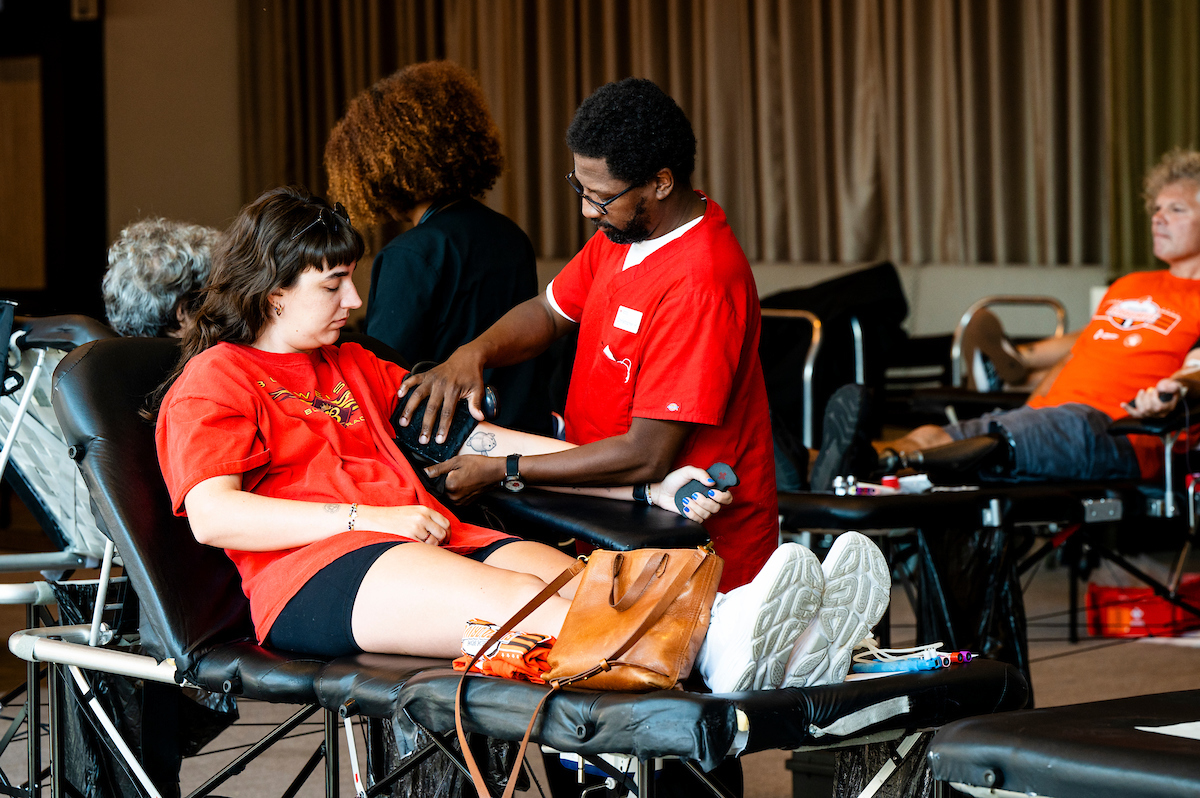
From organizing drives to collect lifesaving blood to assisting families who have been chased from their homes by fire, volunteers are the lifeblood of the Red Cross – the world’s premier humanitarian organization.   

I have witnessed the kindness and compassion of countless Red Cross volunteers in the past ten years, and not only in the Northern Ohio Region. Thousands of Red Cross volunteers deploy to areas across the country after disaster strikes, to help provide shelter, meals, and emotional support to people during their darkest hours. 

In 2016, in the wake of the devastation caused by Hurricane Matthew in North Carolina, I attended a birthday party arranged by Red Cross volunteers for a child whose family was taking refuge in a shelter. A year later, I accompanied Red Cross volunteers in Texas who were bringing warm meals and drinking water to residents at their homes following the flooding caused by Hurricane Harvey. I witnessed Red Cross spiritual care volunteers comfort folks following a mass shooting in Dayton, Ohio in 2019. In 2022, I watched Red Cross volunteers maneuver a disaster response truck through the rubble created by Hurricane Ian at Ft. Myers Beach to bring residents help.  And two years ago, I saw Red Cross volunteers effectively collaborate with aid workers from several other agencies to help residents of Lahaina, Maui in the aftermath of deadly wildfires. 

September 4, 2023. Yankeetown, Florida.
Red Cross disaster responder Mahogany Coward hands relief supplies to Joseph Hill of Yankeetown, Florida.
Photo by Scott Dalton/American Red Cross

True humanitarians. 

“Everyone can be a humanitarian. All it takes is one act to help someone else.” — Valerie Amos, former United Nations Under-Secretary-General for Humanitarian Affairs. 

If you have an interest in obtaining the skills needed to help people affected by large disasters across the country, visit the Red Cross website to learn more.  And if helping neighbors closer to home appeals to your humanitarianism, visit this page.  

It’s never to late to become a humanitarian. Author C.S. Lewis once said, “You can’t go back and change the beginning, but you can start where you are and change the ending.”  

Red Cross youth and young adult volunteer roles offer invaluable experience for individuals like Maddie Frank

By Tim Poe, American Red Cross volunteer

Before American Red Cross Youth Volunteer Maddie Frank arrived for her first shift as Blood Donor Ambassador, she had already recruited a new blood donor, her dad. As Maddie was not yet old enough for her license, her dad drove, deciding to give blood on the way. After her dad downloaded the Blood Donor App, Maddie said, “It was fascinating and fun to watch the blood donation’s progress with him,” culminating in the location where it helped save a life.  

Maddie Frank, Red Cross volunteer

Maddie has been volunteering since January of this year and has already made a tremendous impact. Beginning with Totes for Hope, she has taken on several roles, including Blood Donor Ambassador, Youth Advocate, and Volunteer Services Youth Engagement Lead.  

Red Cross Youth and Young Adult volunteer opportunities and Red Cross Clubs are excellent ways giving people like Maddie can assist their communities, gain tremendous experience, develop leadership and public speaking skills, build resumes, make lasting friendships, and help make the world better.   

There are many Red Cross volunteer opportunities for young people, depending on age. In fact, nationally, as many as 25% of our volunteers are age 24 and younger. For instance, individuals 13 and over can volunteer at blood drives; additional adult supervision is required for those 13-15. Prepare with Pedro presenters can be at least 14. While you must be at least 18 for most disaster relief roles, those ages 16-17 can help support logistics, inventory, and preparation in their region. And young adults (ages 18-24) may be involved in College Red Cross Clubs or hold an adult volunteer position. 

Maddie told me how she has grown up in an atmosphere of helping others and has always enjoyed doing so. Her schools have had service hour requirements, she began working with Totes of Hope for services project at her church, her dad coaches, and her mom helps at a food bank.  

Maddie said she greatly enjoys helping and interacting with people, is looking to become a nurse, and her work as a Red Cross volunteer has helped. Maddie said, “I really enjoy interacting with the donors, seeing their milestones, and working with the other volunteers and staff, as everyone is very kind.” Maddie also said the experience is helping her get a sense of working in a medical field. She has also found several fellow volunteers are studying to become medical professionals, including nurses, and share their experiences. 

In addition to aiding the Red Cross, Maddie has assisted with several programs to help others, is a member of her school’s medical club, enjoys playing basketball, and will soon begin her Junior year at Wash Jesuit High School. 

I asked Maddie what she would tell someone her age interested in becoming a Red Cross volunteer. She said, “Starting out as a blood donor ambassador is really beneficial, as you get to meet people, including those in medical fields, and see what blood drive are like. And you get to see your impact.” 

Keep your kids safe as they head back to school

It’s getting closer… Yes, it is almost time… Time for the kids to go back to school! And while parents all across Northern Ohio collectively exhale that sigh of relief, knowing that their “break” from the summer mayhem is on the horizon, there are still things to think about. Most notably back to school safety! With that, the American Red Cross offers ways to help keep your students safe as they return to school for the upcoming year.

If your student is younger or going to school for the first time, teach them:

  • Their phone number, address, how to get in touch with their parents at work, how to get in touch with another trusted adult and how to dial 911.
  • Not to talk to strangers or accept rides from someone they don’t know.

If your child walks to school, teach them to:

  • Walk on the sidewalk. If no sidewalk is available, walk facing traffic.
  • Stop and look left, then right and left again to see if cars are coming.
  • Cross the street at the corner, obey traffic signals and stay in the crosswalk.
  • Never run out into the street or cross between parked cars.

If your student takes the bus to school, teach them to:

  • Get to their bus stop early and stand away from the curb while waiting for the bus to arrive.
  • Board the bus only after it has come to a complete stop and the driver or attendant has instructed them to get on. And only board their bus, never an alternate one.
  • Stay in clear view of the bus driver and never walk behind the bus.

If your student rides their bike to school, teach them to:

  • Always wear a helmet.
  • Ride on the right in the same direction as the traffic is going.

If you drive your child to school, make sure to:

  • Always use seat belts. Younger children should use car seats or booster seats until the lap-shoulder belt fits properly (typically for children ages 8-12 and over 4’9”), and ride in the back seat until they are at least 13 years old.

If you have a teenager driving to school, make sure they:

  • Use seat belts.
  • Don’t use their cell phone to text or make calls and avoid eating or drinking while driving.

If you are considering getting your student a cell phone:

  • Download the free Red Cross First Aid and Emergency apps to give them access to first aid tips for common emergencies and full weather alerts. Find the apps in smartphone app stores by searching for the American Red Cross or going to redcross.org/apps.

DRIVERS, SLOW DOWN! Drivers should slow down as children head back to school. Know that yellow flashing lights indicate a school bus is getting ready to stop ─ motorists should slow down and be prepared to stop. Red flashing lights and an extended stop sign indicate the bus is stopped and children are getting on or off.

Motorists must stop when they are behind a bus, meeting the bus or approaching an intersection where a bus is stopped. Motorists following or traveling alongside a school bus must also stop until the red lights have stopped flashing, the stop arm is withdrawn, and all children have reached safety. This includes two and four-lane highways. If physical barriers such as grassy medians, guide rails or concrete median barriers separate oncoming traffic from the bus, motorists in the opposing lanes may proceed without stopping. Do not proceed until all the children have reached a place of safety.

Red Cross, Avon Lake mayor team up to send smoke alarms to West Virginia

By Todd James, American Red Cross

In my nearly 20 years with the American Red Cross, I have seen many times how our chapters across the country work together to deliver help where it’s needed. I’ve worked side by side with disaster responders from many cities, states, and even other countries. But it’s not only in disaster response that the Red Cross uses our national network of chapters to provide help. I recently had the opportunity to be a part of helping homes in West Virginia receive free smoke alarms as part of our Home Fire Campaign.  

It all started with a conversation between Joe Matuscak, a member of the North Central Ohio Chapter Board of Directors and Mark Spaetzel, the mayor of Avon Lake in Lorain County. Mayor Spaetzel asked Joe about the Home Fire Campaign, specifically how we provide free smoke alarms and preparedness education for families.  

Charleston, West Virginia high school students repairing homes

A couple of weeks after that initial conversation, the mayor was in Charleston, West Virginia as part of a mission project with the United Church of Christ. He was one of 31 adults that accompanied 85 high school students to Charleston to assist the Appalachian Service Project in providing home repairs and help to low-income families in the area.  

As a construction manager for the project, Mark oversaw nine sites that teams were working on. He noticed that many of the homes did not have working smoke alarms and knew that, for many of these families, the cost of purchasing new alarms was not a cost they could afford. Recalling their recent conversation, Mayor Spaetzel called Joe Matuscak and asked him if there was anything the Red Cross could do to help.  

Joe immediately called me and explained the situation. I told him we would do everything we could to make sure those homes would receive smoke alarms and the safety they provide. I’ve worked on disasters with several members of the Central Appalachian Region team in West Virginia, so I reached out to one of my contacts who quickly put me in touch with Angela Akers, the Community Disaster Program Manager for the Charleston area. I called Angela and explained the situation and within a couple of hours, she had spoken to the mayor, arranged to sign his team up as a Home Fire Campaign partner and provided the smoke alarms and training the team needed to install the alarms and educate families on being prepared for home fires.  

Mayor Spaetzel said he wasn’t sure at first if making the call to Joe would help. “You think about big organizations and the bureaucracy involved and you don’t know if it’s going to work,” he said. “But this was seamless, and it was so easy. The training was quick and clear, and the Red Cross team made it easy and simple to help these families. I know the families appreciated it, because they didn’t currently have working smoke alarms and many of them had never had them.” 

Mayor Spaetzel said that in his position, fire safety and prevention are always on his mind and he’s looking forward to working with the North Central Ohio Chapter to make sure families in Avon Lake know about the Home Fire Campaign and have access to the program.  

Being a part of the Red Cross family means having family members across the country who are ready to help whenever it’s needed, wherever the call comes from. For more information about the Home Fire Campaign, visit redcross.org/NOH.  

Grateful mother encourages others to donate blood after experiencing hemorrhage during birth

By Kathryn Dean, American Red Cross volunteer

In some situations, it takes a village of people to save one persons life.”  – Dr. Kristin Gype 

Last August, 38 weeks pregnant with her second child, Dr. Kristin Gype went in to see her doctor for a routine checkup and ultrasound. Everything had been going smoothly with this pregnancy, but at this appointment, the staff noticed that her amniotic fluid appeared cloudy on the scan. As a precaution, her doctor recommended that she deliver within 24 hours.  

Dr. Kristin Gype and her daughter,

Feeling a bit unnerved at this unexpected turn of events, she called her husband, reluctantly gathered her belongings, and dropped her daughter off at her mother-in-law’s house.  As she hugged her daughter goodbye, Kristin had a powerful urge to squeeze her extra tight and hold on a little longer. 

A few years earlier, she had undergone a C-section with the birth of her daughter and was determined this time to try a natural birth. At the hospital, labor was induced and she received an epidural as she waited for her son to be born. Sometime overnight, they broke her water, and it was perfectly normal. She felt a wave of relief, but also a hint of frustration.

Later that morning, she noticed that her son’s fetal monitor was showing his heart rate dipping periodically into the 30s. A normal fetal heart rate is around 110 to 160 beats per minute. She was also feeling pain in her lower right abdomen. Despite the anesthesiologist administering more medicine, the pain persisted. 

Due to the low heart rate, it was determined that a C-section was necessary, and she went in for emergency surgery. Her son was born in under 90 seconds and was perfect and healthy, but she quickly realized something else was seriously wrong.   

Having attended many C-sections during her career as a nurse anesthetist, Kristin understood the subtle cues the medical staff were giving. She soon realized that she had uncontrolled bleeding and they were trying desperately to stop it.   

“I felt this impending doom,” she recalled. “I felt like I was dying…it truly felt cold and dark, and gloomy, and there was no control.” 

She began losing her ability to communicate coherently with her husband and staff.  At one point they informed her that a total hysterectomy was necessary to try to stop the bleed and she readily agreed. The next thing she knew she woke up in recovery in the ICU.   

After speaking to her doctor the next day, she learned that she had required a total of 52 units of blood during her surgery. To put that number into perspective, the average human body holds around 10 units or pints of blood. In addition, she estimates that up to 83 blood donors were required to produce all of the blood products she needed that day. 

Luckily, she suffered no long-term consequences from this traumatic incident. Today she has a new life perspective, realizing that she was literally saved from the brink by the generous blood donors who contribute to the crucial blood supply in our community.  

To give back, she has been donating her extra breast milk to the Ohio Milk Bank. “I went on to donate 3,500 oz of breast milk,” she proudly explained. “The milk bank providers said 1 ounce of breastmilk can give three meals to a newborn ICU patient.” 

Regarding her blood donors, she reflected, “Those people had a ripple effect. They kept me alive, kept these two babies’ mommy alive. I get to go to work and take care of people and keep them alive, and my breastmilk goes to critically ill babies.”   

“It seems so simple because putting a needle in your arm and donating a pack of units is so minor compared to the downstream effects of all those things. You give somebody another Christmas, give somebody another chance at life.” 

The American Red Cross is in critical need of blood donors. Just one hour of your time could save the life of a new mother or other critically ill patient. To donate, visit RedCrossBlood.org, or download the free American Red Cross Blood Donor App by clicking HERE.

Edited by Glenda Bogar, American Red Cross volunteer

Hiring military veterans works for the Red Cross

By Jim McIntyre, American Red Cross volunteer

“A shared commitment to a greater purpose may just be the most significant advantage veterans bring to the American Red Cross…” – Mike Parks, RADM, USCG (Retired), Regional CEO, American Red Cross of Northern Ohio. 

There were nearly 16 million veterans of the armed forces living in the U.S. in 2023, according to usafacts.org. Nearly 3% were unemployed, according to the Bureau of Labor Statistics. To raise awareness of veterans in need of job placement and to show the challenges of transitioning from the military to civilian workforce, July 25th has been named National Hire a Veteran Day

“Veterans bring unmatched dedication, discipline, and leadership to the workplace – skills forged through service and mission-focused training,” according to Dr. Alaina Foster, Regional Program Director for Service to the Armed Forces and International Services at the Red Cross of Northern Ohio. “Hiring a veteran means gaining a teammate who thrives under pressure, adapts quickly, and leads with integrity.” 

Foster is a veteran of the U.S. Air Force, and comes from a military family. On her team is Nasir Ahmad, also a retired Air Force veteran who recently completed an assignment for the Red Cross that took him to Iraq, where he provided Red Cross services for members of the U.S. military on a base in Baghdad.  He said being a veteran gave him a shared connection with members of the military in need of Red Cross services. 

“When people say, ‘thank you for your service,’ it’s appreciated and great to hear, but organizations like the Red Cross put those words into action by making a deliberate effort to hire veterans,” Nasir said, adding, “These organizations welcome people who know how to work on a team and put their own vision and ambitions second to the overall success of the company.  Firms that are willing to hire veterans gain people that are able to thrive in structured settings as well as adapt to free-flowing projects and events.”  

CEO Mike Parks, who calls the Red Cross “the world’s premier humanitarian organization,” said hiring veterans fits in well with the Red Cross ethos.  

Mike Parks,  Regional CEO, American Red Cross of Northern Ohio
Rear Admiral, United States Coast Guard (Retired)

“I’m fond of saying ‘The Red Cross is all about caring.’  Most successful veterans largely became successful by caring.  Sacrificial giving and servant leadership are both hallmarks of veterans who have found a home in the Red Cross after they’ve served their country in uniform.” 

Mike found a home at the Red Cross, leading the Northern Ohio Region since 2015, following a lengthy career with the U.S. Coast Guard. Nasir has called the Red Cross home since 2023. 

“I was unsure what to expect from the Red Cross, but the Northern Ohio team showed me that there’s still a place where I could serve.  And I’m grateful for it.  Maybe that’s all any of us veterans want — a place to still be of service.”    

Veterans excel in every sector of the employment market, but there are numerous job opportunities at the Red Cross, where the experience of having served in the armed forces can add extra value.  See current job opportunities here. And tap here to learn more about how the Red Cross supports military members, veterans and their families.

Celebrate tattoos and schedule a blood donation this National Tattoo Day! 

By Tim Poe, American Red Cross volunteer

July 17 is National Tattoo Day, a day to “recognize the history, culture, and artists dedicated to etching ink permanently on the skin.” We also think it’s a fantastic time to schedule a blood donation as, despite some myths, having tattoos does not prevent you from donating blood.  

Ryan and Megan Lang, tattooed blood donors

Even if you do not have a tattoo, you’ve likely pondered possibilities. I am. Should I get an American Red Cross logo to commemorate my 7.5 years as a volunteer? Possibly. Or a fountain pin nib, for my love of writing? Granted, I mainly write on a laptop, but we need some artistic license. The pen could also be writing something, like a schwa! Yeah! Or a treble and bass clef, even a grand staff, to celebrate my love of music? That could mask some scars, too! Groovetastic! How about mascots of universities I attended? You have to admit, an Eagle-Penguin-Viking combo could be epic! Logos of previous employers? No, definitely not, especially the one with the common word ending. I’ve got it! All of them, being juggled by a jester! 

Now to bust a myth. Even if I went out and got these tattoos today, I could immediately donate blood if the tattoos were done at a state-regulated, licensed facility in Ohio or most other states. If done in one of the few states that do not regulate tattoo facilities, or by an unlicensed person, I’d only need to wait three months to ensure blood safety. (All blood donations are tested for hepatitis B and hepatitis C, but it is still important for people who may be infected with hepatitis viruses to not donate blood.) More about blood donor eligibility is available here

Also, the Red Cross is currently in need of blood donations and is offering additional ways to say thanks this summer. Those donating from July 15-31 will receive a Fandango movie ticket. Those donating in August can receive a free A1C test and, from August 1-28, a $15 gift card

Whether you have tattoos or not, enjoy celebrating them today, and consider scheduling a blood donation at RedCrossBlood.org or download the free blood donor app. After all, if you’re tattooed you don’t have a problem with needles. And a fun observation: many of the phlebotomists I’ve met have tattoos. Finally, please also read Christy Peters’ excellent post about her grandfather’s tattoos. 

Get a free pair of shades by goodr when you donate blood or platelets

By Kathryn Dean, American Red Cross Volunteer 

July is finally here, and summer has officially started. For many, this means vacations, cookouts, pool time, and fun with family and friends. For blood banks, this busy season can mean a time of fewer donors and a limited blood supply.   

Every two seconds, someone in the U.S. requires a blood transfusion. This equates to around 29,000 units of blood that are needed every day! Whether it be for cancer patients, accident victims, surgical patients, or new mothers, be a hero for a person in need by donating this precious, lifesaving gift. 

While all potential donors are asked to donate if they can, Type O is urgently needed at this time.   

Type O negative blood, often called the “universal donor,” can be safely transfused to anyone and is commonly used in emergencies when there is no time to determine blood type. With only around 7% of the U.S. population having Type O negative blood, it is often in short supply, even though the need for it is great. 

Special Promotion for donors 

Between July 1-14, consider taking time out of your schedule to donate blood, plasma or platelets, and look cool leaving with a free pair of American Red Cross x goodr “Just My Type” sunglasses, while supplies last! You will also receive a sticker with your blood type to personalize your glasses. Find out more about the promotion by clicking HERE

To donate, simply visit RedCrossBlood.org and enter your zip code or download the free Red Cross Blood Donor App by clicking HERE. Save time on the date of your donation by completing your pre-donation forms at RedCrossBlood.org/RapidPass or by using the Blood Donor App. 

Edited by Glenda Bogar, American Red Cross volunteer

Celebrate summer safely: Fourth of July safety tips and more

By Ryan Lang, American Red Cross

The Fourth of July weekend is upon us and the Red Cross is reminding residents of Northern Ohio and beyond to play it safe, especially when it comes to fireworks. Generally, we advise to leave the fancy fireworks displays to the professionals – it’s the best way to ensure everyone has a safe and enjoyable time celebrating Independence Day.

If you are planning a home fireworks display, here are a few tips:

  • Never give fireworks to small children, and never throw or point a firework toward people, animals, vehicles, structures or flammable materials.
  • Always follow the instructions on the packaging.
  • Keep a supply of water close by.
  • Make sure the person lighting fireworks always wears eye protection.
  • Light only one firework at a time and never attempt to relight “a dud.”
  • Store fireworks in a cool, dry place away from children and pets.
  • Never use fireworks around pets, keep pets indoors. Exposure to lit fireworks can potentially result in severe burns or trauma, and many pets are also fearful of loud noises and can become lost, scared or disoriented.

In addition to fireworks safety, water safety is a top priority during the holiday and throughout the summer. Between trips the pool, the beach, the lake, etc., water safety is important for the entire family, especially when kids are involved. Here are a few water safety tips for you and your family:

  • Everyone should learn to swim. Classes are available for both children and adults.
  • Prevent unsupervised access to water. Always designate a “water watcher” to keep a close, constant eye on everyone in and around the water until the next water watcher takes over.
  • Avoid distractions when supervising children. If a child is missing, check the water first. Drowning behavior is typically fast and silent. Unless rescued, a drowning person will last only 20 to 60 seconds before submerging.
  • Reach or throw, don’t go! In the event of an emergency, reach or throw an object out to the person in trouble and tell them to grab on. Don’t go in! You could become a victim yourself. Without putting yourself in danger, rescue and remove the person from the water. Have someone call 911 if needed.
  • Download the Red Cross Swim app for safety tips, kid-friendly videos and activities, and take the free Water Safety for Parents and Caregivers online course.

 For more summertime safety tips, including ways to beat the heat, visit redcross.org.

Dedicated volunteer was the model of Red Cross caring 

By Eilene E. Guy, American Red Cross volunteer

After a career of more than 50 years in nursing and education, Carol McConnell came to volunteer with the American Red Cross because she wasn’t ready to retire from caring for people. 

Carol McConnell, Red Cross volunteer

Her fellow nurse volunteer, Melissa Seibert, said her friend embodied the compassion of Red Cross founder Clara Barton. 

For years, the two of them staffed first aid stations at Pro Football Hall of Fame events, where Carol’s nursing skills matched her caring personality. “She had beautiful white hair; she wasn’t skinny or hefty, just pleasantly plump. She walked with her shoulders back and her chin up. Her demeanor just said, ‘I care,’ Melissa said. 

“She had a soft touch; she was soft spoken. That put people at ease.”  

But Carol was no one-trick nursing pony. She began her Red Cross volunteer career in 1993 in disaster services. When she wasn’t comforting people displaced by a home fire or other calamity, she was often at the office of the Heartland, Stark and Muskingum Lakes chapter. 

She was always ready to volunteer for an activity related to the Red Cross mission, retired chapter executive director Kim Kroh said. “She loved to do outreach, to talk to people at festivals and health fairs. She was such an active volunteer; she was so kind, a gentle soul. 

“She was very involved with our campaign to install smoke alarms. She would go out every week,” Kim said. “Whenever we had a Sound The Alarm event to canvass neighborhoods to install alarms, she was always involved.”  

Carol was known for being reliable. She never quite got the hang of signing up on line for a project, but, “When she said she’d do something, you knew she’d be there,” Melissa said. 

That’s what alerted her fellow volunteers on the morning of March 26, when Carol didn’t show up for a smoke alarm install activity. Her Red Cross partners called the local fire department to do a welfare check. 

Carol had passed away quietly at home, at the age of 90. 

“I was shocked,” Melissa said. “Last year, she said to me, ‘I can’t wait to work with you again next year (at the Hall of Fame festivities)’… When I read her obituary, I couldn’t believe she was 90! 

“Red Crossers are a family, you know,” she said as she choked back tears. “We were devastated.” 

Carol’s family summed up her personality in her obituary: “She never met a stranger and thoroughly enjoyed getting to know new people.” 

The Red Cross gave Carol an outlet for her caring that never faded with the years. She is truly missed.