The attack on America 25 years ago, on 9/11, 2001 brought out the best in people.
“Within the first 48 hours, the Red Cross in Northeast Ohio had deployed emergency response vehicles and workers (most of them volunteers) to both New York and Pennsylvania,” according to Debbie Chitester, Regional Disaster Action Team Manager from Northern Ohio.
September 12, 2001. New York City, New York. Terrorist attack at the World Trade Center. Photo by Daniel Cima/American Red Cross
Debbie went to New York with about two dozen other workers from Northeast Ohio. In this video, she recalls the role the Red Cross played in the days immediately after the attack at Ground Zero, where the Twin Towers of the World Trade Center were brought down. The National September 11 Memorial and Museum now stands at the site.
“It’s still very emotional for me,” Debbie added, “especially at this time of year.”
Debbie Chitester
Northeast Ohio Red Cross Workers were also deployed to Shanksville, Pa., where United Airlines Flight 93 crashed after the passengers fought the terrorists who had hijacked the plane. The role the Red Cross played is acknowledged at the Flight 93 National Memorial in Shanksville, which is about a three and-a-half hour drive southeast of Cleveland.
In 2009, Congress designated September 11 as a National Day of Service and Remembrance. In honor of the sacrifice so many made on that day, many people donate blood at one of the numerous Red Cross blood drives held across the country, not only on 9/11, but also on the days preceding and following the anniversary of the attack.
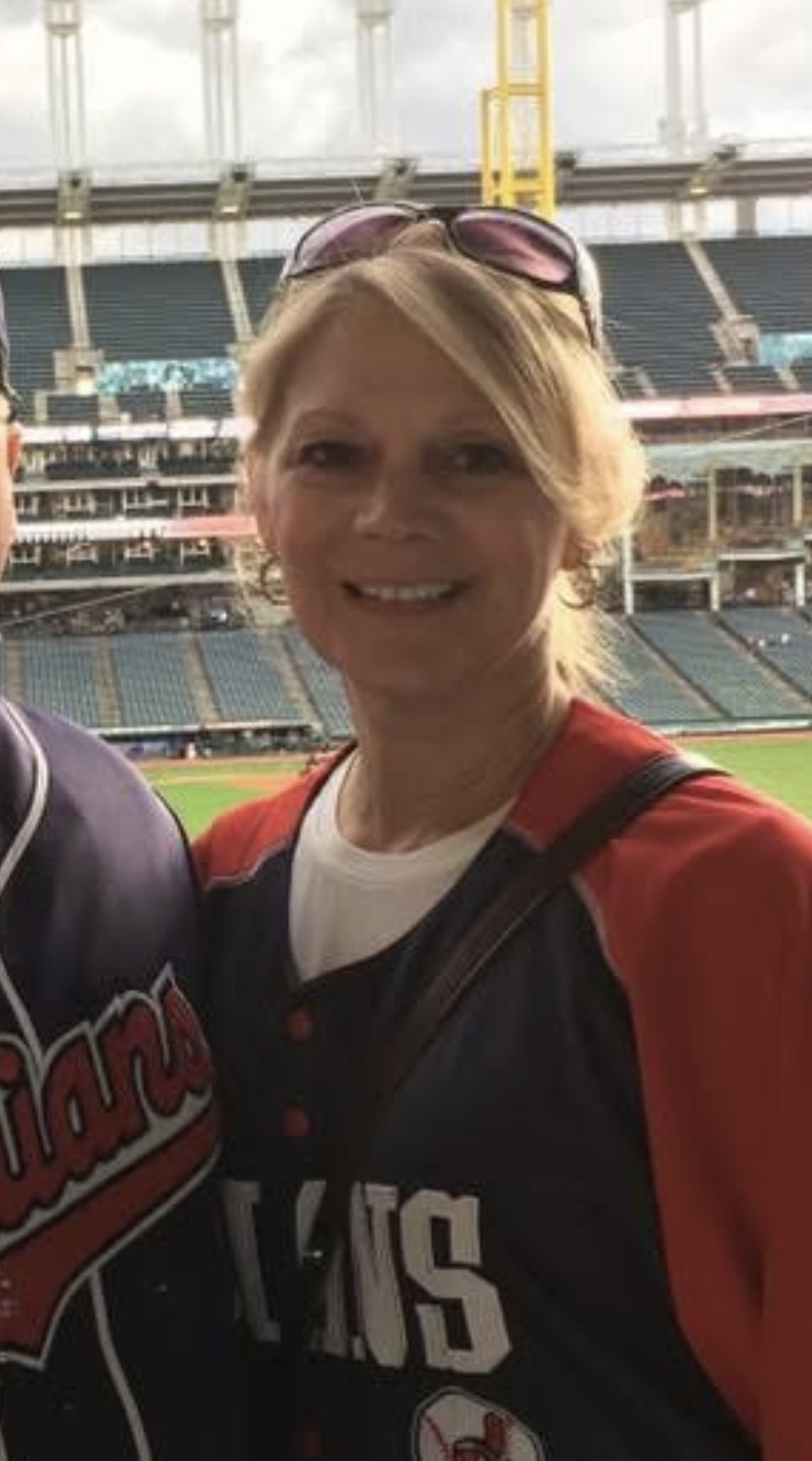
Among the cots and bustle of an American Red Cross blood drive, Linda King assisted donors and a newer phlebotomist when a long-time donor waved her over. When Linda approached the donor, whom she had known for years, the lady smiled and said, “You’re the mom. You’re such a mom.” Linda replied, “I know.”
Linda King, American Red Cross
Linda is happy to take on the role as “mom” to the many blood collectors she has helped over her 23+ years with the Red Cross as an on-the-job instructor and phlebotomist. “I love seeing new staff gain competence and flourish,” Linda said. She has also developed friendships with many donors, volunteers and others.
“I love it. I have the best job at the Red Cross,” Linda said.
As the Red Cross collects about 40% of the nation’s blood supply, blood collectors are vitally important to our mission. They take part in about 500 blood drives across the U.S. each day, helping ensure blood products are available whenever and wherever they are needed.
To help commemorate Blood Collectors Week, September 6-12, I spoke to Linda about her experience at the forefront of one of the Red Cross’s core missions.
Linda’s Red Cross career began with a blood donor’s suggestion. “I was fresh out of classes when a friend who donated blood recommended I consider the Red Cross,” Linda said. Even while undergoing training, Linda knew she wanted to teach. Once she had five years’ experience as a phlebotomist, she also became an instructor.
Linda speaks highly of the many wonderful people she has met, including fellow Red Cross staff members, volunteers, blood donors and those she has met through travels to blood drives and Red Cross facilities. “It’s how I met my husband,” Linda said. They met when Linda was traveling to teach in Cleveland. He is also a blood donor.
Linda especially loves seeing those she trained take flight and continue their careers.
I asked Linda about her experience during blood emergencies. “The recent emergency was very well managed,” Linda said. “We saw a lot of new donors as well as the return of many who hadn’t donated for years.”
Linda also said that, in a blood emergency, she often sees nurses and blood bank staff members donating blood. “They see the effects of a blood emergency firsthand, like surgeries being postponed because there isn’t enough blood,” Linda said.
I asked Linda what she tells those interested in a blood collector career with the Red Cross. She said, “It’s a great job. As I say, I have the best job here. You get to travel, meet people, go to awesome places and meet a lot of repeat donors. The job has been wonderful.”
To those considering donating, Linda said, “Definitely give it a chance. It is so streamlined now, donors can answer the required questions at home and taking vitals is much quicker.” She also said that each day, a donor who hasn’t donated in a while expresses happiness that the finger prick for a hemoglobin check is no longer needed. “About 90% said it was the worst part,” she said.
Linda and her husband also enjoy camping, and traveling throughout our region helps them discover interesting towns and places. She is also an avid reader.
Dan Sutliff’s trip across the Pacific Ocean to Guam and the Northern Mariana Islands in July was no vacation, no opportunity to visit his wife’s relatives there.
As an American Red Cross disaster volunteer, Dan wanted to help bring relief and hope to islanders hit by their third typhoon in as many months: Super Typhoon Bavi.
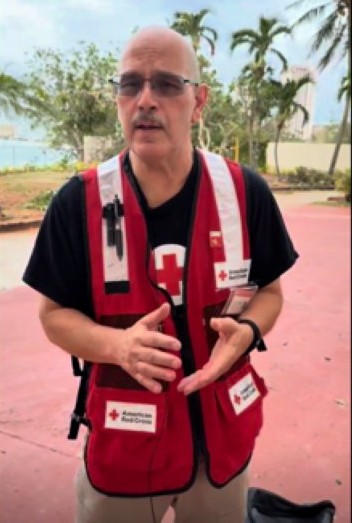
Brunswick resident and Red Cross volunteer Dan Sutliff traveled to the islands to support the relief response because his wife’s family is from Saipan.
Dan, who lives in Brunswick, Ohio, has been a Red Cross volunteer for a couple of years, primarily responding to home fires, bringing reassurance and resources to folks in their time of need: shelter, food, immediate needs
But his deployment to a disaster 7,000 miles away was different: He arrived just in time to hunker down in Guam as the Category 5 storm skirted the American territory, dumping 15 inches of rain in just 12 hours.
The next day he was able to get a quick flight to the neighboring island of Rota, where Bavi made a direct hit with sustained winds of 180 miles an hour. “Almost every building was affected in some way: roofs blown off, walls collapsed,” he said. Communications and critical infrastructure were demolished.
Dan and three other volunteers from “the states” teamed up with four island Red Crossers (Yes, Guam and the Marianas have their own American Red Cross.) got right to work, interviewing families, asking what they needed, and then working with the local authorities to distribute supplies.
Tarps, coolers, hand sanitizer and wipes are typical after a disaster, but the Red Crossers were able to offer supplies customized to the environment of a hot, humid and “buggy” island: sunscreen, bug repellent, solar lights and fans, mosquito nets, butane stoves, portable showers and meal kits tailored to local diets.
“One of our team had lived on Rota,” Dan said. “That local knowledge was critical” to coordinating with local authorities and finding resources – like a place to live, a generator to provide electricity, a vehicle – to be able to do their work.
Dan and his team supported the two shelters on the island. “The steady state population was about 70 in the Center for Aging and about 25 at the high school. There had been more,” while Bavi hovered over the island, he said. They did what they could to make their “guests” comfortable. For example, they used folding cafeteria tables as dividers to give families a bit of privacy.
Dan came away from his first national disaster impressed by how quickly the Red Cross can mobilize relief, even halfway around the world, and how important it is for responders themselves to be flexible, dealing with whatever situation presents itself. Travel hiccups, no big deal; accommodations with no power and, initially, no water. “It was sufficient,” was his attitude.
At the same time, Dan was impressed with the islanders’ resilience. “Some of them had lost everything,” he said, “but their attitude was, ‘We’ll be able to recover’.”
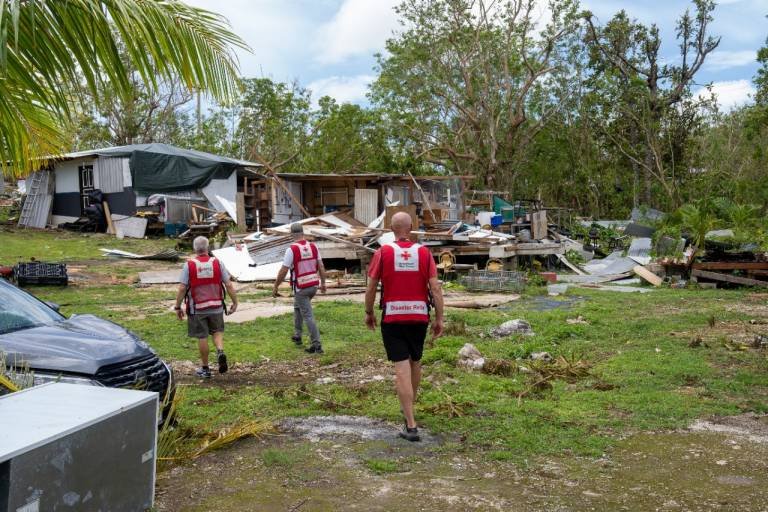
Red Cross volunteers approach home that suffered major damage from Typhoon Bavi that hit the Mariana Islands back in July 2026. It was the third major storm to hit the islands in as many months.
By the way, Dan took the opportunity to Facetime with his wife, Linda’s, uncle on the nearby island of Saipan while he was in the “vicinity.” Everyone in that family is fine after the storm, he said. And the Red Cross was there too.
Would you like to be able to help people – around the corner or around the world – prevent, prepare for or recover from disasters? “The Red Cross makes on-boarding easy,” Dan noted. Go to redcross.org to learn about the many ways to volunteer. (And no, you don’t have to travel far from home to make an impact!)
All the Red Cross disaster relief is free, provided by the generosity of the American people. To support this vital work, donate through redcross.org or 1-800-REDCROSS.
In March of 1976, Jean Lewis was just coming off sick leave after the birth of her first child. Upon learning that her former position at the local library had been filled in her absence, she was offered an alternative job.
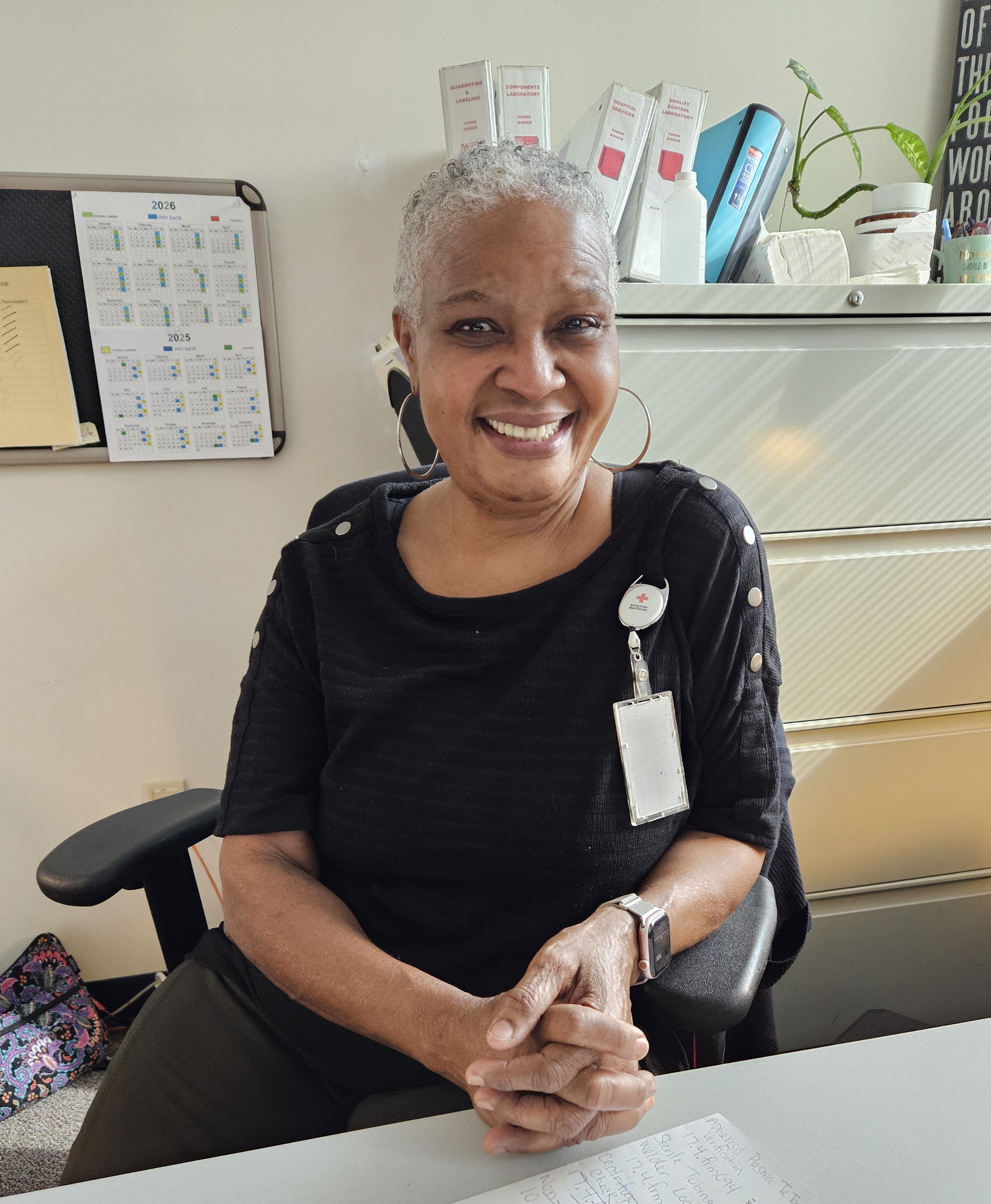
Jean Lewis, American Red Cross
“They put me in a room as long as Chester Avenue (filled) with index cards,” Jean mused. “They said that we are starting automation, and we are going to put all these cards in alphabetical order…and I looked at it and I said, oh no, not me!”
So, she left the library and headed down to the unemployment office. After taking a typing test, she was offered a clerk position at the American Red Cross. The starting pay was $1.98/hr, and she gratefully accepted.
“I have remained in the same department for the entire 50 years.” Jean proudly proclaimed. “I never wanted to leave this department.”
That department is called Manufacturing, which manufactures the blood products that are collected through donations. It has changed names over the course of her career, from Technical Services to Laboratory, and finally to Manufacturing.
“I used to make all the forms that’s now out on the internet in the repository. I used to make all of those forms on the typewriter,” Jean recalled. “I started out making a system up for the forms to be organized. One of the things I give myself credit for at the Red Cross is that I’m very organized.”
Now, after 50 years, Jean is ready for the next phase of her life. “I am going to retire this year, 2026. It is now time for the younger generation to take over,” she reflected. “One of my mottos is, nobody’s job should shut down just because that person’s not here. You should always have a backup.”
During her career, she’s always taught others to do her job just in case something happened and she couldn’t be there.
Post-retirement, Jean plans to travel with her family in a 15-passenger van that she recently purchased. “I have two grandkids, and my 35-year old, Down syndrome nephew. They are the love of my life…we go a lot of places together.”
Jean celebrated 50 years with the Red Cross on March 26 of this year.
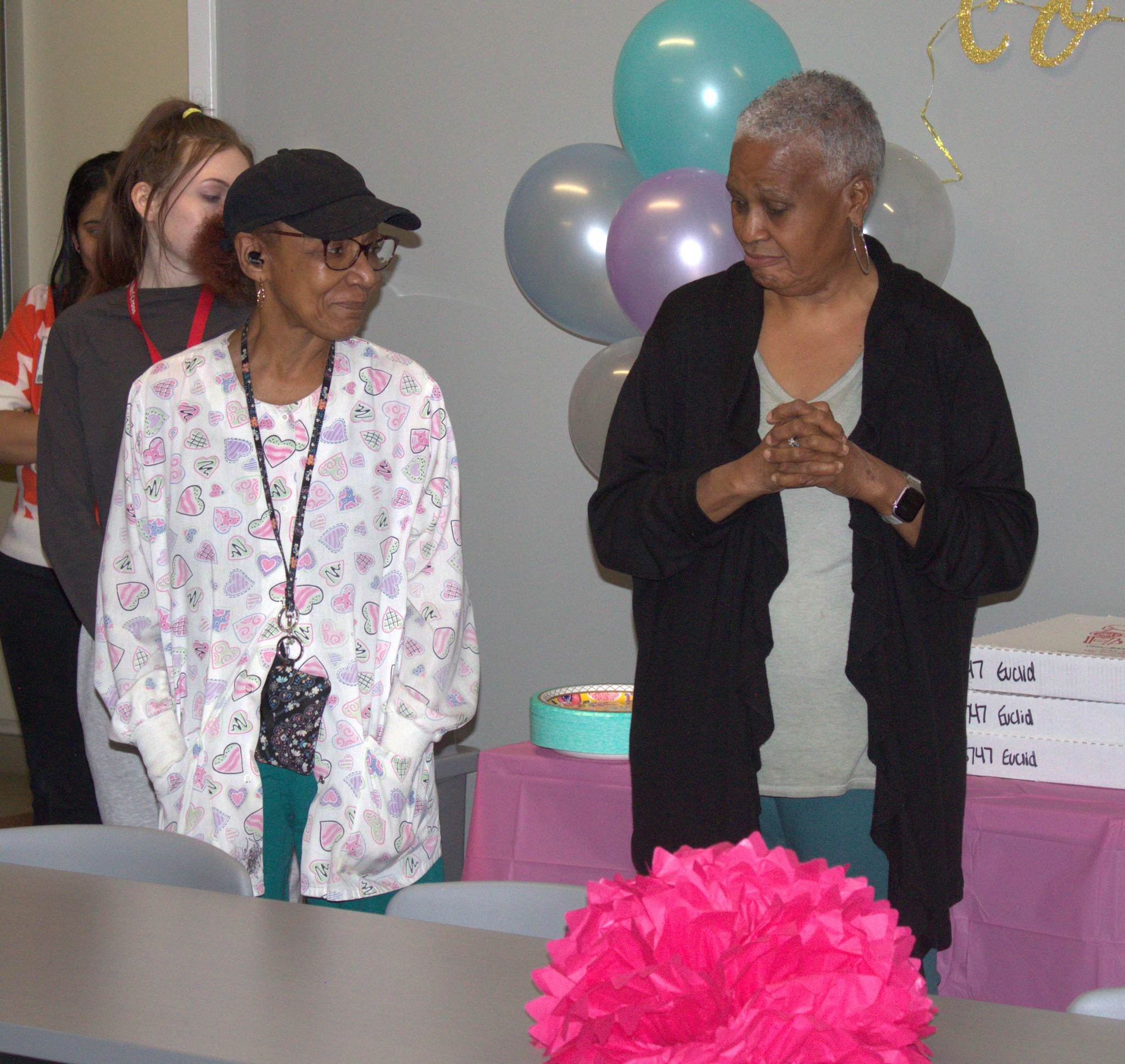
Jackie Greene (left) and Jean Lewis, American Red Cross
On behalf of the American Red Cross, we wish Jean a very happy retirement, and thank her for her 50-years of service! A warm congratulations also to Jackie Greene, who celebrated 55 years with the Red Cross on March 1st!
To conclude, a final word from Joel Prater, Manufacturing Manager, American Red Cross. “When they retire, the Red Cross will be losing two of the hardest working people with the greatest breadth of knowledge and experience imaginable, and it will take 4 people or more to cover all they do for us here.”
Each day in Northern Ohio, the American Red Cross collects and distributes lifesaving blood platelets to help treat people fighting cancer, chronic diseases and traumatic injuries. Platelets are crucial in treating cancer, as they are a key blood clotting component.
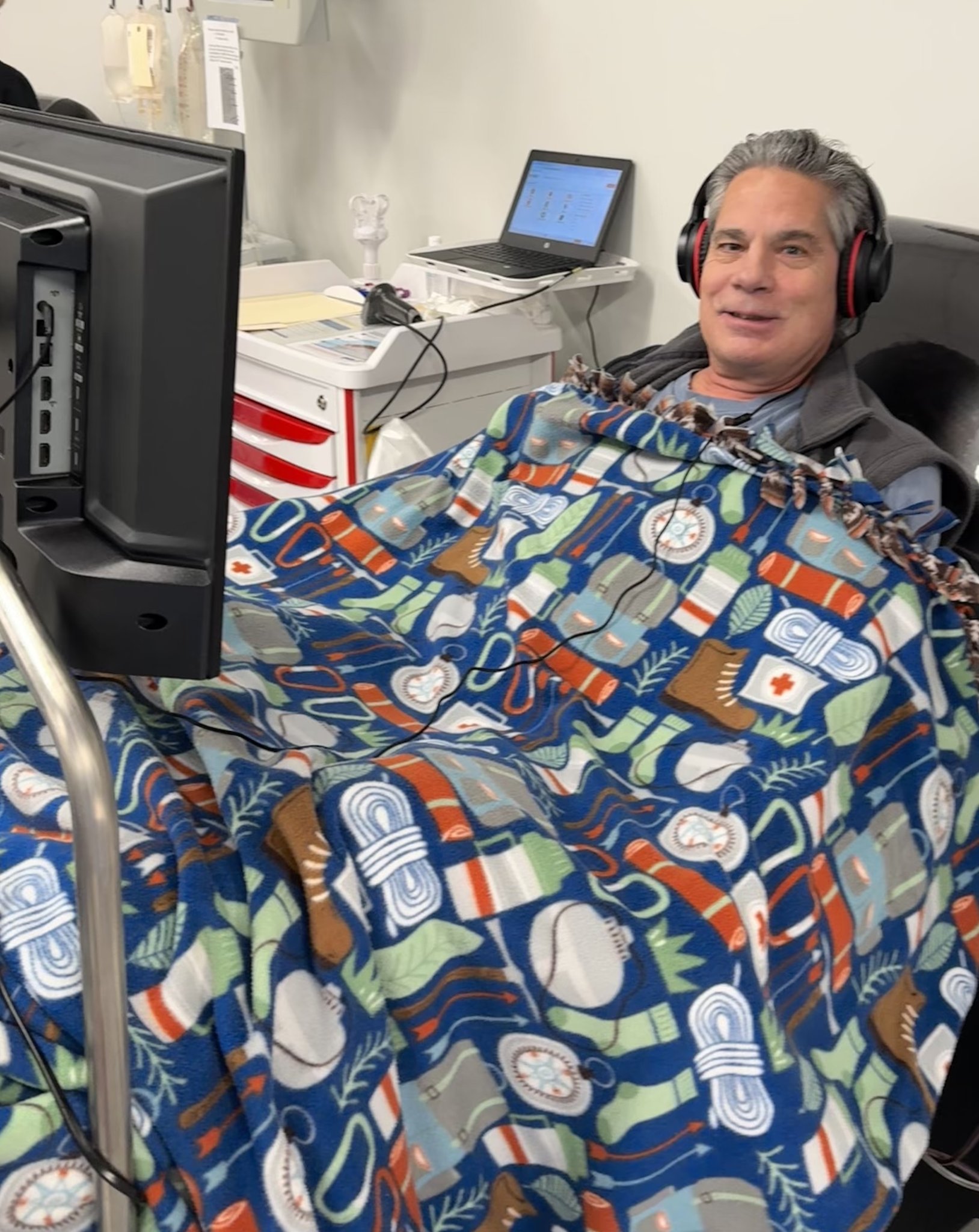
Karl donating platelets at the new Willoughby Blood Donor Center. Karl’s been donating platelets for roughly 30 years! “A kid at the school where my wife worked was diagnosed with cancer and they were looking for people to donate platelets,” Karl said. He stepped up decades ago and continues to do his part to save lives today.
Platelets have a shelf life of only five days, and a unit is needed every 30 seconds in the U.S., creating continual demand.
February 4th is World Cancer Day, which focuses on a disease that has deeply touched many of our lives. For 2026, excluding non-melanoma skin cancers, The American Cancer Society expects about 2.1 million new cancer cases to be diagnosed in the U.S., over 78,000 of them in Ohio.
As the Red Cross supplies 40% of the U.S.’s blood supply, we wanted to focus on the power of platelets in fighting cancer, especially as the Red Cross is currently facing a blood shortage and needs your help.
I spoke with James Keane about his experience on the importance of blood platelets for cancer patients. James’ daughter, Molly, was treated for leukemia from 2015 to 2017, beginning when she was 7 years old.
“When Molly was in the hospital,” James said, “especially during the first few months of her treatment, she got platelets all the time. Both the nature of her leukemia and the course of her treatment made it an almost-daily thing for weeks, if not months. If I recall correctly, there were some medications she received which required a platelet transfusion as part of the protocol.”
James has been aware of blood products much of his life, since his grandfather’s career was at a lab where his team separated blood products. Because of his family history, James asked the doctors and nurses “where all these yellow bags were coming from.” He would have asked if he thought blood shortages were something he needed to worry about but thinks he would have been told “no” even if not true. James explained, “Pediatric doctors and nurses are very careful to only let you know about the things you should be worrying about and watching for at the moment. They are very good at keeping you on a need-to-know schedule, shielding parents from worrying about things in the distant future or otherwise out of their control. There was generally plenty to worry about in the moment.”
To answer James’ question of where blood platelets come from, the vast majority are from platelet donors. An apheresis machine collects the donor’s platelets along with some plasma, returning red cells and most of the plasma back to the donor over about two hours. Platelets can be donated every seven days, up to 24 times a year.
“A shared commitment to a greater purpose may just be the most significant advantage veterans bring to the American Red Cross…” – Mike Parks, RADM, USCG (Retired), Regional CEO, American Red Cross of Northern Ohio.
There were nearly 16 million veterans of the armed forces living in the U.S. in 2023, according to usafacts.org. Nearly 3% were unemployed, according to the Bureau of Labor Statistics. To raise awareness of veterans in need of job placement and to show the challenges of transitioning from the military to civilian workforce, July 25th has been named National Hire a Veteran Day.
“Veterans bring unmatched dedication, discipline, and leadership to the workplace – skills forged through service and mission-focused training,” according to Dr. Alaina Foster, Regional Program Director for Service to the Armed Forces and International Services at the Red Cross of Northern Ohio. “Hiring a veteran means gaining a teammate who thrives under pressure, adapts quickly, and leads with integrity.”
“When people say, ‘thank you for your service,’ it’s appreciated and great to hear, but organizations like the Red Cross put those words into action by making a deliberate effort to hire veterans,” Nasir said, adding, “These organizations welcome people who know how to work on a team and put their own vision and ambitions second to the overall success of the company. Firms that are willing to hire veterans gain people that are able to thrive in structured settings as well as adapt to free-flowing projects and events.”
CEO Mike Parks, who calls the Red Cross “the world’s premier humanitarian organization,” said hiring veterans fits in well with the Red Cross ethos.
Mike Parks, Regional CEO, American Red Cross of Northern Ohio Rear Admiral, United States Coast Guard (Retired)
“I’m fond of saying ‘The Red Cross is all about caring.’ Most successful veterans largely became successful by caring. Sacrificial giving and servant leadership are both hallmarks of veterans who have found a home in the Red Cross after they’ve served their country in uniform.”
Mike found a home at the Red Cross, leading the Northern Ohio Region since 2015, following a lengthy career with the U.S. Coast Guard. Nasir has called the Red Cross home since 2023.
“I was unsure what to expect from the Red Cross, but the Northern Ohio team showed me that there’s still a place where I could serve. And I’m grateful for it. Maybe that’s all any of us veterans want — a place to still be of service.”
Veterans excel in every sector of the employment market, but there are numerous job opportunities at the Red Cross, where the experience of having served in the armed forces can add extra value. See current job opportunities here. And tap here to learn more about how the Red Cross supports military members, veterans and their families.
Rich Colarik knows his way around a knife. He’s been a butcher for nearly four decades. But you can never be too careful. He learned that the hard way, when a knife he was holding slipped from his hand and severed his femoral artery a couple of inches above the knee.
Chris Colarik, left, Red Cross Regional COO TIm O’toole, and Rich Colarik
Fortunately for Rich, he was with his family, including his son Chris, a Madison middle school teacher in Lake County, Ohio, who has received a certificate for First Aid training from the American Red Cross.
As blood began to flow from the wound, Chris took action. He called 9-1-1 and sent his 8 year-old son, Easton, to retrieve a belt. He then used the belt Rich had been wearing to fashion a tourniquet and slow the bleeding.
The Colarik Family
“Chris remembers that his hands were turning white by how hard he was holding the belt,” said his wife, Melissa. She also said the siren from the ambulance was one of the best sounds he’d ever heard.
As the responders applied a proper tourniquet, Rich began to experience shock. “Chris smacked him in the face and held his head and said, ‘stay with me’,” said Melissa. Rich was then loaded into the ambulance and taken to a hospital for emergency surgery.
He has since recovered.
Melissa said, “With my husband’s knowledge and training from his Red Cross certification he was able to save his father’s life.”
Lifesaving Award
Chris was presented with a Certificate of Extraordinary Personal Action, which is awarded to individuals who step up in an emergency and help save or sustain a life using lifesaving skills. “This award is bestowed upon individuals who stepped-up during an emergency,” said Tim O’Toole, Regional COO of the Red Cross of Northern Ohio. “These recipients truly embody the mission and values of the American Red Cross.”
Madison Firefighter Mike Maskal, Chris Colarik, Easton Colarik, Rich Colarik, Madison Fire Lieutenant Mike Brewer
The Lifesaving Award was presented at Madison Fire District Station 3, where Rich was reunited with two of the firefighters who responded that day – Mike Maskal and Lieutenant Mike Brewer.
It was a heartwarming reunion.
Get Trained
Red Cross training gives people the knowledge and skills to act in an emergency and save a life. A variety of online, blended (online and in-person skills session) and classroom courses are available at redcross.org/takeaclass.
Posted by Ryan Lang, Red Cross board member and volunteer
By Samantha Pudelski, American Red Cross volunteer
Fourth of July plans usually include fireworks, barbeques, and spending time near water to stay cool in the warm July sun. Whether you plan to do all of these things or just one of them, the American Red Cross wants you to enjoy a safe and fun fourth of July holiday. Think of these four areas of safety this holiday weekend:
Fireworks Safety The safest way to enjoy fireworks is by attending a public firework show that is put on by professionals. If you are planning to set off fireworks at home, make sure to: o Light fireworks at a safe distance from people, animals, structures, vehicles or anything that is flammable. Do not point or throw fireworks anyone or anything. o Never give fireworks to small children. o Follow the instructions on the fireworks packaging. o Have a supply of water close as a precaution. o If you the person lighting the fireworks, wear eye protection. o Only light one firework at a time. Never attempt to relight a “dud.” o Store fireworks away from children and pets, in a cool, dry place. There are many free community fireworks displays throughout Northern Ohio planned for the July 4 th weekend. Visit your city’s website for details or the links below to find fireworks displays near you. o Northern Ohio area fireworks o Youngstown area fireworks o Northwest Ohio, Southeast Michigan area fireworks
Water Safety Anyone near water, whether it is a pool, lake, water park or other body of water, should know how to swim. At minimum, everyone should have water competency, meaning they can enter the water, take a breath, stay afloat, change positions, swim for a distance and get out of the water safely. Always swim in an area where lifeguards are on duty. Get out of the water at the first sign of thunder or lightning. Stay indoors and away from water at least 30 minutes after the last streak of lightning or roar of thunder. Watch children in or near the water closely and constantly. Pools and spas should be fenced with adequate, four-sided fencing. Children and inexperienced swimmers should wear a properly fitted U.S. Coast Guard-approved life jacket. Everyone on a boat should wear a life jacket, regardless of their ability to swim.
If swimming in an open body of water, such as a lake, river or ocean, make sure to swim with a buddy and walk carefully into open waters. If you get caught in a rip current, stay calm and try not to panic. Signal to those on shore that you need help. Swim parallel to the shore until free of the current and then swim towards the shore.
Grilling Safety Grilling sparks more then 10,000 home fires each year. Always supervise a barbeque grill when it’s being used. Never grill indoors or in any enclosed area. Make sure people and pets stay away from the grill. Keep the grill away from the house, deck, tree branches or anything that could catch fire. Never add charcoal-started fluid to coals that have already been lit.
Heat Safety Stay hydrated – drink enough water to help prevent heat illness. Make a plan to stay cool during the hottest parts of the day. Gather emergency supplies – create a kit for your home and when you’re on the go. Learn how to recognize and respond to heat illness. Learn CPR and first aid.
Bonus Number 5: Have some Free Time this Fourth of July? Donate Blood and See a Movie
This July, The Red Cross, has teamed up with Universal Pictures’ new film, TWISTERS to help avoid a summer blood shortage. Anyone who comes to give blood or platelets with the Red Cross between July 1 and July 31 will get a Fandango Movie Ticket via email. Learn more about the partnership and get more details here.
Posted by Ryan Lang, American Red Cross board member and volunteer
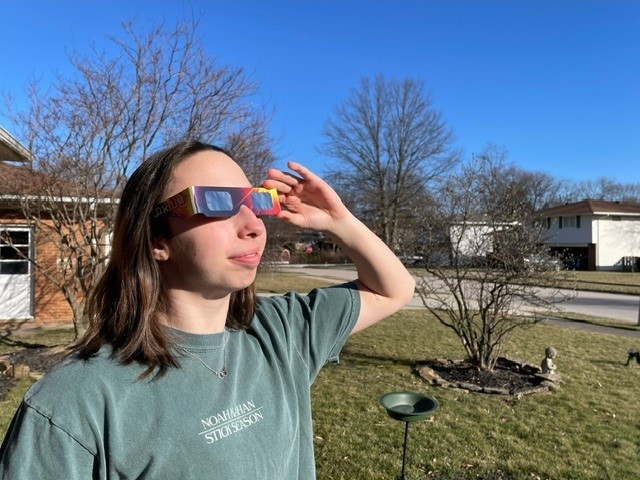
Millions of Northern Ohio residents and hundreds of thousands of visitors will look to the sky through dark glasses on April 8, and the American Red Cross is preparing.
In doing so, Red Cross volunteers and staff throughout Northern Ohio, especially the disaster Assistance Team (DAT), are employing several of their greatest strengths: their experience and dedication, relationships with partner organizations and flexibility.
Preparation is needed. In addition to the eclipse and NASA’s broadcast from the Great Lakes Science Center, Cleveland will host the NCAA Women’s Final Four on April 5 and Championship on April 7. The Cleveland Guardians’ home opener is on the 8th.
While estimates fluctuate, the number of expected visitors is up to 500,000, in addition to the 7.2 million Ohioans who live within the path of totality. The entire region will be crowded, especially downtown Cleveland. Other locations face unique challenges, such as Avon Lake, which will have the longest period of totality.
I spoke with two people leading the preparations. Emma Banton, Regional Readiness Program Manager for Northern Ohio, and Piet Hagenaars, Disaster Program Manager for Northeast Ohio. Both are exceptionally experienced in crisis and emergency management.
The entire Northern Ohio Region Red Cross team has garnered considerable preparedness experience. Emma mentioned seven shelters were operated in our region over the past year, including our largest in over 20 years in Cleveland.
Emma, whose focus is all of Northern Ohio, said, “Each chapter will have at least one shelter team on call from April 5 through 9, while the Northeast and North Central Ohio chapters will each have two shelter teams standing by. Each chapter will also have one canteen team ready for any safety forces that may request refreshments during a response, like a home fire.”
“A Red Cross representative will also be deployed at the Cuyahoga County Office of Emergency Management’s Emergency Operation Center (EOC),” said Piet, “And we are prepared to work with other county offices as needed.”
As home fires will still occur–the Red Cross responds to an average of more than three per day in our region–DAT crews will also be ready. Depending on traffic, crowds and logistics, they may respond virtually. In fact, home fires are a major reason shelters need to be ready. Should a family need a safe place to stay, hotels are fully booked.
Emma and Piet both stressed the importance of preparation, which can be difficult when we do not know where an incident may occur. Considerations include maintaining communication and having fully fueled vehicles should access to gas stations become limited. Emma has also supported the region’s chapter Disaster Program managers and specialists as they updated shelter agreements and ensured readiness.
Emma added that the Disaster Program managers and specialists in all five of our region’s chapters are working diligently to ensure we are fully prepared.
Piet also finds inspiration from other crisis managers, like one who remarked he would never apologize for being over-prepared, and others who pointed out normal rules and expectations often do not apply in a crisis.
Finally, both are looking forward to enjoying this once-in-a-lifetime event. But when and where help will be needed, they are ensuring that the Red Cross is ready.
When is a chain stronger with a flexible link? When it’s the American Red Cross chain that gets vital blood and blood products from donors to recipients.
I’ve blogged about almost all of the links in that life-saving chain: donors who generously volunteer to give the liquid of life; phlebotomists who skillfully, patiently drain that blood from donors’ arms; trained lab technicians who test blood for safety and for unique characteristics that will match with recipients.
Chris Chmura, a Red Cross volunteer delivering lifesaving blood
But that only takes the blood and blood products so far. How does blood get to hospitals where it’s needed for trauma victims, surgery patients and folks being treated for cancer, sickle cell disease and other conditions?
That’s the flexible link in this chain of life. Volunteer Red Cross blood transportation specialists cover this last mile.
“Our blood collection and distribution system would stall without our transportation specialists,” said Alayah Ross, who supervises drivers out of the Cleveland Red Cross blood center.
Alayah Ross supervises drivers out of the Red Cross blood center in Cleveland
“This is ideal for someone who enjoys driving and would like to be involved in a really meaningful activity,” she said.
“And one of the perks of the job is that it’s flexible. We ask for one to four trips a month; we need drivers during the day, in the evening and on weekends, so we work hard to match trips with our volunteers’ own schedules.”
Currently, the Red Cross needs volunteers to drive blood from blood collection sites to the lab in Cleveland for testing and processing, and to deliver blood products to hospitals around northern Ohio.
If you have a valid state driver’s license and at least three years of licensed driving experience, you can choose regular routes, stand-by emergency deliveries or both. This is a great volunteer opportunity for couples, friends or family members.
If you’d like to help hospital patients who need blood and blood products during their battle back to health, click here for more information.
Edited by Glenda Bogar, American Red Cross volunteer
Posted by Ryan Lang, Red Cross board member and volunteer






 NOHredcross