By Ryan Lang, American Red Cross board member and volunteer
Volunteer work for the American Red Cross was never really something Mark Auburn considered. Now, 30 years into his service, he says the Red Cross has become a part of who he is.
Mark Auburn, American Red Cross board member and volunteer
“I don’t have a dramatic story, like many volunteers,” Mark said. “For me, it was swimming lessons when I was a kid – that’s where it started.” It was the personal connection that stood out to him. The time volunteers took with the members of his own community really made a difference to Mark.
Then, when he found out that the majority of the entire organization was volunteers, Mark said he bought-in even more.
“Ninety percent of the people who work for the Red Cross are volunteers. That’s incredible!” And over the course of his 30 years with the Red Cross, Mark has seen those volunteers help people in his own community and around the world. To witness first-hand the reach of the Red Cross has been nothing short of remarkable for Mark.
“One of the huge changes in the Red Cross over my 30 years of volunteering is the sense of relationship between the Red Cross and the community. When I started, we were very locally focused.” Mark has since seen the reach of the Red Cross extend around the world.
Sharing his story with his fellow volunteers is a key part of the Red Cross experience for Mark. “I think it’s important that volunteers talk with other volunteers to learn their individual Red Cross stories.” That’s part of why Mark is looking forward to the upcoming Volunteer Recognition and Appreciation event in Akron.
Mark is not only a volunteer, he’s also a longtime member of the Greater Akron and the Mahoning Valley Chapter Board of Directors. And at 79-years-old, Mark is still going to meetings, face-to-face, to meet and work with fellow board members and other volunteers, all in the name of the Red Cross mission.
The biggest part of that mission is to “alleviate human suffering in the face of emergencies.” Recently, Mark experienced his own health emergency when he was hospitalized with COVID- 19. “I had complications that resulted in an internal bleed,” Mark said.
During his hospital stay Mark suffered a stroke. As a result, he needed six units of blood. “Because of the blood donated by strangers I am able to tell my Red Cross story today. Someone I will never know gave blood because they believe in the mission of the Red Cross, and it saved my life.”
Mark has seen the impact the Red Cross has made in his own life and around the world, and he encourages everyone to find out more about it for themselves. To do so, visit redcross.org.
Posted by Ryan Lang, American Red Cross board member and volunteer
By Christy Peters, Regional Communications Manager
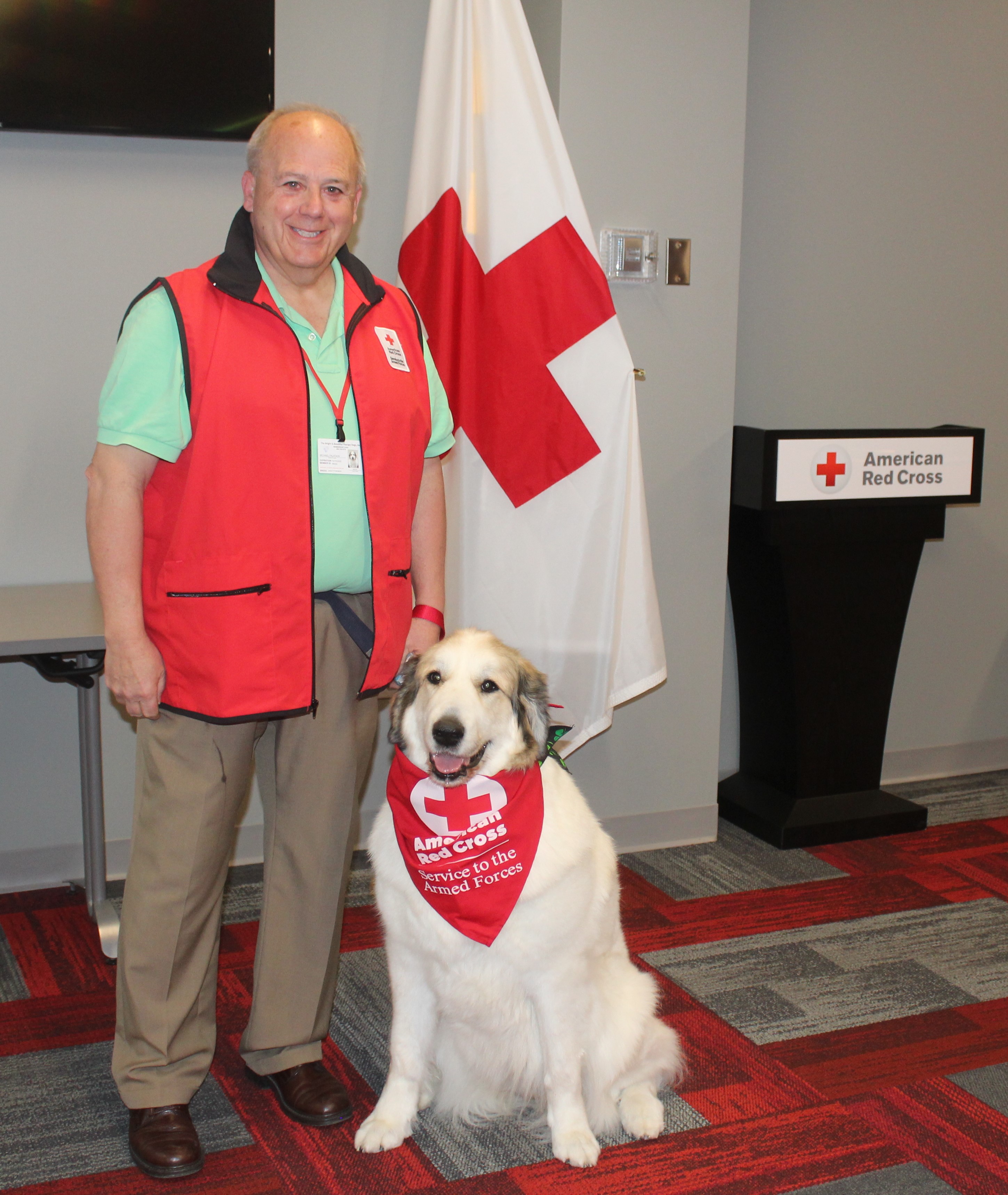
“I love dogs and I love people.” Knowing this about American Red Cross volunteer Mike Falatach, it’s no wonder he’s the volunteer leader for the Red Cross Animal Visitation Program (AVP) in Northern Ohio. Part of Red Cross Service to the Armed Forces, animal visitation teams support military members and their families across the United States and overseas. In Northern Ohio, Mike works with nearly 40 volunteers and their animals, coordinating visits to the Louis Stokes VA Medical Center in Cleveland and National Guard bases across the region.
American Red Cross Animal Visitation Program volunteer lead Mike Falatach with his therapy dog Macee.
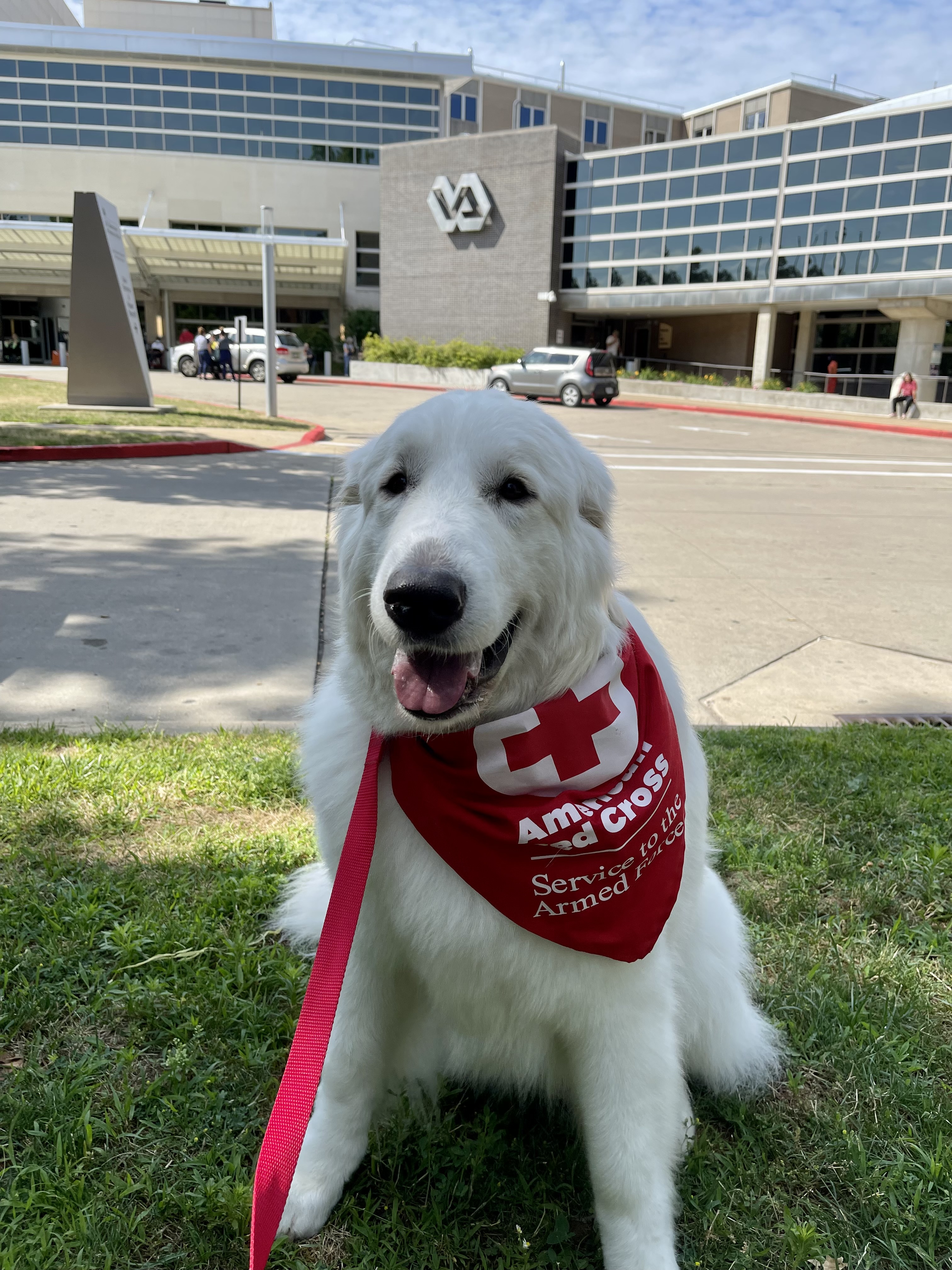
Mike currently has two Great Pyrenees therapy dogs, Macee, who will be 9 in June and Rosie who is 5. In addition to his role at the Red Cross, Mike is certified to evaluate dogs through Bright & Beautiful Therapy Dog Inc. guidelines which is an approved Therapy Dog program by the American Kennel Club (AKC). Mike is also an AKC Temperament Jude and Canine Good Citizen evaluator.
According to the AKC, “therapy dogs and their owners work together as a team to improve the lives of others.” Training to become a therapy dog is no simple task. Dogs must learn to ignore food that’s nearby, how to stay calm amid beeping medical equipment and be with lots of other dogs without turning the event into a playdate.
Rosie is a 5 year-old Great Pyrenees and one of Mike Falatach’s two therapy dogs
“We look for dogs with personality. They wag their tail or cock their head,” Mike said. “A dog that loves to visit with people and gets excited to do so is important because many of our events have lots of people.”
For many military members, seeing a Red Cross therapy dog is an important reminder of home when they are away training. Mike recalls being at Camp Perry in Port Clinton, Ohio for a leadership academy. He said officers came in and sat on the floor with the dogs, crying. “They told us about their dogs, how they missed them,” said Mike. “In the midst of that intense training, the dogs gave them much-needed comfort.”
Rosie ready to visit the Louis Stokes Cleveland VA Medical Center
Mike is always amazed at how a visit from a Red Cross therapy dog can break down barriers with patients. “The dogs take their mind off their pain and what they are going through,” he said. He’s visited individuals who are unable to speak but as soon as they see the dog they smile. Some patients are in the middle of painful medical procedures during a visit, but they perk up and immediately want to pet the dogs when they arrive.
“Macee and I visited a rehabilitation hospital, and a patient was struggling to finish their walk,” said Mike. “The nurse said, ‘If Macee walks with you, can you walk more?’ and the person did. They don’t want to disappoint the dog.”
Rosie visits with a service member as part of the Red Cross Northern Ohio Animal Visitation Program
Mike said being part of an animal visitation program with a national organization like the Red Cross means a lot to his volunteers. There’s a limited number of years for a dog to do therapy work, so any chance volunteers have is exciting for them. “They are eager to participate, they want to share their animals with people,” he said. “The people we meet enjoy it and are so appreciative and that means so much to us.”
The Red Cross is grateful to Mike and his entire team for the important work they are doing to serve military members and their families. You can learn more about Red Cross Service to the Armed Forces here.
Posted by Ryan Lang, Red Cross board member and volunteer
Giving those in need “a hug, a smile, and some hope”
By Jim McIntyre, Regional Communications Director
Monica Bunner describes herself as “something of an adrenaline junkie.”
That’s a reasonable explanation for her willingness to go anywhere the American Red Cross is needed following a disaster. She said she’s not a “sit at the desk type of gal,” but needs to be physically involved.
Monica’s volunteer career with the Red Cross began in 2017. She was watching Hurricane Harvey unfold and felt she had to do something. She deployed to Houston to help, but not with the Red Cross. Not that time.
“A cause I already supported also needed help,” she said. That cause was Best Friends Animal Sanctuary. She was stationed at NRG Center, taking care of pets when she saw Red Cross workers helping people who needed shelter, and thought, “If I’m not doing the animals, maybe I can do the people thing.”
When she returned to Northeast Ohio, Monica began training to become a Red Cross disaster responder. She has helped people following home fires, installed smoke alarms, and assisted at fundraising events. And she began to deploy to help people who needed shelter following major disasters, such as flooding in southern Ohio, Hurricane Ian in Florida, and the devastating Maui wildfires in Hawaii.
Red cross volunteers Randy Liang and Monica Bunner in Maui, Hawaii
“I always wanted to make a difference, to work with communities, to give people some direction, a hug and a smile, and some hope.”
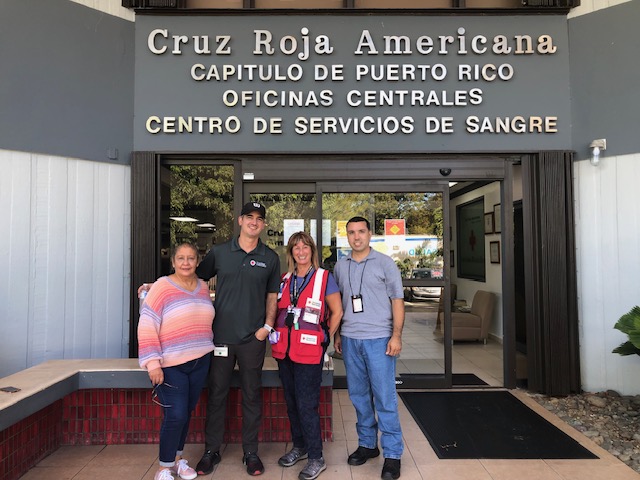
Monica has continued training to expand her skills, and now works primarily with community engagement and partnerships, helping the Red Cross connect with other resources to assist people who have been impacted by disasters. She also helps reunite families who are separated during disasters, and she helped establish Red Cross disaster communications in Puerto Rico.
Fluent in Spanish, Monica was born in Buenos Aires, Argentina, and emigrated to the U.S. with her family when she was a child. She worked at NASA’s Lewis Research Center in Cleveland, helping recruit and train women in non-traditional fields like science and engineering, and was on the team that recruited the first female U. S. astronauts.
Following her NASA career, Monica opened a real estate brokerage and a home rehabilitation business, noting how she was one of the first “female flippers.” And she has traveled to El Salvador with a church group to help build homes there.
Monica plans to continue connecting with and helping people in need through the Red Cross for the immediate future but admits the time will come to slow her frenetic pace. “This work is very physically, mentally and spiritually demanding,” she said. But it’s also rewarding. “I love the feeling of just connecting with people,” she said.
The Red Cross relies on more than 265,000 volunteers like Monica Bunner to fulfil its mission, and if you’d like to learn more, visit redcross.org/volunteer.
Posted by Ryan Lang, American Red Cross board member and volunteer
Dedicated volunteers are a vital part of the American Red Cross workforce. That’s why recognizing volunteers like Pam Orban is an important part of National Volunteer Week.
Pam Orban, American Red Cross volunteer
Pam has been volunteering with her local Red Cross since the summer of 2019 when she signed on as a blood donor ambassador. A retired intervention specialist with a focus on psychology, Pam had originally considered returning to work when she spoke to a friend.
“I was going to go back to the hospital and work in the pediatric department, and then I thought, ‘oh man, I don’t know,’ and then a friend of mine says, ‘well why don’t you do the Red Cross? ’ And that got me started in it,” Pam reflected.
Due to her ever willingness to help out where needed, her role quickly shifted to becoming the lead scheduler for blood drives in her region, as well as a liaison for the Academic Service Learning (AS-L) program. Kathy Cline, volunteer supervisor for Northern Ohio Biomedical Services, has nothing but praise for the hard work and dedication of Pam to the organization over the years.
“Pam’s roles have been an immense support to the success of the Donor Ambassador and Academic Service programs in Northeast Ohio,” said Kathy. “The Donor Ambassador territory she helps lead is always one of the top in the country, and the AS-L program, which she has greatly supported, is a success because of Pam’s assistance.”
The AS-L program coordinates volunteer service with academic learning. Pam works with Kent State University nursing students and the Blood Donor Ambassador (BDA) program.
“Dr.(Mariann) Harding, who is a professor there, developed the program as part of the curriculum for the students. So, the students have to do one drive per semester for credit. It helps us out because it schedules (blood) drives in the southern counties that don’t normally get filled,” Pam explained. “In the BDA, the (students) welcome the donors, help them with registration, talk to them and handle the canteen (refreshment area), and of course they call me for an event. It’s a good experience for these kids.”
Pam’s supervisors admire her reliability and dedication to the Red Cross and willingness to go the extra mile. Pam herself appreciates her volunteer service as a way to keep her mind and body active in retirement.
“I love it. I feel my Red Cross volunteering plays an important role within the community,” Pam joyfully stated. “I work directly with volunteers to find and schedule blood drives. I also help team members whenever needed. I have an active part in saving lives.”
Volunteering can be a rewarding and fulfilling experience, and the Red Cross is always in need of enthusiastic volunteers. Learn more about volunteer opportunities in your area by visiting the Red Cross website.
Edited by Glenda Bogar, American Red Cross volunteer
Posted by Ryan Lang, American Red Cross board member and volunteer
By Samantha Pudelski, American Red Cross volunteer
You may know that 90% of the American Red Cross workforce is made up of volunteers. You also may be aware that there are various roles in which someone can serve the organization. Today, we want to share another aspect of the Red Cross that you may not be as familiar with—our Red Cross Clubs and our club coordinators who help support them.
Wesley Leong, American Red Cross volunteer
Red Cross Clubs support the overall mission of the Red Cross, engaging with key local, national and international issues. Any school age or college student can start a club, with the support of the Red Cross and their school. In the Northern Ohio Region, there are 12 clubs at various high schools and colleges.
Wesley Leong is one of two Red Cross club coordinators who support the region. His passion for the Red Cross Clubs and the organization as a whole is evident the minute he starts talking about it. Wesley works with new and existing clubs, acting as their primary source for any questions, advice or support they need. Typically, he meets with each club’s officers once a month to get an update on their activities. With new clubs, he meets regularly with their leadership to develop a charter and help brainstorm ideas to help establish the club and lay a solid foundation for success. He also acts as a liaison between each club’s officers and the Red Cross Northern Ohio Region, helping navigate any needs that may arise.
Clubs are required to create and hold various mission projects through the year that support the different areas of service in the Red Cross. This school year, some of the events that have taken place include blood drives, volunteering with veterans and completing CPR training.
Wesley has volunteered with the Red Cross for about four years. During the pandemic, he learned about the work done by the Red Cross for natural disasters—in response when disasters strike and how they educate communities to be prepared before they hit their area. This work inspired him to start his own club at Revere High School in Richfield. His club’s first mission project was organizing a gift drive to collect items and create care packages for veterans. The club continues to grow and support the Red Cross.
When asked what was his favorite part of being a club coordinator, he cited all of the different people he gets the opportunity to work with, from the various clubs to the employees and volunteers who support the Northern Ohio Region. He also has the opportunity to see all of the work being done by the clubs in the region and how they impact our community.
For those interested in starting their own Red Cross Club, Wesley highly recommends doing so. “It gives you volunteer and leadership experience, and you can help the community.”
You also have the opportunity to see how different areas of expertise come together to support the Red Cross, from clinical volunteers to even law. It can help individuals find different volunteer opportunities and gain experience in the areas they want to pursue for their future career.
Wesley’s final thoughts sum up his dedication to the Red Cross perfectly. “If you are interested at all in joining the Red Cross as a volunteer, don’t miss out on the opportunity. It will impact so many people around the world and in your community.”
Edited by Glenda Bogar, American Red Cross volunteer
Posted by Ryan Lang, American Red Cross board member and volunteer
A little under six years ago, Tom Johnson decided to help after a disaster, contacted the American Red Cross, and was soon assisting at a Florida shelter in what would become his first of 18 deployments thus far. A few months later, Tom was heading to the Red Cross’s Heartland, Stark, and Muskingum Lakes (HSML) chapter, when his wife, Gwen, decided she would like to help, too.
Tom and Gwen Johnson
Since then, Tom and Gwen have taken on enough roles to fill this page, but Tom is primarily the logistics lead for the Northern Ohio region, while Gwen helps engage volunteers and forge shelter agreements. In short, they ensure people, supplies, facilities, and vehicles are ready whenever and wherever needed.
They are also responders on the Disaster Action Team (DAT) and help install smoke alarms.
Much of the Red Cross’ ability to quickly, effectively provide assistance -whether during a disaster, supplying blood to hospitals, aiding the U.S. Armed Forces, or other lines of service -is due to volunteers like Tom and Gwen.
Mike Parks, Kim Kroh, Tom and Gwen Johnson
Kim Kroh, Executive Director the HSML chapter, said, “Tom and Gwen have amazing stamina and are some of the most philanthropic people I have ever met. Gwen is one of my Community Volunteer Leaders (CVLs) and has helped me immensely, including archiving the history of seven counties. Tom is always willing to help around the chapter, whether that is loading the Emergency Response Vehicle (ERV) for Hall of Fame activities, volunteering at our fundraising events , or reaching high places (Tom is super tall). It is a blessing to have Tom and Gwen representing the HSML chapter, and an honor to call them my friends.”
Tom and Gwen bring a lifetime of experience to the Red Cross. In addition to raising two children, Tom worked in telecommunications for 40 years; Gwen most recently worked in retail. They have three grandchildren, enjoy traveling, hiking, and animal watching.
Being creative, lifetime learners, they have continued to hone skills and explore new avenues as Red Cross volunteers. While Tom had known about several Red Cross services, including being assisted when he was in the service and his father passed, he was still surprised how many opportunities and classes the Red Cross offers. (Another of Tom’s roles is helping at the Ohio Western Reserve National Cemetery).
It is a good fit for them. Tom and Gwen both like to remain busy. It is one of the things Tom enjoys about logistics, especially during deployment, as the days are filled with activity. Gwen enjoys talking with and helping people, although she jokes part of her job is sending them away (on deployments).
While Tom and Gwen modestly describe themselves as being “behind the scenes,” joining to help rather than receive pats on the back, they have seen the positive effects of their work: a young lady hugging a blanket other HSML volunteers had sewn, saying she will cherish it forever; an older woman who couldn’t believe they travelled 90 minutes at night to help just her; a shelter resident initially nervous being around others developing friendships; the appreciation of having someone listen and help after losing their homes.
They have also met a lot of nice people, enjoy the diverse experience and perspectives of their fellow Red Cross members, and being able to help when it is most needed.
For anyone considering becoming a Red Cross volunteer, Tom and Gwen point to the many opportunities, the ability to discover new perspectives and see the world differently, the enjoyment, the friendships, and even the T-shirts. And if you join in the HSML chapter, they will likely be among those helping you begin.
Edited by Glenda Bogar, Red Cross volunteer
Posted by Ryan Lang, Red Cross board member and volunteer
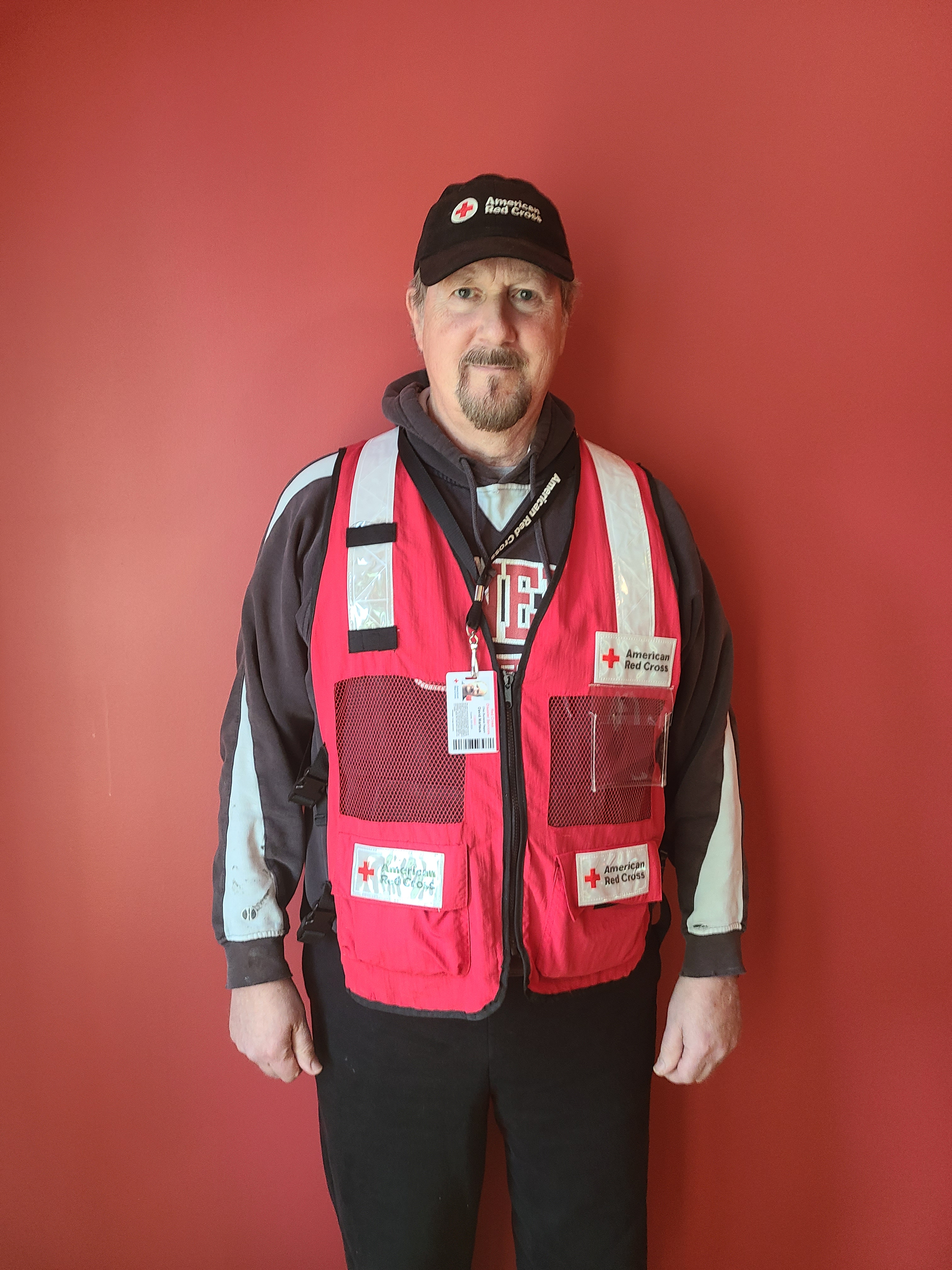
Semper Gumby: Always flexible. That’s a cherished characteristic of American Red Cross volunteers – and Dave Martaus is Gumby in person.
Dave Martaus, American Red Cross volunteer
“Dave is a key volunteer here at the North Central Ohio chapter. He’s willing to do anything that needs to be done – not just the high-profile, public-facing activities, but even the so-called ‘little things’ that keep an operation running,” said chapter Executive Director Todd James.
A retiree from Marathon Petroleum Corp. in Findlay, where he rose through a series of interesting assignments, Dave has been involved with Red Cross facilities maintenance, logistics, disaster response and support for our armed forces.
“Cheryl Wolfe (operations manager for the chapter) always has a list of things for me to do,” he said with a chuckle. Recently, he assembled a couple of new filing cabinets for the office. “Wasn’t something I’d ever done before, but it was interesting.
“When Lora Taylor (disaster program manager) came on board, we needed to account for our disaster trailers. So we brought all four trailers from around the chapter to a vacant garage here in Findlay and emptied all the contents,” he recalled. “We laid all the stuff out; it looked like a giant garage sale.”
He and his co-workers sorted the contents and repacked the trailers with the right number of cots, blankets, comfort kits and other supplies that would be needed in case of a major disaster. He said it was interesting, getting familiar with what’s involved in preparing for a big response.
Dave appreciates the variety of volunteer opportunities within the Red Cross. “I’ve thought about possibly getting involved with blood services,” he said. “I know they need people to transport blood (from blood drives to the blood processing center in Cleveland and from there to hospitals). I could do that.”
Dave Martaus is one of the more than 265,000 Red Cross volunteers that we’re saluting during Volunteer week. But their selflessness is invaluable all year round.
If you’d like to find out more about the many volunteer opportunities with the Red Cross, please click here for more information.
Edited by Glenda Bogar, American Red Cross volunteer
Posted by Ryan Lang, American Red Cross board member and volunteer
What would we do without the selflessness of those who give their time by volunteering?
In honor of National Volunteer Week (April 21-27), we are featuring profiles of some of the dedicated volunteers who help the American Red Cross fulfill its mission in Northern Ohio.
From left: Gail Wernick, Pat Crawford, Kelsey Jeffrey, Debra Kellar, and Kevin Brooks of the Northern Ohio Region Volunteer Services team, and Rachel Hepner, Executive Director, Western Lake Erie Chapter
Pat Crawford spends most of her time honoring and thanking others for their service. From her home base in the Western Lake Erie Chapter, headquartered in Toledo, she handles the five chapters in the Northern Ohio region as the Regional Volunteer Services Recognition and Appreciation Lead. If you thought that in this crucial role in the Volunteer Services Department, Pat seems to have volunteering in her blood, (pun intended) you’d be right! And she passed down that heart to serve to her sons: her eldest was Red Cross trained in water survival, first aid/CPR and was a lifeguard, and her youngest is a law enforcement officer in Findlay.
Like many who volunteer, Pat has a Red Cross story.
Pat’s oldest son and his family moved to Louisiana. When Katrina hit, their home experienced extensive damage, and they had to come back to Ohio for awhile. Pat will be forever grateful for the tremendous support the family received from the Red Cross. Beyond that, Pat appreciates what the Red Cross does for our military.
“I have many family members and friends that were and still are in the military. I know what the Red Cross does to help our servicemen and women and their families,” she said.
Pat’s volunteer experience started many years ago. She was a front desk receptionist and a TeleCare call receiver. She was later “hired” by AmeriCorps to serve a year at the Red Cross, but stayed on for four years, starting first in the Disaster Services office and then moving to other areas like the Pillowcase Project and educational classes. After her last AmeriCorps year, she retired and became a full-time volunteer for the Red Cross.
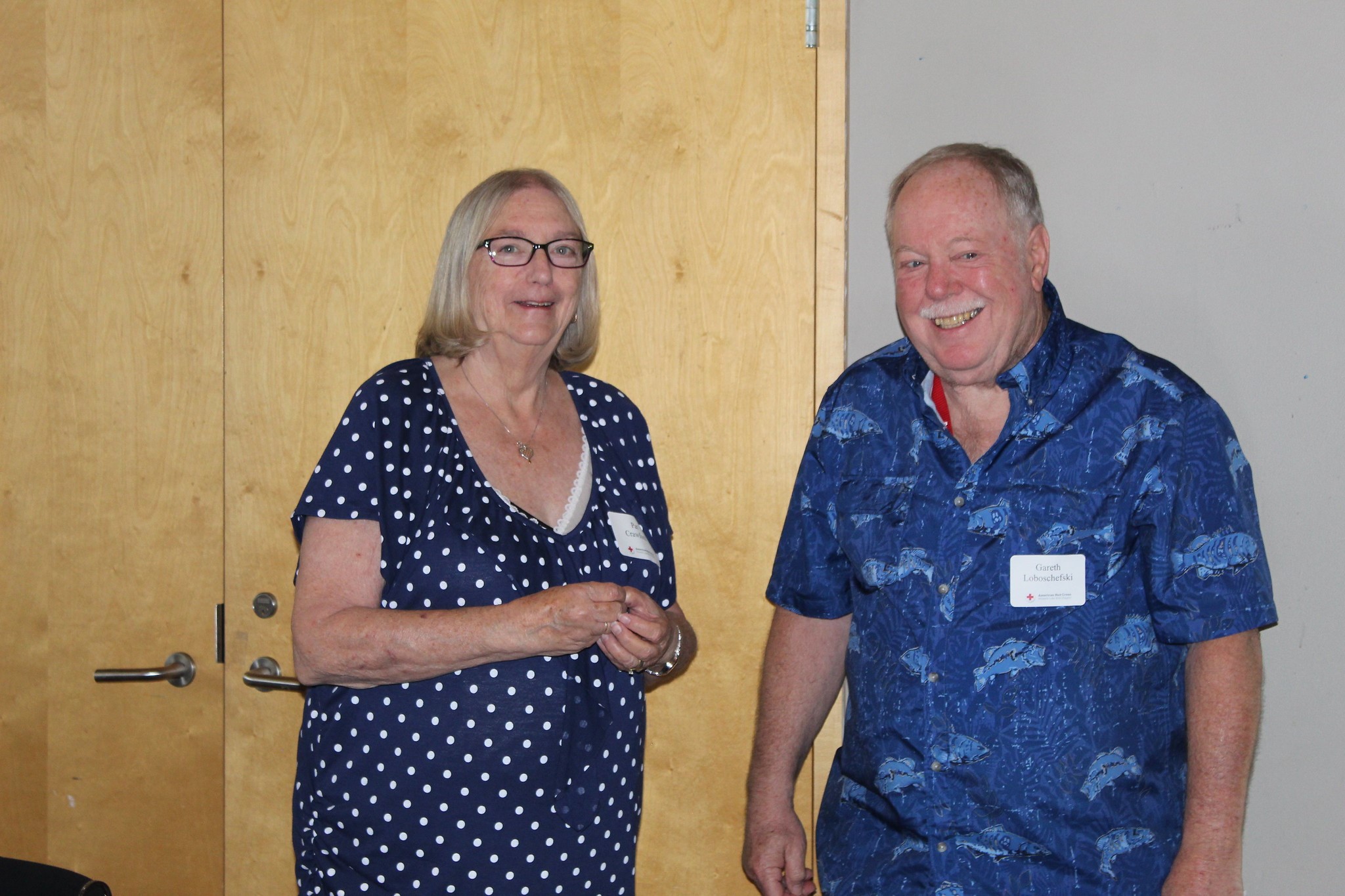
Volunteers Pat Crawford and Gareth Loboschefski catch up at a volunteer recognition event
What Pat loves most about her job as the Volunteer Services Recognition and Appreciation Lead is expressing gratitude for the hard work of the many volunteers throughout the regions’ five chapters.
“I feel it is very important to let volunteers know that they are appreciated and supported for what they do,“ Pat said. “I feel really good when a volunteer wins a gift card or receives a Red Cross item and they take the time to tell you how much they appreciate it.”
While it may be the little things that Pat finds rewarding, she has one story in particular that exemplifies the powerful life-changing and lifesaving impact volunteering can make.
One day, way back when she worked the phones, she received a call from a woman who could not get in touch with one of her older female clients. “We called the police and fire to do a wellness check on this person, because her daughter, who lived out of town, hadn’t spoken to her since Saturday, and it was now Monday,” Pat shared.
Pat called emergency responders who broke into the house and found the woman unresponsive, but thankfully alive. When Pat went to visit the client in the hospital, the grateful woman said, “you saved my life” — a comment she still gets goosebumps about.
One of Pat’s dreams, and something she worked over two years to accomplish was to get the Nurses Pin awarded at the Recognition and Appreciation Events. That dream came true for Pat in 2023 and will continue every year. “They are special pins that have numbers that are assigned to the volunteer nurse, and records of these pins are kept in the archives in Washington, D.C.,” said Pat.
Pat Crawford, who spends much of her time honoring others for their volunteer work, is a true example herself of what it means to be a Red Cross volunteer.
Edited by Glenda Bogar, Red Cross volunteer
Posted by Ryan Lang, Red Cross board member and volunteer
CLEVELAND, April 16, 2024 When John Gareis began his career with the American Red Cross, there were elevator operators in the building that housed the offices in Cleveland. Blood collected from donors was stored in glass bottles – not the plastic pouches used today. “And there were no electronics,” John said, pointing to an old typewriter on display in the lobby of the current Red Cross offices in Cleveland.
John Gareis and wife Emily at a Red Cross fundraiser
If the computer systems that exist today were common then, John may not have been hired.
“I saw a notice posted on a job board at CSU (Cleveland State University),” John said. He was studying business management at the time and needed a part-time job. “They asked me if I had good handwriting. I said, ‘I guess so,’ and I got the job.”
48 years later, John is retiring from the Red Cross, following a storied career that began in the records department, where he was tasked with writing blood donor information by hand.
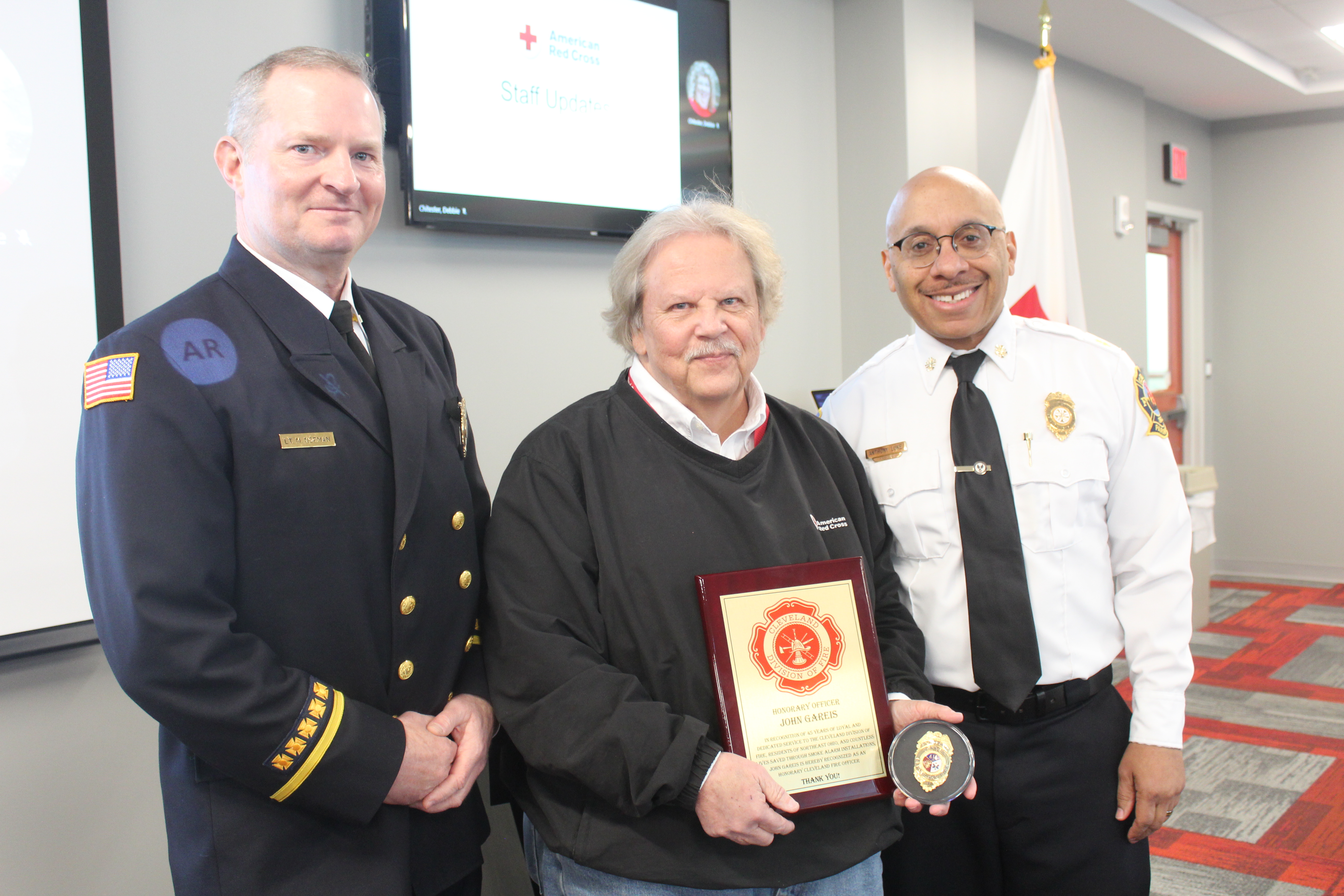
Lt. Mike Norman, left, and Chief Anthony Luke of the Cleveland Division of Fire recently presented John with a plaque and a badge as an honorary officer
“It was only supposed to last a couple of weeks,” he said with a wry grin.
“I met John in December 1986,” said Darlene Morris, the current manufacturing director at the blood laboratory in Cleveland. “I had started at Red Cross the month prior, and he was hosting our Christmas party.! He had a great sense of humor and was fun to be around.”
John eventually transferred from Biomedical Services to Humanitarian Services and led the Wayne County chapter headquartered in Wooster. “Whenever there were any disasters or fires, John was always there to help,” said Greg Long, who served as the chapter chairman of the board. “He always had whatever was needed to assist the families and first responders.”
Greg said John worked hard to create and develop the Festival of Trees, a legacy fundraising event. And he worked with John to help build a new chapter headquarters building in downtown Wooster. “John put together a blue-ribbon campaign committee and we raised the money, 1.8 million dollars, and built the new chapter house.” Construction was completed in 2008.
John Gareis providing instructions at a Sound the Alarm event
John has weathered many changes in structure and operation at the Red Cross and is ending his career as the regional preparedness manager. Renee Palagyi, who worked closely with John for several years at regional headquarters in Cleveland, first met John in 2006, when she was a Red Cross volunteer in Ashtabula County. She served on a committee focused on disaster preparedness and response. “I was immediately struck by the wide base of knowledge John had, not just in disaster but in overall chapter function, fundraising, Service to the Armed Forces, and so much more,” she said. “Such an easy-going guy who was willing to share what he knew with the entire group.”
Arguably, John’s most significant contribution to the Red Cross involves the development of Operation Save-a-Life, an initiative to make homes and families safer with free smoke alarms. It began in 1992 in partnership with the Cleveland Division of Fire and served as a model for the national Home Fire Campaign, a highly successful initiative that is credited with saving more than 2,000 lives since being introduced nationwide in 2014.
“The success of the life-saving smoke alarm program is truly a credit to John and his desire to get it done,” said Renee. “For so many years our region was the gold standard in this program and that must be credited to John, who didn’t just lead it; he was out there installing alarms, teaching families how to be safe and pulling together incredible teams across the region for large scale installations.”
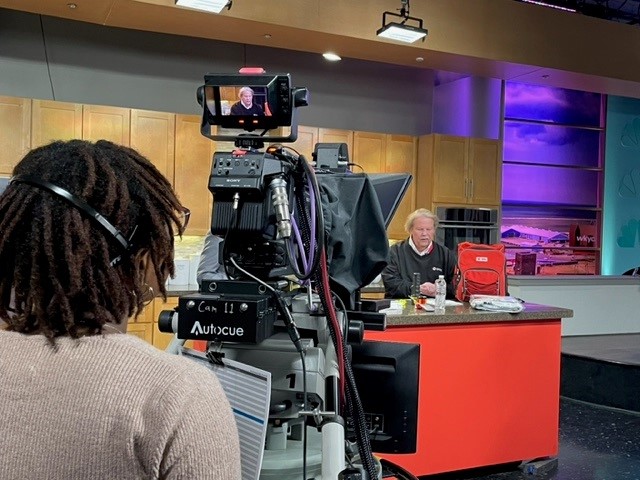
John Gareis at WKYC demonstrating the importance of building a preparedness kit
John is quick to note he wasn’t involved with the creation of the smoke alarm program, but he speaks of it with pride. “We started it. It went national because of the work done by our staff, our volunteers and our partners to make it such a success,” he said. “We wear that as a badge of honor, and we continue to be a national leader every day.”
Regional CEO Mike Parks also shared his high praise for John.
“John’s contribution to the American Red Cross over the past five decades cannot be overstated. His knowledge and expertise, especially when it comes to preparing communities and families for potential disasters, has resulted in a more resilient Northern Ohio,” he said. “His inspiring leadership of the Home Fire Campaign has created safer homes, families, and communities. Thanks to his tireless efforts, the Northern Ohio Region continues to set an example for the rest of the country when it comes to smoke alarm installations and homes made safer.”
Regional CEO Mike Parks recognized John’s contributions at the 30th anniversary celebration of the smoke alarm program
His retirement is not the end of John Gareis’ Red Cross career; he plans to continue sharing his expertise as a volunteer.
“I feel honored to have worked alongside John for the past eight years and look forward to continuing to do so as John moves into a volunteer role supporting our training team,” said Emily Probst, regional disaster officer.
Mike Parks shared a similar sentiment. “I wish John the very best in the future and am comforted in knowing he will continue to provide his valuable service to the Red Cross as a volunteer.”
Edited by Glenda Bogar, American Red Cross volunteer
Posted by Ryan Lang, American Red Cross board member and volunteer
March is Red Cross Month and the American Red Cross wants to encourage everyone to learn the important skills of CPR, first aid and AED usage.
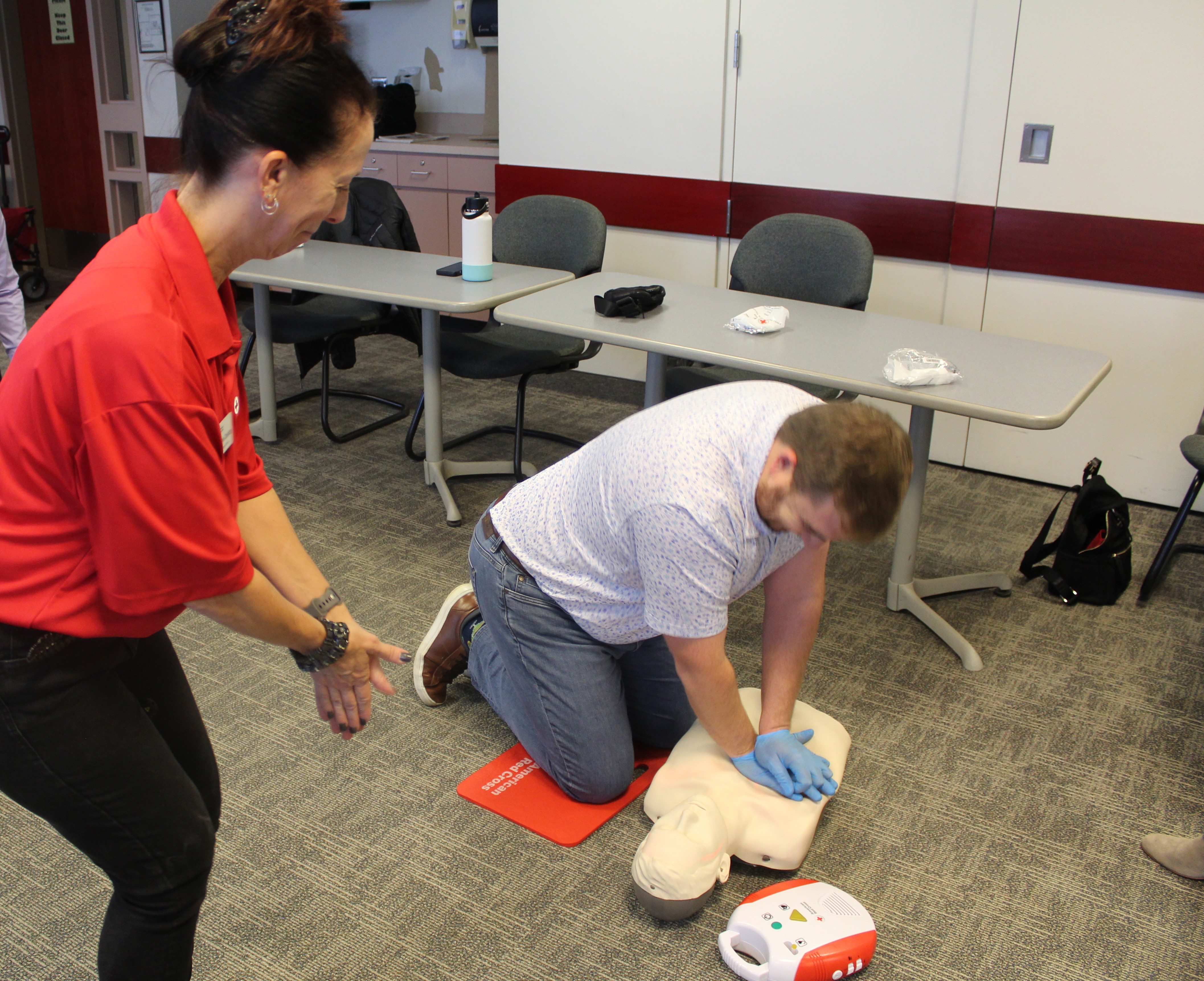
Red Cross instructor Angele Cassiday teaching CPR
Sudden cardiac arrest can happen anywhere. According to the American Heart Association, more than 357,000 cardiac arrests occur outside of the hospital setting each year in the United States, and nearly 90% of those arrests are fatal.
Despite this, survival rates can double or triple for victims of cardiac arrest if CPR is started immediately. That’s why training is vitally important so that prompt medical attention can be given before emergency responders arrive.
What should you do if you see a person suddenly collapse? Assess the scene for safety and check the victim’s pulse and breathing. Call 911. Start CPR. Use an AED.
How do you check a pulse? The easiest way is to place your fingers on the victim’s throat and slide your fingers laterally down into the groove on either side of the esophagus. The wrist can also be used; the pulse is located just below the thumb joint, also in the groove.
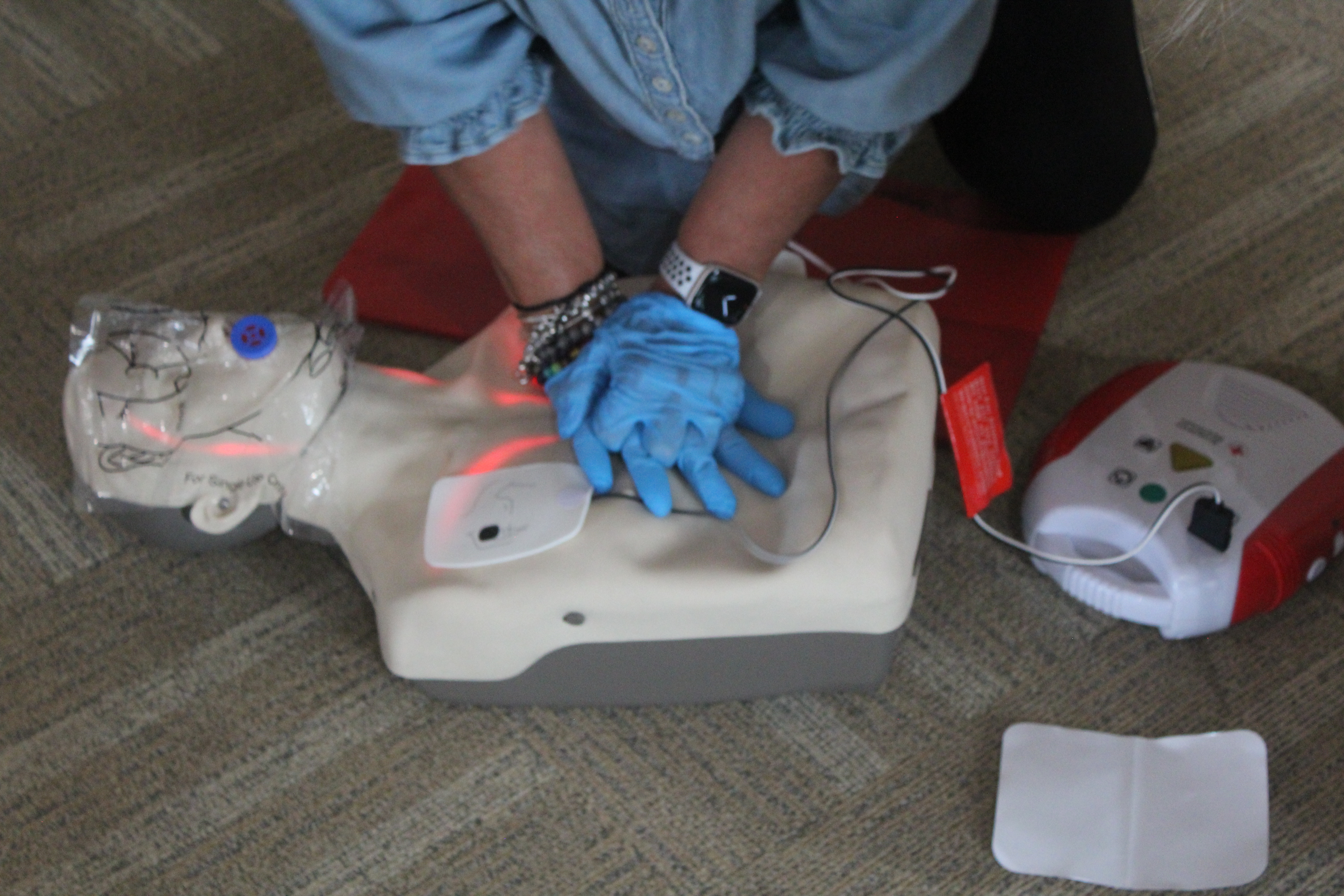
CPR, or cardio-pulmonary resuscitation, is the application of chest compressions to keep blood pumping through the body. The Hands-Only CPR method is recommended for bystanders in public settings, meaning the focus is solely on delivering chest compressions, without breaths, until emergency responders arrive.
AED stands for automated external defibrillator. It is an important, lifesaving tool used in sudden cardiac arrest when the heart stops beating or is beating ineffectively. The machine is easy to use and talks you through the steps to deliver effective medical care until help arrives. Anyone can learn to use an AED.
More and more communities are placing AEDs in public areas, such as parks, town centers, grocery stores and workplaces, so lifesaving measures can be started even earlier. The next time you are out and about, note the locations of AED machines in your community. This knowledge may help save someone’s life one day.
Did you know that the Red Cross offers training in CPR, first aid and AED? While CPR and AED training is common among health care workers, child care workers and lifeguards, it is a skill that anyone can and should learn. Be prepared for any situation by visiting https://www.redcross.org/take-a-class and signing up to take an online or in-person class.
Edited by Glenda Bogar, Red Cross volunteer
Posted by Ryan Lang, Red Cross board member and volunteer











 NOHredcross