Toledo mom grateful for Red Cross assistance following devastating fire
By Jim McIntyre, American Red Cross volunteer
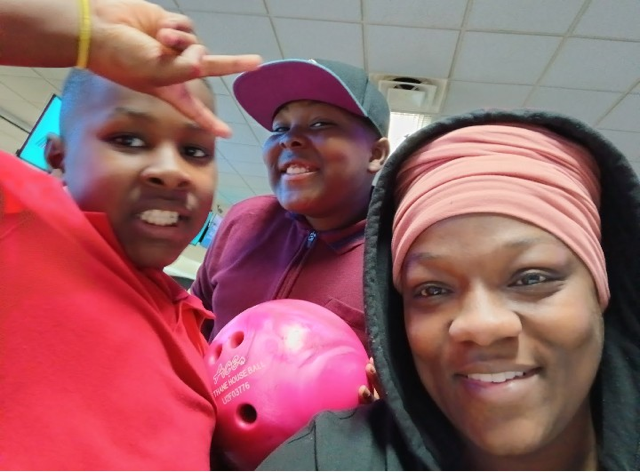
“This is the first time in my adult life I’ve actually been content.” That quote may not seem to make much sense, coming from someone who suffered a home fire less than a month before. But that’s not how Ashley Jackson sees it.
“Everything happens for a reason, even the bad stuff,” said the Toledo school bus driver, referring to the fire that destroyed much of her home on January 29, 2026. “So many blessings have come from it.”
Ashley Jackson (bottom right), Okikechukwu Emeana (left), Chibueze Emeana (center)
Ashley was able to escape safely with her two young sons and their cat at about 4:30 the morning the fire tore through the upstairs of their home. She said she had no idea what to do or where to go. She had no insurance, and she thought she and her children were going to have to sleep in their car. That’s when she was told to call the American Red Cross, where she connected with a caseworker.
“You guys jumped right into action,” Ashley said, by helping her stay focused and calm. “I thought I was OK, but I just busted out in tears, and she (the Red Cross caseworker) stayed on the phone with me the entire time and consoled me and helped me stay strong for my kids. Because once I started crying, they started crying!”
The Red Cross was able to give Ashley immediate financial assistance for an extended stay in a hotel, where she and her children spent the first week following the fire. She said they also connected her with other resources for clothes and basic necessities.
“They were checking up on me about every day, maybe twice a day, through calls and text messages. Just being very kind, and, I don’t know…human.”
Like many people, Ashley was unaware of the help the Red Cross offers to people in her situation.
“I thought it was like some organization that helped foreign countries,” she said.
In Northern Ohio alone, the Red Cross responds to more than 3 home fires every 24 hours, offering the same compassionate care and financial assistance that Ashley and her family received. And most of that help is provided by volunteers.
And now, Ashley is considering becoming a Red Cross volunteer.
“I’m happy. Everybody’s safe. We’re getting back into a routine. Being on the receiving end, I want to give back.”
Anyone who wants to give back and help their neighbors in need can visit redcross.org/volunteer to learn more about the many ways the Red Cross offers to help make our communities safer and more resilient.
On Friday, October 17, 2025, I said goodbye to my wife and my two young sons before leaving for Alaska for two weeks. As I texted other family and friends about my deployment, there was one response I saw more than any other: “What happened in Alaska?” Of course I knew, it was my job to know, but most of the rest of the world hadn’t heard. Alaska’s story hadn’t been told.
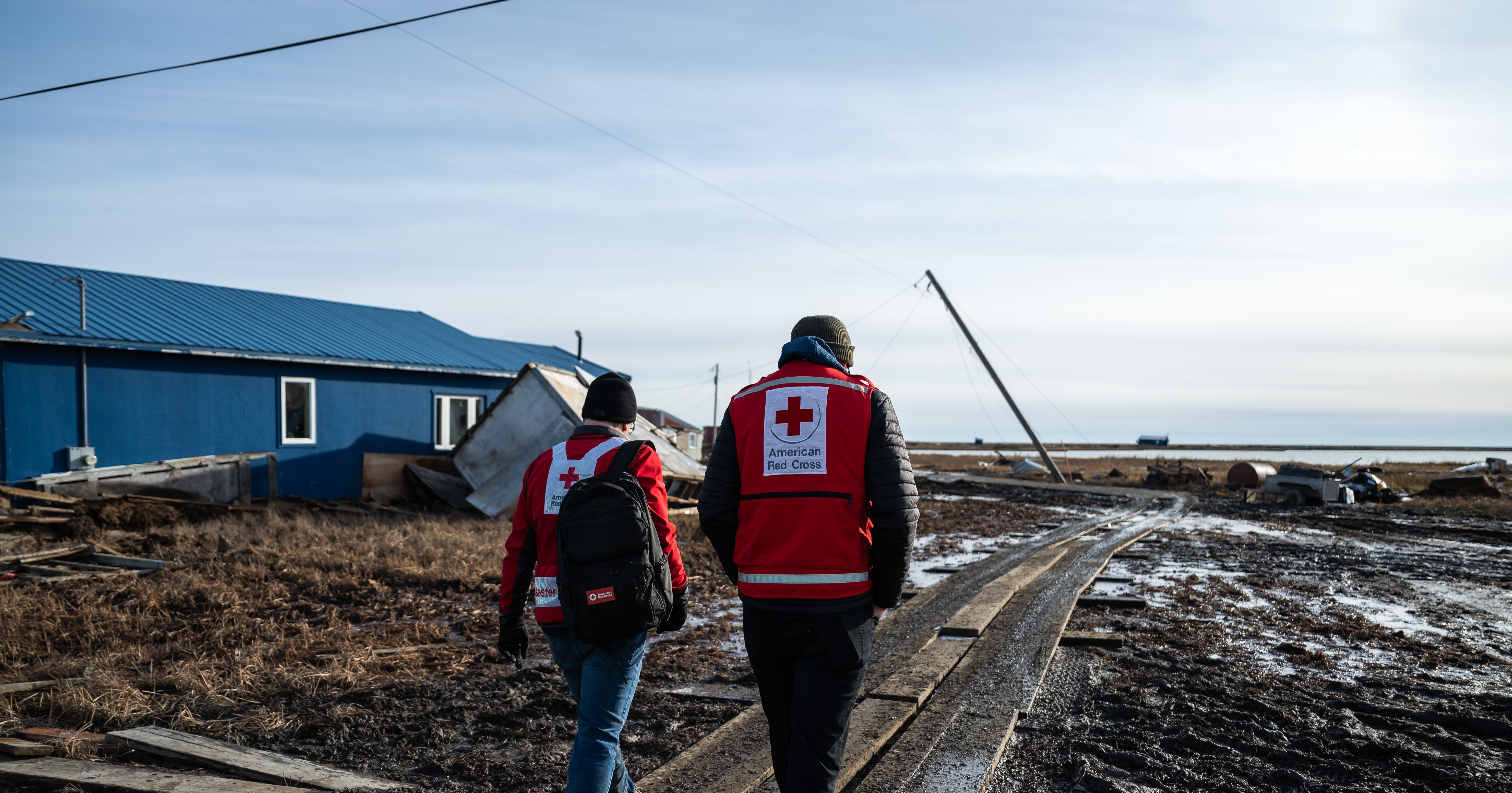
October 19, 2025. Kipnuk, Alaska.
Red Crosser Dale Kunce in the heavily-damaged village of Kipnuk, on Oct. 19, 2025.
The Red Cross is helping in Alaska as officials stage one of the largest airlifts in the states recent history, evacuating entire villages that were left in ruins last weekend by Typhoon Halong. We are working with state, tribal, local officials and partners to support the evacuees who are being flown to shelters in Anchorage, where they will find a safe place to stay, food, emergency relief supplies, emotional support and health services. Hundreds of Red Cross disaster workers from across the country are being deployed to help during what could be a prolonged relief response with access to some villages cut off and others left uninhabitable as Alaskas winter sets in.
Photo by Scott Marder/American Red Cross
The early morning of October 11, 2025, the remnants of Typhoon Halong devastated indigenous villages along the west coast of Alaska. Hundreds of residents, primarily from Kipnuk and Kwigillingok, were evacuated – first airlifted to Bethel, where the U.S. Army National Guard established a transitional shelter, and then flown to Anchorage on a military C-130 plane. Residents left behind their homes, or what was left of their homes, their valuables, mementos, even their pets. They left behind everything.
In Anchorage, the American Red Cross established two shelters – one at the Alaska Airlines Center at the University of Alaska Anchorage (UAA) and another at the William A. Egan Center downtown. Residents of these villages moved into their new temporary homes, uncertain what was next.
“I still can’t believe we lost our place,” said Gilbert Amik, speaking of his home in Kipnuk that was washed away in the storm. “But help is here… We will move forward from here.” For Gilbert, a big part of that help was Red Cross volunteer Deb Blaze, from California. She and Gilbert built a special bond over the time Gilbert and his mother, Carrie, had been staying at the shelter at UAA.
Red Cross volunteer Deb Blaze hugging Gilbert Amik, resident of the village of Kipnuk in Western Alaska, who was evacuated, along with his mother, in the wake of Typhoon Halong. Photo by Ryan Lang/American Red Cross
“It makes me feel good,” Gilbert said, expressing gratitude for the help he and his mother received, specifically from his new friend. Deb said, “It was a special bond. It was like we were supposed to meet.”
Gilbert and Deb’s story was just one of countless inspirational anecdotes that came out of the tragic storm. The people I spoke with during my two-week deployment were resilient, strong, kind, and faithful – both the residents and the Red Crossers.
I met a young girl, just nine-years-old, who despite losing her home brought so much joy to others in the shelter. I met a volunteer from Alaska who carried around a Yup’ik bible with her for days, just so she could get it to a resident who requested it. I met a tribal elder from the village of Kipnuk who spoke to the younger generation about faith, hope, and strength. I met a group of people who made me want to be better, and I’ll continue to tell their story.
Alli’s first Red Cross deployment story
Alli Katterheinrich on her first Red Cross deployment in Anchorage, Alaska, October 2025.
Alli Katterheinrich is a Regional Philanthropy Partner for the Red Cross of Northern Ohio. She deployed to Alaska as part of the Special Public Outreach Team, telling the story of people directly impacted by Typhoon Halong.
“I got the call on a Tuesday and was on a plane the next day,” Alli said. “It was a lot to process,” she said, talking about wrapping her head around her first deployment as a Red Crosser and being thousands of miles away from home.
The time difference was a challenge for Alli, who said sometimes it was difficult to get in a phone call with her husband. The darkness was another challenge. “I’m a morning person and I get up early, but the sun doesn’t come up until 9 a.m. here, so even that was a major adjustment,” she explained.
But it was the residents’ stories that helped, Alli said. “I spoke with so many village residents who took me through their entire experience,” she said, “from being airlifted from their homes to their time in our shelters. I feel very fortunate that they feel comfortable enough to share their stories with me.”
“So much of it was organic,” Alli said. “People would see me sitting, wearing my Red Cross vest, and they would come up and start talking to me and telling their story.” And for Alli, me, and so many others I spoke with, it was those conversations and that storytelling tradition that was so cathartic. And it is the stories that we will carry with us.
A Northern Ohio story
Being thousands of miles away from your home for weeks, sometimes longer, can be hard on a Red Cross volunteer. You miss your family, your bed, your morning routine… You miss a lot. But it’s the friendly faces that make it a lot easier. “There were so many other volunteers from Northern Ohio,” Alli said, “and that helped.”
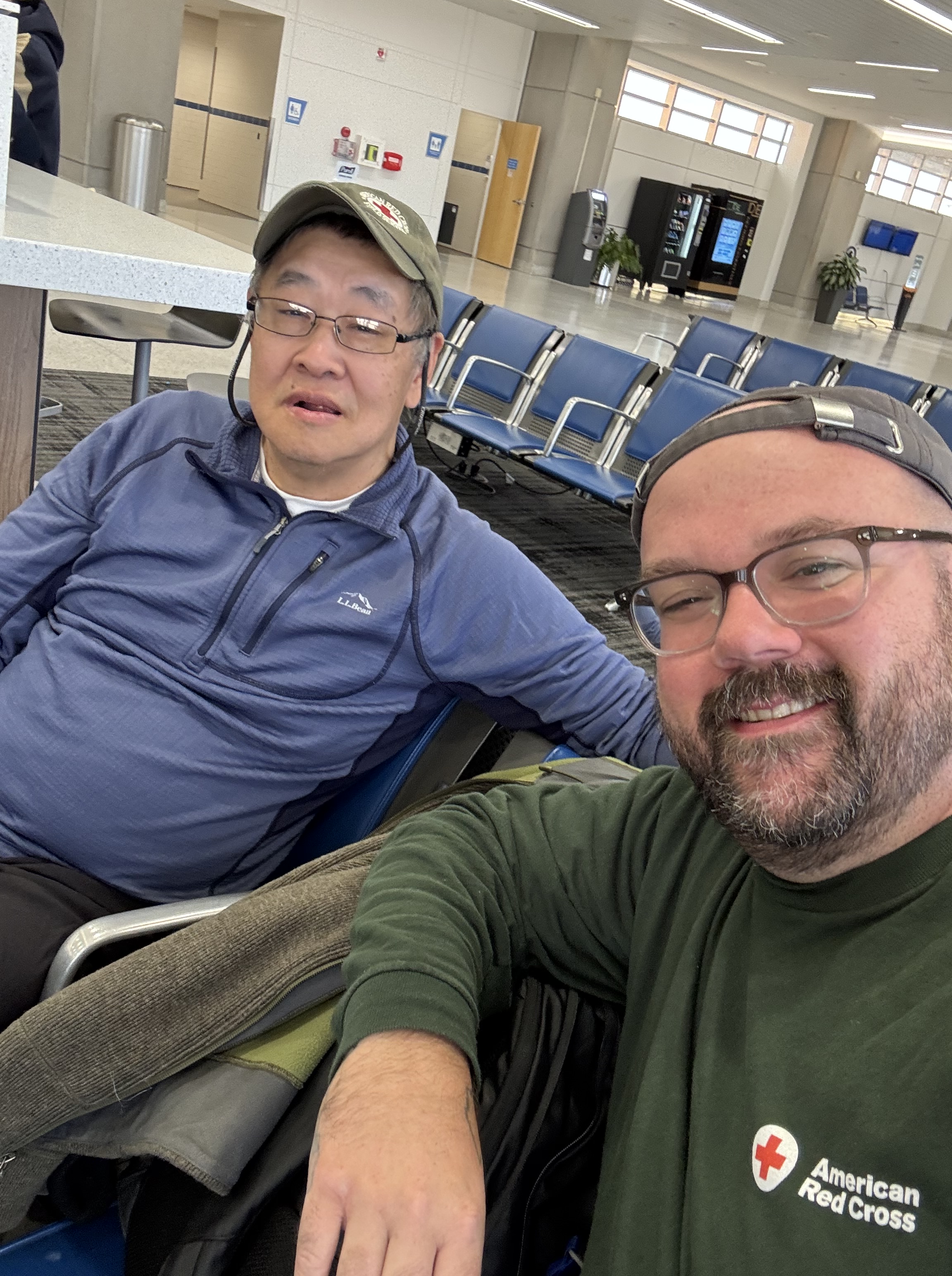
Randy Liang (left) and Ryan Lang at Akron-Canton Airport, waiting to take off to Alaska in response to Typhoon Halong that hit the western coast of Alaska in October 2025.
I met Randy from Cuyahoga Falls at Akron-Canton Airport, waiting to board our flight together. He’s an IT specialist who spent more than a month in Alaska, making sure the Red Cross staff had the connectivity they needed to execute the mission. Treacy from Northeast Ohio worked 12-hour shifts at the shelter for weeks, caring for residents, making sure they had what they needed. Callene, originally from Lorain, met with every volunteer who checked into the operation, helping acclimate them to the Alaska culture. Jeff, from the Heartland, Stark, and Muskingum Lakes chapter, worked tirelessly in the shelters, providing meals and snacks and more. And when it was time for those residents to leave, Jeff helped pack their things, sending them off with a smile and a hug.
The lifesaving mission of the Red Cross is not possible without these people who volunteer so much more than just their time. I’m grateful to be a small part of this group of incredible people, and I will continue to tell their story.
Before American Red Cross Youth Volunteer Maddie Frank arrived for her first shift as Blood Donor Ambassador, she had already recruited a new blood donor, her dad. As Maddie was not yet old enough for her license, her dad drove, deciding to give blood on the way. After her dad downloaded the Blood Donor App, Maddie said, “It was fascinating and fun to watch the blood donation’s progress with him,” culminating in the location where it helped save a life.
Maddie Frank, Red Cross volunteer
Maddie has been volunteering since January of this year and has already made a tremendous impact. Beginning with Totes for Hope, she has taken on several roles, including Blood Donor Ambassador, Youth Advocate, and Volunteer Services Youth Engagement Lead.
Red Cross Youth and Young Adult volunteer opportunities and Red Cross Clubs are excellent ways giving people like Maddie can assist their communities, gain tremendous experience, develop leadership and public speaking skills, build resumes, make lasting friendships, and help make the world better.
There are many Red Cross volunteer opportunities for young people, depending on age. In fact, nationally, as many as 25% of our volunteers are age 24 and younger. For instance, individuals 13 and over can volunteer at blood drives; additional adult supervision is required for those 13-15. Prepare with Pedro presenters can be at least 14. While you must be at least 18 for most disaster relief roles, those ages 16-17 can help support logistics, inventory, and preparation in their region. And young adults (ages 18-24) may be involved in College Red Cross Clubs or hold an adult volunteer position.
Maddie told me how she has grown up in an atmosphere of helping others and has always enjoyed doing so. Her schools have had service hour requirements, she began working with Totes of Hope for services project at her church, her dad coaches, and her mom helps at a food bank.
Maddie said she greatly enjoys helping and interacting with people, is looking to become a nurse, and her work as a Red Cross volunteer has helped. Maddie said, “I really enjoy interacting with the donors, seeing their milestones, and working with the other volunteers and staff, as everyone is very kind.” Maddie also said the experience is helping her get a sense of working in a medical field. She has also found several fellow volunteers are studying to become medical professionals, including nurses, and share their experiences.
In addition to aiding the Red Cross, Maddie has assisted with several programs to help others, is a member of her school’s medical club, enjoys playing basketball, and will soon begin her Junior year at Wash Jesuit High School.
I asked Maddie what she would tell someone her age interested in becoming a Red Cross volunteer. She said, “Starting out as a blood donor ambassador is really beneficial, as you get to meet people, including those in medical fields, and see what blood drive are like. And you get to see your impact.”
After a career of more than 50 years in nursing and education, Carol McConnell came to volunteer with the American Red Cross because she wasn’t ready to retire from caring for people.
Carol McConnell, Red Cross volunteer
Her fellow nurse volunteer, Melissa Seibert, said her friend embodied the compassion of Red Cross founder Clara Barton.
For years, the two of them staffed first aid stations at Pro Football Hall of Fame events, where Carol’s nursing skills matched her caring personality. “She had beautiful white hair; she wasn’t skinny or hefty, just pleasantly plump. She walked with her shoulders back and her chin up. Her demeanor just said, ‘I care,’ Melissa said.
“She had a soft touch; she was soft spoken. That put people at ease.”
But Carol was no one-trick nursing pony. She began her Red Cross volunteer career in 1993 in disaster services. When she wasn’t comforting people displaced by a home fire or other calamity, she was often at the office of the Heartland, Stark and Muskingum Lakes chapter.
She was always ready to volunteer for an activity related to the Red Cross mission, retired chapter executive director Kim Kroh said. “She loved to do outreach, to talk to people at festivals and health fairs. She was such an active volunteer; she was so kind, a gentle soul.
“She was very involved with our campaign to install smoke alarms. She would go out every week,” Kim said. “Whenever we had a Sound The Alarm event to canvass neighborhoods to install alarms, she was always involved.”
Carol was known for being reliable. She never quite got the hang of signing up on line for a project, but, “When she said she’d do something, you knew she’d be there,” Melissa said.
That’s what alerted her fellow volunteers on the morning of March 26, when Carol didn’t show up for a smoke alarm install activity. Her Red Cross partners called the local fire department to do a welfare check.
Carol had passed away quietly at home, at the age of 90.
“I was shocked,” Melissa said. “Last year, she said to me, ‘I can’t wait to work with you again next year (at the Hall of Fame festivities)’… When I read her obituary, I couldn’t believe she was 90!
“Red Crossers are a family, you know,” she said as she choked back tears. “We were devastated.”
Carol’s family summed up her personality in her obituary: “She never met a stranger and thoroughly enjoyed getting to know new people.”
The Red Cross gave Carol an outlet for her caring that never faded with the years. She is truly missed.
For Nasir Ahmad, deployment was nothing new. As a retired member of the United States Air Force, Nasir had been on multiple deployments. But his most recent trip overseas with the American Red Cross Service to the Armed Forces was new territory. Previously, Nasir was carrying out his mission as a service member. This time, he’d be providing a service to other service members along with his Red Cross team.
Nasir Ahmad, Service to the Armed Forces
The Service to the Armed Forces (SAF) branch of the Red Cross focuses on active service members, veterans, and their families, providing various humanitarian services and resources. Nasir explains that his primary focus is on emergency communication, which looks different in Northern Ohio compared to in Iraq, where Nasir was recently deployed for six months.
“You become directly involved in the process (of emergency communication) when you’re overseas,” Nasir said. At home, in the Northern Ohio Region, most of the work Nasir and the SAF team does is over the phone, whereas in Iraq, it’s often face to face. “It’s just different when your overseas and the service member has a conversation with you,” Nasir explained. He spoke of one example where a female service member was having a personal emergency, on the base, at 9 o’clock one night. As he and the rest of the team were settling down for the evening, there was someone who needed direct care. That is the work of SAF in action.
“When I was in the Air Force,” Nasir, who was an aircraft mechanic, said, “we had that mission, that focus, and when you go with your squadron, there’s nothing else. Now, with the Red Cross, I get to focus on the service member and assisting them and being there for them, and I’m really enjoying this mission.”
When asked whether his experience in the Air Force prepared him for deployment with the Red Cross, Nasir said it did because of his shared connection with the service members he is there to help. “But don’t feel like you have to be a service member of former service member to do this,” Nasir said. “It’s really a beautiful thing to not have that connection and still be willing to go over there and assist and be there and support our service members.”
There are all types of SAF volunteers. Many who have prior military backgrounds, others who have family members who have served, but also there are those who have no background or personal connection to the military. “I’ve seen some volunteers who deploy with no connection,” Nasir said. “That’s why I commend them so highly because at least I had my buddies with me.”
But in preparing for a deployment with the Red Cross SAF team, Nasir explains that is when relationships are built and friendships are formed, often life-long friendships. “We form our own team,” Nasir said, “and it reminded me of going with my unit.”
The team Nasir deployed with, “Team 55,” had only met online prior to their case work and other Red Cross training at Camp Atterbury, in Edinburgh, Indiana. “In the same room it was different,” Nasir said. “We had Red Crossers who had deployed before… and they were absolutely essential.” Even with his previous military experience, specifically deploying overseas, Nasir said he approached his training as a first timer. “They were so valuable to my experience. It being my first time overseas with the Red Cross… I leaned on the Red Crossers who had done this before. Those were the ones who were leading the way.”
The American Red Cross would not operate at the level it does without its incredible volunteers. In fact, 90% of the Red Cross mission is accomplished by volunteers, many of whom are utilizing their skills across multiple lines of service.
Nikole Goncalves, Red Cross volunteer
Nikole Goncalves is only a couple of years into her Red Cross journey and already she is exploring all the different volunteer opportunities available to her.
“A little more than two years ago I started as a Blood Services Donor Ambassador after I donated blood for the first time,” Nikole said. She saw what they did for her when she went to donate and thought, “Oh this is cool,” and she signed up.
“I enjoy putting a smile on donors’ faces when they walk in the door,” Nikole said, adding that she feels like she’s doing a lot for her community while working as a Blood Donor Ambassador.
Now, Nikole is doing even more for her community as a part of the Sound the Alarm program. “I didn’t realize the Red Cross installed smoke alarms in homes,” Nikole said after seeing photos from previous Sound the Alarm events. With her photography background (she studied photography in college) Nikole thought this was a perfect opportunity to utilize her particular skillset as a volunteer.
Photo credit: Nikole Goncalves, American Red Cross
Photo credit: Nikole Goncalves, American Red Cross
So, Nikole started volunteering as a staff photographer for Sound the Alarm events, taking photographs of other volunteers and Red Cross staffers installing smoke alarms in homes around Toledo and Lorain, where she’s originally from.
“I feel like the photos I take of these installations can really tell the story and give the look of the Red Cross mission.” And Nikole says she’s learned so much about that mission while going out for Sound the Alarm events.
“My outgoing personality makes people feel comfortable,” Nikole said. And whether that’s a first time blood donor walking up to her table or someone she’s taking a picture of at a Sound the Alarm event, the Red Cross sure is grateful for volunteers like her.
If you’d like to join Nikole and the thousands of other volunteers utilizing your skills while carrying out the Red Cross mission, click here.
Standing in line at a doctor’s office, Kevin Kovak and the person in front of him discussed the time they had after retirement. The person said he was quite busy, helping others as an American Red Cross volunteer. It clicked for Kevin. After getting home, Kevin examined volunteer opportunities on the Red Cross website and applied to be a Blood Transportation Specialist. A few weeks later, Kevin was riding in a vehicle with fellow volunteer Pete Angiocchi, learning routes and job details, delivering lifesaving blood. Kevin knew this is what he wanted to do and soon had weekly routes of his own, delivering critical blood to hospitals throughout Northern Ohio.
Kevin Kovak, Red Cross volunteer
Kevin is nearing his first year as a Red Cross volunteer and has made an impact. Alayah Ross, Red Cross Service Delivery Supervisor, Volunteers and Transportation, praised Kevin as being a great person, who is “very enthusiastic and understanding, which enhances his volunteer position tremendously.” She said, “He is very efficient and doesn’t mind training new volunteers or taking on new tasks,” and, while modest, “engages others to register and complete much needed shifts” and use the app. Alaya added, “Thanks so much Kevin!”
Kevin has known the importance of helping others since childhood. His mother had been a Red Cross volunteer, spoke fondly of it, and was later involved in other community services, often with Kevin’s help, such as Meals on Wheels and raising money for cancer research.
When asked why the Blood Transportation appeals to him, Kevin said he loves to drive and expressed appreciation for the focus, dedication and professionalism, both at the Red Cross and hospitals. Most of all, Kevin likes helping to keep people alive.
A unique aspect of Blood Transportation is that specialists often travel independently, and as timeliness and accuracy are critical, efficiency is key. Kevin mentioned this appeals to a certain personality, someone who is self-motivated and focused, often someone who does not seek the spotlight but is essential.
Blood Services is still a team effort, of course, and Kevin spoke very highly of staff members and fellow volunteers, especially Alayah Ross and Pete Angiocchi. Kevin said that Alayah is great at balancing the role’s critical nature while making it enjoyable. As for Pete, Kevin said he is a “volunteer superstar” who has helped Kevin throughout, including writing detailed diagrams and notes to assist Kevin on a new route.
Kevin brings experience from his distinguished career to the Red Cross. He received a degree in industrial technology from Kent State in 1980, where he met his wife, began a career in engineering sales, eventually moving to senior management and retired in 2021.
Kevin loves to spend time with his wife, two children and three grandchildren. He is a major Cleveland sports fan and 455 Club member. He also studies history, takes part in a Civil War Roundtable, is an avid reader and enjoys walking.
When asked what he would tell someone considering becoming a Red Cross volunteer, Kevin said there are so many ways to give back, and the Red Cross is one of them, with a variety of opportunities. “If you want to give back and feel good about doing something to help, then sign up.”
If you are interested in volunteer opportunities, please visit this link.
Edited by Glenda Bogar, American Red Cross volunteer.
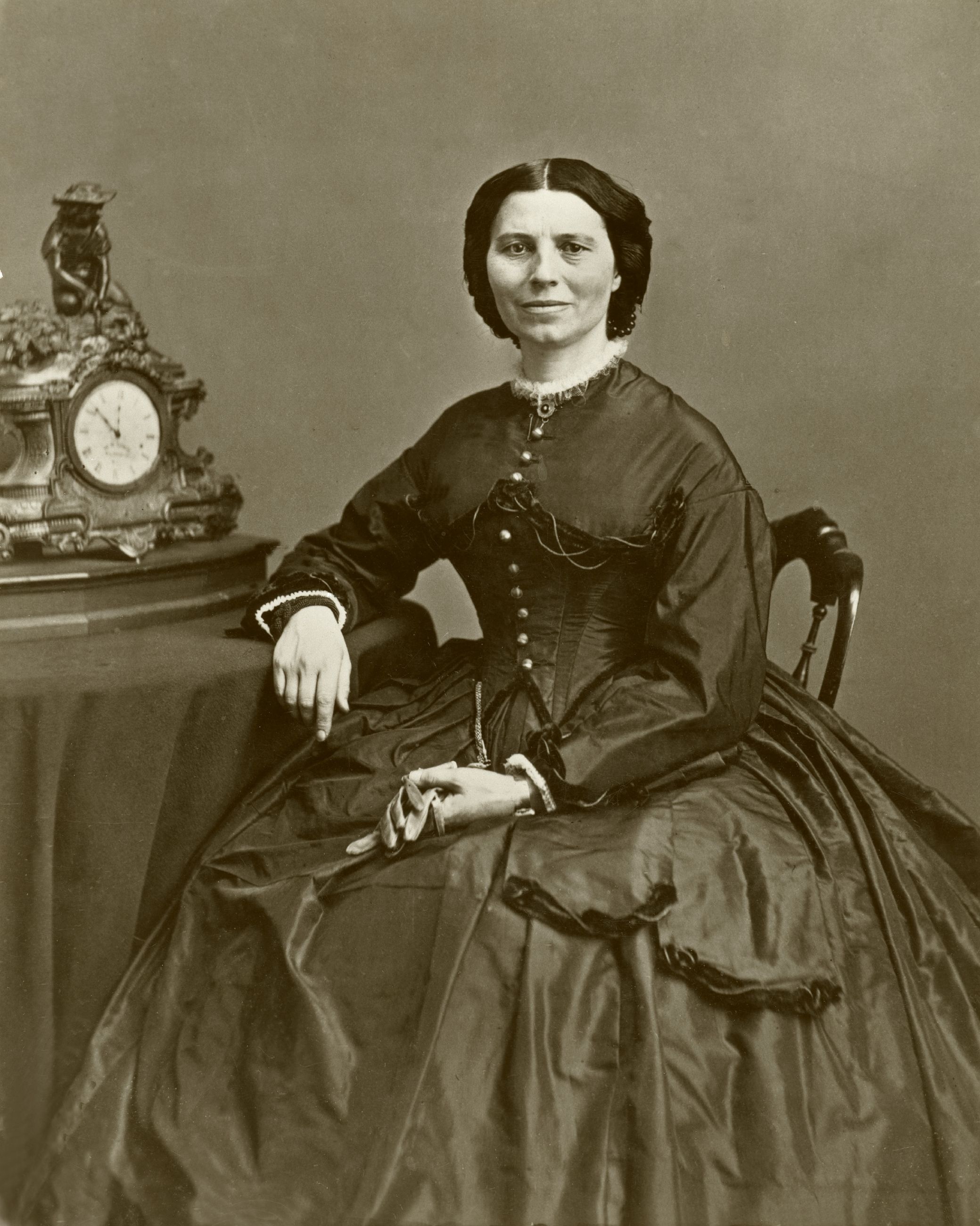
Portrait of Clara Barton, founder of the American Red Cross.
She was bent over, sobbing, frustrated, nearly everything in her family’s apartment destroyed. We sat in an American Red Cross vehicle outside a partially burned apartment complex. It was near the beginning of the school year, and she had recently purchased books, school supplies and clothes for her children. Unfortunately, her neighbor, whom I had helped earlier, had a moment of carelessness. Like most renters I assisted, especially those in lower-income areas, she did not have renter’s insurance. But we were there. One of my favorite moments as a Red Cross volunteer was handing her an aid packet, a lifeline, and seeing her frustration and despair turn to gratitude and resilience. Her family would have a place to stay, would eat, and her children’s clothes and school supplies would be replaced. Her race, gender, legal status, religion, beliefs, class and orientation didn’t matter. She needed help, and the Red Cross provided.
Scenes like this play out an average of three times per day in Northern Ohio, and about 65,000 times per year nationally. Similarly, someone in the U.S. needs blood every two seconds, while U.S. Armed Forces members, veterans and their families receive assistance daily. Our services have never, nor will ever, be contingent on anything other than if someone needs our help.
As March is Red Cross Month, we would like to reiterate that helping everyone has been a core principle since our founding in 1881 and remains central to our Fundamental Values of humanity, impartiality, neutrality, independence, voluntary service, unity and universality. Clara Barton, who faced discrimination as a woman, believed in “perfectly equal rights–human rights,” and instilled those values in the Red Cross from the outset.
For the past 144 years, the Red Cross remained committed to helping those in need, bringing out the best of humanity in times of crisis.
February 25, 2025. Pike County, Kentucky. American Red Cross volunteer, Tony Susi, comforts Tina Roberts after she lost her entire home in Eastern Kentucky after devastating floods hit her community just over a week ago.
Red Crossers are on the ground across Kentucky, assessing damage, working with community partners and local emergency management, and providing hot meals, a safe place to stay and other support to residents impacted by flooding.
Photo by Scott Dalton/American Red Cross
The need for Red Cross services and the commitment to help everyone has never been greater. The climate crisis is having a tremendous impact, as the Red Cross is responding to nearly twice as many large disasters as a decade ago, and they are increasing. Additionally, the climate crisis is taking a heavier toll on frontline communities, including low-income families, older adults, communities of color and people with disabilities.
The Red Cross is responding to these challenges through strengthening partner networks; improving disaster relief capacity; enhancing our engagement with diverse communities, including offering information in Spanish; reaching out to diverse blood donors; continuing our Sickle Cell initiative; and adding health screenings for blood donors at different times throughout the year, currently including screening for Sickle Cell trait and, this month, A1C.
We could use your help. If you can donate blood, give financially or volunteer, your assistance has a tremendous impact. And no matter who you are, please reach out if disaster strikes, as the Red Cross continues its commitment to helping all.
Edited by Glenda Bogar, Red Cross volunteer
Posted by Ryan Lang, Red Cross board member and volunteer
By Gail Wernick, Regional Volunteer Services Officer, American Red Cross of Northern Ohio
As I begin my 15th year with the American Red Cross, I would like to share a message of appreciation to the truly special Red Cross team and volunteers with whom I have had the privilege of working to deliver our mission.
This fall I deployed for the first time in-person to be a part of the Hurricane Helene Disaster Relief Operation in Asheville, North Carolina. On deployment, I joined a team of dedicated Red Crossers to share volunteer opportunities with surrounding communities. Due to intermittent internet availability, the team often connected with new volunteers personally to complete volunteer intake to begin volunteering as soon as possible! The Disaster Event Based and Local Community Volunteer teams supported volunteer scheduling, with more than 200 calls/texts to coordinate and prepare for the volunteers’ engagement. The team created volunteer recognition messaging and unique ways to say THANK YOU! Each day, some more than 12 hours, was filled with new experiences, learning quickly, and adjusting to the evolving needs of the disaster operation. I will always remember my Red Cross deployment experience and the kind people I met, who inspired me and helped make a meaningful difference each day.
Thank you for delivering service in the community to help your neighbors when needed most. Your efforts are greatly appreciated, and we are most grateful for your service as a Red Cross Disaster volunteer.
Featured in the photo above, Red Cross volunteer deployment team members, disaster event based and local community volunteers from Asheville, North Carolina.
Glen McCandless, a disaster event based volunteer, featured on the far right in the photo above, volunteered at the AG Center every day for two weeks consecutively. He said, “Volunteering at the shelter and helping others in the midst of so much devastation is like salve for the soul.”
The Red Cross shelter supervisors we met extended their sincere appreciation for the dedicated disaster volunteers from the local community who tirelessly volunteered, many whose own lives and homes have been impacted by the disaster, to prepare and serve meals and offer support. Whether a volunteer gave two hours or several days of their time to help, we are grateful to them for helping deliver the Red Cross mission!
More than 1,400 Disaster Event Based Volunteers joined the Red Cross in North & South Carolina this October and November, engaging in more than 640 volunteer commitments to provide comfort, care and hope by assembling and distributing emergency supplies, preparing and serving meals, setting up and cleaning up and supporting residents impacted by Hurricane Helene.
The Red Cross is here to help make your volunteer experience the best it can be! Please continue to volunteer with us and encourage your friends and family to join you. Thank you for exploring and sharing our most-needed ongoing volunteer opportunities at www.redcross.org/volunteer. We are working hard to prepare for, respond to and help communities recover from disaster. Become a part of the Red Cross Disaster Action Team at www.redcross.org/dat.
By Mary Falconer-Williams, American Red Cross volunteer
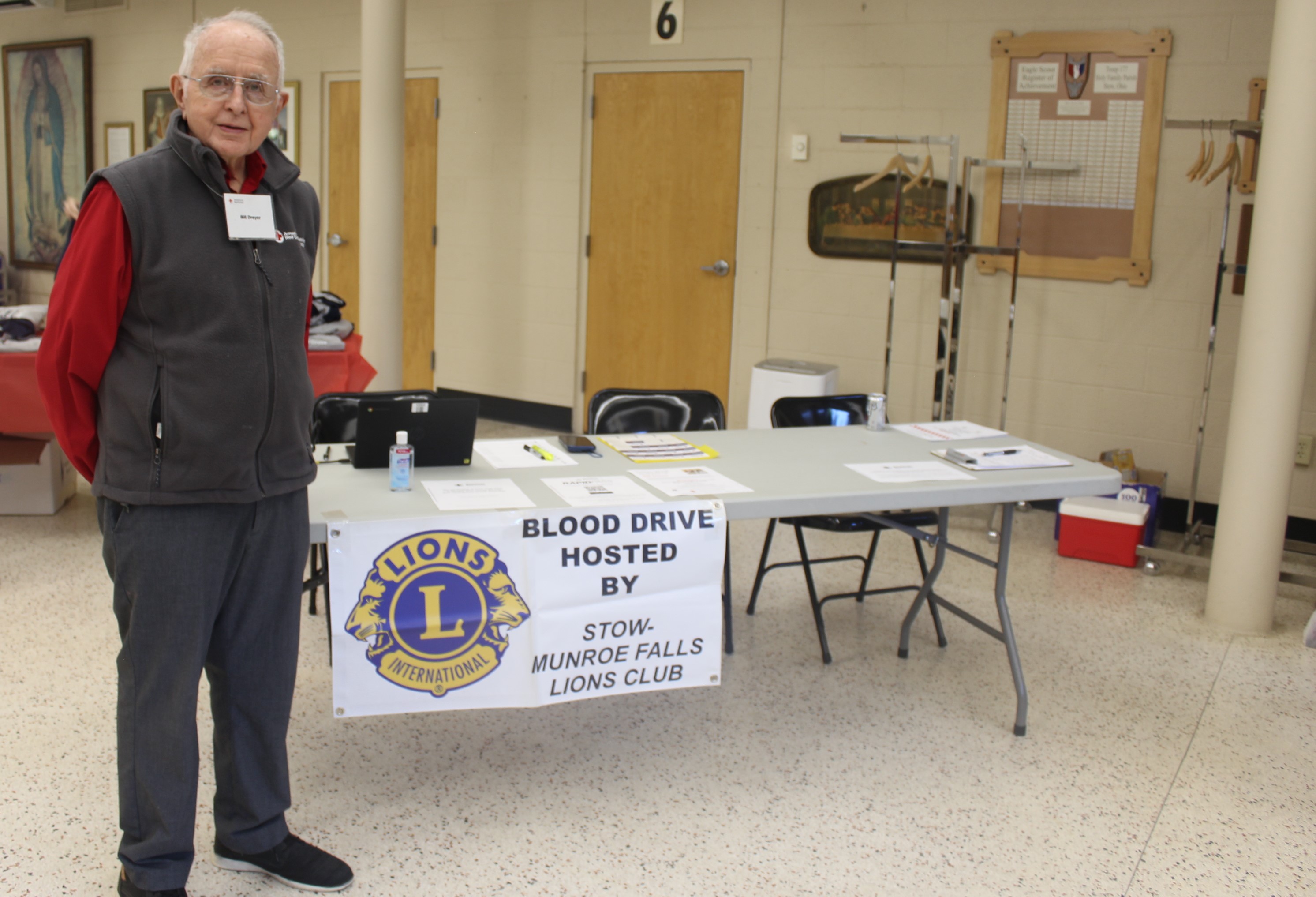
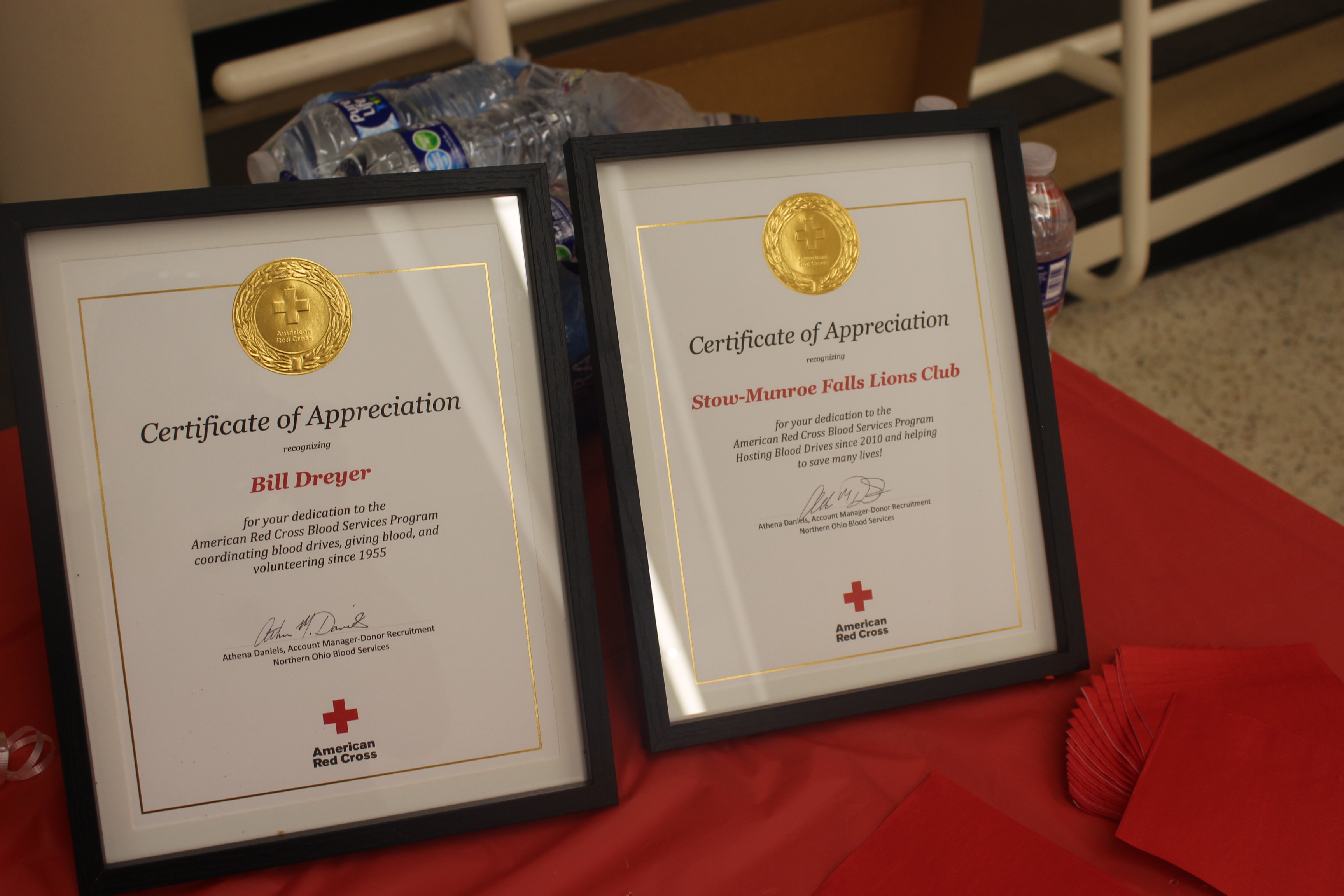
Volunteer Bill Dreyer first spotted the poster announcing that the American Red Cross would be hosting a blood drive on the Kent State University campus in 1955. Bill attended the drive, donated a pint, and from that point on was a firm believer in the power of donating blood, and gave every chance he could.
Bill Dreyer, Red Cross volunteer
“I know that my donations mean so much to those individuals who are fighting an illness or have been in an accident,” Bill states. Individuals like his mother, who received several pints in 1999.
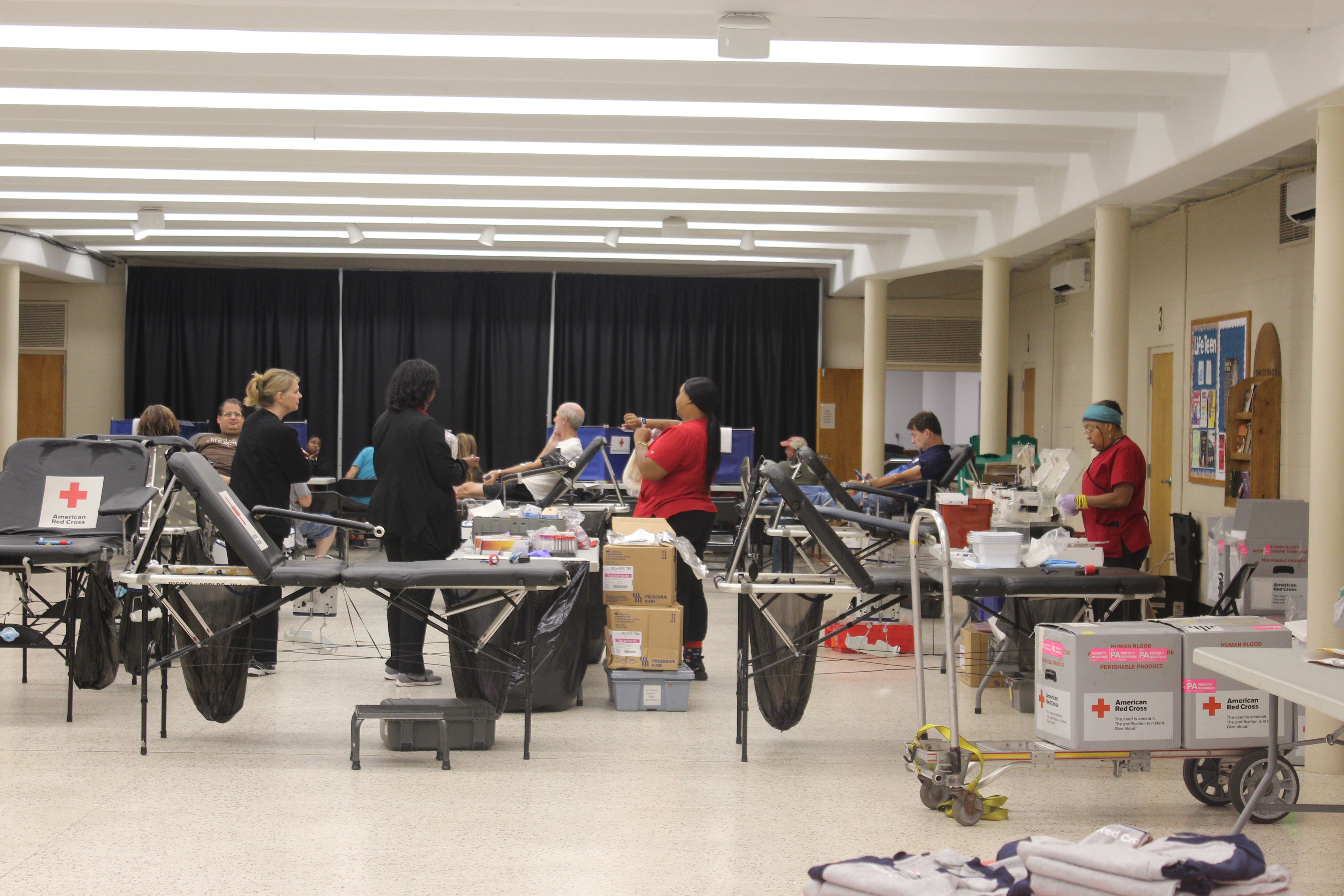
A humanitarian at heart, Bill joined the Stow-Munroe Falls Lions Club in the fall of 2000 and shortly afterward began volunteering with the Red Cross helping in the refreshment area (canteen), at registration, and as a bag labeler. And in 2010 his passions combined when the Lions Club and Holy Family Catholic Church in Stow hosted a blood drive. And Bill has been instrumental in growing the impact of that first drive. The co-sponsored event has hosted drives six times a year, ever since!
65 pints of lifesaving blood were collected at the drive held on September 3, 2024.
Though he is now unable to donate blood due to medical reasons, Bill proudly notes that he has donated 278 pints of blood throughout his life.
“It’s really not hard, and the staff are gentle. Come in and see us, we’ll show you around,” Bill invites those individuals who haven’t ever donated or haven’t in a while. To find a drive near you, go to redcrossblood.org and tap “find a drive.”
Posted by Ryan Lang, Red Cross board member and volunteer









 NOHredcross