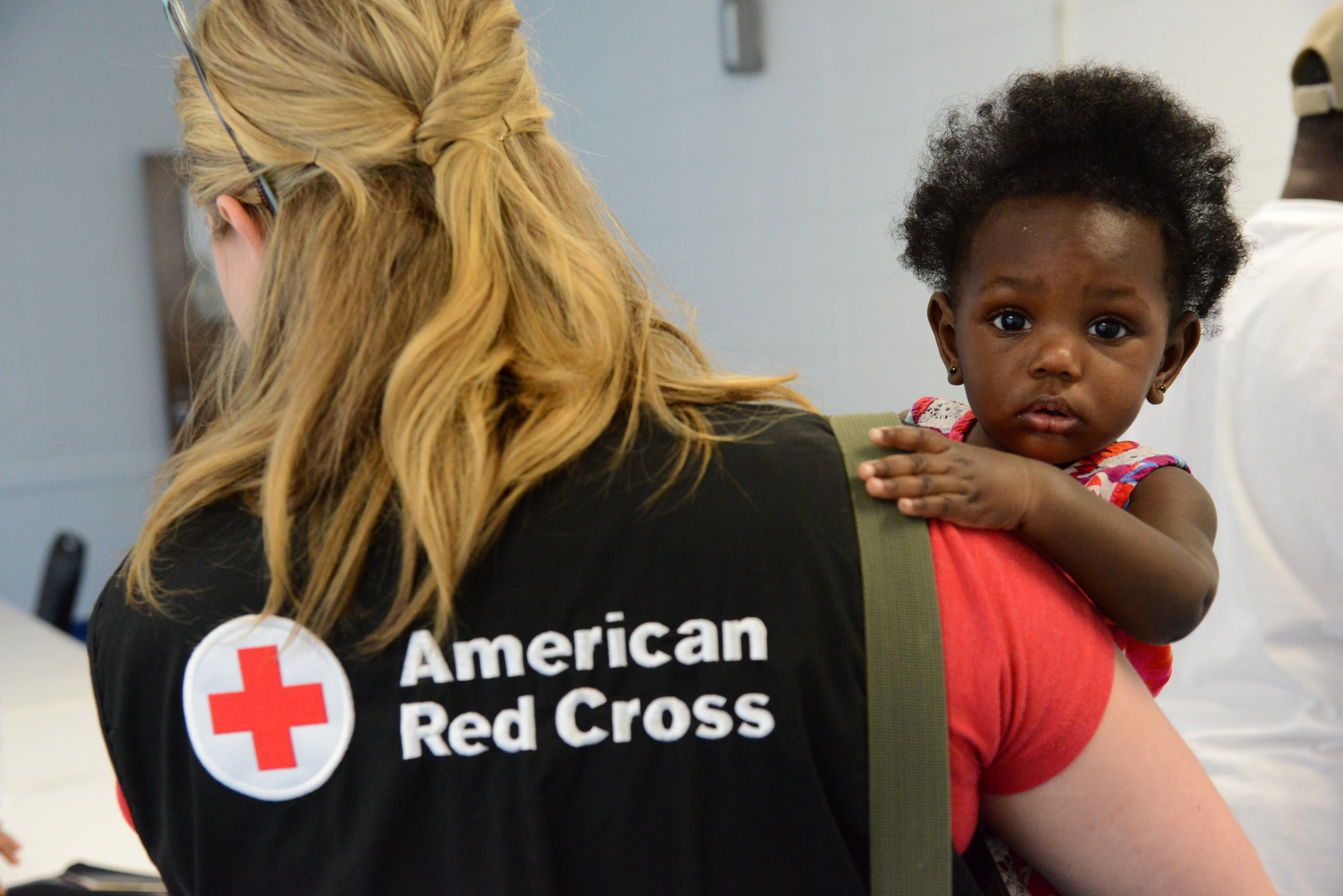
Full Circle: A Hurricane survivor joins the Red Cross mission to help others 

By: Kathryn Dean, American Red Cross volunteer 

In 1996, two hurricanes made landfall in North Carolina: Hurricane Bertha, a category 2 storm, followed 8 weeks later by Hurricane Fran, a category 3 storm.  The combined damages produced by these storms in North Carolina totaled over 2.5 billion dollars and caused the evacuations of over a million people.  
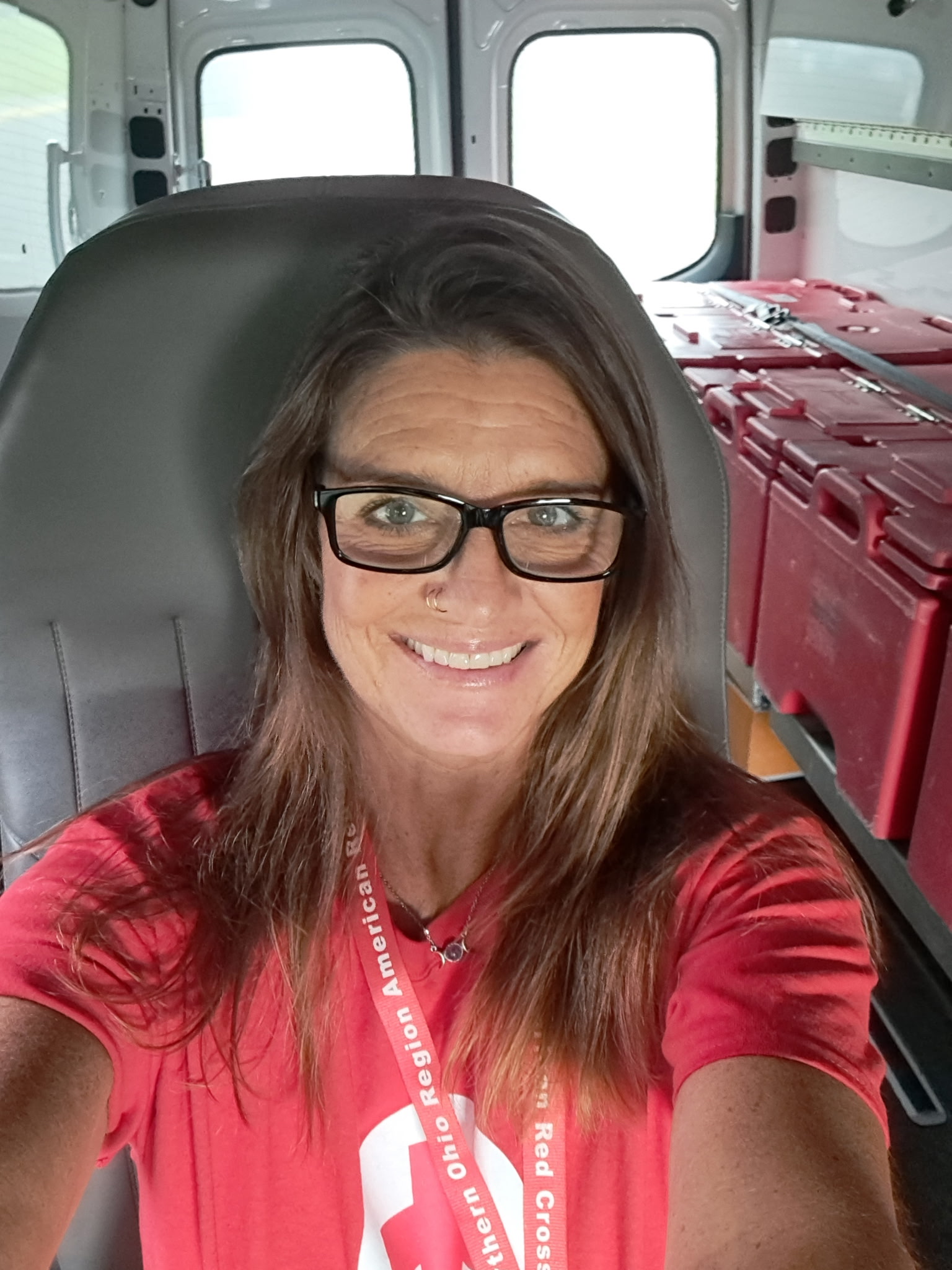
Natalie Whitmer, American Red Cross volunteer

Natalie Whitmer, an American Red Cross volunteer based out of Canton, Ohio, was one of those evacuees.  She was living in North Carolina at the time and experienced firsthand being displaced to an evacuation shelter run by the Red Cross.   

Following the storms, she and her husband returned home to assess the damage. “We found that the front half of our mobile home was destroyed.  That’s where my daughter’s bedroom was, so a lot of their clothing and their bedding and all of that stuff was lost.”  Natalie explained. 

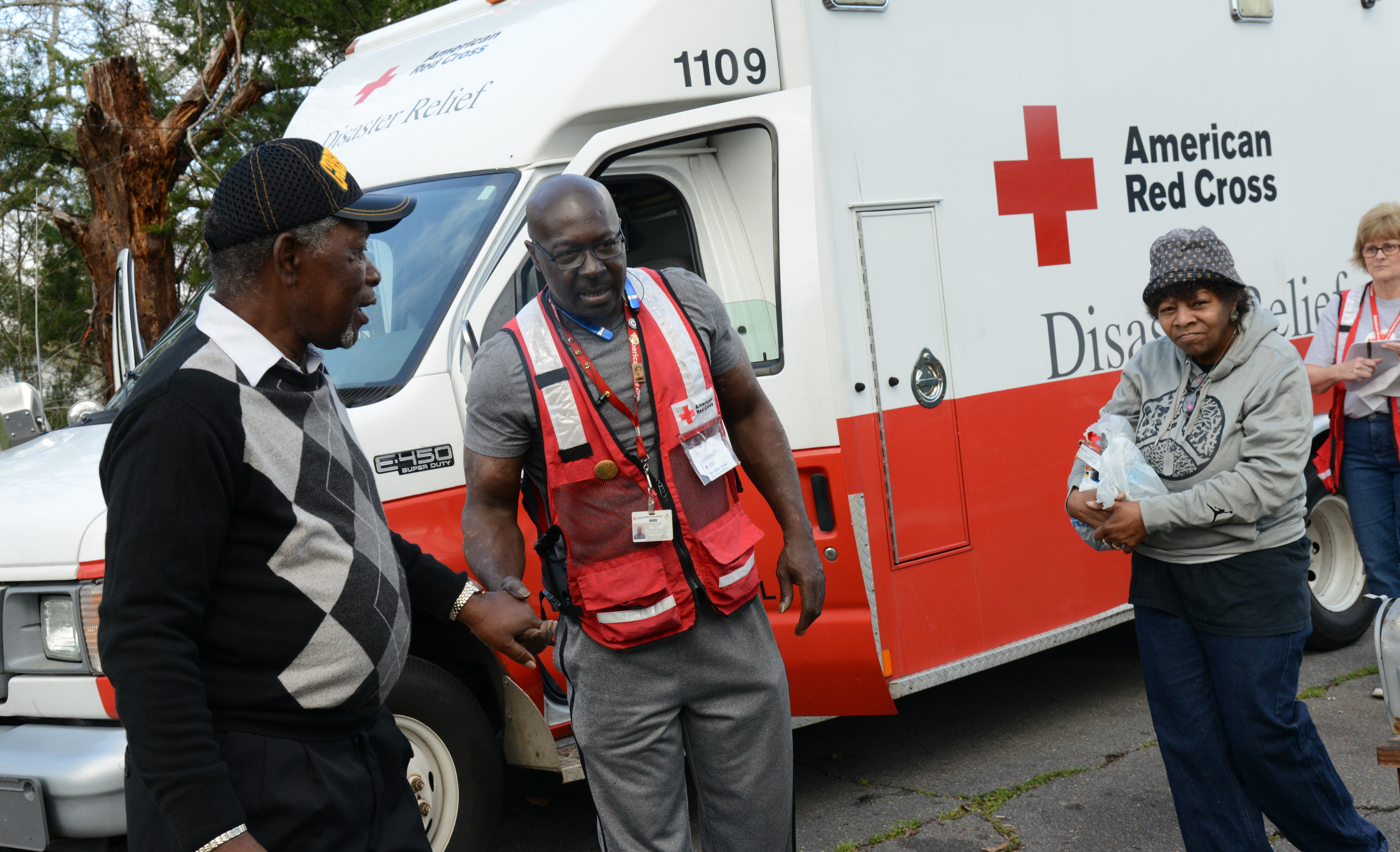
The Red Cross had also deployed ERV vehicles, or Emergency Response Vehicles, which drove through their neighborhood and provided food and water after the storm. 

 “They had set up an office, and they just asked the address, where we lived, what happened, what I’m missing, what I need help with, and they gave me a voucher to be able to go and get diapers and clothing for my children, which was amazing…I think it was like six weeks we were without water and electricity.”  

Her story came full circle when in 2024, now Red Cross volunteer, she was deployed to another pair of hurricanes, Helene & Milton, that hit within a 2-week timespan.  There she manned a Red Cross ERV and supervised an evacuation shelter.  Regarding that time, she reflected, “It’s amazing that I’m (now) on this end of it (and) able to do the same.” 

Since joining the Red Cross in 2023, Natalie has deployed multiple times to a variety of disasters, assisting in sheltering, feeding, and other vital roles.  She also now works as a Casework Supervisor Coordinator for the Northeast Ohio Chapter. 

“It’s extremely fulfilling and it’s just so comforting knowing that we have an organization out here that has all of this to offer,” she said.  “I never knew Red Cross had so much until I started working with them, and it just blows my mind. It’s just an absolutely beautiful organization, their mission and everything, and the people that run it, all the volunteers.” 

This holiday season, consider giving back to others by donating your time as a volunteer.  Click HERE to find out more about becoming a Red Cross Volunteer and all of the opportunities available at the Northern Ohio Chapter. 

Canada wildfires: One Northern Ohio Red Cross volunteer’s deployment story

By Ryan Lang, American Red Cross

As part of the global Red Cross and Red Crescent movement, national societies often support disaster response in neighboring countries. The American and Canadian Red Cross have a long history of this kind of collaboration, including sending volunteers to support sheltering and other disaster response work.

This summer, the American Red Cross deployed more than 115 trained disaster volunteers to help the Canadian Red Cross’s effort amidst the worst wildfire season in the country in the past 30 years.

Northern Ohio volunteer Paul Hiszem (second from right) with other Red Cross and Canadian Red Cross volunteers providing relief during the Manitoba wildfires, July 2025.

One of those volunteers is Paul Hiszem, from the Northern Ohio Region. Paul’s been a Red Cross volunteer for about five years and has been on nearly a dozen deployments. This one, however, was slightly different.

“We were expecting about 4,000 residents, but we only got about 400,” Paul said of the shelter he was working at in Winnipeg. “Residents of the affected communities were being evacuated by plane.”

Residents from outside Manitoba may not have had damage to their home, but were in mandatory evacuation zones, so they hopped on small planes and were taken to Winnipeg, where Paul and other Canadian Red Cross and American Red Cross volunteers and shelter workers were waiting for them.

“A vast majority of the people we were working with were indigenous,” Paul said. “Some of them didn’t speak English. Emotionally, that was a big challenge because they’d been away from home for so long. We interacted some, trying to keep them apprised of different schedules and things, but it was different, a different setup than a lot of the shelters I’ve worked before.”

With more than 100 volunteers joining the massive relief operation, it marked the largest support effort on behalf of the American Red Cross in Canada. Prior to this summer, in 2016, the American Red Cross supported relief efforts when an Alberta wildfire forced more than 88,000 residents of Fort McMurray and surrounding areas to leave their homes in search of safety.

Canadian Red Cross volunteers are no strangers to supporting disaster relief efforts in the U.S., either. In recent years, 56 Canadian Red Cross volunteers have deployed to disasters across the United States. The American and Canadian Red Cross are two of the 191 Red Cross and Red Crescent Societies that make up the International Federation of Red Cross and Red Crescent Societies (IFRC), the world’s largest humanitarian network. Often referred to as National Societies, their roles differ country by country, but they are all united by our Fundamental Principles and all strive for the good of humanity.

And that’s what Paul is doing as a volunteer – striving for the good of humanity and working to prevent and alleviate human suffering in emergencies. Hear more of Paul’s story on the latest episode of our Be a Hero podcast here. And click here to sign up to be a disaster volunteer.  

Military Appreciation: Air Force Veteran’s first Red Cross deployment

By Ryan Lang, American Red Cross

For Nasir Ahmad, deployment was nothing new. As a retired member of the United States Air Force, Nasir had been on multiple deployments. But his most recent trip overseas with the American Red Cross Service to the Armed Forces was new territory. Previously, Nasir was carrying out his mission as a service member. This time, he’d be providing a service to other service members along with his Red Cross team.    

Nasir Ahmad, Service to the Armed Forces

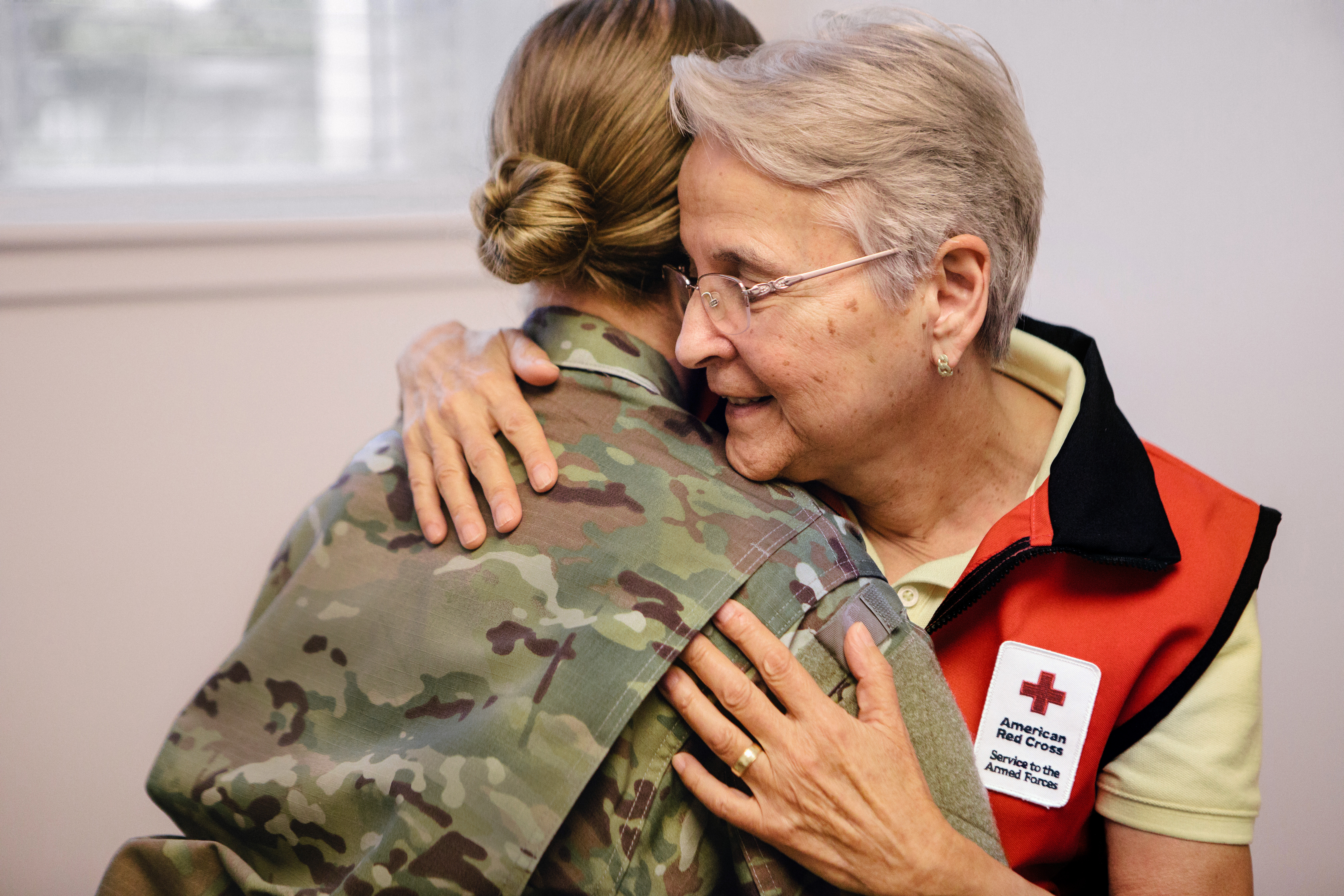
The Service to the Armed Forces (SAF) branch of the Red Cross focuses on active service members, veterans, and their families, providing various humanitarian services and resources. Nasir explains that his primary focus is on emergency communication, which looks different in Northern Ohio compared to in Iraq, where Nasir was recently deployed for six months.

“You become directly involved in the process (of emergency communication) when you’re overseas,” Nasir said. At home, in the Northern Ohio Region, most of the work Nasir and the SAF team does is over the phone, whereas in Iraq, it’s often face to face. “It’s just different when your overseas and the service member has a conversation with you,” Nasir explained.  He spoke of one example where a female service member was having a personal emergency, on the base, at 9 o’clock one night. As he and the rest of the team were settling down for the evening, there was someone who needed direct care. That is the work of SAF in action.

“When I was in the Air Force,” Nasir, who was an aircraft mechanic, said, “we had that mission, that focus, and when you go with your squadron, there’s nothing else. Now, with the Red Cross, I get to focus on the service member and assisting them and being there for them, and I’m really enjoying this mission.”

When asked whether his experience in the Air Force prepared him for deployment with the Red Cross, Nasir said it did because of his shared connection with the service members he is there to help. “But don’t feel like you have to be a service member of former service member to do this,” Nasir said. “It’s really a beautiful thing to not have that connection and still be willing to go over there and assist and be there and support our service members.”

There are all types of SAF volunteers. Many who have prior military backgrounds, others who have family members who have served, but also there are those who have no background or personal connection to the military. “I’ve seen some volunteers who deploy with no connection,” Nasir said. “That’s why I commend them so highly because at least I had my buddies with me.”

But in preparing for a deployment with the Red Cross SAF team, Nasir explains that is when relationships are built and friendships are formed, often life-long friendships. “We form our own team,” Nasir said, “and it reminded me of going with my unit.”

The team Nasir deployed with, “Team 55,” had only met online prior to their case work and other Red Cross training at Camp Atterbury, in Edinburgh, Indiana. “In the same room it was different,” Nasir said. “We had Red Crossers who had deployed before… and they were absolutely essential.” Even with his previous military experience, specifically deploying overseas, Nasir said he approached his training as a first timer. “They were so valuable to my experience. It being my first time overseas with the Red Cross… I leaned on the Red Crossers who had done this before. Those were the ones who were leading the way.”     

To hear more of Nasir’s story, click here to listen to our Be A Hero podcast. To find out more about volunteer opportunities with the Red Cross Service to the Armed Forces, click here.

Non-stop disasters – non-stop responses

Regional Red Cross executive reflects on most recent deployment

By Todd James, Executive Director, American Red Cross of North Central Ohio

Todd James in Iowa, June, 2024

I recently returned from a disaster relief operation in southwest Iowa, an area devastated by massive flooding in June. You’re probably trying to remember if you had heard about flooding in Iowa. You probably did, it was big news for a few days. But as is always the case, something else happened and the news moved on to cover the story of the day. Well, the cameras and reporters may have moved on, but for the people of Siouxland, as they call the region, moving on will be a long, hard process. I am so proud of the American Red Cross responders who left their own homes, jobs and families to rush into the devastation to offer shelter, comfort and hope, and I am honored that I had the opportunity to serve with them.

A month after the flood waters receded, with the help of the Red Cross, the community was able to focus on long-term recovery. What does that look like? It’s different for every family but all will need the help of many partners, non-profits, governmental agencies and the business community, working together. Our Red Cross long-term recovery team will continue to collaborate with these partners, helping and guiding them on how to come together to best serve those on the road to recovery.

The Red Cross is responding to nearly twice as many large disasters as we did a decade ago to help families and communities struggling with more frequent and intense disasters. In 2023 alone, the U.S. experienced an all-time high of 28 billion-dollar plus disasters that ravaged communities and forced hundreds of thousands of people to flee from severe storms, floods and wildfires.

This was my 41st disaster deployment and I have seen first-hand how disasters are happening more frequently and causing more damage. There is no more down time between big disasters, time when our responders can catch their breath, come home and focus on the great work the Red Cross is doing in their community. Now we are constantly responding to these large-scale disasters, as well as the thousands of home fires, storms and other disasters that happen every day but don’t make the headlines.

To equitably meet the growing and unique needs of disaster-affected families and communities, the Red Cross is enhancing our large-scale disaster response and recovery services, expanding financial assistance, strengthening local partner networks, and growing our disaster workforce. This effort includes fortifying the critical infrastructure and technology that enables 24/7 response to disasters across the country.

The need to help during disasters has never been greater. Please, join us to provide
relief and hope when it matters most. Help people affected by disasters big and small,
including climate-driven crises, by making a gift to Red Cross Disaster Relief at
redcross.org or by calling 1-800-RED CROSS (800-733-2767). Our volunteers are at the heart of our mission and represent 90% of our workforce. Click here to sign up for opportunities to help. To help make sure your family and community are ready for a disaster before it happens, click here.

Posted by Ryan Lang, Red Cross board member and volunteer

Pre-deployment training complete: Nasir is underway

By Mike Parks, Regional CEO, American Red Cross of Northern Ohio

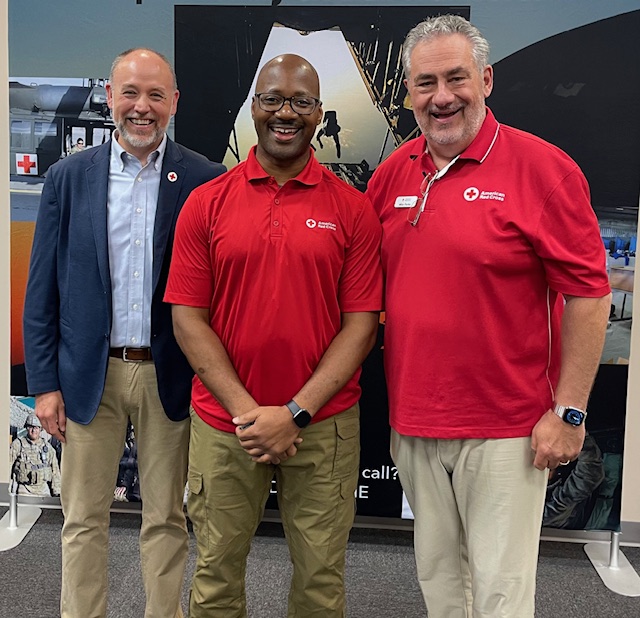
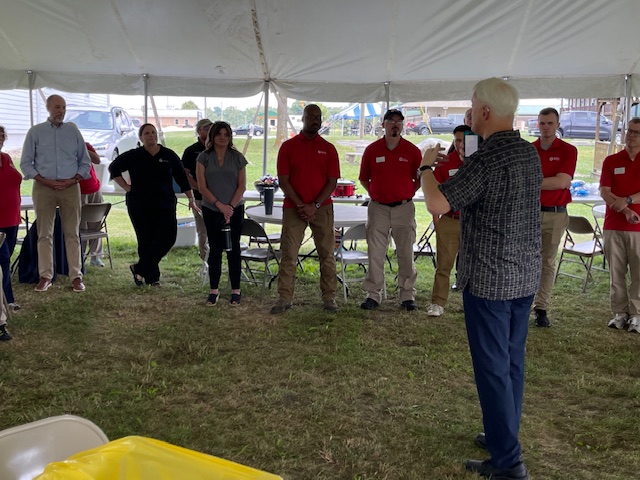
Last Thursday, on the 25th of July, I travelled to Camp Atterbury in Indiana, to participate in the sendoff for Team 55.  Team 55 is a group of 21 Red Crossers from around the United States who are deploying to military bases around the globe to help support United States service members who are stationed overseas. 

Trevor Riggen, Nasir Ahmad, and Mike Parks

Our own Nasir Ahmad, Northern Ohio’s first Service to Armed Forces Mobile Specialist, is a member of Team 55.   The sendoff was the end of a pre-deployment training period that helped prepare the team members for their assignments.  Both Trevor Riggen, President of Humanitarian Services, and Michael Jordan, Vice President of SAF/International Services US Field Operations, travelled to Indiana to address the team—thanking them for their sacrifice and willingness to support our deployed service members.  They each shared personal stories of their time in the Peace Corps (Trevor) and deployments as a U.S. Marine (Michael) and the vital role the Red Cross played in their lives. 

Michael Jordan addresses deploying SAF Specialists

I had the privilege of joining Nasir and his teammates at a barbeque lunch that was supported by volunteers from the Indiana Region.  It was great to spend some quality time with Nasir prior to his departure.  I was also able to personally express the well- wishes of his Northern Ohio colleagues, many of whom were gathered in Cleveland for an all-staff meeting at the same time as the sendoff. 

Deploying SAF Specialists

My personal highlight of the trip to Camp Atterbury was to see how prepared Nasir is for his deployment and how appreciative he is for the support of his colleagues in Northern Ohio.  As Nasir heads to Baghdad, Iraq to support our service members, I’m confident he’ll bring them the same degree of joy and comfort he’s been able to bring all of us over the past year.  He’ll be in our thoughts and prayers as we look forward to his return in six months!

Nasir Ahmad at Camp Arifjan, Kuwait, July 28, 2024

Editor’s note: Early Monday morning, July 29 th , Nasir emailed this photo and quote: “I’m at Camp Arifjan, Kuwait.  Our fellow Red Crossers here are great and the volunteers are extraordinarily committed.  But I’ll be leaving here soon and arriving at my deployment site so, hopefully, my next email to you will be from Baghdad, Iraq.”

Previous article: https://nohredcross.org/2024/07/12/regional-specialist-bagdad-bound/

Posted by Ryan Lang, Red Cross board member and volunteer

Helping those in need after a disaster is challenging but rewarding

By Mike Arthur, Regional Mass Care & Logistics Manager, American Red Cross of Northern Ohio

I’m grateful to live in northern Ohio, one of the safest areas of the country from a weather-related disaster standpoint. We don’t have to worry about a hurricane coming and wiping our homes away. We are unlikely to walk out our front doors and have trouble breathing due to smoke from a nearby wildfire.

I have never worried about the fate of my family and myself, where we would live and work after a disaster destroyed my home and place of work. I have never had to make a decision about which of my hard-earned belongings I need to take with me when I evacuate. I have never had my community devastated. Every year thousands of families have their lives changed drastically when their homes and communities are affected by disasters large and small.

Mike Arthur, during the Red Cross response to hurricane Harvey in Houston, Texas in 2017
 

I’m also grateful that I get the opportunity to help people in need. As a Regional Mass Care & Logistics Manager, I get to put the skills and talents learned over the course of my life to good use leading and supporting the American Red Cross workforce in meeting the needs of our clients locally and nationally.

I get to deploy for a few weeks each year making an immediate difference in someone’s life. Deployments to large disasters are tough but incredibly rewarding. The hours can be long. The food is not always five star. I sometimes sleep on a cot in a staff shelter with my fellow workers. It can be stressful. Compassion fatigue is a risk.

Residents wait to receive clean up supplies from the Red Cross after hurricane Harvey in 2017.

I look forward to each deployment and go as often as I can. I feel like I make a difference. I have made incredible friends across the country. I have great stories to tell. I get to bring hope to those in need. I help provide a safe place to sleep and food in bellies, and sometimes, most importantly I can provide a warm hug, bright smile and a sympathetic ear. My life is fuller because of my deployment experiences. I hope you will take to opportunity to join me out in the field this year and experience the magic of helping.

Help those in need when they need it most by becoming a volunteer with the Red Cross. To find a volunteer opportunity that’s right for you, visit redcross.org/volunteer.

Edited by Glenda Bogar, Red Cross volunteer

Honoring our commitment during Military Appreciation Month

By Doug Bardwell, Red Cross volunteer

June 20, 2018. Washington, DC. Development SAF Stock Photography Project 2018. Photo by Roy Cox/American Red Cross

In 1776, our founders signed the Declaration of Independence, but without a military to back up our claims, the British Crown could have quickly regained control of our country. Fast forward to 2022, and one needs to look no further than Ukraine to see why our country needs a well- trained, well-equipped, always-prepared military.

Our military guarantees our entire way of life, so we need to do all we can to be there for our fighting men and women, along with their families. That was the original aim of the Red Cross founder, Clara Barton when she began caring for the wounded during the Civil War.

Service to the Armed Forces (SAF)

Since 1881, the American Red Cross has deployed alongside our military in every U.S. conflict since the Spanish-American War. The Red Cross also provides in-person support on more than 100 military installations and deployment sites worldwide, leveraging the services of 14,700 SAF volunteers around the globe.

“Members of the military, veterans, and their family members all make sacrifices,” said Jessica Tischler, Regional Program Director, Service to the Armed Forces and International Services.  “From emotional wellness workshops to emergency communications, our staff of volunteers works hard to help provide valuable service to the armed forces.

Red Cross services for our military and their families include:

Before deployment:

 “Get to know us before you need us” sessions inform the military family about the variety of Red Cross services available to them.

During deployment:

 Delivering verified emergency messages to active-duty personnel worldwide
 Facilitating financial assistance and resources through Military Aid Societies
 Military hospital services – providing comfort and help with therapy
 Coping strategies for families at home
 Mind-body stress reduction workshops

After deployment:

 Assistance at local VA hospitals and facilities
 Hero Care Resource Directory
 Information and referral services to community programs
 Military and Veteran Caregiver Network
 Reconnection workshops
 Assistance with veteran’s assistance appeals

Since 9/11, Red Cross and its volunteers have served more than 1 million military families, providing 24/7 emergency care and communications. Would you like to support military and veteran families in your community? Don’t take your freedoms for granted. Sign up to become a Red Cross volunteer or donate on our Support Military Families webpage.

Edited by Glenda Bogar, Red Cross volunteer

A Report on the Flooding in Louisiana

By: Pam Williams, volunteer


Since the flooding in the south began three weeks ago, nearly 2,000 Red Crossers working alongside partners have provided 4,700 overnight stays in 60 shelters; served 290,000 meals and snacks; distributed more than 119,000 relief items including comfort kits and cleaning supplies; and provided nearly 9,000 health and mental health consultation.

I deployed to Louisiana as part of the External Relations team. As a Government Operations Lead, I helped coordinate necessary services and activities with local, state, federal and Tribal government partners and worked with our Community Partner Services volunteers who identify non-government partners, private agencies and/or organizations and members of the affected communities to assist those affected by the disaster.

This was my 22nd deployment and several of them have been in response to floods. My friends think I’m off to see the country, and I suppose they’re right, but I’m seeing it in pain. However, while each disaster and each response is different I have found one constant – I am seeing people at their best. Whether it is Red Cross volunteers who leave their lives and families to respond, community groups who step up to help their neighbors or those affected by the disaster who are amazingly resilient there is a spirit that moves people forward.

Since returning to Northeast Ohio, here are some of the things I have learned about the response in Louisiana:

  • This is the largest sheltering operation for the Red Cross in Louisiana since Hurricane Gustav and Ike in 2008, and Hurricane Isaac in 2012.
  • As many as 12,000 people have been impacted by the flooding across the state with hundreds of residences either destroyed or receiving major damage.
  • The Red Cross estimates that we will spend between $8.5 million and $11.5 million helping people affected by spring floods and storms across Texas, Mississippi, Louisiana and Tennessee – and we haven’t raised anywhere near the millions of dollars we’re spending to provide the relief needed.
  • Since the flooding began, the Red Cross and our partners have provided more than 3,000 overnight stays in 30 shelters; served 216,000 meals and snacks; distributed 53,000 relief items including comfort kits and cleaning supplies; and provided 3,800 health and mental health consultations in Louisiana alone. Over three weeks into this response operation we are still sheltering affected residents and pockets of previously unidentified people are popping up everyday. There are over 430 areas that continue to be marked as inaccessible so our Disaster Assessment teams can’t yet get in to see how badly the homes have been affected.

The Red Cross has also deployed hundreds of volunteers (like me) to staff these disasters–and we are appealing for additional Red Cross volunteers now. The time and talent of every volunteer makes a real difference in people’s lives. Go to redcross.org/volunteer today to learn more about volunteer opportunities and how to submit a volunteer application.

Louisiana Floods 2016

Sunday March 13, 2016. Rayville, Louisiana. Bobby Ray Griffin and Mildred Means took on more than a foot of water in their Rayville, Louisiana, home. They had already spent much of the day removing flood-damaged furniture from their home when Red Cross volunteers came through their neighborhood with snacks and water. Photo by Daniel Cima/American Red Cross

Louisiana Floods 2016

March 14, 2016. Monroe, Louisiana. At 9-months-old, Jakenzie Bradford is one of the youngest staying at this Monroe, Louisiana, Red Cross shelter. She and her family where displaced when floodwaters entered their home nearly a week ago. The Red Cross provides a safe place where children and families can feel comfortable and secure as they begin the road to recovery after disasters like floods. Photo by Daniel Cima/American Red Cross