By Ryan Lang, American Red Cross board member and volunteer
As a lifelong pet owner and pet lover, I hope I’m never in a situation where I’d need to perform CPR on my dog. And while I hope it never comes to that, I can find comfort in the fact that if it does, the American Red Cross has a free app that can show me exactly what I need to do.
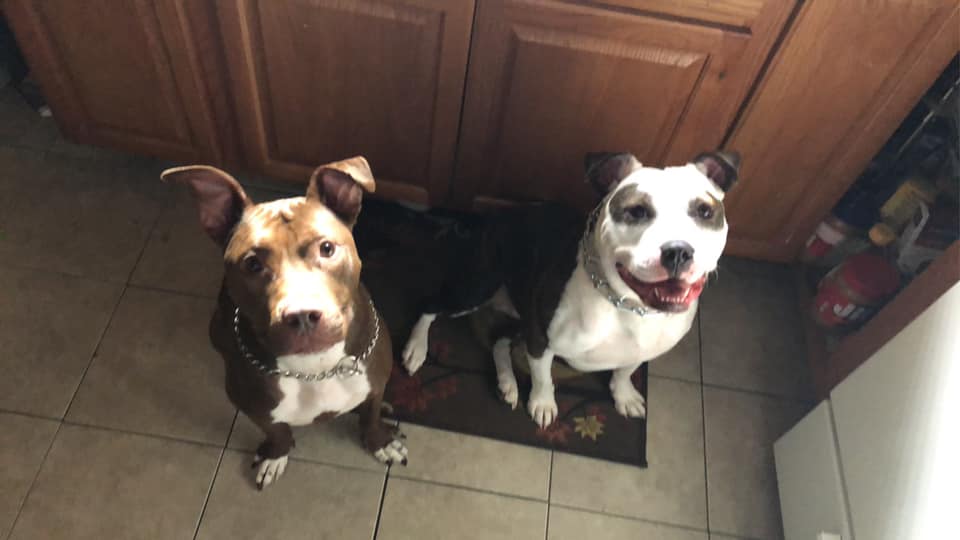
Amos and Dublin
From recognizing warning signs to the ABCs of pet CPR (airway, breathing, circulation), the Pet First Aid app has you covered. With lifesaving instructions on allergic reactions, bleeding, car accidents, poisoning and more, the app helps you prepare for virtually every scenario you can imagine. It also gives guidance on how to include your pet in your emergency preparedness plans. And after you’ve brushed up on your emergency pet response, put your knowledge to the test with a quiz.
In addition to emergency response information, the Red Cross provides wellness tips for your pet. It offers information on what supplies to have in your home and on hand for your cat or dog. You can upload not only your vet’s information, but also your pet’s information for easy access in case of an emergency.
So in the spirit of National Dog Day that just passed and National Cat Day that’s coming up in October, take a moment and download the free Pet First Aid app. You can find it by going to redcross.org/apps or by searching for ‘American Red Cross’ in app stores. Who knows, you could save your furry friend’s life!
Edited by Glenda Bogar, American Red Cross volunteer
Posted by Ryan Lang, American Red Cross board member and volunteer
By Ryan Lang, American Red Cross board member and volunteer
More than 20 years ago, if you’d asked Ashley Hopkins about donating blood, you may have gotten a cringe coupled with a shake of the head. While she’d grown up around blood donors and blood drives (her father was a firefighter, now fire captain), donating herself was never really an option.
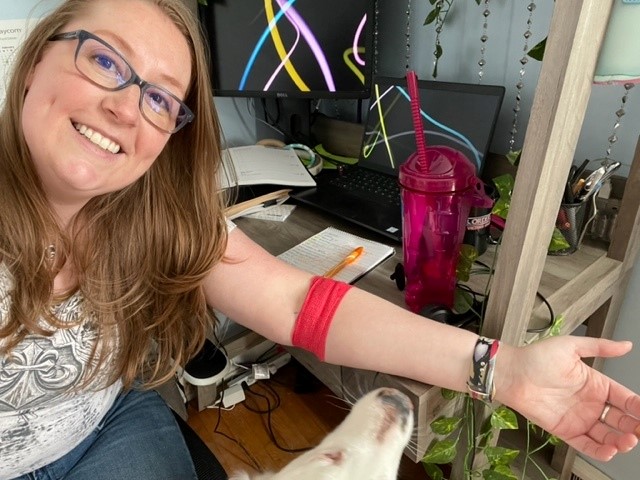
Ashley Hopkins, American Red Cross board member, volunteer and blood donor
“Back then I had a crazy fear of not even needles, but needles taking blood out — it just freaked me out so I never did it,” Ashley said.
So how did someone with a healthy fear of the blood donation process wind up a volunteer for the American Red Cross Blood Services and a regular donor?
“I went to volunteermatch.org and put in my zip code, and (blood services) came up as a flexible option with weekend availability.” So despite Ashley’s apprehensions, it was a perfect match, and as she’d soon find out, even more perfect than she’d initially thought.
Ashley started out working weekend blood drives. “I did a background check and then shadowed someone for a couple of blood drives and then I was on my own,” she said, noting that back in 2012 things were “a little bit different.”
At one of those blood drives at the Canfield fair (Ashley’s favorite blood drive), she was working a few days in a row with one specific blood rep who asked her why she’d never donated before.
“I don’t know, it just seemed kinda scary,” Ashley replied. But that same day she decided to roll up her sleeve and donate — on the bus at the fair, which Ashley highly recommends. “It is heaven,” she advocated.
When you donate blood, the Red Cross tests your blood. And that’s when Ashley found out how special hers was. “I did not know that they were testing for a specific allele (genetic information present in your DNA) in your blood that is an antibody.” After donating Ashley got an email saying that her blood was CMV negative, which is quite rare.
Red Cross board member and volunteer Lou Joseph with Ashley Hopkins
From RedCross.org: CMV is generally harmless to adults but can be fatal to babies. For this reason, babies needing transfusions as part of their medical care should only receive blood from donors who have not been exposed to CMV (CMV negative).
And being O-Positive, Ashley’s blood is even more special, as she’s compatible with roughly 80 percent of people who need blood! Even more of a reason for her to donate regularly — every 56 days, if she can.
When asked what she’d say to someone who is apprehensive about donating for the first time, especially someone who is nervous or scared, Ashley simply said, “Volunteer at a blood drive!” She said seeing it happen and helping with the process helped her overcome her fear of not just needles, but the whole process.
To find a blood drive near you, CLICK HERE. To learn about volunteer opportunities with the Red Cross, CLICK HERE.
Edited by Glenda Bogar, American Red Cross volunteer
Never underestimate the power of volunteers. The American Red Cross certainly doesn’t: Harnessing the willingness of volunteers and the generosity of supporters is what we’re all about.
Carol Schemmer
In Ottawa County, Club Red is a million-dollar example of that willingness and generosity. Club Red members focus on four “pillars” of service to the Red Cross: fundraising, support of the military, blood drives and education.
Carol Schemmer serves as the group’s commander, the same rank she held as a U.S. Navy nurse – although she hastens to say she doesn’t “command,” she just coordinates.
With a core of a couple of dozen women, she can call on as many as 60 “ad hoc” participants for specific events: staging fundraisers, packing “boxes from home” for service men and women at Christmas, manning blood drives, teaching citizen CPR and making homes safer with free smoke alarms.
“The Red Cross addresses so many needs,” Carol said. “For us, it comes down to ‘If we don’t do it, who will? If I don’t step up, who will?’”
Club Red began in Ottawa County when one woman, Cindy Amerine, was inspired to raise funds for the Red Cross in the wake of Hurricane Katrina. Her “Sherry and Chocolates” event evolved over the years, featuring home tours, galas and, more recently, a day-long golf and social event that raised more than $50,000!
That put the group’s tally “well north of a million dollars” since its first fundraiser in 2006, said Rachel Hepner, executive director of the Western Lake Erie Chapter of the Red Cross.
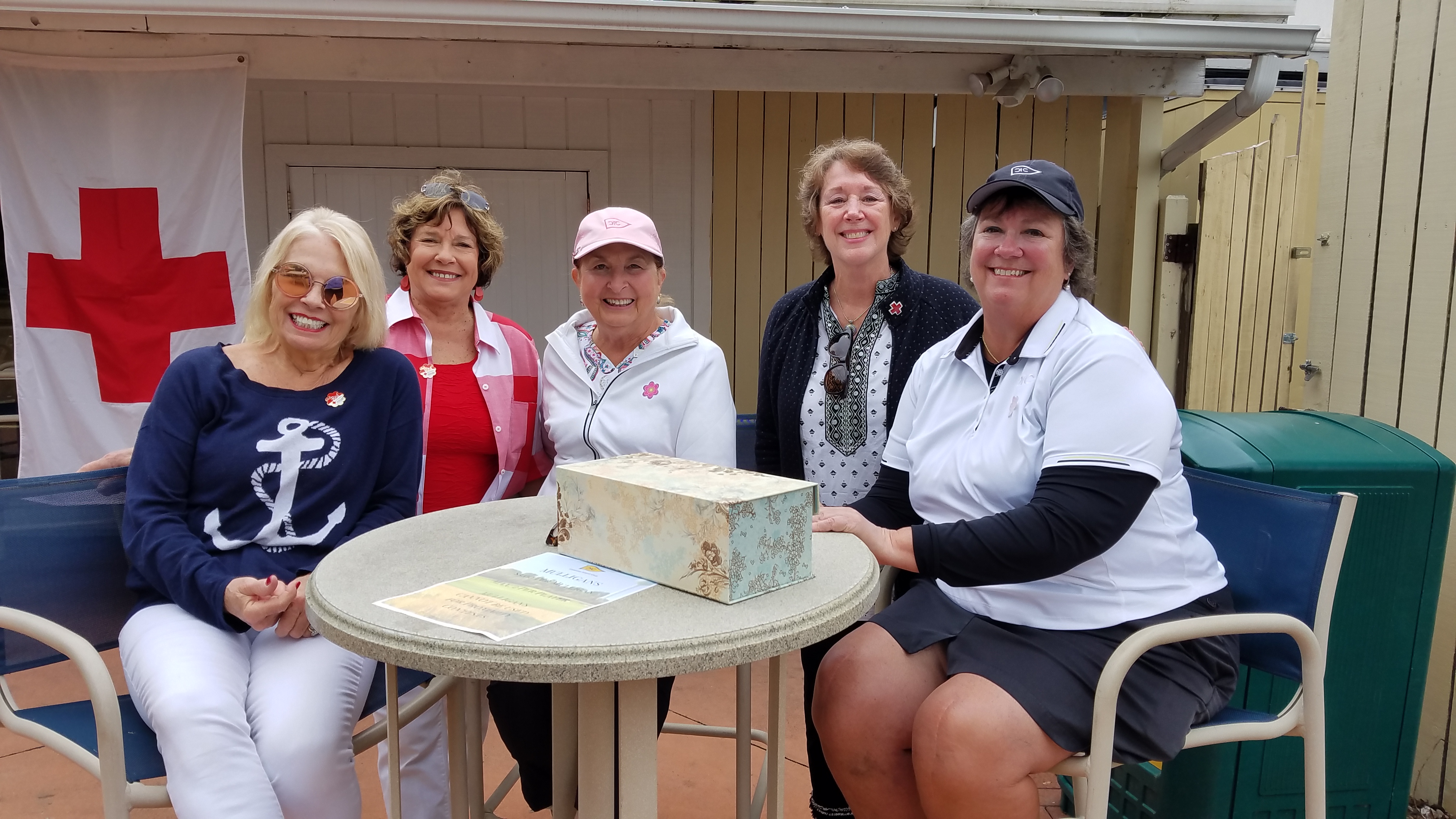
Club Red volunteers staff a registration table at a recent golf outing
“I can’t tell you how fortunate we are to have the support of these wonderful women, who give so generously of their time to these important activities,” Rachel said. “But it’s not just their time and their talents: It’s the influence they have on their community on behalf of the Red Cross.”
Carol said it’s easy to muster support. “People here know the Red Cross. We’re just a conduit for the generosity of the community that supports us.
“We’re connecting the community with the cause.”
If you’d like to get involved with Club Red of Ottawa County, Rachel Hepner at Rachel.hepner@redcross.org can put you in touch with this dynamic group. For volunteer opportunities with the Red Cross elsewhere, go to redcross.org/volunteer.
As Carol said, “If we don’t do it, who will?”
Edited by Glenda Bogar, American Red Cross volunteer
Posted by Ryan Lang, American Red Cross board member and volunteer
Here are 16 tips to help to educate the whole family:
Driving
In Northern Ohio, as children return to school earlier and earlier each year, it’s not unusual in August to see children lined up, waiting for school buses. That means drivers need to readjust their driving habits.
As youngsters wait for the bus for the first time, many have never been asked to stand in one spot without dancing around or chasing their nearby friends. It’s not unusual to see one of them dart off the curb and into the street without looking. Lesson: if you see young children on the street corner – slow down and watch for unexpected behavior.
As young drivers with new driver’s licenses start to drive to school for the first time, they can be easily distracted between the car radio, their cellphone, and/or friends they see along the way. Lesson: remind them before they leave every day in August to be on the lookout for little ones who might dart out between parked cars.
Grandparents may be pressed into service with school starting again, playing chauffeur to their grandchildren. As darling as they can be, resist adjusting the rearview mirror to have extended conversations with your little loved ones. Lesson: for every second you are peering into the backseat, someone else’s child could run out in front of your moving vehicle.
Grandparents must also be aware of current driving regulations regarding car seats, booster seats, etc. Lesson: In Ohio, State law requires:
Infants and young children must ride in a child safety seat until they are 4 years old, AND, weigh at least 40 pounds.
Every child ages 4-8 who is no longer in a car seat must use a booster seat until he/she reaches 4’9” tall.
Children and teens, ages 8-15, who are not in booster seats must use adult seat belts.
This grandparent recalls traveling with our children unstrapped in a car bed on the back seat. Fortunately, their guardian angels watched over them. Don’t even think about trying that now.
Awareness
“There are some special steps parents of younger kids should take, especially if they have youngsters going to school for the first time,” said Mike Parks, Regional CEO. Lesson: “They should make sure the child knows their phone number, address, how to get in touch with their parents at work, how to get in touch with another trusted adult and how to dial 911. And teach them not to talk to strangers or accept rides from someone they don’t know.”
The American Red Cross always stresses the importance of having an emergency plan before disaster strikes. Lesson: Back-to-school time is an excellent opportunity to think about “What-If”. As you imagine different scenarios, who can you enlist to help out?
Neighbors, other parents, friends, relatives? Make sure to have current contact information for each of them.
Red Cross sheltering operations cease after six days
Residents of the Terrace Towers apartments in East Cleveland have been relocated to other short-term housing options, and the shelter operated by the American Red Cross has closed.
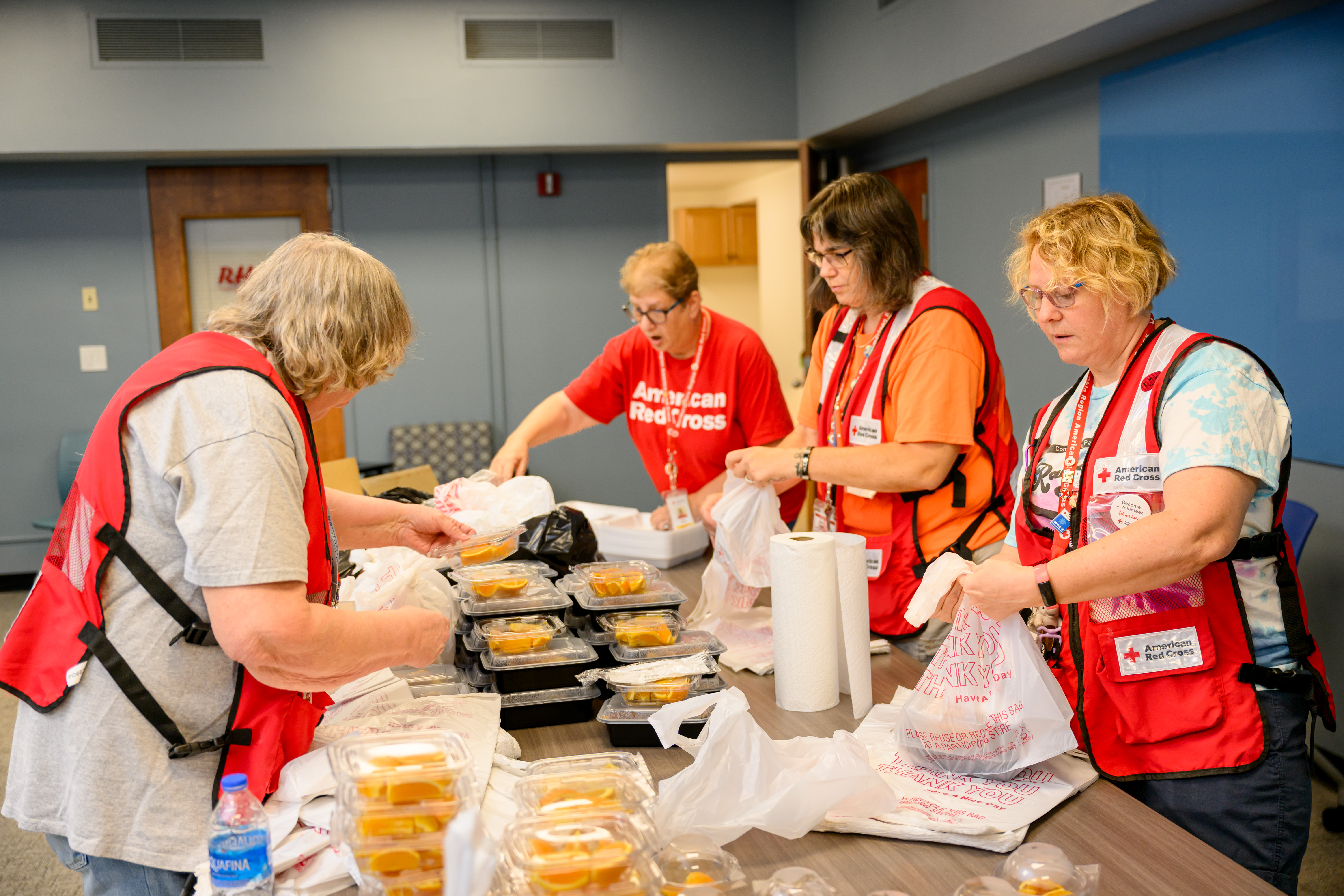
Red Cross workers preparing meal distribution. Photo credit: Cuyahoga County Multimedia
More than 130 residents took refuge in the shelter for six nights, after fire forced them to flee on Monday, July 3rd . They took refuge the first two nights at the Salvation Army East Cleveland Corps Community Center. On Wednesday, the shelter was transferred to a dormitory at Case Western Reserve University. The shelter closed on Sunday.
It was the largest sheltering operation in Northern Ohio since 2004.
Tom Revolinsky, Red Cross disaster program manager, and Alfreda Scott, Terrace Towers resident. Photo credit: American Red Cross
“We made a lot of friends,” said Tom Revolinsky, Disaster Program Manager for the Red Cross of Northeast Ohio. “A lot of the residents were understandably upset when they were forced out of their homes on the night before the fourth of July, but by the time they left the shelter on Sunday, we were getting lots of hugs.”
During the six nights of shelter operations, the Red Cross provided: 525 overnight shelter stays 2,023 meals 304 health services 256 comfort kits (personal hygiene items) 125 blankets Continuous emotional support
Officials with RHM Real Estate Group, the Terrace Towers property management firm, is providing alternative housing options for the residents while repairs to the apartment complex are being made.
“We’re grateful to Terrace Towers property management for working so diligently this week to find alternative lodging for their residents,” said Emily Probst, Regional Disaster Officer for the Red Cross of Northern Ohio. “And we thank the Salvation Army for providing space for the first two nights, and Case Western Reserve University for opening one of their dormitories to these residents.”
Emmanuel Grant, Terrace Towers resident. Photo credit: American Red Cross
Emmanuel Grant, one of the residents of Terrace Towers who took refuge at the Red Cross shelter, said, “One thing I appreciate about the Red Cross; they follow scripture when it said to extend hospitality, caring for your neighbor. So these things have really been a blessing.”
Alfreda Scott, Terrace Towers resident. Photo credit: American Red Cross
“My experience, believe it or not, has been wonderful,” said shelter resident Alfreda Scott. “It’s just been like a nice community, and everyone’s been hugging and supporting each other, and it’s been wonderful.”
She said once her housing situation stabilizes, she plans to become a Red Cross volunteer.
“I made some new friends.”
You can hear more from Emmanuel and Alfreda in this video here.
Red Cross and County Emergency Management workers. Photo credit: Cuyahoga County Multimedia
The Red Cross received assistance from several organizations, including the Cuyahoga County Office of Emergency Management, and several businesses stepped-up to provide meals, including Bon Appetit, Case Western Reserve University’s food service provider.
“No one organization can carry out such a challenging task alone, and we’re thankful for all the help the residents received,” said Probst. “We’re also indebted to our dedicated volunteer workforce. We could not have provided such valuable assistance without them.”
To learn more about volunteer opportunities with the Red Cross, visit redcross.org/volunteer.
Posted by Ryan Lang, Red Cross board member and volunteer
July 30, 2014. City of Myrtle Beach Parks and Recreation, South Carolina. Julieth Martinez, 4, enjoying her swim lesson as part of the Centennial campaign. Photo by Connie Harvey/American Red Cross
I first saw the effects of heat stroke when I was 10. I was at a day camp for the first time. Decades later, I vaguely recall activities, canoes, a lake and even the heat. But I clearly remember seeing the fellow camper stumble, vomit and pass out. Counselors carried him inside and put him on a table, getting water and ice. The rest of us followed, worried, overhearing frantic conversations. Once inside, someone put on a movie to calm us, but I think we all knew he was in trouble and an ambulance was on the way. My memory becomes fuzzy after that. A darkened room, an ignored movie, a child my age prone on a table, teenagers tossing ice and water on him until the EMTs arrived, quickly giving treatment and taking him away. I saw him a few weeks later at another event, recovering.
As much as we enjoy summer and especially being active, heat can be dangerous, even life-threatening. In fact, the last several years have seen excessive heat cause more fatalities than all other weather events. Climate change is also making extreme heat events more frequent and severe, even here in Northern Ohio.
For a medical professional’s perspective on heat safety for our region, I reached out to Patricia Horvath, a registered nurse and American Red Cross volunteer regional nurse lead for Northern Ohio. Patricia explained, “a heat wave is more than 48 hours of high heat (90°F or higher) when high humidity (80 percent relative humidity or higher) is expected.”
Patricia Horvath, Regional Volunteer Nurse Lead
“For us in Northern Ohio, the uptick in heat-related illnesses such as heat exhaustion are often seen around local family fun runs, sports camps for kids and pre-season athletic training for high school kids during heat waves,” she said. “I’ve also experienced it at outdoor family reunions when seniors rapidly became dehydrated in the sun.
“The saddest and most devasting situation I have seen is the death of a child—left or forgotten—in a hot parked car,” she continued. “After an hour, the average in-car temperature is 43 degrees higher than the outdoor temperature. After 90 minutes, this rises to 48 degrees higher. Therefore, when it’s 90 degrees outside, it could reach an incredible 138 degrees in your parked car. That’s hotter than any outdoor temperature ever recorded on Earth! Parents, grandparents and caregivers need to establish memory hooks as a routine to be sure to check for the little ones in car seats before leaving. It’s easy to get distracted or absentminded these days. Unfortunately, this also occurs often with pets. If you see a child in a parked car alone on a hot day even with windows cracked, say something and get help. Minutes matter.”
Patricia also spoke of the importance of community. “Like most things in a community, it’s those who live there who look out for each other that makes it healthy and safe. With heat waves, communities in Northern Ohio now will open free access to designated ‘cooling centers’ for residents, such as recreational centers, libraries and community centers. Check on your vulnerable elderly neighbors to be sure they have access to air-conditioning. Invite them to your house or give them a ride to a cooling center for the day. I have had air conditioning parties for my neighbors and friends during heat waves. Growing up, this is something my parents used to do when AC in private homes was more of a luxury.”
Patricia’s general advice to stay safe is:
Be aware of the predicted heat and humidity for the day.
Keep hydrated even if you are not thirsty.
Keep cool, stay indoors or in the shade and, minimize exercise/activity.
Check in with kids and the elderly to keep them safe too.
Know the signs of heat exhaustion and heat stroke.
When patients living with sickle cell disease face a sickle cell crisis, blood transfusions can make a lifesaving difference. That’s why the Akron National Panhellenic Council partnered recently with the American Red Cross to grow the number of blood donors who are Black to help patients with sickle cell disease, the most common inherited blood disorder in the U.S.
28 donations were collected at the Akron NPHC blood drive on Saturday, June 23, to help raise awareness for patients living with the disease. Nine sororities and fraternities took park in the drive.
Jasina Chapman, first-time blood donor and organizer of the Akron NPHC blood drive for sickle cell awareness
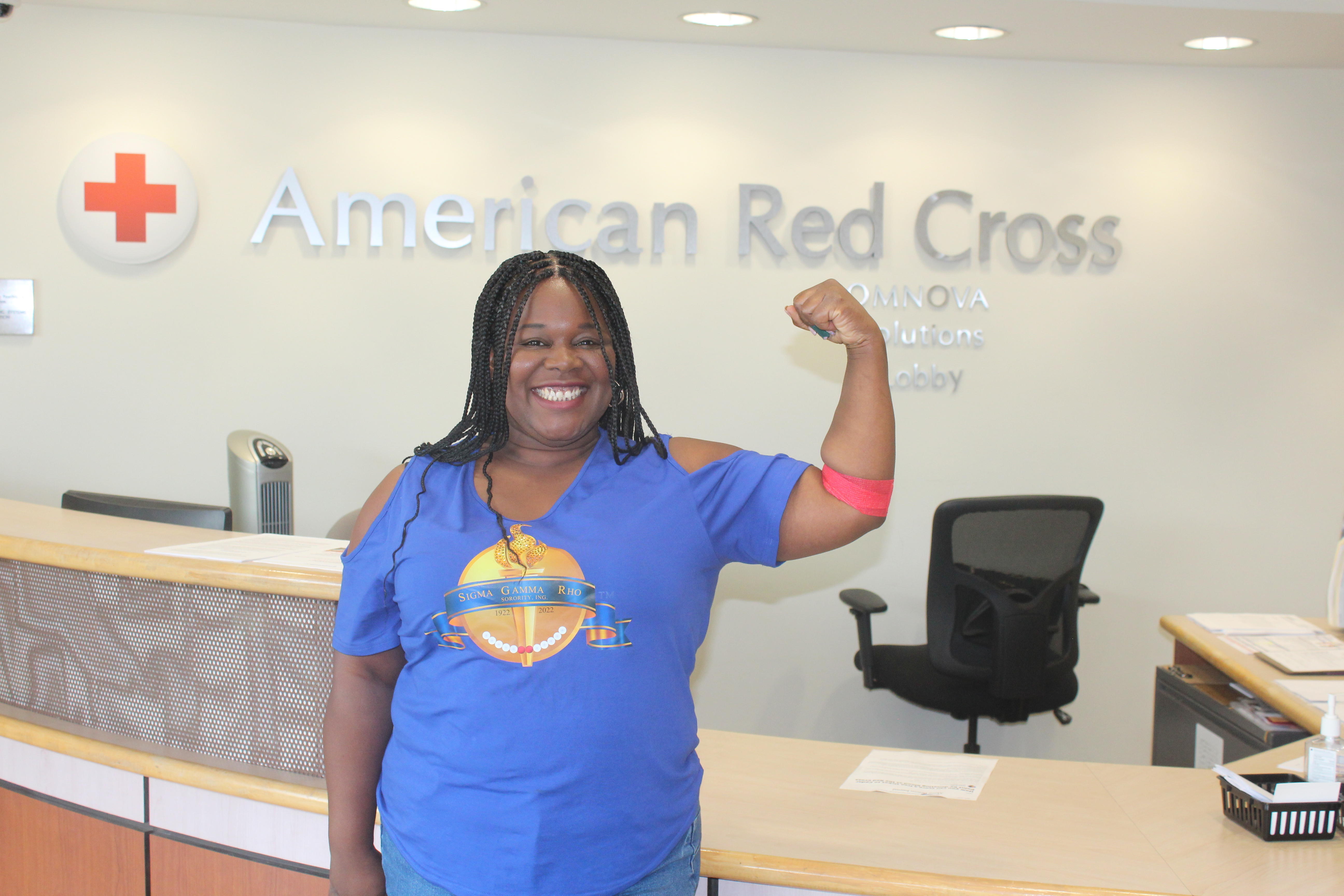
“We mobilized all of our groups to get them to either donate or volunteer,” said Jasina Chapman, who donated blood for the first time at the drive. As the Community Service Chairperson for the Eta Delta Sigma Chapter of Sigma Gamma Rho Sorority, Inc. and the Akron NPHC, she helped organize the blood drive.
“We are African American leaders in our community,” she said. “We need to activate African Americans to donate blood.”
More than 100,000 people live with sickle cell disease nationwide, and the majority of patients are of African descent. The disease distorts soft, round blood cells and turns them hard and crescent-shaped, which can cause extreme pain. When hardened, the cells can get caught in blood vessels, potentially leading to stroke and organ failure. Blood transfusions are often used in treatment, and many individuals who are Black have distinct markers on their red blood cells that make their blood donations the most compatible match for helping patients with sickle cell disease. One in three African American blood donors is a match for people with sickle cell disease.
Christa Nuru, one of 28 donors at the Akron NPHC blood drive
How to donate blood: Simply download the American Red Cross Blood Donor App, visit RedCrossBlood.org, call 1-800-RED CROSS (1-800-733-2767) or enable the Blood Donor Skill on any Alexa Echo device to make an appointment or for more information. All blood types are needed to ensure a reliable supply for patients. A blood donor card or driver’s license or two other forms of identification are required at check-in. Individuals who are 17 years of age in most states (16 with parental consent where allowed by state law), weigh at least 110 pounds and are in generally good health may be eligible to donate blood. High school students and other donors 18 years of age and younger also have to meet certain height and weight requirements.
Blood and platelet donors can save time at their next donation by using RapidPass ® to complete their pre-donation reading and health history questionnaire online, on the day of their donation, before arriving at the blood drive. To get started, follow the instructions at RedCrossBlood.org/RapidPass or use the Blood Donor App.
What do Juneteenth (today) and World Sickle Cell Day (also today) have in common? Both of these events focus on African Americans.
Glinda Dames-Fincher is a member of the American Red Cross Sickle Cell Sub-committee in northern Ohio. She’s a proud, outspoken “sickle cell warrior” calling for more Black blood donors.
Glinda Dames-Fincher
“Over 80 percent of Americans with Sickle Cell Anemia are of African descent, and ethnicity matters with blood transfusion,” she said. Many individuals who are Black have unique structures on their red blood cells that make their donations the most compatible to help patients with sickle cell disease. Glinda likes to think of it as “special sauce.”
“So please, African Americans, roll up your sleeves and help sickle cell warriors like me fight their battle!”
For Glinda, the need is personal. In order to combat the many effects of sickle cell (SCD) on her body, she gets two units of red blood cells every month; the procedure involves withdrawing one unit of her damaged blood each time and then transfusing in two units of healthy red cells.
She figures she’s received more than 600 units of red cells, between regular transfusions and the many surgeries she’s undergone to repair organs damaged by oxygen deprivation.
Glinda is a wealth of knowledge about sickle cell:
This inherited disorder makes red blood cells sticky, rigid and curl into a C “sickle” shape, limiting their ability to carry oxygen into every tissue in the body. The misshapen cells also tend to clump, leading to various complications. “For many pediatrics, a stroke is their first major sickle cell event,” she said.
When tissues are starved of oxygen, something as simple as a change in the weather can trigger excruciating pain – called a sickle cell crisis – lasting from hours to days or even weeks. That often sends sickle cell sufferers to emergency rooms for treatment, including pain killers and blood transfusions.
Sickled red blood cells also die prematurely: The distorted cells die within 10 to 20 days, compared to normal red blood cells that typically last 100 to 120 days. That leads to a shortage of red blood cells, a type of anemia. Here again, transfusions are crucial.
Glinda is 64. “When I was born, life expectancy for a sickle cell patient was 18 years. Now it’s 40 to 60 years, thanks to medications and research,” she said. However, over time, patients may be subject to persistent infections, and damage to kidneys, heart, lungs and other organs.
SCD affects more than 100,000 people in the United States. Eight out of 10 of them are of African descent; the rest are Hispanic or trace their ancestry to south Asia (such as India), southern Europe (Greece and Italy) or the Middle East (such as Saudi Arabia and Lebanon).
SCD testing is part of the routine blood tests for newborns in the United States. Additionally, the Red Cross provides sickle cell trait testing for all blood donors who identify themselves as Black or African American. Those with the “trait” inherited a sickle cell gene from one parent; those who got a sickle cell gene from both parents are born with the disease.
Since the best blood match for a patient receiving ongoing transfusions comes from donors of the same genetic background, the Red Cross is urging people of all ethnicities to give blood and help increase the number of diverse donors, so we can find the best match for all patients.
A dedicated donor reflects on World Blood Donor Day
By Doug Bardwell, American Red Cross volunteer
As I was asked to write this article, I tried to remember back when I made my first donation, some 56 units and 26 years ago. At the time, I was working in Terminal Tower, and I decided to give when a co- worker said something as simple as, “Hey, I’m going over to donate blood. Want to come along?”
Doug Bardwell
I’m sure I asked about qualifications, but he assured me that they’d give me a quick physical check and make sure I was able to donate. That’s all it took, and I was on my way to becoming a blood donor. “Why not?”
The blood donor center was set up in an unoccupied office space in Tower City Center. I was actually amazed at how quick it was to make my donation. No drama, just a pint of blood lighter when I left and a sticker to show I had donated.
Outta sight – outta mind
Nobody asked again until 2003, right after the Invasion of Iraq. While having a discussion about the war with a friend, he said that he had heard someone saying the only thing we could do to help our troops was to donate blood or donate money.
With a growing family, I had more of the former than the latter, so I checked around to see where and when the closest donation site would be opening. Donation number two was scheduled, but this time, someone at the Red Cross site asked about how often I donated. They made mention of the idea of donating around Christmas each year as a way to give someone else a gift that might save a life but cost me nothing. That sounded like a great idea, so I put a yearly note on my Day-Timer calendar for each December.
You can do more, you know?
It was another conversation with a Red Cross worker that finally spurred me to do more when they said, “You know, you can donate every eight weeks, don’t you?” Well, no, I guess I didn’t, but that started it rolling, trying to donate as frequently as my schedule would permit.
I also realized at that time that if I hadn’t been asked by someone else to go the first time, I might have never donated at all. I then started talking about donations to family members and other friends.
I do the coming events A/V screens in our church’s foyer and lobby, so I started making sure that all upcoming blood drives were advertised on our screens each time they were scheduled. Posting on social media, I’d mention the date and time with a “Won’t you join me next Tuesday?” type message.
So, I’ll end with the same message that started me – “Hey, want to come along?” There are dozens of locations available each week. It’s honestly easy to do, and you could save as many as three lives each time you donate.
Posted by Ryan Lang, Red Cross board member and volunteer
The basketball referee crumbled to the floor of the court, lifeless. The game between the Glass City Wranglers of Toledo and the Jamestown Jackals of New York came to an abrupt halt, as players and spectators wondered what was wrong.
Myles Copeland did not wait.
Myles Copeland – Toledo Firefighter
Myles is a Toledo firefighter – and was playing with the Wranglers during his off hours when referee John Scully suffered cardiac arrest – something Myles was trained to treat. He immediately began CPR, cardiopulmonary resuscitation, performing chest compressions while awaiting the arrival of emergency medical personnel, and that likely saved John’s life.
Myles Copeland won an Acts of Courage award from the American Red Cross of Western Lake Erie for his swift intervention, as did Lt. Jim Schulty, also with the Toledo Fire Department. Jim performed CPR on a fellow hockey player after his heart stopped beating and is also credited with saving a life.
These are just two examples of the value of knowing how to perform CPR, and there’s no better time to highlight these stores, as National CPR + AED Awareness week begins today. And while Myles and Jim are professional firefighters and have had on-the-job training, anyone can be trained to help save lives with CPR and an AED.
More than 350,000 people suffer a cardiac arrest annually, but only 9% survive.
Every second counts when responding to a cardiac arrest. If you see someone suddenly collapse, call 911, send someone for the AED and begin CPR.
Nicole and Lindsey Bechter
That’s what Lindsey and Nicole Bechter did while they were serving as referees at a volleyball court in Cuyahoga Falls last summer. A player collapsed, and the sisters took turns performing CPR until the ambulance arrived.
Even if you aren’t trained, doing chest compressions (pushing hard and fast in the center of the chest) is better than doing nothing. It’s what Jim Kuhn did. The bus driver for the city of Wadsworth helped keep a passenger alive by pushing down on the man’s chest after he collapsed when trying to board the bus last November. For their lifesaving actions, Jim, Lindsey and Nicole received Acts of Courage awards from the Red Cross of Greater Akron and the Mahoning Valley.
Acts of Courage award winner Jim Kuhn, center, with board member Ryan Lang, left, and committee chair Tara Silva, right.









 NOHredcross