In March of 1976, Jean Lewis was just coming off sick leave after the birth of her first child. Upon learning that her former position at the local library had been filled in her absence, she was offered an alternative job.
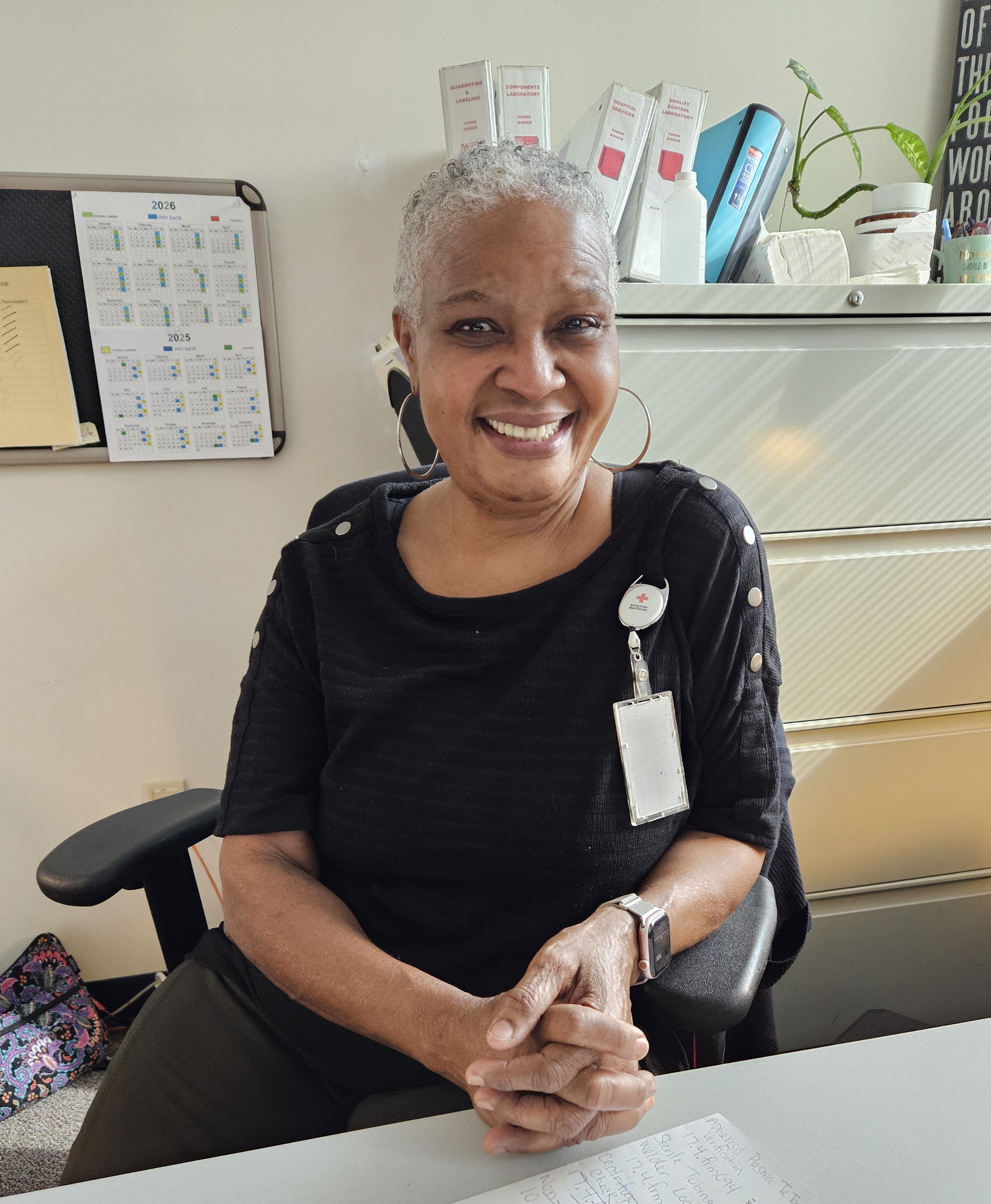
Jean Lewis, American Red Cross
“They put me in a room as long as Chester Avenue (filled) with index cards,” Jean mused. “They said that we are starting automation, and we are going to put all these cards in alphabetical order…and I looked at it and I said, oh no, not me!”
So, she left the library and headed down to the unemployment office. After taking a typing test, she was offered a clerk position at the American Red Cross. The starting pay was $1.98/hr, and she gratefully accepted.
“I have remained in the same department for the entire 50 years.” Jean proudly proclaimed. “I never wanted to leave this department.”
That department is called Manufacturing, which manufactures the blood products that are collected through donations. It has changed names over the course of her career, from Technical Services to Laboratory, and finally to Manufacturing.
“I used to make all the forms that’s now out on the internet in the repository. I used to make all of those forms on the typewriter,” Jean recalled. “I started out making a system up for the forms to be organized. One of the things I give myself credit for at the Red Cross is that I’m very organized.”
Now, after 50 years, Jean is ready for the next phase of her life. “I am going to retire this year, 2026. It is now time for the younger generation to take over,” she reflected. “One of my mottos is, nobody’s job should shut down just because that person’s not here. You should always have a backup.”
During her career, she’s always taught others to do her job just in case something happened and she couldn’t be there.
Post-retirement, Jean plans to travel with her family in a 15-passenger van that she recently purchased. “I have two grandkids, and my 35-year old, Down syndrome nephew. They are the love of my life…we go a lot of places together.”
Jean celebrated 50 years with the Red Cross on March 26 of this year.
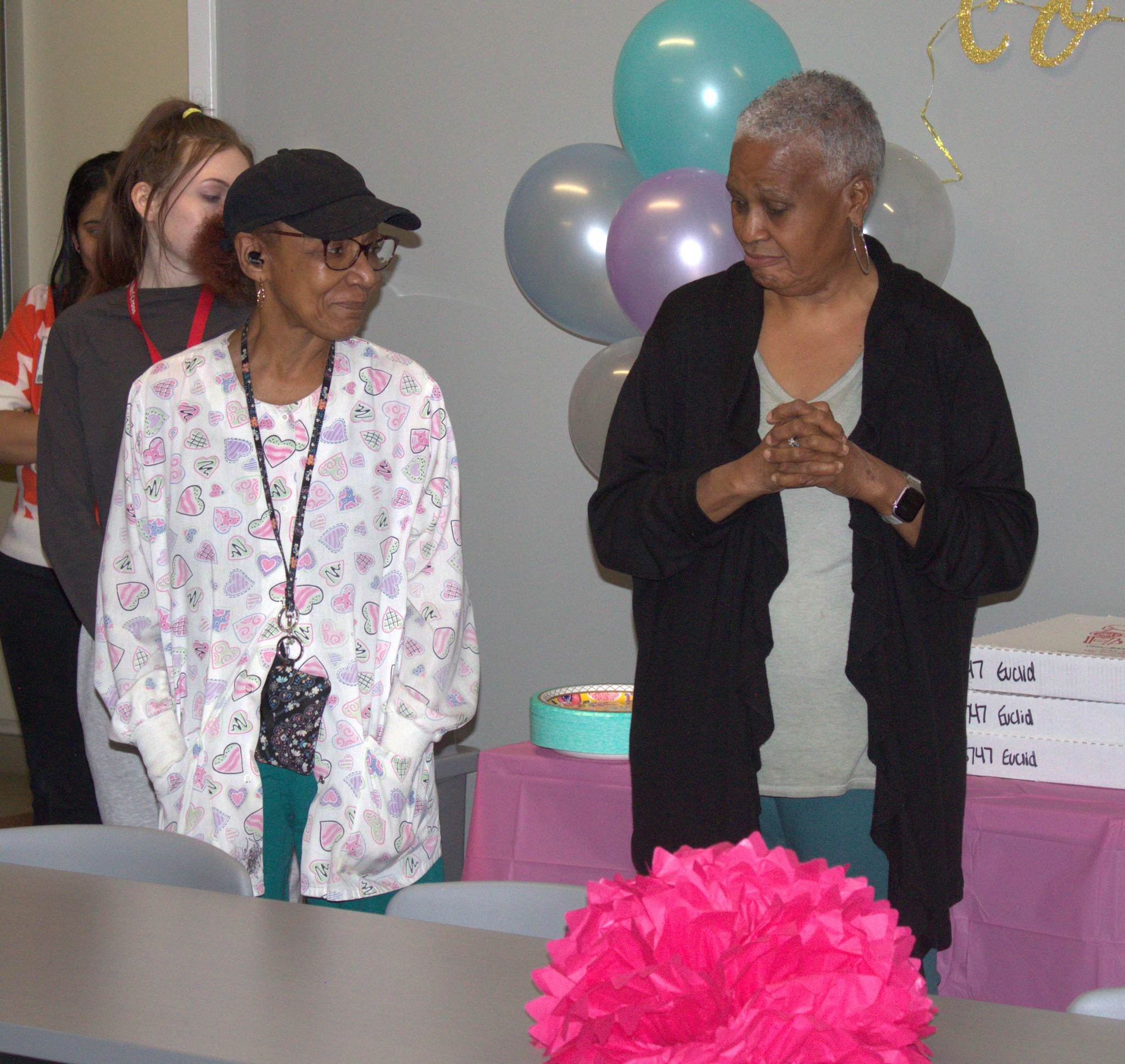
Jackie Greene (left) and Jean Lewis, American Red Cross
On behalf of the American Red Cross, we wish Jean a very happy retirement, and thank her for her 50-years of service! A warm congratulations also to Jackie Greene, who celebrated 55 years with the Red Cross on March 1st!
To conclude, a final word from Joel Prater, Manufacturing Manager, American Red Cross. “When they retire, the Red Cross will be losing two of the hardest working people with the greatest breadth of knowledge and experience imaginable, and it will take 4 people or more to cover all they do for us here.”
Elaine Rettig has made what she thinks is a “win-win” deal with her family: If they give blood to the American Red Cross, she gives them cash.
Elaine Rettig and her husband Al
For every pint of blood each of her three children, their spouses and seven grandchildren donates, they receive $100! It’s $50 for an attempt to donate, even if it’s not successful.
And somewhere, someone – or two or three – will receive the gift of life when they need it most.
Elaine was one of those recipients more than 50 years ago when she needed an emergency C-section for the birth of her first child. It took seven units of blood to get her through the crisis.
Over the years, through two more kids and a career in nursing, Elaine donated 62 units of blood to “pay it forward.”
But that’s nothing compared to her husband Al’s generosity: When he makes his next donation in May, he will have given 144 pints of blood. That’s 18 gallons! That’s in addition to a couple of gallons he gave as a medic in the U.S. Navy, including on duty in Vietnam.
Elaine can no longer donate blood herself, but one night in bed, it occurred to her she might spur family members to carry on the mission. She was thinking about one of her granddaughters, who’s active in a high school Red Cross Club.
“What teenager can’t use an extra hundred dollars every couple of months,” she asked with a grin in her voice. She knows her grown children too appreciate the “little bit extra” from Mom, but no, Al isn’t in line for the cash award she adds, with her wry sense of humor.
Since starting the incentive program for her 13 family members less than a year and a half ago, Elaine has accounted for 33 units of blood and three unsuccessful attempts. After 10 donations or attempts per person, she figures the habit should be established and she’ll pay in advance for the next 10 donations.
She thinks of this as a form of early inheritance transfer.
As a retired nurse, Elaine knows that the testing involved with blood donation can uncover silent health problems. In fact, one of her granddaughters tested too low for hemoglobin in a pre-donation screening: It turned out she was anemic and really needed iron supplements. Elaine considers that a win at a blood drive, even without a unit collected.
By the way, the Red Cross is doing free A1c tests on all units donated during March, to screen for prediabetes or Type 2 diabetes. Red Cross data shows one in five blood donors has an elevated A1c level, which can often be controlled with lifestyle changes before the condition develops further. As the nation’s largest blood supplier, the Red Cross is uniquely positioned to alert otherwise healthy donors to undiagnosed anemia, diabetes and hypertension.
“While the dreaded jab of a needle is not like a kiss from your sweetheart, knowing you will be helping someone through a rough time in their life is an extra reward,” this wise grandma in Findlay said.
To schedule a blood donation this month and get the free A1c test and a $15 Amazon gift card, to go RedCrossBlood.org/March or download the free American Red Cross Blood Donor app.
The American Red Cross of Greater Akron and the Mahoning Valley has been celebrating everyday heroes from the local community for the past 30 years with the annual Acts of Courage event in Akron. On March 5, 2026, that the chapter celebrated its 30th and final Acts of Courage event marking the end of an era.
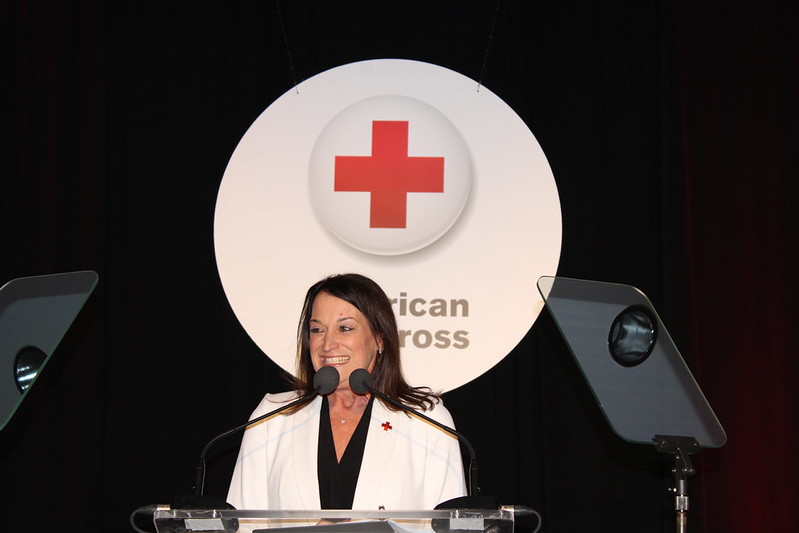
Rachel Stine, Executive Director of the American Red Cross of Greater Akron and the Mahoning Valley
“It’s been an absolute honor to be a part of the Acts of Courage event for over ten years,” Rachel Stine, Executive Director of the Greater Akron and Mahoning Valley chapter of the Red Cross said. “This event has showcased those who truly care about community and embody the spirit of the Red Cross.”
In fact, the entire event has embodied the spirit of the Red Cross for decades, and the grand finale was no different. From a Red Cross volunteer saving a life at a local restaurant, to one of our youngest recipients, a seven-year-old girl, calling for help when no one else heard her neighbor, the acts of courage that were on display were astounding.
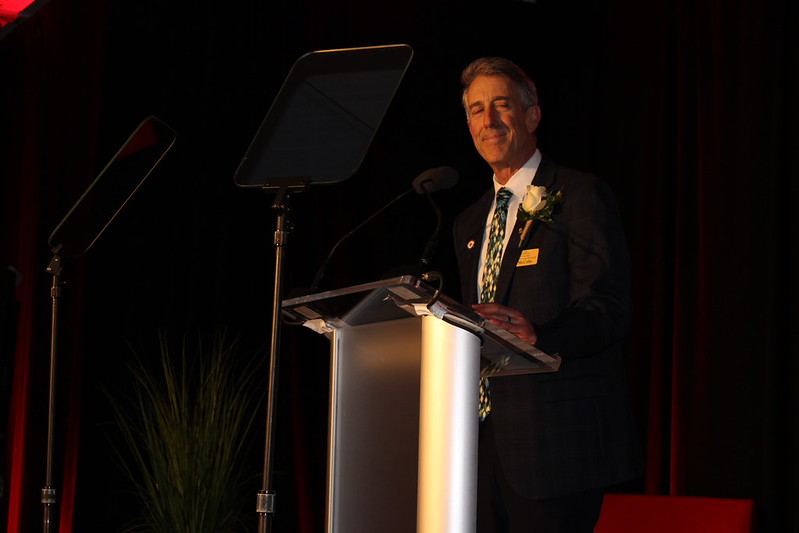
Jack McCabe, 2026 H. Peter Burg Community Leadership Award recipient
We also honored this year’s H. Peter Burg Community Leadership Award recipient, Jack McCabe. Jack is a longtime board member and Vice President and General Manager for the Utility Vegetation Management division of Davey Resource Group. Jack is a true servant leader and is making a difference in his community and beyond every day.
See all of the photos from the event here, and tap the videos below to hear the stories from our heroes themselves. Also below is a short vignette that takes you on a journey from where the Red Cross in Greater and Akron the Mahoning Valley was, is, and will be.
As for what the future holds, Rachel says, “You will see your Red Cross over the next 30 years continue to honor even more heroes every day with the volunteers serving and meeting the needs of communities near and far.
Acts of Courage awards recipients:
Chris’ Red Cross training kicked in when a student at the Medina County Career Center needed it most:
Ashley utilized lifesaving skills she learned through the Red Cross to help a coworker in distress:
Evelyn is proof that heroes come in all sizes:
Jeff is a healthcare worker and an everyday citizen who stepped up in someone else’s time of need:
Red Cross volunteer Jennifer was out getting a bite to eat and noticed a man choking:
Twinsburg Fire and Police, along with the dispatch team, honored for the team effort to save a baby from a home fire:
30 Years of Acts of Courage in Greater Akron and the Mahoning Valley:
Toledo mom grateful for Red Cross assistance following devastating fire
By Jim McIntyre, American Red Cross volunteer
“This is the first time in my adult life I’ve actually been content.” That quote may not seem to make much sense, coming from someone who suffered a home fire less than a month before. But that’s not how Ashley Jackson sees it.
“Everything happens for a reason, even the bad stuff,” said the Toledo school bus driver, referring to the fire that destroyed much of her home on January 29, 2026. “So many blessings have come from it.”
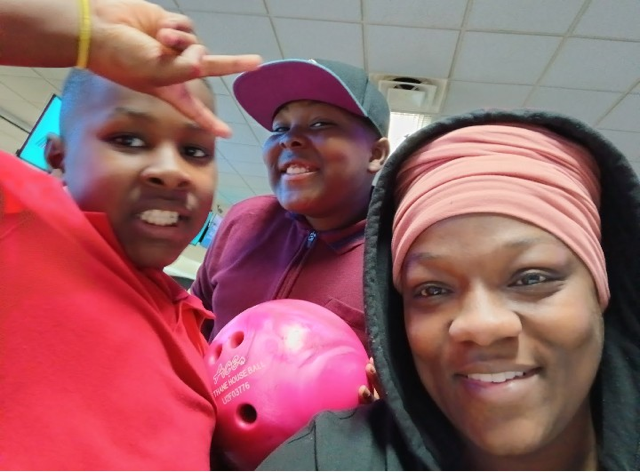
Ashley Jackson (bottom right), Okikechukwu Emeana (left), Chibueze Emeana (center)
Ashley was able to escape safely with her two young sons and their cat at about 4:30 the morning the fire tore through the upstairs of their home. She said she had no idea what to do or where to go. She had no insurance, and she thought she and her children were going to have to sleep in their car. That’s when she was told to call the American Red Cross, where she connected with a caseworker.
“You guys jumped right into action,” Ashley said, by helping her stay focused and calm. “I thought I was OK, but I just busted out in tears, and she (the Red Cross caseworker) stayed on the phone with me the entire time and consoled me and helped me stay strong for my kids. Because once I started crying, they started crying!”
The Red Cross was able to give Ashley immediate financial assistance for an extended stay in a hotel, where she and her children spent the first week following the fire. She said they also connected her with other resources for clothes and basic necessities.
“They were checking up on me about every day, maybe twice a day, through calls and text messages. Just being very kind, and, I don’t know…human.”
Like many people, Ashley was unaware of the help the Red Cross offers to people in her situation.
“I thought it was like some organization that helped foreign countries,” she said.
In Northern Ohio alone, the Red Cross responds to more than 3 home fires every 24 hours, offering the same compassionate care and financial assistance that Ashley and her family received. And most of that help is provided by volunteers.
And now, Ashley is considering becoming a Red Cross volunteer.
“I’m happy. Everybody’s safe. We’re getting back into a routine. Being on the receiving end, I want to give back.”
Anyone who wants to give back and help their neighbors in need can visit redcross.org/volunteer to learn more about the many ways the Red Cross offers to help make our communities safer and more resilient.
“Sickle Cell disease is the most common inherited blood disorder in the United States,” and Colleen Meadows is bound and determined to make that fact common knowledge.
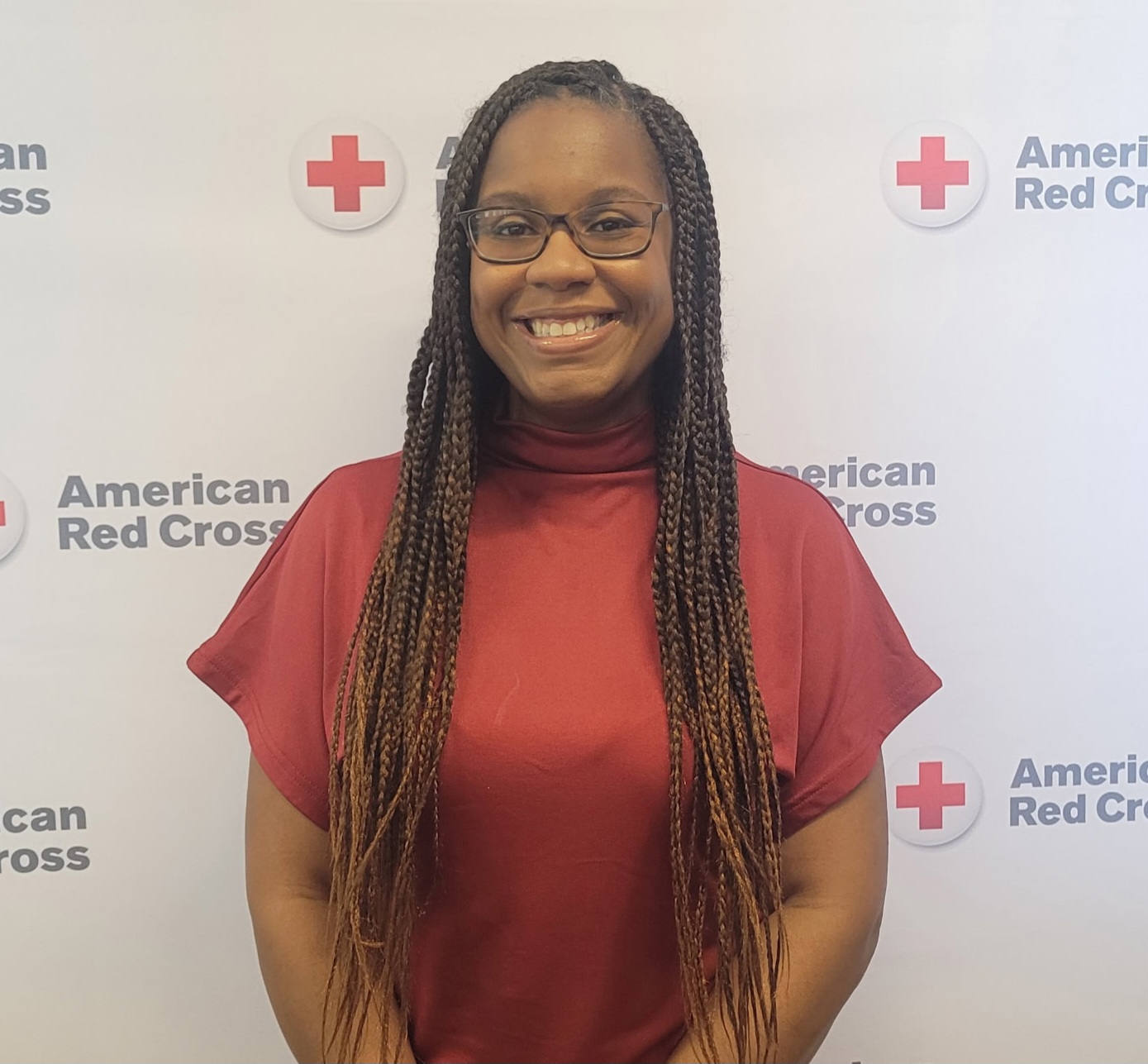
Colleen Meadows, Emerging Markets Manager
Colleen has made it her full-time mission as emerging markets manager for the American Red Cross in Ohio.
But it’s not just knowledge she wants to spread. She wants action! “I want to increase awareness of sickle cell disease to get more Ohioans – especially those of African American descent – to step up and donate blood.”
More than 100,000 people in America – primarily those of African American descent – live with sickle cell disease. The disorder causes red blood cells to curve into a “C” or sickle shape, which in turn makes the cells more likely to clump and weakens their ability to carry oxygen.
Regular blood transfusions help prevent strokes and treat anemia, periodic episodes of excruciating pain called “sickle cell crises” and life-threatening damage to internal organs. Blood from donors of the same racial and ethnic heritage contains antigens that help counteract patients’ pain and injury.
“Sickle cell is an internal condition. You can’t see it,” Colleen told me. “Everything they (patients) go through is dire.”
Colleen is well aware of the legacy of mistreatment African Americans have experienced at the hands of the healthcare establishment, so she stresses the fact that their blood is uniquely suited to fellow African Americans. The problem is that while one in three African American blood donors is a match for sickle cell patients, they make up less than 3% of the total number of donors.
“The Red Cross is committed to increasing and widening the donor base in order to meet the needs of the whole diverse population of this country,” she says.
Colleen’s focus isn’t limited to African Americans. She’s also working to connect with Latino and LGBTQ+ populations which haven’t historically been welcomed into the ranks of blood donors. She’s recruiting trusted community leaders to spearhead awareness and donation events, and she’s teaching prospective donors how to prepare for a successful donation experience.
Colleen began her “career in blood” almost two decades ago when she became a Red Cross phlebotomist. For years she was dedicated to making every donor’s “jab” as comfortable as possible, to encourage repeat donations.
But for the past year she’s shifted to outreach to boost and broaden those donor numbers. And she’s encouraged by the response. “In one year, we’ve seen a lot of changes. The numbers (of donors) have gone up significantly and we’ve had a lot more first-time drives,” she says.
Colleen encourages everyone who can to make a blood donation, especially now, when severe winter weather and seasonal illness has led to a nationwide blood shortage. Schedule your donation by visiting RedCrossBlood.org, using the Blood Donor App, or calling 1-800-RED-CROSS.
During Phlebotomist Recognition Week, the American Red Cross of Northern Ohio is proud to spotlight Katie Currenti, who has dedicated 29 years to serving as a Red Cross phlebotomist.
Katie first started working at the Red Cross after moving to the U.S. from Ukraine and studying to become a medical assistant. Before moving here, she had previously worked as a speech pathologist and held a nursing degree back at home.
Katie Currenti, Red Cross phlebotomist, at the newly opened Willoughby Blood Donation Center
“When I arrived here in this country, I wanted to continue to help people in the medical field,“ Katie explained, “so I went to school for medical assistance and started my career with the Red Cross, because what better way to continue helping others than making sure lifesaving blood products are available for patients in hospitals.”
Phlebotomists play a vital role in the blood donation process. Specially trained to collect lifesaving blood donations, they ensure each unit is safely prepared for patients in hospitals across the region. Their work extends beyond just basic blood collection as they also comfort and educate donors who come in, greeting them with a smile and providing a friendly, familiar face for repeat donors.
“What keeps me and has kept me here is my (Red Cross) family, which includes staff and, most of all, donors and volunteers.” Katie reflected, “I have come to know so many who have walked through these doors and continue to make new ones. I feel privileged that what I do truly matters to so many and know that all of us together have saved millions upon millions of lives in 29 years!”
Katie primarily works at the Red Cross Blood Donation Center in Parma, Ohio, and also supports the newest Northern Ohio blood donation center in Willoughby.
This Phlebotomist Recognition Week, help honor Katie and other Red Cross blood donation heroes by scheduling an appointment to give blood. Donors who give between now and February 28, 2026, will receive a $20 e-gift card to a merchant of their choice. Visit RedCrossBlood.org to find a blood drive or blood donation center near you.
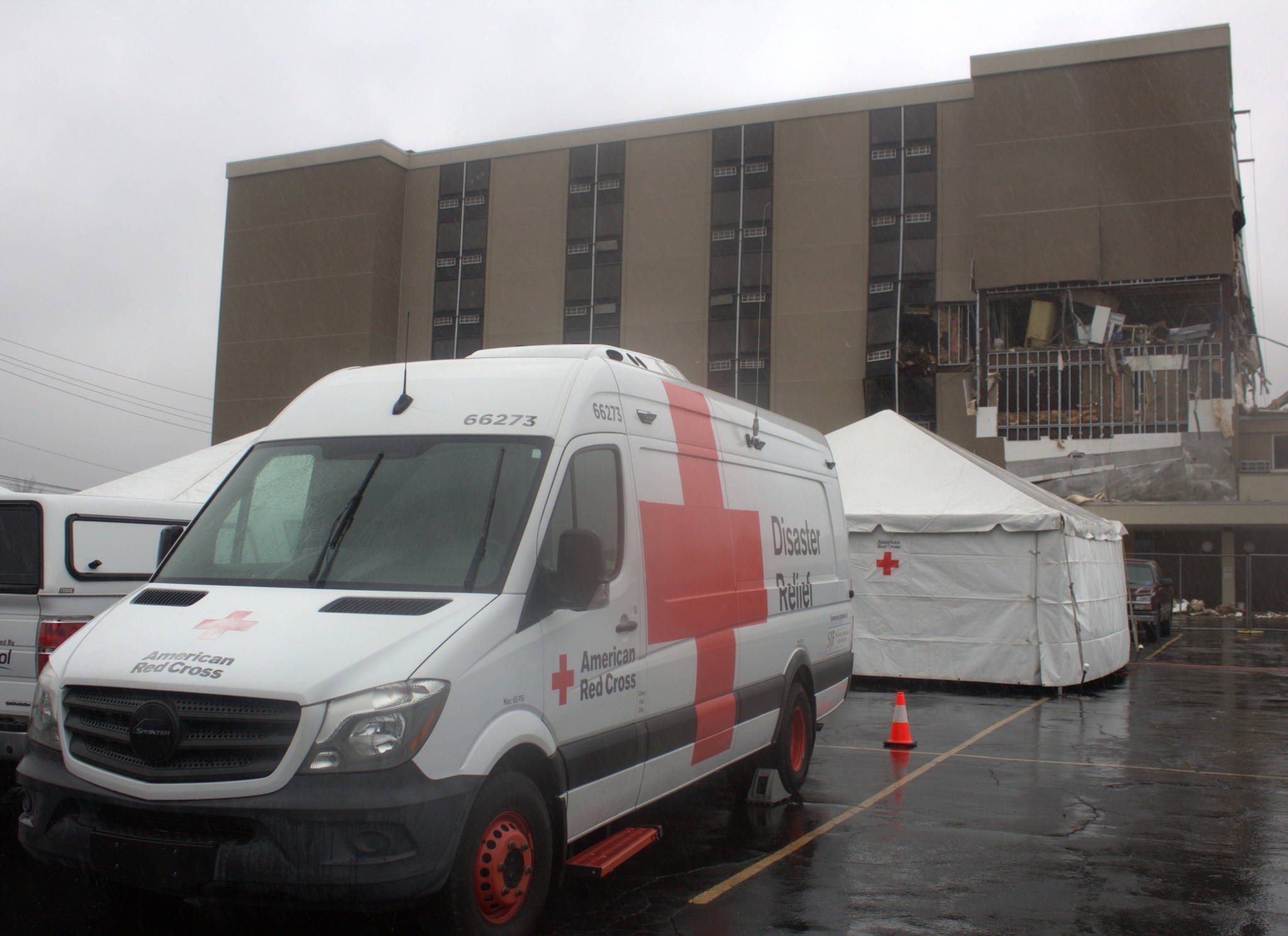
On Saturday November 22, 2025, an explosion displaced dozens of residents at the Phoenix House senior living apartment complex in Austintown Township, Ohio.
Red Cross MRV outside the Phoenix House apartment complex in Austintown Township after an explosion displaced dozens of residents.
Red Cross volunteers were on scene quickly, providing immediate needs for those residents who were left out in the cold. Within hours, our Disaster Action Team members from across the region were in Austintown Township, coordinating with first responders, local leaders, and community partners to best serve these residents.
A staging area was set up at the local senior center and the Red Cross went to work. When it was deemed safe, the Red Cross set up tents outside of the apartment complex to triage residents going into the complex to retrieve essentials such as medicine, personal belongings, and more.
Our volunteers were out in the freeing temperatures and rain for days, assisting residents with not just this process, but opening cases for these people to get much-needed financial assistance. This relief effort lasted weeks, and our volunteers and DAT team members worked tirelessly through the Thanksgiving holiday to make sure that these people, who were living through their worst nightmare, had what they needed when they needed it most.
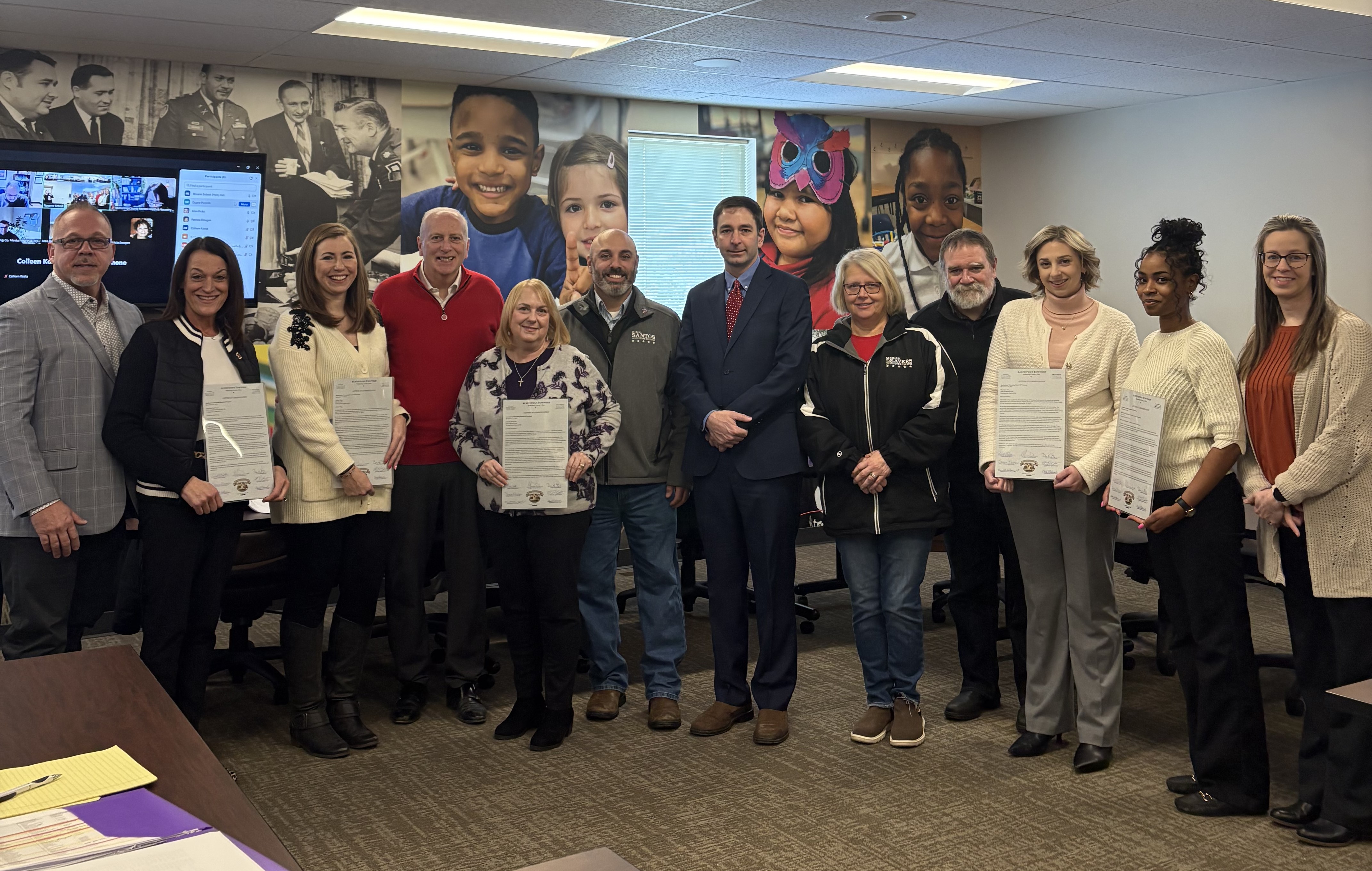
Austintown Township Trustees recognizing the efforts of the American Red Cross of Northern Ohio and other community partners and organizations for their efforts in the wake of the Nov. 22, 2025, explosion at the Phoenix House apartments.
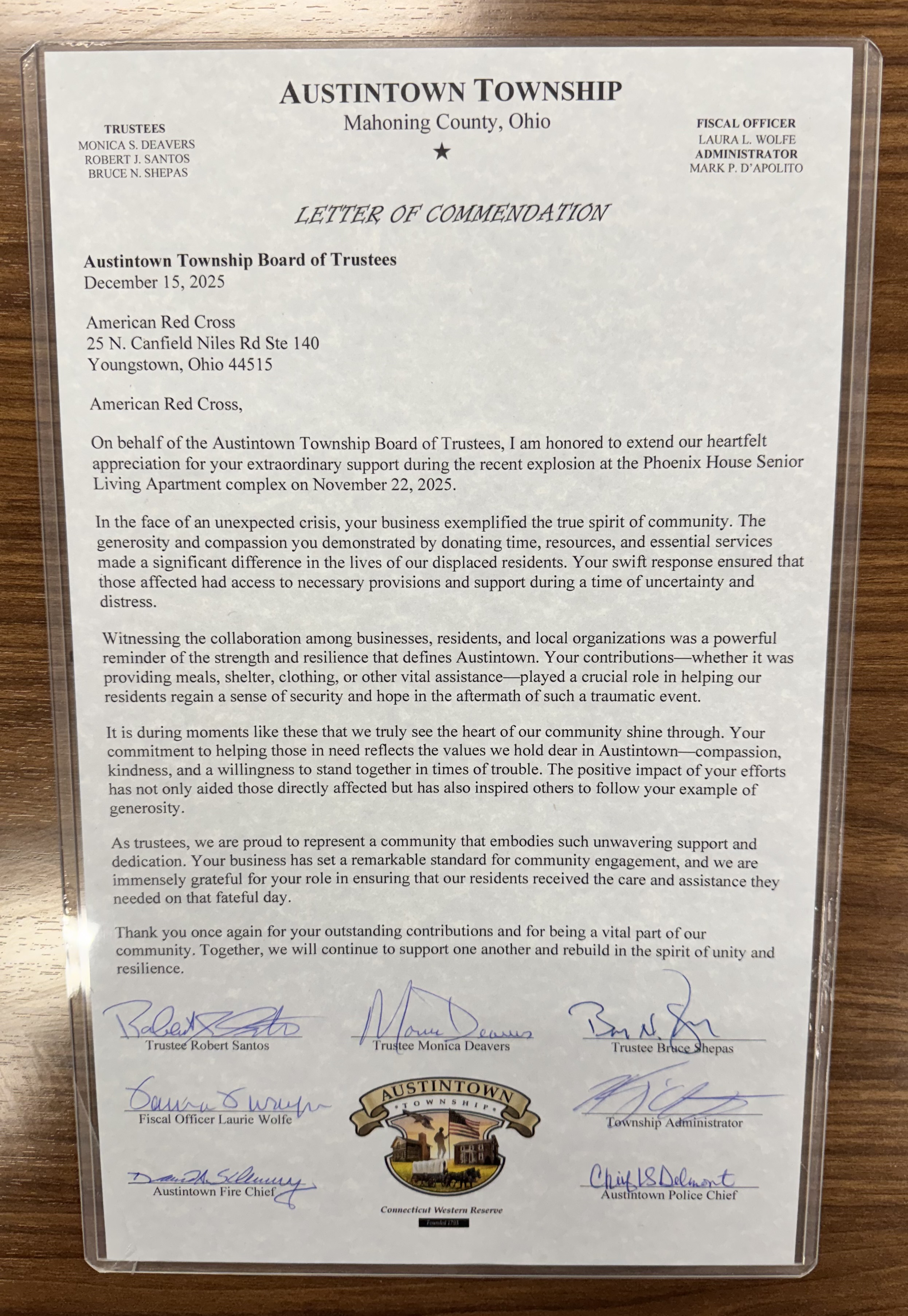
On February 2, 2026, in recognition of those efforts, the Austintown Township Trustees issued the American Red Cross of Northern Ohio a Letter of Commendation, highlighting the collaborative efforts of our team and our community partners.
The commendation reads, in part, “In the face of an unexpected crisis, your business exemplified the true spirit of community,” which is what the Red Cross of Northern Ohio does best. Shoutout to our region’s Community Disaster Program Specialist, Lisa Friend-Timko, who led the charge and coordinated one heck of a relief effort.
Each day in Northern Ohio, the American Red Cross collects and distributes lifesaving blood platelets to help treat people fighting cancer, chronic diseases and traumatic injuries. Platelets are crucial in treating cancer, as they are a key blood clotting component.
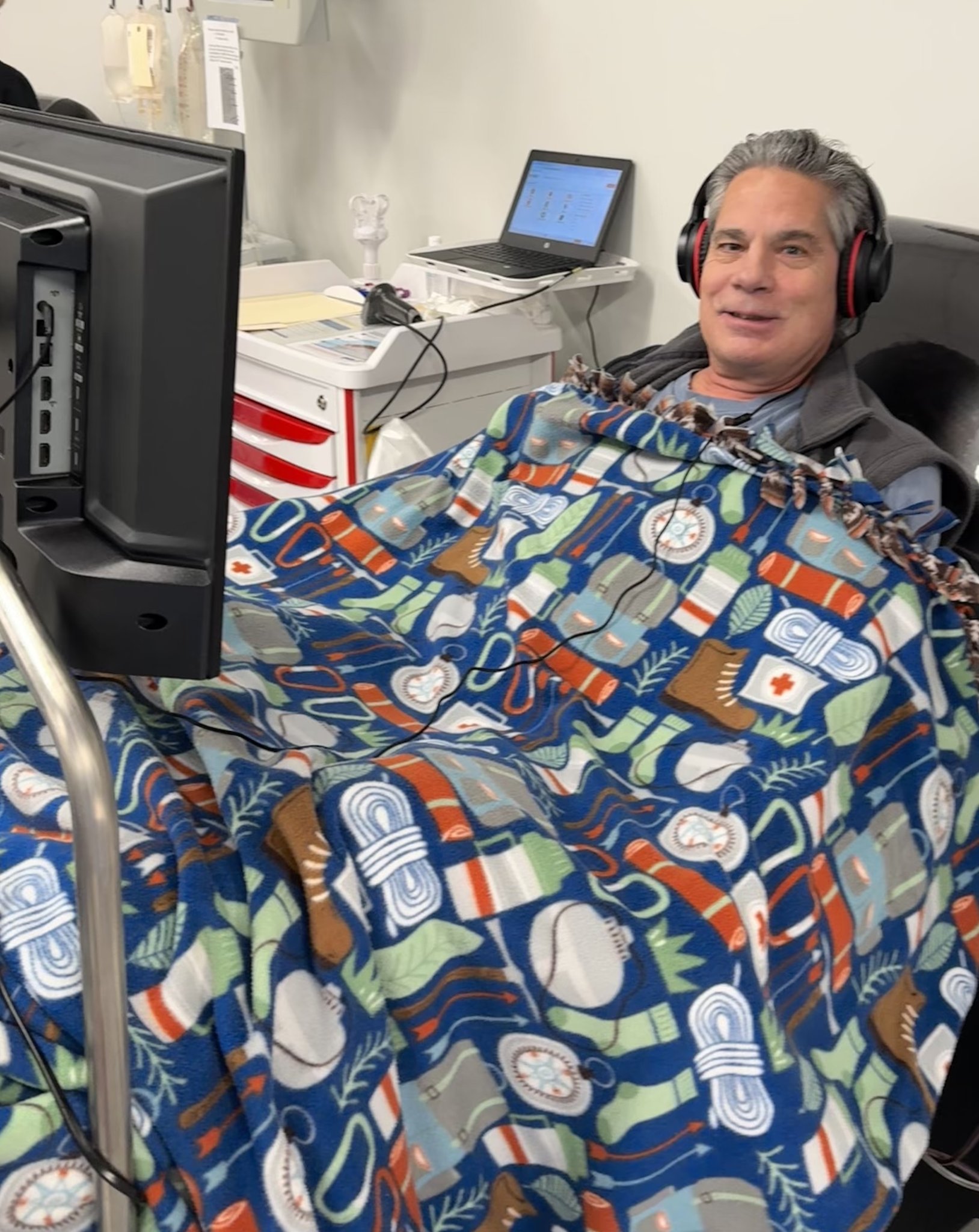
Karl donating platelets at the new Willoughby Blood Donor Center. Karl’s been donating platelets for roughly 30 years! “A kid at the school where my wife worked was diagnosed with cancer and they were looking for people to donate platelets,” Karl said. He stepped up decades ago and continues to do his part to save lives today.
Platelets have a shelf life of only five days, and a unit is needed every 30 seconds in the U.S., creating continual demand.
February 4th is World Cancer Day, which focuses on a disease that has deeply touched many of our lives. For 2026, excluding non-melanoma skin cancers, The American Cancer Society expects about 2.1 million new cancer cases to be diagnosed in the U.S., over 78,000 of them in Ohio.
As the Red Cross supplies 40% of the U.S.’s blood supply, we wanted to focus on the power of platelets in fighting cancer, especially as the Red Cross is currently facing a blood shortage and needs your help.
I spoke with James Keane about his experience on the importance of blood platelets for cancer patients. James’ daughter, Molly, was treated for leukemia from 2015 to 2017, beginning when she was 7 years old.
“When Molly was in the hospital,” James said, “especially during the first few months of her treatment, she got platelets all the time. Both the nature of her leukemia and the course of her treatment made it an almost-daily thing for weeks, if not months. If I recall correctly, there were some medications she received which required a platelet transfusion as part of the protocol.”
James has been aware of blood products much of his life, since his grandfather’s career was at a lab where his team separated blood products. Because of his family history, James asked the doctors and nurses “where all these yellow bags were coming from.” He would have asked if he thought blood shortages were something he needed to worry about but thinks he would have been told “no” even if not true. James explained, “Pediatric doctors and nurses are very careful to only let you know about the things you should be worrying about and watching for at the moment. They are very good at keeping you on a need-to-know schedule, shielding parents from worrying about things in the distant future or otherwise out of their control. There was generally plenty to worry about in the moment.”
To answer James’ question of where blood platelets come from, the vast majority are from platelet donors. An apheresis machine collects the donor’s platelets along with some plasma, returning red cells and most of the plasma back to the donor over about two hours. Platelets can be donated every seven days, up to 24 times a year.
As we make our way through the first couple of weeks of the New Year, our “To Do” lists are no doubt full, maybe some with a few things that we should’ve taken care of in 2025. No judgements – we all have tasks we need to catch up on.
But when we’re making those lists and catching up on our tasks, are we keeping in mind the people who might need us the most?
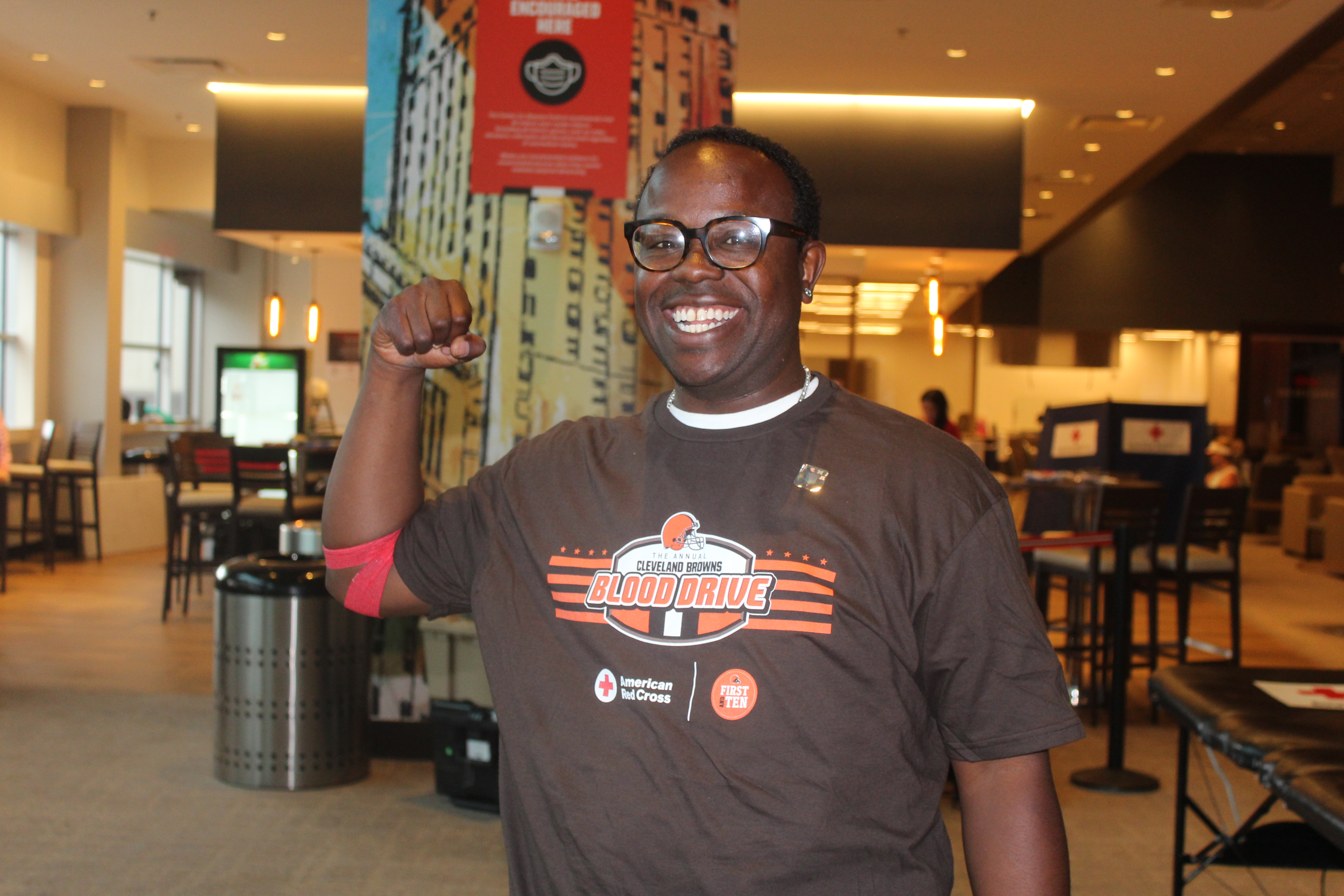
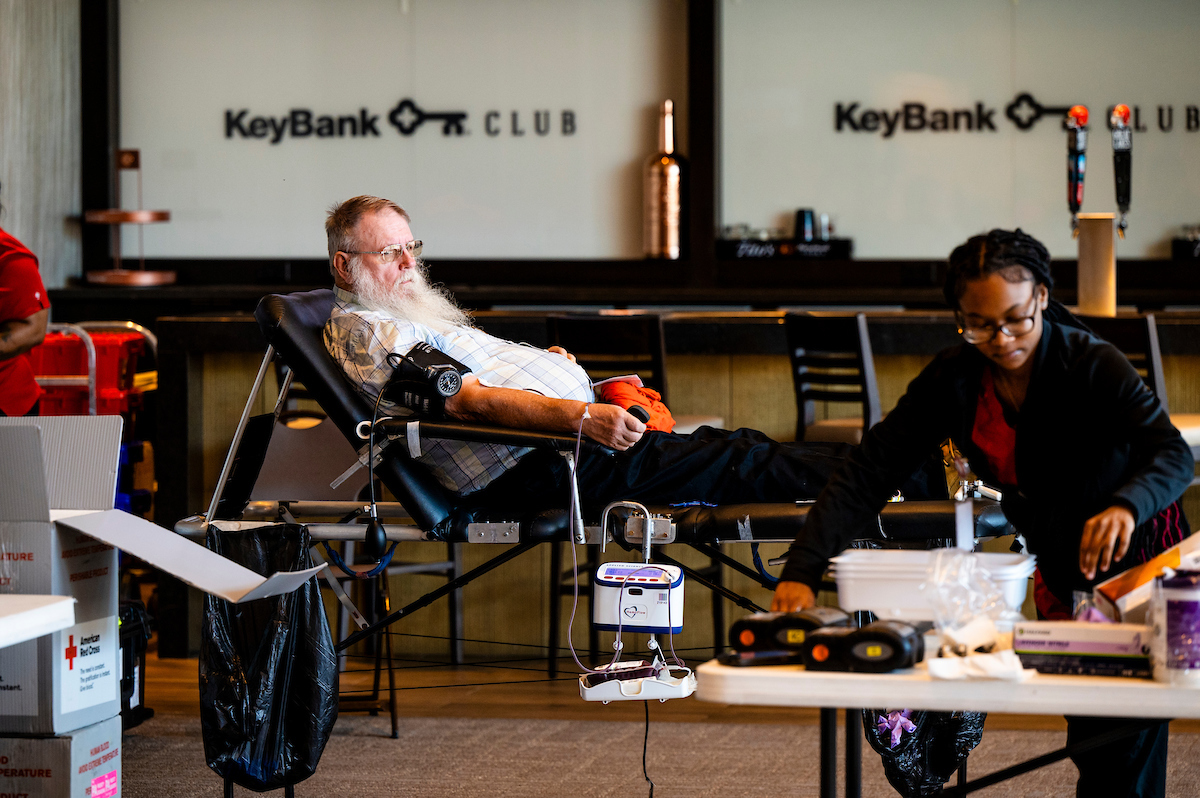
Browns Give Back hosted our annual First and Ten Blood Drive in the KeyBank Club of Cleveland Browns Stadium in partnership with the American Red Cross on July 27, 2024.
Coming off the holiday season, the American Red Cross is teetering on a blood shortage. For the better part of the past two months, we’ve been focusing on time with family and friends, gathering around the dinner tables and the Christmas trees, sharing in all the seasonal joy. For patients who rely on lifesaving blood transfusions, their holidays were likely a little bit different – spent more in hospital beds than around holiday tables.
A blood shortage isn’t just felt on a large scale, but also on a deeply personal level. Patients with conditions such as sickle cell disease, cancer, or chronic anemia depend on regular transfusions. These winter months can delay travel plans or slow down our routines, but they don’t delay clinic visits for patients who rely on these transfusions. Their need is constant, just like the need for blood.
As we settle into 2026, the Red Cross is encouraging donors to schedule a blood donation appointment to ensure the blood supply remains stocked. You can make your appointment by:
1. using the Red Cross Blood Donor App 2. visiting RedCrossBlood.org 3. or calling 1-800-RED-CROSS
And, if you donate blood between now and the end of January, you are automatically entered for a chance to win a trip for two to Super Bowl LX in the San Francisco Bay Area, as our thank you for helping during the critical post-holiday time!
The winner and guest will get to enjoy Super Bowl LX in Santa Clara, CA, access to day-of in-stadium pregame activities, tickets to the official Super Bowl Experience, round-trip airfare, three-night hotel accommodations (Feb. 6-9, 2026), plus a $1,000 gift cardfor expenses.Click here for more details!
I’ve recently discovered a connection between my family and the Red Cross going back to the Johnstown Flood of May 31,1889 when Clara Barton’s Red Cross became a national life-saving organization whose efforts helped my great grandpa’s survival.
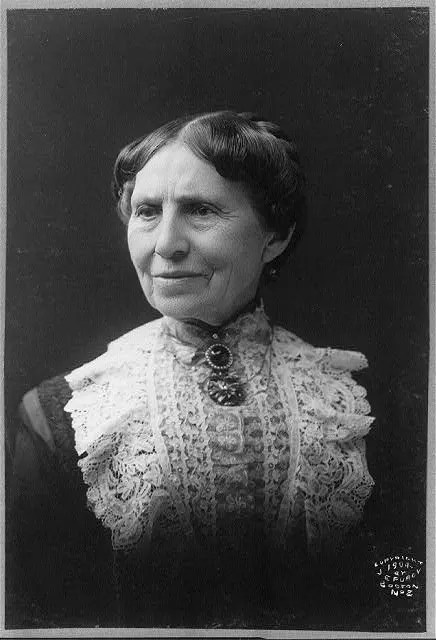
Clara Barton, Library of Congress
I thought my ties with the Red Cross began when I became a lifeguard at 15. My service continued as a young spouse volunteering at an Army clinic on an infantry base in Vilseck, Germany before becoming a part of the Northern Ohio Chapter when my husband retired.
However, the personal link goes back further and has a more profound impact than I realized. Now that we’ve moved back to my childhood hometown, I’ve had more opportunities to research my family’s roots, especially after inheriting ancestral documents, including a memoir
The family account written by my Great Uncle Andrew described life in Johnstown Pennsylvania at the turn of the 20th century and focused quite a bit on his dad, my Great Grandpa Stefan Furst.
Though I heard family stories as a kid, I had vague notions of the immigrant experience during the turn of the 20th century when relatives from all sides of my family left Czechoslovakia.
Like many migrants from Eastern Europe at the time, they first settled in the Appalachian Mountains outside of Pittsburg in Fayette and Cambria Counties. They worked in the coal mines before moving to Cleveland for better pay and working conditions in factories.
My dad also told us kids his grandpa survived the Johnstown Flood and that his mother, Margaret, grew up under the constant threat of a disaster, as there were more floods after 1889.
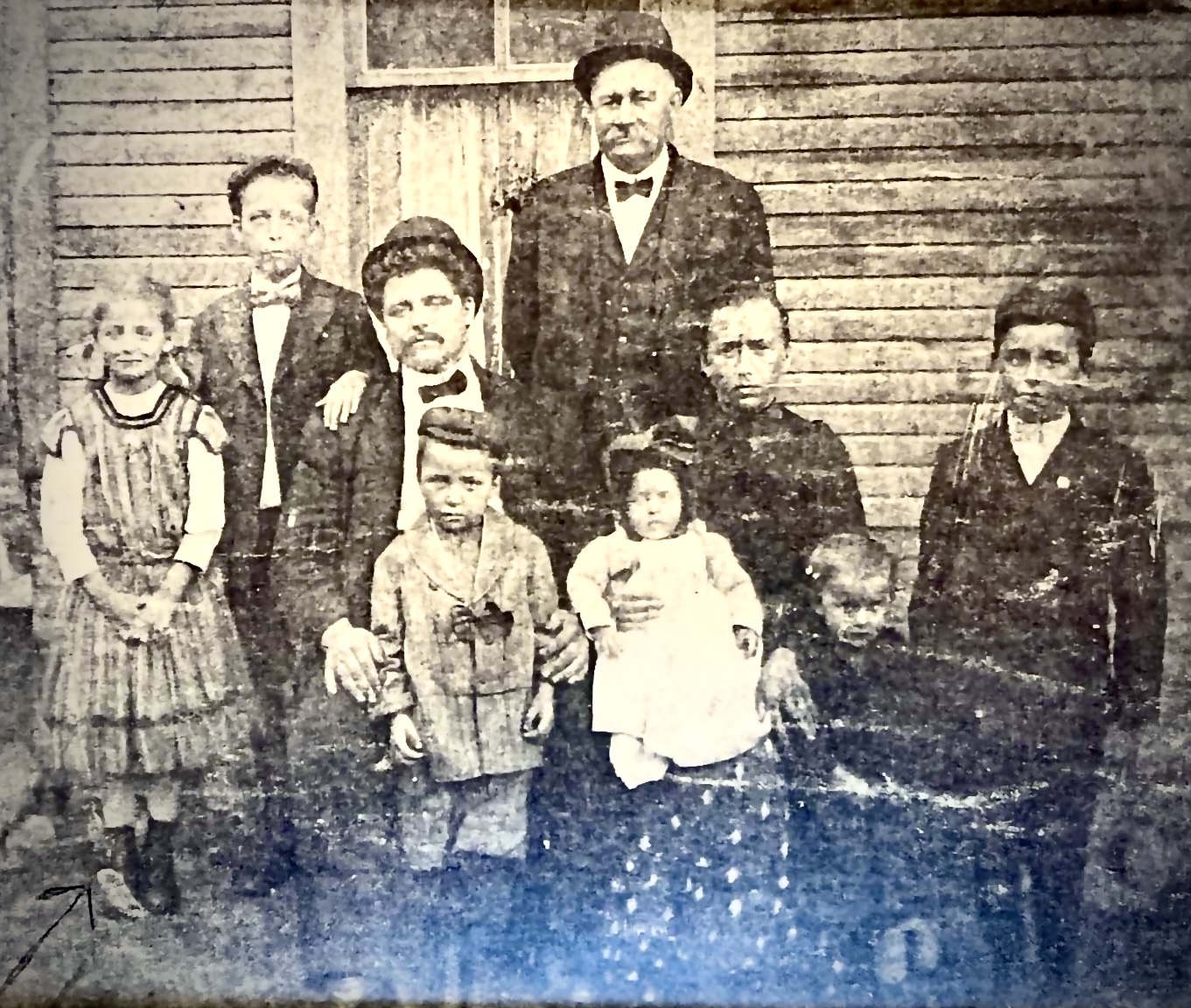
The Furst Family Johnstown, PA Stephen and Elizabeth sitting middle, Maragret and Andrew standing left
In my continued research online, I found out that my great grandpa arrived from Slovakia in 1884, at age seven. However, I couldn’t find records of parents or siblings that might have come with him. So, this summer I went to Appalachia using the paper trail left to me to uncover more information about where my family first lived in America.
My first stop took me to Uniontown’s history room in Fayette County where a researcher pointed out a chair that Clara Barton had used when helping displaced people after the Johnstown Flood in neighboring Cambria County. Historic rains and the breaking of the poorly maintained South Fork Fishing Dam destroyed the city of 30,000, taking more than 2,200 lives.
The “Angel of the Battlefield” from 25 years earlier during the Civil War was in her D.C. office when she learned of the horrific tragedy. At 67 years old, Clara Barton quickly gathered a team of 50 nurses and doctors, and with a load of supplies, arrived in Johnstown five days later.
The Red Cross remained in Johnstown for six months, providing supplies, temporary shelter, medical care, reuniting families, and finding homes for orphans.
My great grandpa was twelve at the time of the flood. If any other family members were with him, there are no indications of survival –just the account of his dad written by Andrew.
In addition, not only were records destroyed, but in the wake of devastation, “journalists” falsely accused immigrants of looting which resulted in vigilante violence and lynchings. From resources I read like David McCullagh’s book, The Johnstown Flood, detailing the immigrant experience in the flood’s aftermath, I imagine my own remaining relative laid low.
Nevertheless, my great grandpa did make it out alive due to the Red Cross and other relief efforts assisting anyone in need, regardless of their ethnic derivation.
As I stood in the Uniontown library this summer, looking at the chair, it dawned on me that my great grandpa likely stood in front of Clara Barton as she sat on that simple wooden seat, providing him food and shelter as she did for 1000’s of other destitute people after that flood.
In the following years, my great grandpa lived in a neighboring town. But once he turned 18, he moved back to Johnstown when he met his wife, Elizabeth, and they went on to have six kids.
Additionally, though he worked in the coal mines for a few years, the citizens of Cambria County elected my great grandpa constable, often times a lifetime position. He then worked for his community until his sudden death in 1916 at the age of 38.
A couple of years later, my Great Grandma Elizabeth remarried a widower and soon after they moved to Cleveland’s Slavic Village with their children. My Grandma Margaret and Great Uncle Andrew also went on to have their own families, with Andrew living to 100 years old.
Although my great grandpa had a short life, he lived through tremendous change and survived devastation with help from people like Clara Barton.
In sum, though my writing involves historical research, this family project has further opened my eyes to the significance of details and numbers when reading old documents, as well as the relief efforts associated with major tragedies.
I not only understand how the Johnstown Flood became the impetus of the Red Cross becoming an international relief organization but have gained a deeper gratitude for all individual relief efforts 136 years ago as they ensured my family’s survival.
I also feel more fortunate to be part of the organization that saved my great grandpa. From working in that little clinic in Germany as a new Army wife to my hometown of Cleveland as part of the Service to Armed Forces, I’m proud to be a Red Cross volunteer.



 NOHredcross