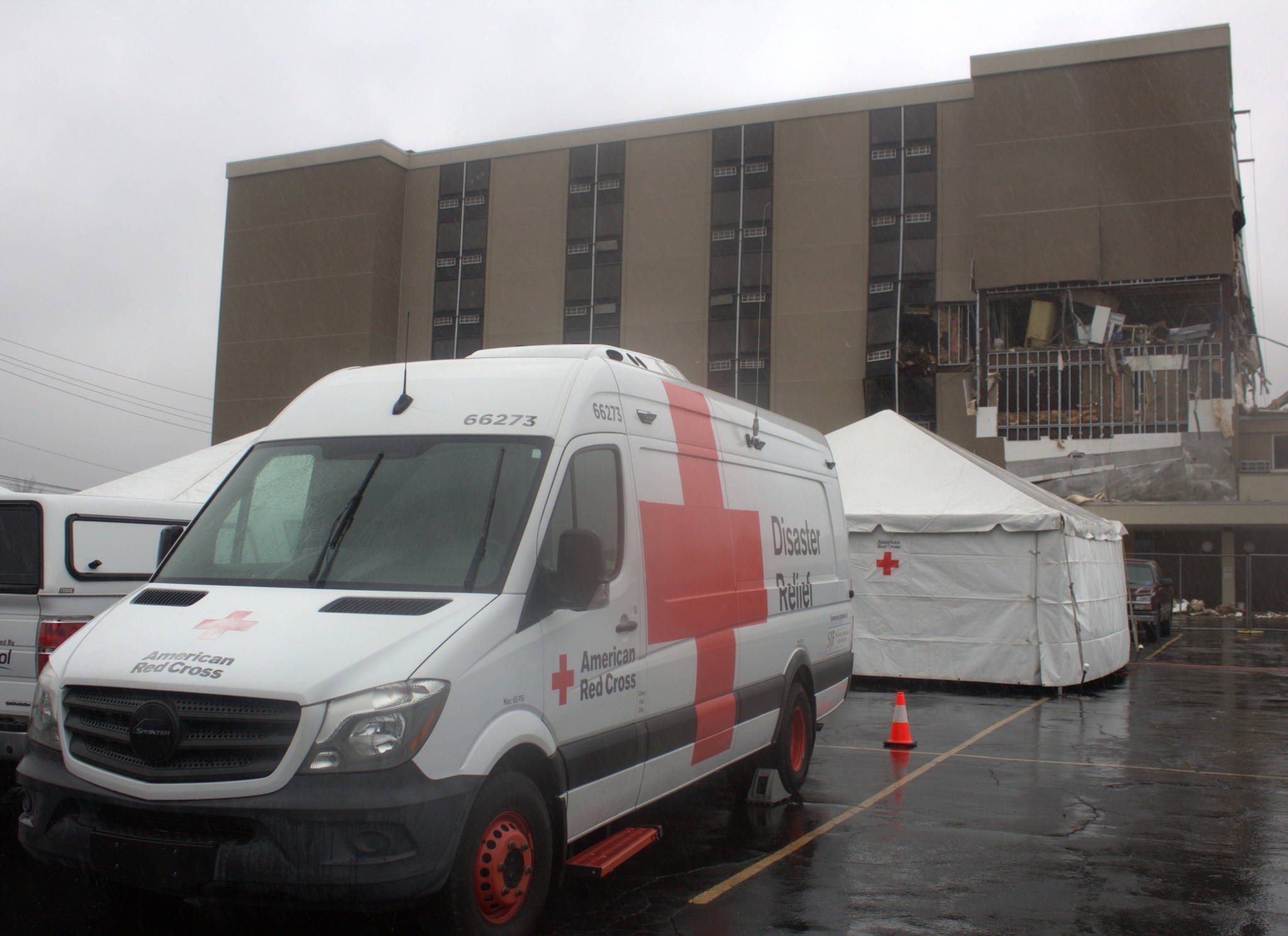
On Saturday November 22, 2025, an explosion displaced dozens of residents at the Phoenix House senior living apartment complex in Austintown Township, Ohio.
Red Cross MRV outside the Phoenix House apartment complex in Austintown Township after an explosion displaced dozens of residents.
Red Cross volunteers were on scene quickly, providing immediate needs for those residents who were left out in the cold. Within hours, our Disaster Action Team members from across the region were in Austintown Township, coordinating with first responders, local leaders, and community partners to best serve these residents.
A staging area was set up at the local senior center and the Red Cross went to work. When it was deemed safe, the Red Cross set up tents outside of the apartment complex to triage residents going into the complex to retrieve essentials such as medicine, personal belongings, and more.
Our volunteers were out in the freeing temperatures and rain for days, assisting residents with not just this process, but opening cases for these people to get much-needed financial assistance. This relief effort lasted weeks, and our volunteers and DAT team members worked tirelessly through the Thanksgiving holiday to make sure that these people, who were living through their worst nightmare, had what they needed when they needed it most.
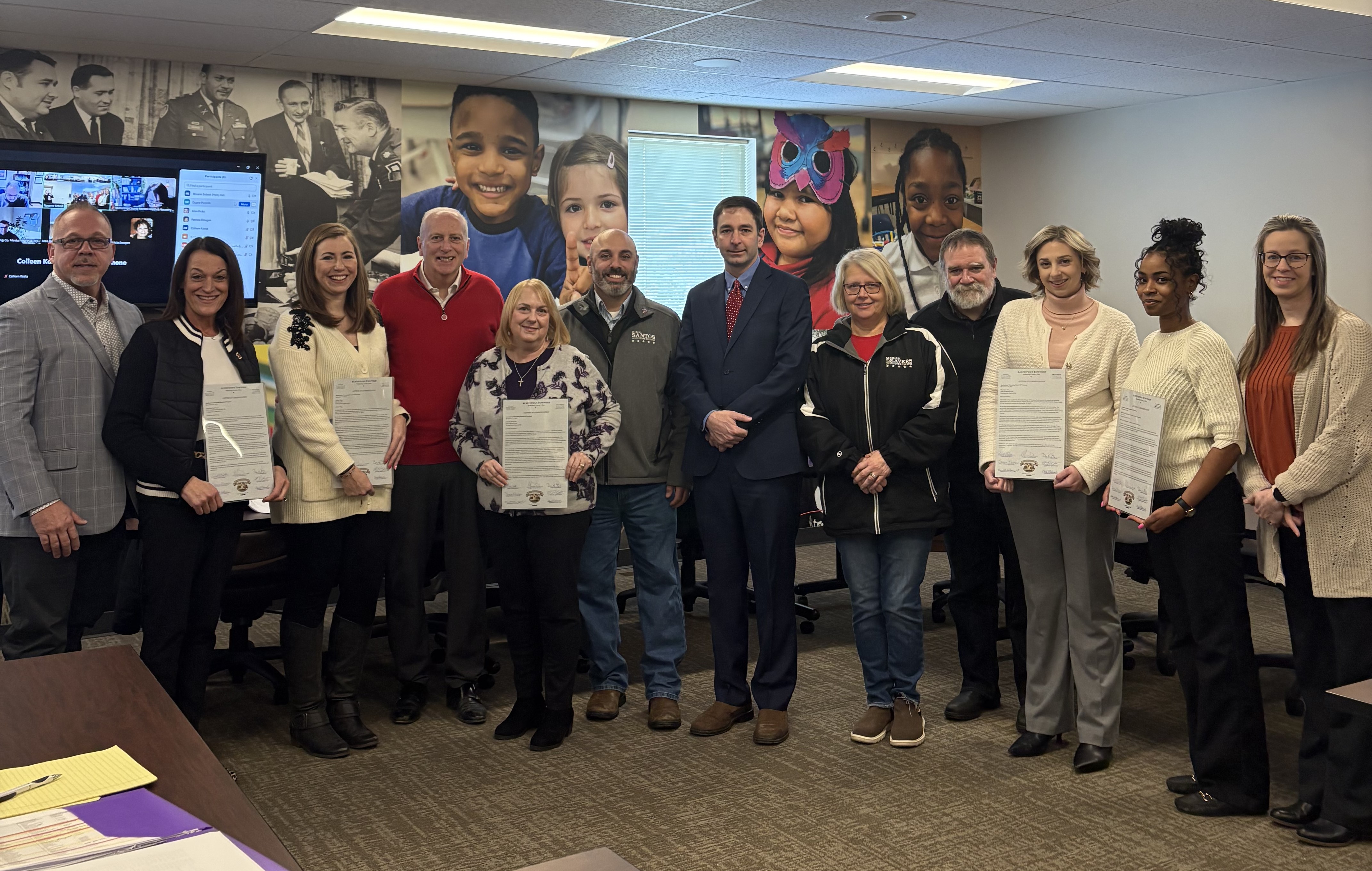
Austintown Township Trustees recognizing the efforts of the American Red Cross of Northern Ohio and other community partners and organizations for their efforts in the wake of the Nov. 22, 2025, explosion at the Phoenix House apartments.
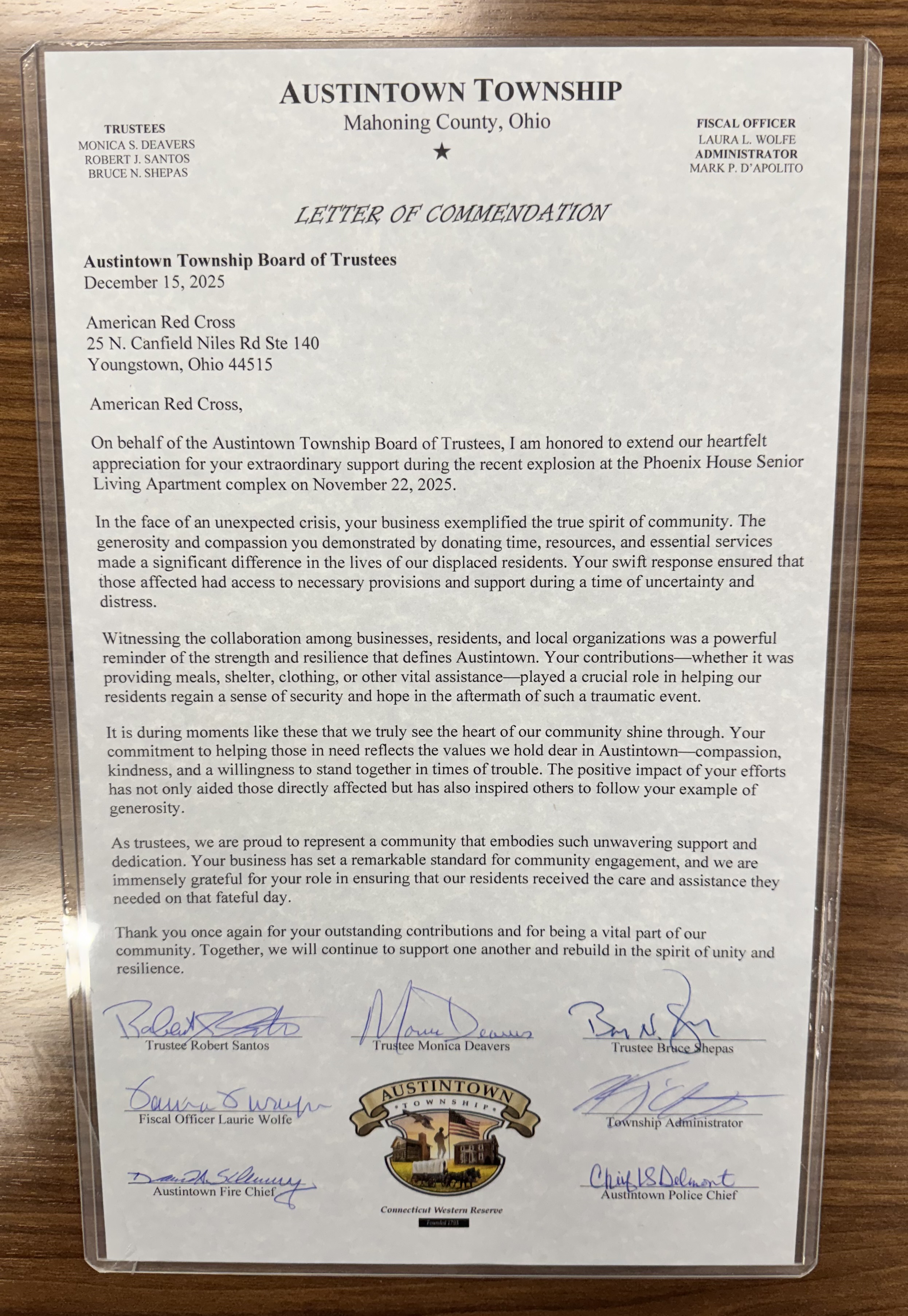
On February 2, 2026, in recognition of those efforts, the Austintown Township Trustees issued the American Red Cross of Northern Ohio a Letter of Commendation, highlighting the collaborative efforts of our team and our community partners.
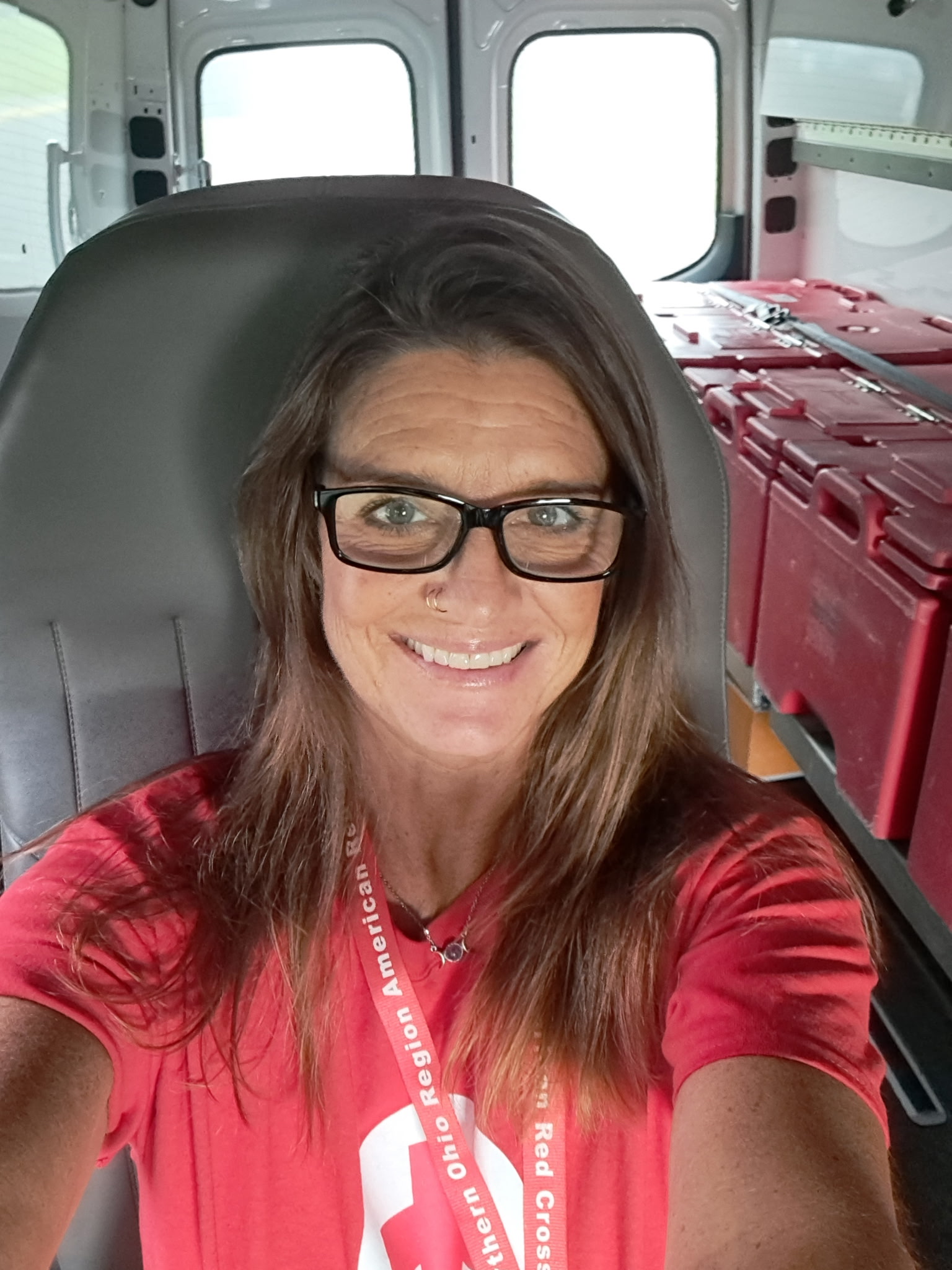
The commendation reads, in part, “In the face of an unexpected crisis, your business exemplified the true spirit of community,” which is what the Red Cross of Northern Ohio does best. Shoutout to our region’s Community Disaster Program Specialist, Lisa Friend-Timko, who led the charge and coordinated one heck of a relief effort.
In 1996, two hurricanes made landfall in North Carolina: Hurricane Bertha, a category 2 storm, followed 8 weeks later by Hurricane Fran, a category 3 storm. The combined damages produced by these storms in North Carolina totaled over 2.5 billion dollars and caused the evacuations of over a million people.
Natalie Whitmer, American Red Cross volunteer
Natalie Whitmer, an American Red Cross volunteer based out of Canton, Ohio, was one of those evacuees. She was living in North Carolina at the time and experienced firsthand being displaced to an evacuation shelter run by the Red Cross.
Following the storms, she and her husband returned home to assess the damage. “We found that the front half of our mobile home was destroyed. That’s where my daughter’s bedroom was, so a lot of their clothing and their bedding and all of that stuff was lost.” Natalie explained.
The Red Cross had also deployed ERV vehicles, or Emergency Response Vehicles, which drove through their neighborhood and provided food and water after the storm.
“They had set up an office, and they just asked the address, where we lived, what happened, what I’m missing, what I need help with, and they gave me a voucher to be able to go and get diapers and clothing for my children, which was amazing…I think it was like six weeks we were without water and electricity.”
Her story came full circle when in 2024, now Red Cross volunteer, she was deployed to another pair of hurricanes, Helene & Milton, that hit within a 2-week timespan. There she manned a Red Cross ERV and supervised an evacuation shelter. Regarding that time, she reflected, “It’s amazing that I’m (now) on this end of it (and) able to do the same.”
Since joining the Red Cross in 2023, Natalie has deployed multiple times to a variety of disasters, assisting in sheltering, feeding, and other vital roles. She also now works as a Casework Supervisor Coordinator for the Northeast Ohio Chapter.
“It’s extremely fulfilling and it’s just so comforting knowing that we have an organization out here that has all of this to offer,” she said. “I never knew Red Cross had so much until I started working with them, and it just blows my mind. It’s just an absolutely beautiful organization, their mission and everything, and the people that run it, all the volunteers.”
This holiday season, consider giving back to others by donating your time as a volunteer. Click HERE to find out more about becoming a Red Cross Volunteer and all of the opportunities available at the Northern Ohio Chapter.
On Friday, October 17, 2025, I said goodbye to my wife and my two young sons before leaving for Alaska for two weeks. As I texted other family and friends about my deployment, there was one response I saw more than any other: “What happened in Alaska?” Of course I knew, it was my job to know, but most of the rest of the world hadn’t heard. Alaska’s story hadn’t been told.
October 19, 2025. Kipnuk, Alaska.
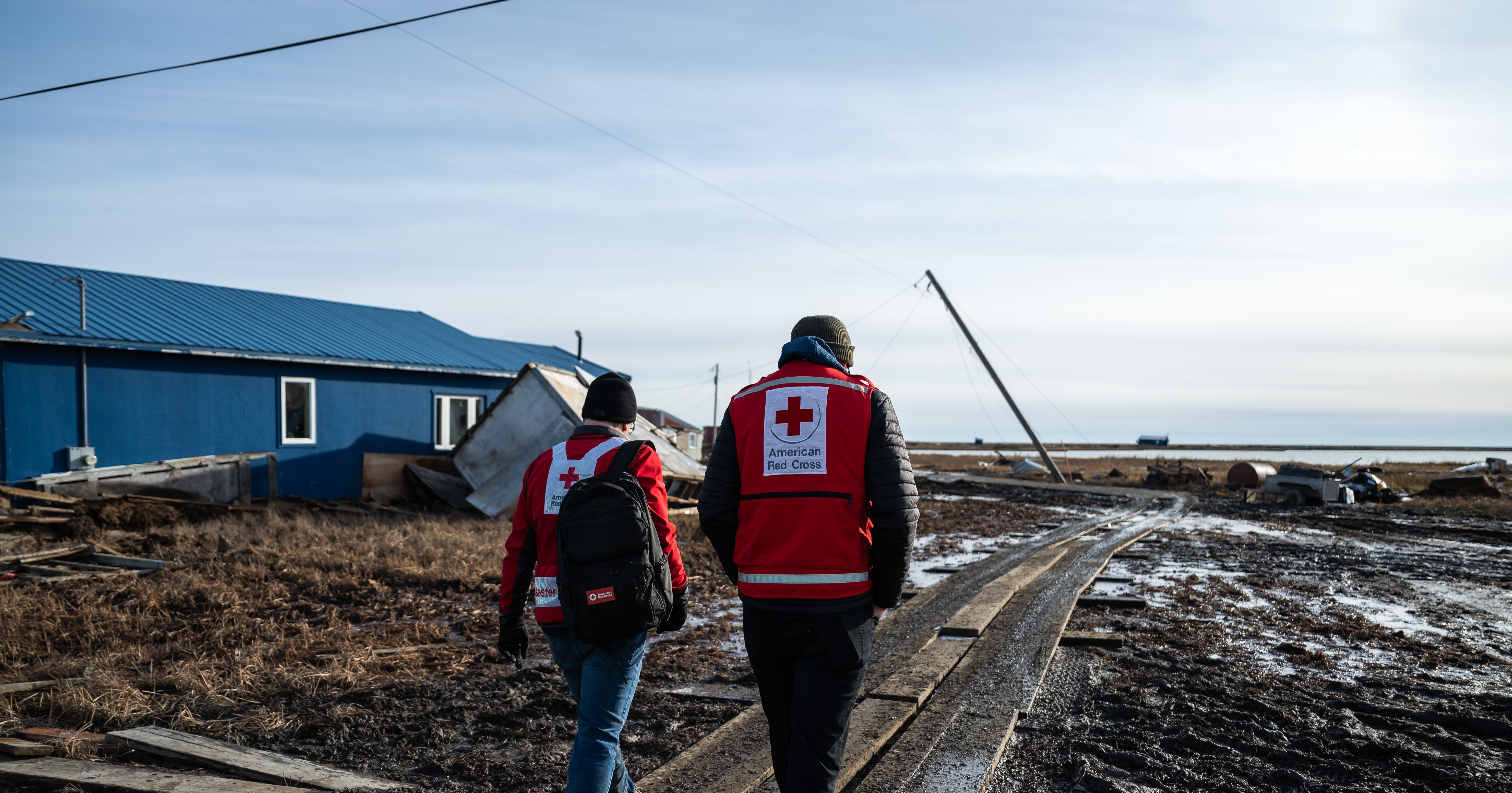
Red Crosser Dale Kunce in the heavily-damaged village of Kipnuk, on Oct. 19, 2025.
The Red Cross is helping in Alaska as officials stage one of the largest airlifts in the states recent history, evacuating entire villages that were left in ruins last weekend by Typhoon Halong. We are working with state, tribal, local officials and partners to support the evacuees who are being flown to shelters in Anchorage, where they will find a safe place to stay, food, emergency relief supplies, emotional support and health services. Hundreds of Red Cross disaster workers from across the country are being deployed to help during what could be a prolonged relief response with access to some villages cut off and others left uninhabitable as Alaskas winter sets in.
Photo by Scott Marder/American Red Cross
The early morning of October 11, 2025, the remnants of Typhoon Halong devastated indigenous villages along the west coast of Alaska. Hundreds of residents, primarily from Kipnuk and Kwigillingok, were evacuated – first airlifted to Bethel, where the U.S. Army National Guard established a transitional shelter, and then flown to Anchorage on a military C-130 plane. Residents left behind their homes, or what was left of their homes, their valuables, mementos, even their pets. They left behind everything.
In Anchorage, the American Red Cross established two shelters – one at the Alaska Airlines Center at the University of Alaska Anchorage (UAA) and another at the William A. Egan Center downtown. Residents of these villages moved into their new temporary homes, uncertain what was next.
“I still can’t believe we lost our place,” said Gilbert Amik, speaking of his home in Kipnuk that was washed away in the storm. “But help is here… We will move forward from here.” For Gilbert, a big part of that help was Red Cross volunteer Deb Blaze, from California. She and Gilbert built a special bond over the time Gilbert and his mother, Carrie, had been staying at the shelter at UAA.
Red Cross volunteer Deb Blaze hugging Gilbert Amik, resident of the village of Kipnuk in Western Alaska, who was evacuated, along with his mother, in the wake of Typhoon Halong. Photo by Ryan Lang/American Red Cross
“It makes me feel good,” Gilbert said, expressing gratitude for the help he and his mother received, specifically from his new friend. Deb said, “It was a special bond. It was like we were supposed to meet.”
Gilbert and Deb’s story was just one of countless inspirational anecdotes that came out of the tragic storm. The people I spoke with during my two-week deployment were resilient, strong, kind, and faithful – both the residents and the Red Crossers.
I met a young girl, just nine-years-old, who despite losing her home brought so much joy to others in the shelter. I met a volunteer from Alaska who carried around a Yup’ik bible with her for days, just so she could get it to a resident who requested it. I met a tribal elder from the village of Kipnuk who spoke to the younger generation about faith, hope, and strength. I met a group of people who made me want to be better, and I’ll continue to tell their story.
Alli’s first Red Cross deployment story
Alli Katterheinrich on her first Red Cross deployment in Anchorage, Alaska, October 2025.
Alli Katterheinrich is a Regional Philanthropy Partner for the Red Cross of Northern Ohio. She deployed to Alaska as part of the Special Public Outreach Team, telling the story of people directly impacted by Typhoon Halong.
“I got the call on a Tuesday and was on a plane the next day,” Alli said. “It was a lot to process,” she said, talking about wrapping her head around her first deployment as a Red Crosser and being thousands of miles away from home.
The time difference was a challenge for Alli, who said sometimes it was difficult to get in a phone call with her husband. The darkness was another challenge. “I’m a morning person and I get up early, but the sun doesn’t come up until 9 a.m. here, so even that was a major adjustment,” she explained.
But it was the residents’ stories that helped, Alli said. “I spoke with so many village residents who took me through their entire experience,” she said, “from being airlifted from their homes to their time in our shelters. I feel very fortunate that they feel comfortable enough to share their stories with me.”
“So much of it was organic,” Alli said. “People would see me sitting, wearing my Red Cross vest, and they would come up and start talking to me and telling their story.” And for Alli, me, and so many others I spoke with, it was those conversations and that storytelling tradition that was so cathartic. And it is the stories that we will carry with us.
A Northern Ohio story
Being thousands of miles away from your home for weeks, sometimes longer, can be hard on a Red Cross volunteer. You miss your family, your bed, your morning routine… You miss a lot. But it’s the friendly faces that make it a lot easier. “There were so many other volunteers from Northern Ohio,” Alli said, “and that helped.”
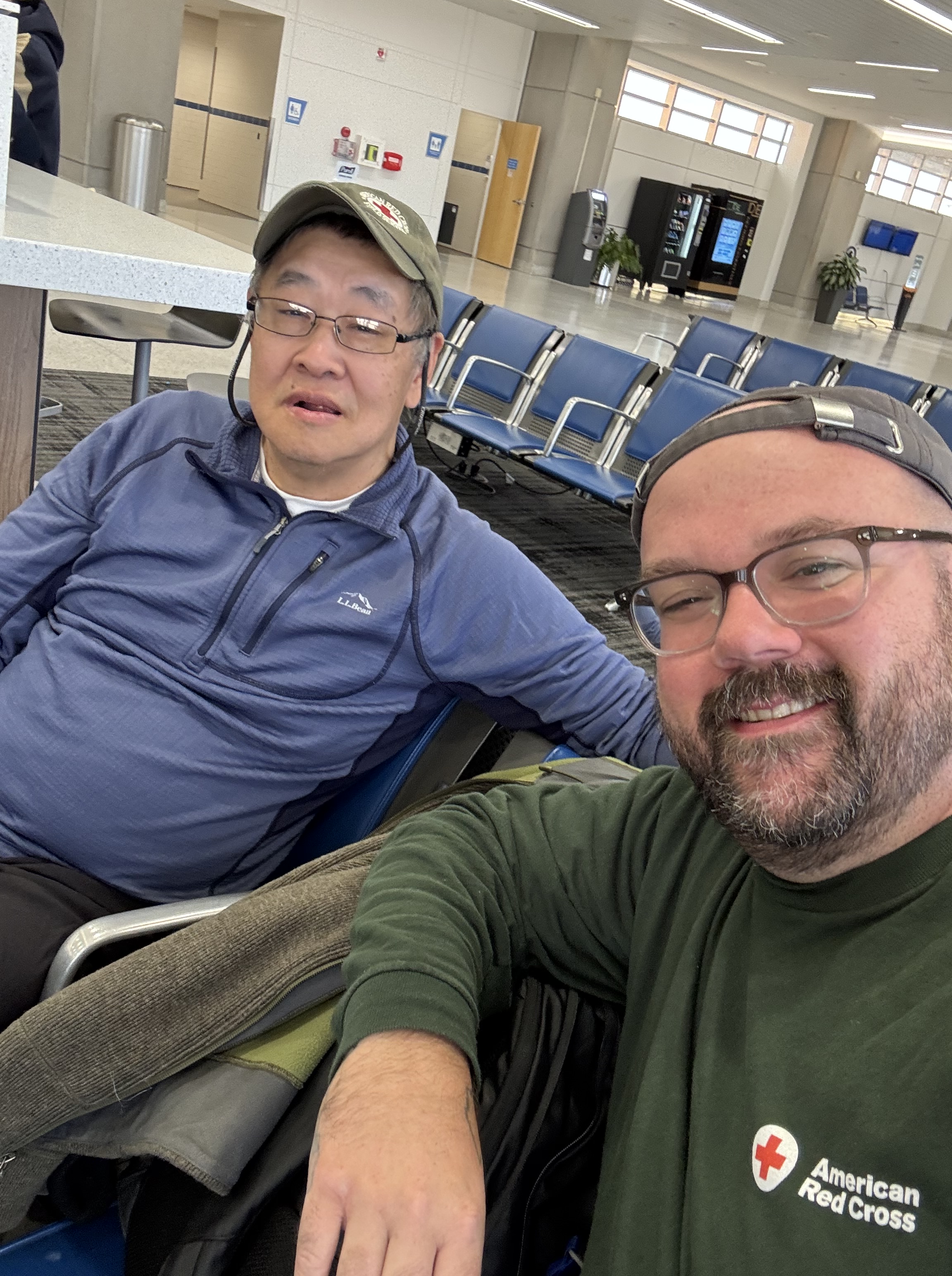
Randy Liang (left) and Ryan Lang at Akron-Canton Airport, waiting to take off to Alaska in response to Typhoon Halong that hit the western coast of Alaska in October 2025.
I met Randy from Cuyahoga Falls at Akron-Canton Airport, waiting to board our flight together. He’s an IT specialist who spent more than a month in Alaska, making sure the Red Cross staff had the connectivity they needed to execute the mission. Treacy from Northeast Ohio worked 12-hour shifts at the shelter for weeks, caring for residents, making sure they had what they needed. Callene, originally from Lorain, met with every volunteer who checked into the operation, helping acclimate them to the Alaska culture. Jeff, from the Heartland, Stark, and Muskingum Lakes chapter, worked tirelessly in the shelters, providing meals and snacks and more. And when it was time for those residents to leave, Jeff helped pack their things, sending them off with a smile and a hug.
The lifesaving mission of the Red Cross is not possible without these people who volunteer so much more than just their time. I’m grateful to be a small part of this group of incredible people, and I will continue to tell their story.
By Ryan Lang, American Red Cross board member and volunteer
Relief efforts continue throughout the Southeast weeks after Hurricanes Helene and Milton ravaged the Carolinas, Georgia and the Gulf Coast of Florida. The storms left a trail of damage totaling hundreds of billions of dollars and counting. At least 250 people were killed and dozens more are still missing.
American Red Cross workers and volunteers have been on the ground throughout the region since before the storms hit, operating shelters and assisting with cleanup. Those are the Red Crossers you’ve seen. But there are many more you haven’t seen, working tirelessly to reunite family members separated by the storms.
The Red Cross is one of many groups that work behind -the -scenes of a disaster to help reunite loved ones. We support requests for reunification that come in through our national call center including emergency welfare inquiries, family reunification requests and military inquiries.
Emma Banton, Regional Mass Care Manager
As of October 19, more than 11,500 inquiries have been made to help find missing residents in the Southeast. Regional Mass Care Manager for the Red Cross of Northern Ohio, Emma Banton, was assigned to help reunite people who are looking for their missing family members. She says the deployment has been extremely rewarding, but mentally and emotionally difficult at times.
“To be the person who can assist with reconnecting a family with their loved ones has been a tremendous feeling,” Emma said. “Unfortunately, so many lives were lost in this tragic disaster that the work of reunification does not always have the ending we hope for.”
Those cases that wind up working out as intended, with families and friends reuniting, are the reasons Emma and others do what they do. “Thank you for all that you do for the people affected by the hurricane,” one grateful family member wrote. Another person sharing their good news simply wrote, “They are OK,” letting Emma know she’d been in touch with her loved ones.
Monica Bunner, Red Cross disaster volunteer
Monica Bunner is a long-time disaster responder who has assisted with several national disaster relief operations. Monica said of her time as a reunification volunteer, “There is no greater demonstration of (the Red Cross’) commitment than to reunite loved ones who are emotionally struggling after a disaster.”
“It’s also a great opportunity for those who want to deploy but cannot be boots on the ground,” Monica added. “Equally important are the many team members who do the research, talk with the seekers and prepare (each) case virtually.”
To find out more about reunification, or if you need help finding a loved one in the aftermath of a disaster, click here.
Regional Red Cross executive reflects on most recent deployment
By Todd James, Executive Director, American Red Cross of North Central Ohio
Todd James in Iowa, June, 2024
I recently returned from a disaster relief operation in southwest Iowa, an area devastated by massive flooding in June. You’re probably trying to remember if you had heard about flooding in Iowa. You probably did, it was big news for a few days. But as is always the case, something else happened and the news moved on to cover the story of the day. Well, the cameras and reporters may have moved on, but for the people of Siouxland, as they call the region, moving on will be a long, hard process. I am so proud of the American Red Cross responders who left their own homes, jobs and families to rush into the devastation to offer shelter, comfort and hope, and I am honored that I had the opportunity to serve with them.
A month after the flood waters receded, with the help of the Red Cross, the community was able to focus on long-term recovery. What does that look like? It’s different for every family but all will need the help of many partners, non-profits, governmental agencies and the business community, working together. Our Red Cross long-term recovery team will continue to collaborate with these partners, helping and guiding them on how to come together to best serve those on the road to recovery.
The Red Cross is responding to nearly twice as many large disasters as we did a decade ago to help families and communities struggling with more frequent and intense disasters. In 2023 alone, the U.S. experienced an all-time high of 28 billion-dollar plus disasters that ravaged communities and forced hundreds of thousands of people to flee from severe storms, floods and wildfires.
This was my 41st disaster deployment and I have seen first-hand how disasters are happening more frequently and causing more damage. There is no more down time between big disasters, time when our responders can catch their breath, come home and focus on the great work the Red Cross is doing in their community. Now we are constantly responding to these large-scale disasters, as well as the thousands of home fires, storms and other disasters that happen every day but don’t make the headlines.
To equitably meet the growing and unique needs of disaster-affected families and communities, the Red Cross is enhancing our large-scale disaster response and recovery services, expanding financial assistance, strengthening local partner networks, and growing our disaster workforce. This effort includes fortifying the critical infrastructure and technology that enables 24/7 response to disasters across the country.
The need to help during disasters has never been greater. Please, join us to provide relief and hope when it matters most. Help people affected by disasters big and small, including climate-driven crises, by making a gift to Red Cross Disaster Relief at redcross.org or by calling 1-800-RED CROSS (800-733-2767). Our volunteers are at the heart of our mission and represent 90% of our workforce. Click here to sign up for opportunities to help. To help make sure your family and community are ready for a disaster before it happens, click here.
Posted by Ryan Lang, Red Cross board member and volunteer
Today, August 8th marks the one-year anniversary of the Maui wildfires, the deadliest U.S. wildfire in over a century. Most of the town of Lahaina was devastated. 3,710 homes were destroyed or made unlivable, and the confirmed death toll is now 102. As always, the American Red Cross quickly responded to the disaster and worked with partner organizations to bring much needed assistance.
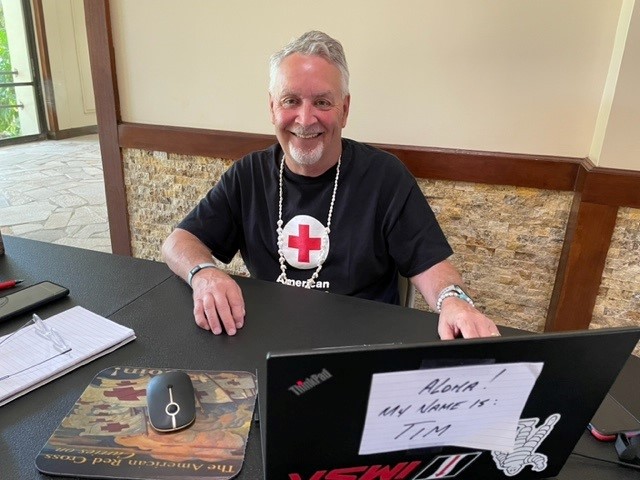
Several workers from the Northern Ohio Region joined the disaster relief operation on Maui, including Regional CEO Mike Parks, Regional Disaster Officer Emily Probst, Disaster Program Manager Tim Reichel, and Regional Communications Director Jim McIntyre. Several regional volunteers deployed as well, including IT specialist Randy Liang and Medina-based volunteer Monica Bunner.
Photos, from top left: Ohio Representative Dave Joyce and Mike Parks, Emily Probst, Tim Reichel, Jim McIntyre and Monica Bunner
For the anniversary, I spoke with Monica, who deployed to Maui for three weeks in late August and early September 2023, serving in the Disaster Recovery Operation headquarters as a Community Engagement and Partnership Manager.
Since she began volunteering with the Red Cross in 2017, Monica has deployed to several national disasters and serves as a disaster responder among other roles here in Ohio. Even with such experience, she had seen nothing quite like the Maui wildfires’ aftermath.
Randy Liang and Monica Bunner
Seeing the area following the disaster was a bittersweet experience for Monica. She had been to Maui several times before, mostly for relaxation, and knew the community. “I felt I really needed to be there to help,” she said.
And help was desperately needed. Monica said that the level of devastation was so widespread, and that the disaster unfolded with such speed that many of those affected were dazed, shocked, confused, and did not know how to proceed.
There was an immediate need for Monica to put her experience and organizational skills to work. Hawaii-based Red Cross personnel worked closely with those deployed from across the U.S., and the Red Cross coordinated with partner relief organizations and community representatives.
Monica said engaging and working with community leaders was critical, as Maui’s population is exceptionally diverse. (Maui County states its cultural heritages include Hawaiian, Japanese, Caucasian, Filipino, Chinese, Korean, Tongan, Samoan, and others.) As some groups were unfamiliar with Red Cross services and the commitment to help everyone following a disaster, Monica said ensuring all those impacted knew they had somewhere to turn for help was important, and she made sure to take time for everyone.
Each day, Monica had a stark reminder of the devastation. The shelter and headquarters were on opposite sides of Lahaina, and with each commute she saw the fire’s remnants and the growing memorials to the many lost lives.
And each day, Monica also saw the importance of Red Cross services. She and other Red Cross personnel took part in helping people find food, shelter, and supplies, locate loved ones, get critical information, receive financial assistance, connect with partner organizations, and find friendly, helpful faces and smiles. And most importantly, through all this, they helped people find hope. Monica said there is, “Definitely hope. Always hope.”
Watch this video on the one-year anniversary of the Red Cross response to the Maui Wildfires:
Finally, disasters occur each day, including Tropical Storm Debby, the current Park Fire, and home fires. Please consider volunteering or supporting the Red Cross.
Editor’s note: Hurricane Debby’s torrential rains are exacerbating the national blood shortage announced by the Red Cross on Monday.
Debby’s devastating flooding, power outages and travel hazards have forced the cancellation of blood drives in the Southeast, causing hundreds of lifesaving blood products to go uncollected when more donations are so desperately needed.
Tuesday’s tornadoes in Northeast Ohio also resulted in cancelled blood drives on Wednesday, resulting in about 130 donations going uncollected.
Even as we work to overcome this blood shortage, the Red Cross is providing food, shelter and comfort to communities affected by the hurricane in the Southeast and wildfires in the West. And disaster workers in Northeast Ohio continue responding to requests for assistance from residents whose homes suffered structural damage.
People urgently need aid now. You can help by making an appointment to give blood or platelets or financial donation by visiting redcross.org or calling 1-800-RED CROSS (800- 733-2767).
Polyrhythms of raindrops drum at the window, accented by rolling bellows of thunder, a severe late May storm approaches. Lights flicker. I am relieved the roof, damaged weeks ago, has finally been repaired. Yet as a Northern Ohio resident I am fortunate, as the region is less prone to natural disasters. Earlier, I watched reports from the latest of this spring’s tornado outbreaks. Amidst the catastrophic scenes, as always, American Red Cross volunteers and staff members are there, ensuring those impacted have food, shelter, care, comfort, and resources to begin recovering.
March 30, 2023. Amory, Mississippi.
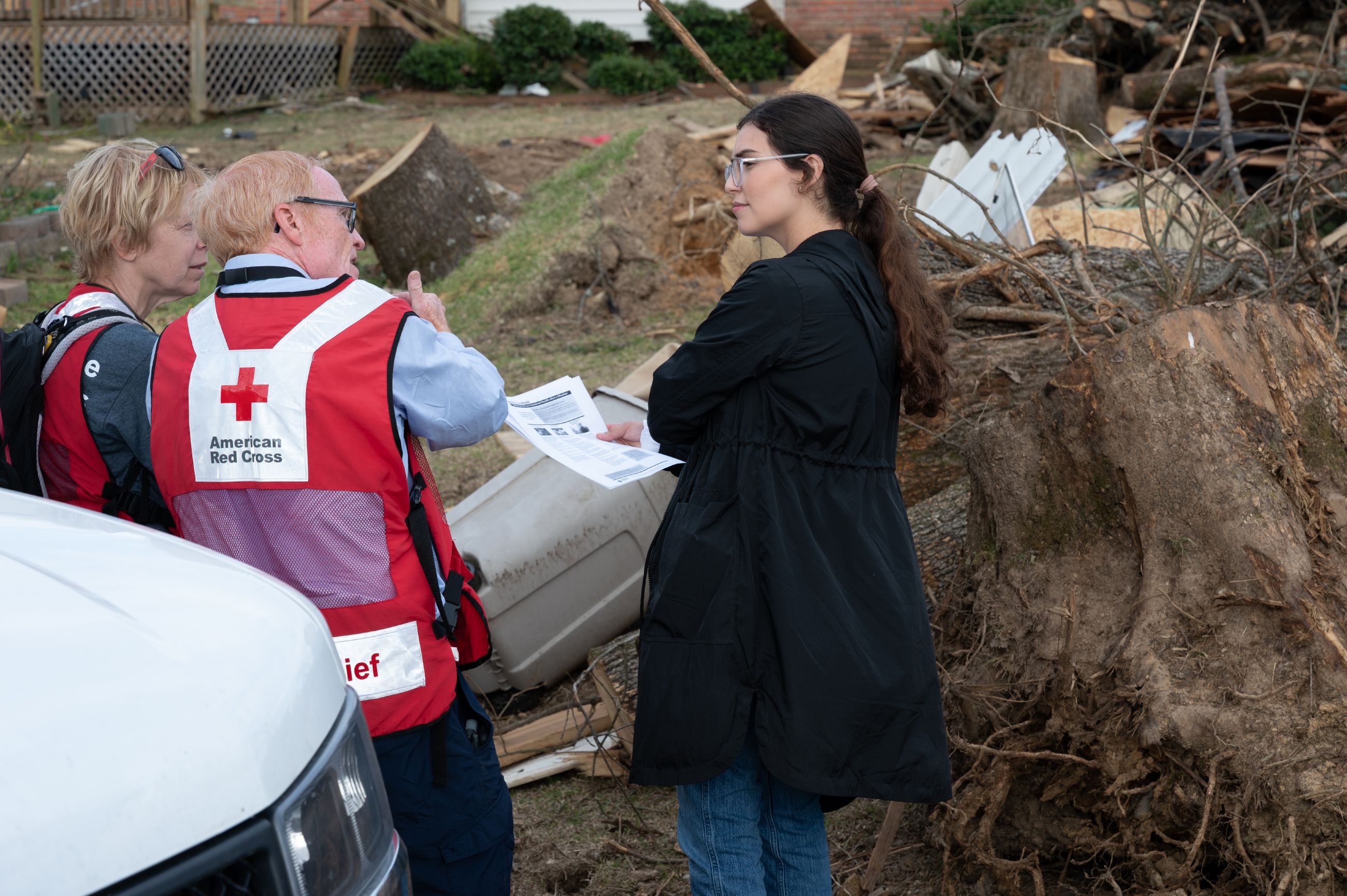
Red Crosser Eric Besson examines damage to a home on Thursday in Amory, Miss. As many as 2,000 structures across Mississippi received major damage or were destroyed by tornadoes on March 24. More than 380 trained Red Cross disaster workers are on the ground in Mississippi, Georgia and Alabama, as the nonprofit organization works with partners to make sure everyone has a safe place to stay, meals, emotional support and comfort in the aftermath of deadly tornadoes on March 24.
Photo by Scott Dalton/American Red Cross
As extreme weather events become more frequent and severe–and 2024 is predicted to be an exceptionally active year–the need for Red Cross services is increasing. Already, the Red Cross responds to almost twice as many large disasters than it did a decade ago, and in just the last 10 months, 125 volunteers from Northern Ohio have assisted residents affected by hurricanes and wildfires across the U.S. Four Northern Ohio volunteers are currently deployed to Texas and Iowa.
As eventful as 2023 was, with weather-related disasters forcing an estimated 2.5 million people from their homes, one-third of them for longer than a month, according to the New York Times, 2024 may be even more severe.
The National Oceanic and Atmospheric Administration (NOAA) reports that, as of May 8, 2024, the US has had seven confirmed weather/climate disaster events, each with losses over $1 billion, resulting in the deaths of 70 people. The NOAA also states there were 384 preliminary tornado reports in April, more than double the 1991-2020 average and the second highest April count on record.
March 31, 2023. Rolling Fork, Mississippi. Red Crosser Yolanda Gainwell visits with Karebya Christmas on Friday outside Christmas heavily damaged home in Rolling Fork, Miss. Christmas was home with her three children ranging in age from 2 to 11 years old when the tornado arrived. Just like Christmas grandmother taught her, she brought the family into the bathtub and put a pillow on top of them. No one was injured, but her home suffered major damages, disrupting their lives, as well as the self-owned business she ran from the home. On Friday, Christmas received help at a drive-through distribution center, where the Red Cross and partners distributed rakes, shovels, totes, clean-up kits, flashlights, batteries and more. Displaced, Christmas is staying at a hotel in Ridgeland, Miss. until at least Monday. As she finished talking with Gainwell, Christmas thanked her for coming to talk with her at her home, but with the damage rendering it uninhabitable, she hesitated to call it a home. I dont know what to call it my blessing in disguise, maybe, she said. Photo by Scott Dalton/American Red Cross
As summer approaches, the likelihood of an extremely active hurricane season and above-average wildfire season looms. Jim McIntyre, Regional Communications Director for the American Red Cross, Northern Ohio Region, recently conducted an interview with meteorologist Trent Magill of WEWS News 5. Jim and Trent discussed recent events, the need for planning and Red Cross services, and the outlook for the hurricane and severe storm season. Trent states, “everything we’re seeing shows above average intensity,” and that “it’s going to be a rough season.” Continuing, Trent says “Everyone should have a plan.”
Hopefully, you are wondering what you can do. For one, make sure you are prepared and have a plan. For another, please consider volunteering with the Red Cross. Volunteers account for 90% of the Red Cross workforce and represent a wide array of cultures, backgrounds, ages, gender identities, lifestyles, and beliefs, just like those we serve. Everyone is welcome, and free online training is provided.
April 9, 2023. Little Rock, Arkansas. William Burkey, a member of the Red Cross disaster mental health team, and Jamie Harms, a member of the disaster health services team, work together to bring comfort and hope to Paula Rocha, whose home was damaged by a tornado that struck Little Rock, Arkansas, and several nearby towns. Photo by Kevin Suttlehan/American Red Cross
Three key positions are especially needed: Disaster Action Team volunteers, who help families in need following a disaster; Shelter Services volunteers, who support day-to-day activities in an emergency shelter; and Disaster Health or Mental Health Services volunteers, who use their professional skills as licensed healthcare providers to assist those impacted by a disaster. Please consider joining, as I can personally attest you will work alongside outstanding people and the see difference Red Cross services provide.
Posted by Ryan Lang, American Red Cross board member and volunteer
Donate on GivingTuesday or give blood during the holidays to help for future crises
Randy Liang and Monica Bunner, volunteers from Greater Akron and the Mahoning Valley responded to wildfires in Hawaii
In 2023, extreme disasters took a devastating toll on people in the U.S. who turned to the American Red Cross for help coping with a record number of billion-dollar disasters.
So far this year, an all-time high of 25 separate billion-dollar disasters ravaged communities across the country, and more than 170 disaster workers from the Northern Ohio Region responded. They deployed to help people affected by extreme weather disasters such as: January tornadoes in Georgia, Alabama and Mississippi Flooding caused by an atmospheric river in California in March April flooding in Florida Tornadoes in Missouri and Arkansas in April Typhoon Mawar in Guam in May Catastrophic flooding in Vermont in July Southern California flooding in the wake of Tropical Storm Hillary in August Wildfires fueled by prolonged drought conditions in Hawaii in August Hurricane Idalia in Florida in August Hurricane Lee in New England in September
Red Cross volunteer Jeff Mann of Heartland, Stark and Muskingum Lakes deployed to Guam in response to Typhoon Mawar in May
Volunteers from Northern Ohio also responded to disasters in our own communities, including: The train derailment and chemical burn in East Palestine in February The largest shelter operation in Northern Ohio since 2004 following an apartment fire in East Cleveland August flooding in several north central Ohio counties Multi-family fires in Akron, Uhrichsville, and Maumee
Robert Gee, a resident of East Palestine, stayed in a Red Cross shelter after a train derailment there in February
In addition, families sweltered in the nation’s hottest summer on record. And back-to-back disasters led to a series of blood drive cancellations, which further strained the national Red Cross blood supply that was already dwindling from summer travel and back-to-school activities.
“Increasing extreme disasters are causing more humanitarian needs for families in Northern Ohio and across the country,” Mike Parks, Regional CEO of the Red Cross of Northern Ohio, said. “This holiday season, please remember those who need support in the face of emergencies — and join us to provide care and comfort by making a financial donation or by giving blood or platelets.”
Help on GivingTuesday and during the holidays by visiting redcross.org to make a financial donation or an appointment to give blood or platelets. Individuals can also register for volunteer opportunities.
Volunteers from Northeast Ohio helped feed and shelter more than 130 residents for six nights after fire forced them to flee their apartment building in East Cleveland
RESPONDING TO ADDITIONAL EMERGING NEEDS Beyond extreme disasters, people stepped up through the Red Cross to address other emerging needs for communities, including: BLOOD DONATIONS: As the nation’s largest blood supplier, the Red Cross is grateful for the millions of donors who rolled up a sleeve throughout the year for patients in need. To further improve people’s health outcomes, the Red Cross has been working with community partners to introduce blood donation to a new and more diverse generation of blood donors — which is critical to ensuring that a reliable blood supply is available to the 1 in 7 hospital patients who need a lifesaving blood transfusion. LIFESAVING TRAINING: This year, the Red Cross expanded its training to empower people to act during current-day crises — which is vital considering that nearly half of U.S. adults report being unprepared to respond to a medical emergency. This included launching the new “Until Help Arrives” online training course last spring for opioid overdoses, severe bleeding, cardiac arrest and choking emergencies, and partnering with professional sports leagues through the Smart Heart Sports Coalition to help prevent tragedies among student athletes by offering CPR training and increasing access to AEDs. MILITARY FAMILIES: Red Cross workers helped service members on U.S. military installations and deployment sites worldwide — including in Europe, the Middle East and Southeast Asia. As part of our support this year, Red Cross volunteers delivered emergency communications messages connecting more than 87,000 service members with their loved ones during times of family need, while also engaging members in morale and wellness activities during deployments. INTERNATIONAL: As part of the world’s largest humanitarian network, the American Red Cross supported international response efforts to disasters such as this year’s massive earthquakes in Türkiye and Syria, the drought and hunger crisis in Africa, and flooding in Pakistan and Bangladesh. This has included providing millions in cash assistance, food, shelter, basic supplies, medical care and mental health services. As devastating conflicts persist in other areas of the world, the global Red Cross Movement continues to provide aid for people suffering, including those in Ukraine and in Israel and Gaza, as part of its neutral, humanitarian mission.
About Our Regional Holiday Supporters: The Red Cross is grateful for corporate partners who contribute to our Holiday Campaign. They include Westfield. Thanks to their generosity and that of other supporters, the Red Cross is able to bring help and hope to people in need.
Posted by Ryan Lang, Red Cross board member and volunteer
As an American Red Cross volunteer, I have seen the need and effectiveness our disaster relief services. When families are affected by a disaster—whether a single-family home fire or large-scale event—they need immediate assistance, as “Help can’t wait.” And the need for services has never been greater and continues to increase.
August 31, 2023. Horseshoe Beach, Florida.
A Red Cross emergency response vehicle drives through the devastated community of Horseshoe Beach, Florida. Red Cross volunteers are delivering food and supplies in hard-hit neighborhoods after Hurricane Idalia. As a result of the climate crisis, hurricanes are becoming more intense and more destructive with increased rainfall and higher storm surges.
Photo by Scott Dalton/American Red Cross
When disaster strikes, the Red Cross’ ability to immediately respond is thanks to generous donations, including funding from members of the Annual Disaster Giving Program (ADGP). Three of these members are based in Northern Ohio. The J.M. Smucker Company, Marathon Petroleum Foundation, Inc., and FirstEnergy Corporation aid through the Annual Disaster Giving Program.
The J.M. Smucker Company became a Red Cross Disaster Responder in 2017 and went on to become an ADGP supporter in 2019. It currently contributes at the $500,000 level. On its Community Resources web page, The J.M. Smucker Company says, “Major tragedies are a heartbreaking reality, and it is critical our communities have the resources to recover and rebuild. Through our partnerships, including with the Red Cross, United Way and Habitat for Humanity, we have helped support these efforts with product and financial donations. Our employees have also stepped up, volunteering time and effort to help their neighbors in need.”
Marathon Petroleum Foundation, Inc., has been an ADGP supporter since 2020 and currently contributes at the $250,000 level. In its 2022 Sustainability Report, Marathon Petroleum said, “MPC’s disaster response support considers immediate humanitarian needs, as well as long-term recovery in affected communities. As an added form of support in times of high-impact emergencies, MPC activates a special employee donation matching program separate from our company matching gift program, enabling employee donations to make a greater impact in times of crisis.” It donated over $1.2 million to disaster recovery efforts in 2022.
Thanks to the ADGP members and other donors, the Red Cross has the resources, personnel and training to respond, even as needs increase.
“The generous support of the members of ADGP allows the Red Cross to provide services such as preparedness programs, response to disasters and client recovery planning,” said Barb Thomas, senior disaster program manager for the Red Cross’ Northern Ohio region. “The American Red Cross could not meet the mission of alleviating human suffering in the face of disasters without the members of ADGP as community partners and donors.”
Honoring professional healthcare volunteers during National Nurses Week
By: Kelly C. McClure, MLS, BSN, RN, American Red Cross volunteer
What does a disaster look like? There’s no rough blueprint or an all-encompassing definition for the word, but for those who have lost everything in a fire, flood, earthquake, or hurricane, it can look like complete despair. In the United States alone, a disaster occurs approximately every eight minutes. Stretched out, that’s more than 60,000 disasters each year that the American Red Cross will deploy volunteers to help victims by supplying clean water, food and shelter. But what happens when there are physical injuries, wounds or medical conditions that need immediate attention? The Red Cross’ team of volunteer nurses are there to help.
Beth Kartman-Orgel, RN, Red Cross volunteer
The volunteer nurse corps for the Red Cross include an amazing team of registered nurses (RNs), licensed practical nurses (LPNs), licensed vocational nurses (LVNs) and nurse practitioners (NPs) who undergo many hours of training to become Service Associates (SAs) with the Red Cross’ Disaster Health Services. In addition to learning first aid, providing care at a shelter, psychological first aid, mass casualty education and deployment training, they also learn how to reunify families that have been separated. Once deployed, they not only provide physical assessments of injured victims who may need to be transported to a hospital for a higher level of care but also provide valuable health care education to victims.
One of the many dedicated nurses in the volunteer nurse corps is registered nurse, Beth Kartman-Orgel, who has been a nurse for 46 years and a volunteer nurse with the Red Cross for six. During this time, she has deployed to many disaster sites including several in Florida after hurricanes and some in California during wildfires.
“Being deployed is a whole lot different than being a regular nurse,” Beth said. “You need to be able to think on your feet, make do with little to no equipment or support and, at times, without electricity, running water or supervisors because there is no internet or phone service.”
Any nurse will tell you that each day brings with it a whole new set of challenges. However, as a volunteer nurse in the Red Cross, those challenges look somewhat different.
“I love the challenges we face on deployments — the different ethnicities, languages, and belief systems among staff and clients,” she explained. “I always loved camping, so showering in a truck, washing at a sink with bottled water, if need be, using flashlights to make rounds or give meds or change dressings is all in a day’s work.” Undoubtedly, Beth loves what she does for the Red Cross and has also completed Disaster Health Services supervisor training, which she hopes to utilize on her next deployment.
Deploying to a disaster area after a hurricane or wildfire isn’t the only way nurses can be involved with the Red Cross. Registered nurse, Cindy Russo, has been a volunteer with the Red Cross for 30 years and began her journey in Blood Donor Services at blood drives. Here, she completed donor registrations and medical histories and obtained blood pressure and hemoglobin tests before blood donation. In more recent years, Cindy has predominantly worked in Disaster Health Services, assisting victims after home fires to obtain new prescriptions for their medications and necessary medical equipment like wheelchairs, walkers and oxygen machines. In the past, Cindy has also deployed to regions affected by hurricanes and has even helped install smoke alarms in local homes. After 30 years of volunteering, she has found the work to be extremely rewarding.
“Helping those in a time of need is the most rewarding part,” she said. “It is a great extension of what many nurses do every day and is a way to use their skills and talents to help others.”












 NOHredcross