A Lifelong Donor: Jean Myers’ Story

By Neleen Leslie
American Red Cross Volunteer

When people think of giving blood these days, they often think of the iconic Red Cross bloodmobile and a brief eight to ten-minute stint with Red Cross staff and volunteers. When giving blood, a donor doesn’t usually know who the recipient might be, but what if the person in need of blood was someone who they knew and loved? Perhaps a family member? What if the situation was so grave that the blood had to be transferred directly from her body to his? That’s how Jean Myers first gave blood.

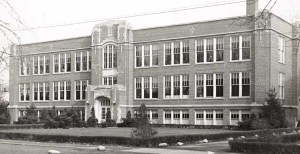
New London High School 1937

Photo of the New London High School in 1937. http://www.oldohioschools.com

Jean (nee Haynes) was 16-years old when her father, Harold Haynes, was badly injured. Harold had fallen into a gutter while moving a bull on their family farm in Clarksfield, OH. Jean, was a junior at New London High School. Her dad had been hospitalized for some time when she was asked to give blood. She doesn’t remember being scared of the prospect; after all, this was her dad. What Jean remembers is taking the bus into town with her mother and riding the old streetcar down Euclid Avenue to Huron Road Hospital. Jean lay on a hospital bed next to her father, as blood was transferred directly from her body to his. It was May of 1946 and a school day, so believe it or not, she went right back to school afterwards. It was Jean’s first time giving blood, but it wouldn’t be her last.

img_2223Today, Jean is 87-years-old and has donated almost 16 gallons of blood, not including her first blood donation all those years ago. (Her total gallons donated would have been even more if she had not been rejected a number of times due to low iron levels.) Jean remembers when blood drives first started in New London. They were held at New London High School, which was a collection point for New London and neighboring communities. Volunteers would travel from as far as Greenwich to the high school to give blood. In those days, blood collection drives were held annually so if you were ineligible to give blood during a blood drive, it would be a whole year before you would have another chance to do so. The temporary collection center consisted of four gurneys organized in a square. That meant that donors had to wait their turn. And if their iron levels were low? Well, according to Jean, they would eat more broccoli and get ready for the next blood drive.
The old high school Jean remembers has since been torn down and Red Cross blood drives are now held at the New London Eagles Aerie #2869. Facilities aside, a lot has changed since Jean started giving blood. Donors are now able to give blood once every 56 days instead of once a year, and the process is a far cry from the blood drives at the old high school.

Some things however, have not changed. Jean continues to be in very good health, and plans to continue giving blood. In addition to giving blood, Jean has volunteered with the Red Cross as a receptionist and as a blood drive coordinator.

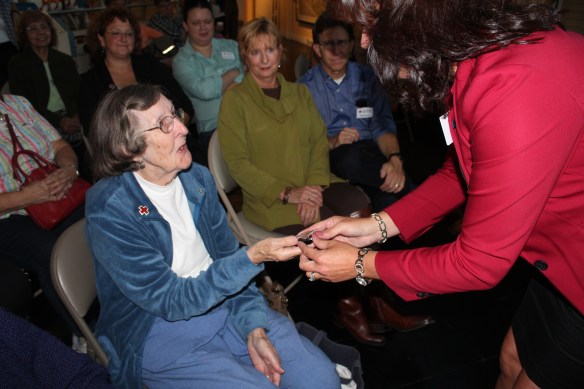
She describes the Red Cross as “a good group that does wonderful work.” She also adds that, “through the years, the extra blood makes a difference for the small town.” Jean was awarded a 70 year pin at the Red Cross Volunteer Recognition event in the Lake Erie/Heartland Chapter.

img_2232

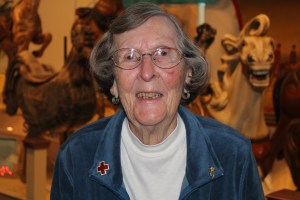
American Red Cross Volunteer Jean Myers receives a 70-year pin from Lara Kiefer,                      Executive Director, Lake Erie/Heartland Chapter                                                                                                 Photo credit: Jim McIntyre/American Red Cross

If you would like to volunteer, please visit www.redcross.org/neo and click on Volunteer to get your profile started today!


Red Cross Volunteers Credited with Saving Man’s Life

Performed CPR, Used AED to Save a Man at the Wayne County Fair

Farm animals. Funnel cakes. First Aid.

All are traditions of the Wayne County Fair.

The Red Cross has been providing first aid to fair goers for more than 60  years, as a service to the community.  This year, that service helped save at least one life.

A man attending the fair on Monday, September 12, suffered cardiac arrest and collapsed. Red Cross first aid workers rushed to perform CPR. They also applied a newly-acquired AED (automated external defibrillator) while awaiting the arrival of Wayne County EMS personnel.

The man survived.  “The ER staff said the Red Cross saved his life, as there was no way he would have made it if he had to wait for the squad to reach him inside the fairgrounds,” said Lara Kiefer, Executive Director of the Lake Erie/Heartland Chapter.

Captain Doug Hunter of the Wayne County Sheriff’s office also credited the Red Cross crew, in a video posted on Facebook.  Capt. Hunter said, ” I want to recognize the life-saving efforts of the representatives of the Wayne County Red Cross.” He continued,
“They frantically started doing what they are trained to do and tried to revive this man.”  He went on to describe the use of the AED.  “It was not looking good folks. I had pretty much written this man off as not going to survive, but they kept going.”

Captain Hunter also credits a nurse from the Wooster Community Hospital for assisting.

“It was truly a remarkable moment,” Captain Hunter said, in describing the moment the man first showed signs of life. “The people from the Red Cross at the Wayne County Fairgrounds saved this man’s life.”

Most first aid requests involve far less serious ailments, but the service provided by the Red Cross was deemed so important, a facility was built on the fairgrounds for use as a first aid station during the run of the fair every year.

About 120,000 people attend the Wayne County Fair, and the Red Cross provides first aid service free of charge.  Red Cross first aid workers respond to 200-300 incidents each year.  Taxpayer money is saved, by reducing the number of calls made to 911.

Our first aid service at the fair has been valued at approximately $20,000.

But for the man who suffered cardiac arrest on Monday, no value can be placed on the life-saving skills of the Red Cross first aid responders.

You can learn the same life-saving skills employed by the Red Cross by taking a class, to learn First Aid, CPR and AED. Training for other skills, such as babysitting and swimming and water safety are also offered. Go to redcross.org/takeaclass.

Photo credit: Mary Williams/American Red Cross

Red Cross Teams with Alcoa to Install 150 Alarms

Fire Safety Walk took place just ahead of National Preparedness Month

It can be hot work, especially when temperatures reach into the 90s like they have this summer. This is the kind of weather that makes you long for air conditioning and tall glasses of ice water, dripping with cool condensation.

But one dedicated team steadfastly treks through the humid air to make sure that homes will remain safe as the temperatures begin to fall.

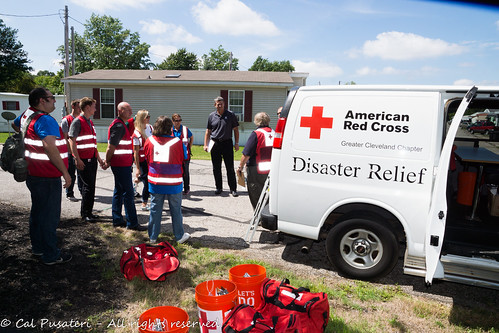
That team? Our Operation Save-A-Life partners at Alcoa, who helped the Red Cross install 150 smoke alarms in 71 homes at the Miller Mobile park on the 93 degree day of August 25, just ahead of National Preparedness Month.

“The team from Alcoa is the easiest and best group I get to work with,” said John Gareis, Regional Disaster Training Coordinator. You can see more photos of the event on our flickr page.

During the month of September, the Red Cross urges families to develop a fire escape plan, so everyone in the household knows what to do if fire occurs.  Home fires are the most common threat people face across the country, and every family should develop a fire escape plan.

If your group would like to help install smoke alarms with the Red Cross, please call or email our volunteer services team at 216-431-3328 or NEOvolunteer@redcross.org.

DSC01725-6

DSC01729-9

Photo Credit: Cal Pusateri/American Red Cross Volunteer

Louisiana Rising: A Benefit Concert for Flood Relief to air Monday, September 5

We are thrilled to share some exciting news: this coming Monday, September 5, Raycom Media will host a telethon, Louisiana Rising: A Benefit Concert for Flood Relief live from Baton Rouge’s River Center Theater between 7:00 – 9:00 p.m. (CT). The Red Cross is the sole beneficiary for the telethon, and all proceeds will support our disaster response in Louisiana.

Randy Jackson and Harry Connick, Jr. will co-host the live broadcast, which will air across Raycom Media’s 45 television stations nationwide including WOIO Channel 19 and WTOL Channel 11 here in northern Ohio.

The telethon will feature a dozen artists, including Aaron Neville, five-time Grammy nominee Hunter Hayes, as well as New Orleans-based musicians Better Than Ezra, Sonny Landreth, Chris Thomas King, MacKenzie Bourg, Luther Kent and Rockin’ Dopsie. Raycom Media’s Tupelo-Honey Raycom will produce the show, and Johnny Palazzotto, a Baton Rouge musician, will serve as music director.

The telethon is also available through livestream at redcross.org/SupportLA, where visitors can also make a donation to support our Louisiana flood relief efforts.

We are extremely grateful for the singular generosity shown by Raycom, which will help us greatly in raising funds needed in response to this devastating disaster.

To learn more about the event and the artists associated with the telethon, please visit Louisianarisingfloodrelief.com.

Thank you for supporting the efforts of the Red Cross and those Northeast Ohio volunteers who have deployed to Louisiana.

Visit us at the Canfield Fair!

IMG_1649[1]

Red Cross volunteers are on site at the First Aid station, Bloodmobile and in the Medical Building at the Canfield Fair.

Fair goers can stop in for first aid, or sign up to receive a free smoke alarm installation and fire safety education.

A bloodmobile will be on site from 12:30 until 8 p.m. today through September 5th.

Visit our Lake to River Chapter Facebook page to view more photos.

Photo Credit: Mary Williams/American Red Cross

Mike’s Louisiana Report #1

Greetings…I’ve been in Baton Rouge since last Friday responding to DR063-17–a flooding incident that is the worst natural disaster since Superstorm Sandy in 2012 with more than 60,000 homes and 7,000 businesses destroyed. I am assigned to a new pilot concept in Louisiana called the Red Cross Liaison Network along with other Regional Executives and Executive Directors from around the country to provide dedicated support to specific Parish Government and community leaders. This focused-care approach has enabled the relief operation to better understand and better meet community-specific needs, especially those arising on short or no notice.

IMG_4237

Photo Credit: Mike Parks/American Red Cross

I’ve been assigned to Livingston Parish, one of the hardest hit regions–the devastation of homes and business that I’ve witnessed first hand has been incredible. One of my responsibilities is to check in on our shelter operations–there are currently three Red Cross shelters operating in Livingston Parish. Imagine my surprise when I rolled into one shelter and ran into two volunteers (Jeff and Tom) from Canton, who had just arrived to support the operation. It was a treat to see fellow Northeast Ohio teammates engaged in supporting these folks who have lost so much, and in many cases, everything. It’s a privilege to serve alongside such dedicated Red Cross volunteers.

The Red Cross’ work here is far from done and will require many more volunteers and resources. I’d like to thank all those from Northeast Ohio who have already deployed to help with this disaster. And for those who are considering doing so, be forewarned that it’s hard work, but it’s incredibly meaningful and rewarding when you can be on the ground helping those in such desperate need–doing what the Red Cross has done since its founding 135 years ago–caring for and helping those in need. I appreciate everyone’s support back home in Northeast Ohio. The Red Cross is still facing the need for tremendous resources to respond to this disaster, and everyone’s support is greatly appreciated.

Michael N. Parks

Ring! Ring! Goes the Bell – Back to School Safety Tips

It’s almost time for the school bells to ring again and the American Red Cross has steps everyone can follow to help make the trip back to the classroom a safe one.

“Safety should be the top priority for all students, especially younger children and those heading to school for the first time,” said Tim O’Toole, Regional Disaster Officer for the region. “Whether riding, biking or walking to school, we want everyone to arrive and then return home safely.” 

Back to school_stop for bus tip.png

SCHOOL BUS SAFETY If children ride a bus to school, they should plan to get to their bus stop early and stand back from the curb while waiting for the bus to arrive. Other safety steps include:

  • Wait to board the bus until it has come to a complete stop and the driver or attendant has signaled to get on.
  • Tell children they should only board their bus – never an alternate one.
  • Always stay in clear view of the bus driver and never walk behind the bus.
  • Cross the street at the corner, obey traffic signals and stay in the crosswalk.
  • Never dart out into the street, or cross between parked cars.


GET TO SCHOOL SAFELY If children ride in a car to get to school, they should always wear a seat belt.

  • Younger children should use car seats or booster seats until the lap-shoulder belt fits properly (typically for children ages 8-12 and over 4’9”) and ride in the back seat until they are at least 13 years old.
  • If a teenager is driving to school, parents should mandate that he or she use seat belts. Drivers should not use their cell phone to text or make calls, and should avoid eating or drinking while driving.
  • Some students ride their bike to school. They should always wear a helmet and ride on the right in the same direction as the traffic is going.
  • When students are walking to school, they should only cross the street at an intersection. If possible, use a route with crossing guards.
  • Parents should walk young children to school, along with children taking new routes or attending new schools, at least for the first week to ensure they know how to get there safely. Arrange for the kids to walk to school with a friend or classmate.


WHAT DRIVERS SHOULD KNOW Drivers should know what the yellow and red bus signals mean and be aware that children are out walking or biking to school and slow down – especially in residential areas and school zones. Yellow flashing lights indicate the bus is getting ready to stop and motorists should slow down and be prepared to stop. Red flashing lights and an extended stop sign indicate the bus is stopped and children are getting on or off. Drivers in both directions must stop their vehicles and wait until the lights go off, the stop sign is back in place and the bus is moving before they can start driving again.

Parents should also make sure the child knows their phone number, address, how to get in touch with their parents at work, how to get in touch with another trusted adult and how to dial 9-1-1. They should also teach children not to talk to strangers or accept rides from someone they don’t know.

TAKE A FIRST AID CLASS Red Cross training can give someone the confidence and skills to help with everyday emergencies from paper cuts to school sports injuries. A variety of online and in-class courses are available at redcross.org/takeaclass. People can download the free Red Cross First Aid App (redcross.org/apps) for instant access to expert advice whenever and wherever needed.

Two Tips for Keeping Your Child’s Commute Safer this Week

This week is heating up in Northeast Ohio and that means hot-hot-hot! vehicles.

Here’s two tips for keeping your child’s commute safer during these steaming days:

For more reading, check out Sarah’s post on Red Cross Chat.

(And a special “Thank you” to Lt. Rick Edwards of the Akron Police Department for stopping by to talk with us.)

Video created and produced by Ryan McDivitt, American Red Cross Volunteer

More Local Red Cross Workers Respond to West Virginia Flooding

Resources Include Personnel, Equipment

Nearly 500 American Red Cross volunteers have responded to the call for help in West Virginia, where heavy rain last week caused widespread flooding.  Seven volunteers are from Northeast Ohio.  In addition, Regional CEO Mike Parks is there to offer his assistance.

“It’s extremely rewarding to see American Red Cross volunteers and staff from across the country descend on the devastated communities of West Virginia,” said Parks. “It makes me proud to be part of this humanitarian organization.”

23 fatalities are being attributed to the flooding.  Preliminary reports indicate upwards of 2,000 homes could have been damaged or destroyed.  Thousands of people are still without power and gas service. Many areas are still inaccessible due to flood damage, and the number of affected homes is likely to change.

Red Cross workers, including those from Northeast Ohio, continue to support shelter operations. Workers are also providing meals, relief supplies and other assistance to those affected.

By the numbers:

-More than 1,900 overnight stays in emergency shelters

-More than 40,000 meals and snacks distributed

-Over 61,000 relief items like cleaning supplies and comfort kits distributed

Red Cross disaster mental health workers are helping people cope with the loss of their homes. Health workers are helping to replace needed items like prescription medications and eyeglasses. The Red Cross is working with state and local officials and with partners like the Southern Baptist Convention and AmeriCorps to help ensure people get the help they need.

In addition to the Red Cross personnel deployed, the Northeast Ohio Region is also contributing 3 emergency response vehicles and 2 passenger vans to the response and recovery effort in West Virginia.

This is a large relief response and the Red Cross needs the public’s support. Entire families have lost their homes and everything they own. We need your support now to help people affected by disasters big and small.

  • People can help by donating to Red Cross Disaster Relief to support disasters big and small by visiting redcross.org, calling 1-800-RED CROSS or texting the word REDCROSS to 90999 to make a $10 donation.
  • Donations to Disaster Relief will be used to prepare for, respond to and help people recover from disasters big and small.

 Financial donations are the quickest and best way to get help to the people who need it most.

FLOOD SAFETY

Download the free Red Cross Emergency App to have safety information and shelter locations available on your mobile device.

  • The Emergency App features emergency weather alerts to help keep the user safe, and provides information about what to do in case of floods as well as the locations of open shelters.
  • Red Cross apps are available in smartphone app stores by searching for the American Red Cross or going to redcross.org/apps.


Lake to River Celebrates Volunteers

We love our volunteers!

Thank you so much to those who volunteer their time and heart to the Red Cross. Thank you to those who answer calls from people in our community in an effort to prevent and alleviate human suffering in the face of an emergency!

volunteer Appreciation 2016 08

On Thursday, April 21 the Lake to River chapter held a luau for their local volunteers. We want to thank and congratulation Jay Rosenthal (53 years) and Tab Alden (48 years) of service.  Nearly 50 volunteers, their guests and staff members attended the celebration.

volunteer Appreciation 2016 04

volunteer Appreciation 2016 12

volunteer Appreciation 2016 16

Volunteer Appreciation 2016 22

The Lake to River Chapter, which serves Ashtabula, Columbiana, Jefferson, Mahoning, and Trumbull Counties, has 225 volunteers.

If you are interested in volunteering with the Red Cross, visit www.redcross.com/neo and click on “Volunteer”.