Thank you from the bottom of our hearts!

By Gail Wernick, Regional Volunteer Services Officer, American Red Cross of Northern Ohio

As I begin my 15th year with the American Red Cross, I would like to share a message of appreciation to the truly special Red Cross team and volunteers with whom I have had the privilege of working to deliver our mission.

This fall I deployed for the first time in-person to be a part of the Hurricane Helene Disaster Relief Operation in Asheville, North Carolina. On deployment, I joined a team of dedicated Red Crossers to share volunteer opportunities with surrounding communities.  Due to intermittent internet availability, the team often connected with new volunteers personally to complete volunteer intake to begin volunteering as soon as possible! The Disaster Event Based and Local Community Volunteer teams supported volunteer scheduling, with more than 200 calls/texts to coordinate and prepare for the volunteers’ engagement. The team created volunteer recognition messaging and unique ways to say THANK YOU!  Each day, some more than 12 hours, was filled with new experiences, learning quickly, and adjusting to the evolving needs of the disaster operation. I will always remember my Red Cross deployment experience and the kind people I met, who inspired me and helped make a meaningful difference each day.

Thank you for delivering service in the community to help your neighbors when needed most. Your efforts are greatly appreciated, and we are most grateful for your service as a Red Cross Disaster volunteer.

Featured in the photo above, Red Cross volunteer deployment team members, disaster event based and local community volunteers from Asheville, North Carolina.

Glen McCandless, a disaster event based volunteer, featured on the far right in the photo above, volunteered at the AG Center every day for two weeks consecutively. He said, “Volunteering at the shelter and helping others in the midst of so much devastation is like salve for the soul.”

The Red Cross shelter supervisors we met extended their sincere appreciation for the dedicated disaster volunteers from the local community who tirelessly volunteered, many whose own lives and homes have been impacted by the disaster, to prepare and serve meals and offer support. Whether a volunteer gave two hours or several days of their time to help, we are grateful to them for helping deliver the Red Cross mission! 
More than 1,400 Disaster Event Based Volunteers joined the Red Cross in North & South Carolina this October and November, engaging in more than 640 volunteer commitments to provide comfort, care and hope by assembling and distributing emergency supplies, preparing and serving meals, setting up and cleaning up and supporting residents impacted by Hurricane Helene. 

The Red Cross is here to help make your volunteer experience the best it can be! Please continue to volunteer with us and encourage your friends and family to join you. Thank you for exploring and sharing our most-needed ongoing volunteer opportunities at www.redcross.org/volunteer.  We are working hard to prepare for, respond to and help communities recover from disaster. Become a part of the Red Cross Disaster Action Team at www.redcross.org/dat.

Northern Ohio Red Crossers deliver relief where hurricane survivors need it

Husband and wife team-up to respond to storms far from home

By EILENE E. GUY, American Red Cross volunteer

Jeff and Laura Mann were on what you would call a “mission of mercy” when I reached them by phone, headed for the hospital in flood-ravaged Asheville, N.C., to pick up specialized medical equipment for a baby in an American Red Cross shelter in Burnsville, another hour away.

Jeff Mann, inside the Red Cross disaster vehicle, hands supplies to wife Laura in Burnsville, North Carolina

The couple are what the Red Cross calls a “fulfillment team.” Jeff says they’re “a store on wheels.”

They deliver consumables like toilet tissue, paper towels and baby formula as well as essentials like pillows, blankets, and special need items to shelters in northwestern North Carolina, where the number of storm refugees continued to grow.

When we talked, a week after Hurricane Helene swept from the Gulf to the East Coast, the Manns were still seeing helicopters – some ferrying evacuees to shelters and others airlifting food and water to isolated communities.

Jeff, a retired YMCA executive director, is a veteran disaster responder. “This is my 15th, 16th (response) – I don’t know,” he told me with a chuckle. He’s served in evacuation shelters, warehouses, supply units. “I’m quite a rover… wherever I’m needed.”

Jeff Mann was interviewed by news reporters at the Akron Canton Airport before his deployment to Guam in response to Typhoon Mawar 2023

Laura, on the other hand, is on her first deployment. She’s been on the board of the Heartland, Stark, Muskingum Lakes chapter of the Red Cross for years and taken lots of disaster response training. But this is the first time her work as a CPA has allowed her to take off for two weeks.

She’s excited to be helping bring relief to a region devastated by hurricane winds and unprecedented flooding. It’s a plus that she’s working with her husband.

“Laura and I are bonding,” Jeff offered. “It’s our 39th anniversary this week,” Laura explained. “This is a good marriage test.” They both laughed comfortably.

The couple, who call Louisville, Ohio, in Stark County home, are finding conditions in mountainous North Carolina challenging. Many roads, even if passable, are one lane where downed trees have been hacked back just enough so Jeff can squeeze his box truck through. Cell phone service and GPS are spotty.

“We were headed for the hospital in Asheville the first time and GPS died at the edge of town,” Laura recalled. “There were no streetlights and we didn’t have a clue. We just had to figure it out.”

Laura Mann at a Red Cross warehouse

A typical day has them at a Red Cross warehouse in Greenville, S.C., at 7 in the morning to load up, with a list of special orders to be picked up at local big-box stores. Then they head north to Asheville and on to shelters as far as Boone, another two hours away.

“We go up one side of the (Blue Ridge) mountains and back down the other,” Laura said. They were still in the truck, on the way back to Greenville, when we chatted at 9 o’clock in the evening last week.   

The Manns are among the more than 2,000 trained Red Cross disaster responders providing shelter, food, emotional support, replacement medical devices and prescriptions, and other urgent needs to storm victims across five states. At the same time, some 200 Red Cross reunification staff have fielded thousands of requests for help locating loved ones.

Red Crossers and our partners have given out nearly 480,000 meals and snacks in shelters and from mobile feeding trucks. With partner organizations, they’ve provided more than 35,000 overnight stays.

None of this disaster response, which will go on for months as the Red Cross helps individuals and families plan the next steps in their recovery, would be possible without the generosity of the American people. Please consider making a financial donation by going to redcross.org, calling 1-800-RED-CROSS.

If you’d like to get trained and become part of the hands-on relief effort, as Jeff and Laura Mann are doing, visit NEOvolunteer@redcross.org or call 216-431-3328 to learn about all the different roles that might interest you.

Helping those in need after a disaster is challenging but rewarding

By Mike Arthur, Regional Mass Care & Logistics Manager, American Red Cross of Northern Ohio

I’m grateful to live in northern Ohio, one of the safest areas of the country from a weather-related disaster standpoint. We don’t have to worry about a hurricane coming and wiping our homes away. We are unlikely to walk out our front doors and have trouble breathing due to smoke from a nearby wildfire.

I have never worried about the fate of my family and myself, where we would live and work after a disaster destroyed my home and place of work. I have never had to make a decision about which of my hard-earned belongings I need to take with me when I evacuate. I have never had my community devastated. Every year thousands of families have their lives changed drastically when their homes and communities are affected by disasters large and small.

Mike Arthur, during the Red Cross response to hurricane Harvey in Houston, Texas in 2017
 

I’m also grateful that I get the opportunity to help people in need. As a Regional Mass Care & Logistics Manager, I get to put the skills and talents learned over the course of my life to good use leading and supporting the American Red Cross workforce in meeting the needs of our clients locally and nationally.

I get to deploy for a few weeks each year making an immediate difference in someone’s life. Deployments to large disasters are tough but incredibly rewarding. The hours can be long. The food is not always five star. I sometimes sleep on a cot in a staff shelter with my fellow workers. It can be stressful. Compassion fatigue is a risk.

Residents wait to receive clean up supplies from the Red Cross after hurricane Harvey in 2017.

I look forward to each deployment and go as often as I can. I feel like I make a difference. I have made incredible friends across the country. I have great stories to tell. I get to bring hope to those in need. I help provide a safe place to sleep and food in bellies, and sometimes, most importantly I can provide a warm hug, bright smile and a sympathetic ear. My life is fuller because of my deployment experiences. I hope you will take to opportunity to join me out in the field this year and experience the magic of helping.

Help those in need when they need it most by becoming a volunteer with the Red Cross. To find a volunteer opportunity that’s right for you, visit redcross.org/volunteer.

Edited by Glenda Bogar, Red Cross volunteer

Back-to-back disasters require nationwide Red Cross response

More than a thousand volunteers deploy to help those affected by wildfires, Hurricane Ida and flooding

Back-to-back massive disasters have more than 1,200 American Red Cross volunteers, including 32 from Northern Ohio, working tirelessly from coast to coast right now providing food, shelter and comfort to thousands of people in need. We are working around the clock with our partners to provide help to people struggling with the heartbreaking damage left behind by Hurricane Ida.

The Red Cross is working to provide help to people struggling with the massive flooding caused by the remnants of Hurricane Ida. Wednesday night, some 430 people sought refuge in 13 Red Cross and community shelters across Virginia, Maryland, Pennsylvania, New Jersey and New York. Some 130 trained Red Cross workers are on the ground now to support relief efforts. The Red Cross and its partners have already provided some 1,300 meals and snacks and distributed more than 100 relief items. Trained Red Cross volunteers have already made nearly 100 contacts providing emotional support, health services and spiritual care for people who’ve been evacuated.

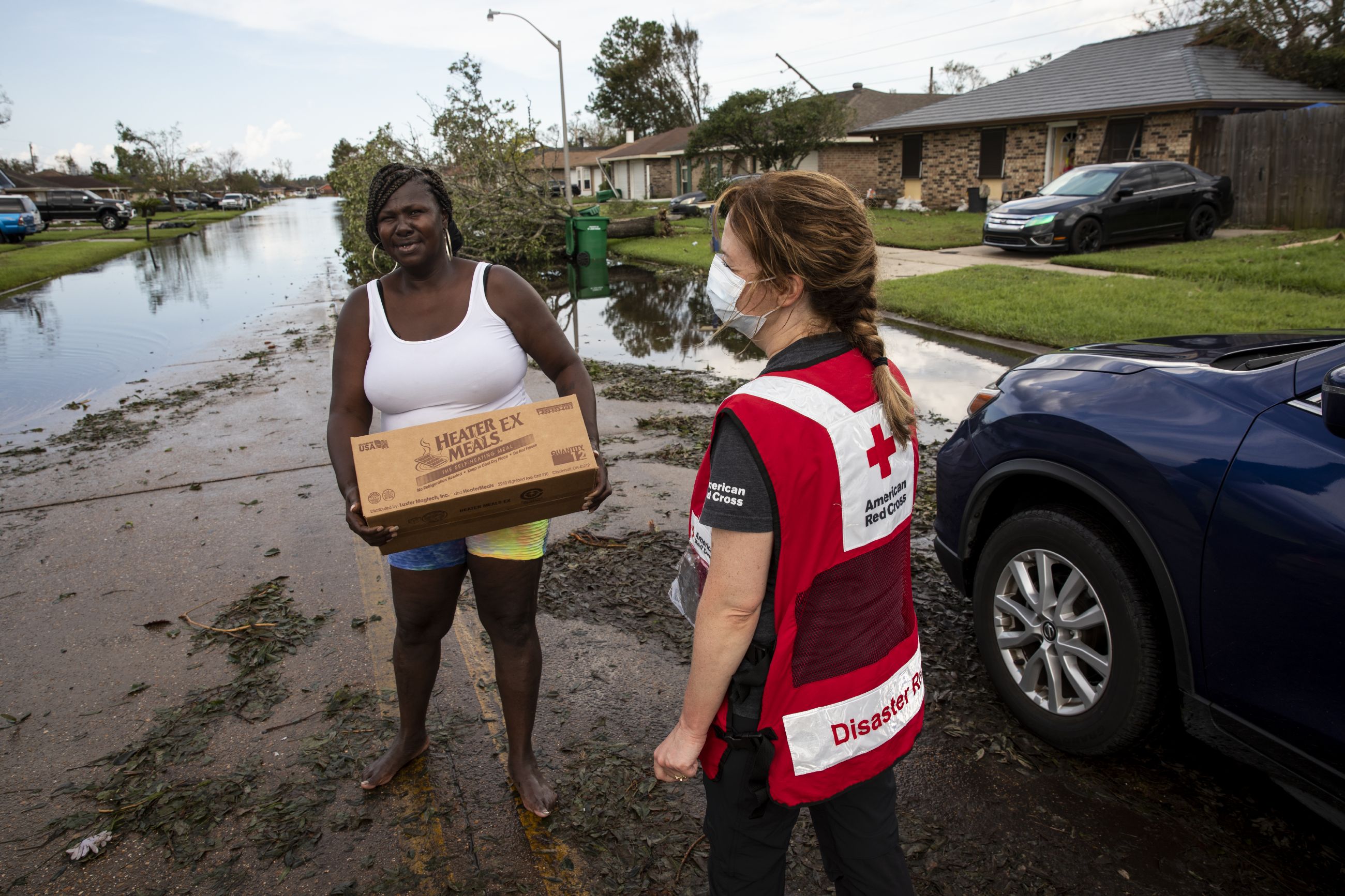
Wendy Halsey of the American Red Cross hands boxes of Meals Ready to Eat (MRE) to Cassandra Simon in LaPace, LA, one of the areas of Louisiana which suffered extreme damage from Hurricane Ida. Photo by Scott Dalton/American Red Cross

While massive flooding affected many states in the northern U.S., many southern states continue to deal with the aftermath Ida. Nearly 900 trained Red Cross workers are on the ground now to support relief efforts. The Red Cross and our partners have provided nearly 51,000 meals and snacks and distributed more than 16,000 relief items to people in need.

And, in the midst of responding to Hurricane Ida, the Red Cross continues to help people in California where tens of thousands of people are under evacuation orders as massive wildfires continue to spread. Red Cross workers have been on the ground since June helping evacuees find a safe place to stay, food to eat and emotional support during this heartbreaking time.

Red Cross volunteer Dave Wagner looks over damage from the Dixie Fire in Greenville, CA, a small town that was devastated by the fire on Saturday, August 7, 2021. Photo by Scott Dalton/American Red Cross

The Red Cross expects to respond to more disasters in the coming months, as the season is only beginning. Financial donations enable the Red Cross to prepare for, respond to and help people recover from disasters. To give, visit redcross.org or call 1-800-RED CROSS.

Individuals in unaffected areas of the country are urged to make an appointment to give blood to ensure a sufficient blood supply remains available for patients. Schedule a blood or platelet donation appointment by using the Red Cross Blood Donor app, visiting RedCrossBlood.org or calling 1-800-RED CROSS (800-733- 2767).

The Red Cross needs more volunteers now. If you have the time, you can make a significant impact. Review our most urgently needed volunteer positions at redcross.org/volunteertoday.

Local volunteers and blood donors needed for busy disaster season

Many weather experts predict a destructive wildfire and hurricane season this year. The American Red Cross needs volunteers to help people who are affected by these disasters.

“We’re preparing for another extremely busy disaster season, and it’s critical to have a trained, ready volunteer workforce to make sure we can provide relief at a moment’s notice,” said Mike Parks, Regional CEO, American Red Cross of Northern Ohio. “This year’s wildfire season is already very active and dangerous because of the severe drought and dry woodlands across the west. And experts are predicting we could see 10 or more hurricanes in the upcoming weeks.”

“We’re preparing for another extremely busy disaster season, and it’s critical to have a trained, ready volunteer workforce to make sure we can provide relief at a moment’s notice.”

Mike Parks, Regional CEO, American Red Cross of Northern Ohio

SHELTER VOLUNTEERS AND HEALTH PROFESSIONALS NEEDED

The Red Cross needs new volunteers to support disaster shelters. Volunteers will help with reception, registration, food distribution, dormitory, information collection and other vital tasks inside disaster shelters. Both entry and supervisory-level opportunities are available.

The Red Cross also needs volunteers who can work in disaster shelters to address people’s health needs and provide hands-on care in alignment with their professional licensure (registered nurse and licensed practical nurse/licensed vocational nurse). Daily observation and health screening for COVID-19-like illness among shelter residents may also be required. If you are an RN, LPN, LVN, APRN, NP, EMT, paramedic, MD/DO or PA with a current and unencumbered license, this position could be right for you.

Red Cross volunteer Dave Wagner looks out damage from the Dixie Fire on the outskirts of Greenville, CA, a small town that was devastated by the fire on Saturday, August 7, 2021. Many of the evacuated residents found shelter with the Red Cross in nearby Quincy and Susanville, CA.
Photo by Scott Dalton/American Red Cross

DISASTER ACTION TEAM MEMBER

Local Disaster Action Teams provide 24-hour emergency response to local disasters, particularly home fires, ensuring that those affected have access to resources for basic necessities such as food, shelter and clothing. If you are team-oriented and want to help your neighbor, the DAT responder may be just the thing for you.

Disaster Action Team members from Northern Ohio respond to a fire in Lakewood on Aug. 4, 2021.

At 1 p.m. today, the Red Cross will host a Facebook Live event where our experts will discuss the various volunteer roles and how you can get involved in helping families after disasters here locally and across the country. Tune in to learn more and get your volunteer questions answered.

Last year, the Northern Ohio Region provided immediate emergency assistance to more than 5,100 people after nearly 1,200 home fires and other disasters.

If you can’t join us this afternoon but are interested in helping your community when disasters occur, you can sign up online or contact our area offices at 216-431-3328 or neovolunteer@redcross.org.

BLOOD AND PLATELET DONORS NEEDED

Wildfires, record-breaking heat and a busy hurricane season can also impact the nation’s blood supply. On top of the toll extreme weather events take on the lives of millions, disasters can cause blood drive closures or prevent donors from being able to give safely. Eligible donors can help overcome the critical need for blood and ensure blood is readily available by making an appointment to give by using the Red Cross Blood Donor App, visiting RedCrossBlood.org, calling 1-800-RED CROSS (1-800-733-2767) or enabling the Blood Donor Skill on any Alexa Echo device.

Hurricane season begins

June 1st is the traditional start; wildfires also become more devastating

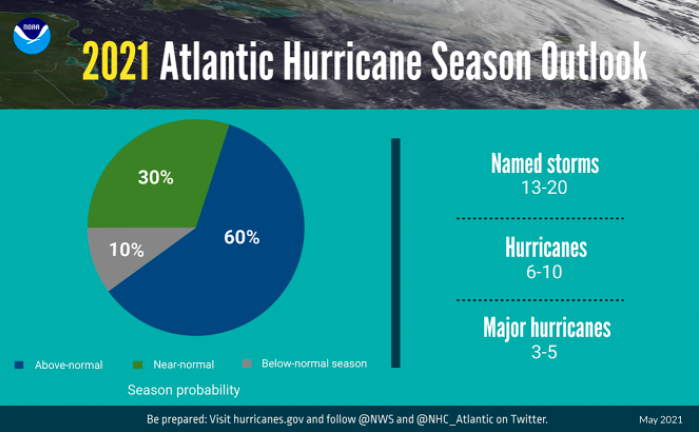
With hurricane season just getting started, here is the 2021 Atlantic hurricane outlook from the National Oceanic and Atmospheric Administration. Above-normal storm activity for the second year in a row is being predicted. According to NOAA, the Atlantic could see as many as five major hurricanes this season between June 1 and November 30.

While we live in an area that isn’t typically impacted by hurricanes, we DO send Red Cross volunteers from Northern Ohio into hurricane zones, to help affected residents find safe shelter and to help them with their recovery when the skies clear.

We want to help anyone you may know in storm-prone areas stay safe by following a few simple steps. You can find more safety tips at redcross.org/hurricane and on our free Emergency App (search “American Red Cross” in mobile app stores).

Wildfire risk also high

While wildfires can strike at any time, we’re heading into the time of year when they are most devastating, particularly in the western U.S.

As you’ll see in this outlook, after 2020’s record-setting blazes burned over 10 million acres, extended drought conditions mean many communities across the West are again at high risk for severe wildfires this year. In California, wildfires already have destroyed about triple the average acreage that they usually do by this point in the year.

We are hoping for the best, but are ready to offer safe refuge, nourishing meals, emotional support and other essentials when blazes – and other disasters – force families to flee their homes.

How to help during hurricane season

By Doug Bardwell, American Red Cross volunteer

June 1, 2020- The Atlantic hurricane season 2020 starts June 1 and continues through November 30. According to the Climate Prediction Center (CPC) at the National Oceanic and Atmospheric Administration (NOAA), this year has a 60% chance of being worse than normal.

Predictions include 13 to 19 named storms, of which six to 10 could develop into hurricanes, and three to six of those could develop into major hurricanes, Category 3 to Category 5.

We’ve already seen the first two tropical storms: Arthur, which began on May 16, touching the coast of North Carolina, and Bertha, which gained tropical storm status for a few hours on May 27, making landfall in South Carolina.

Texas Tornadoes 2020

So how can you help?

While Northern Ohio is far from most hurricanes, our volunteers often are called on to provide assistance to areas impacted by violent winds and high floodwaters. And due to new precautions being taken to prevent the spread of COVID-19, volunteers are needed more than ever to help with responses to large hurricanes and wildfires.

“This year hurricane preparations will be the same—yet different,” said Tim O’Toole, regional disaster officer. “This is due in large measure to working within the COVID-19 environment.”

He said COVID-19 makes everything more complex. “While our preference is to utilize non-congregate sheltering, such as hotel rooms and dormitories, large events such as hurricanes will require us to open congregate shelters. The COVID environment will require us to increase spacing in shelters in order to comply with social distancing guidelines. This means we may need to open more shelters, but with fewer people in them to provide an adequate response.”

Texas Tornadoes 2020

Tim said such a response will require a larger volunteer disaster workforce.  And that more volunteer health workers will be needed, as residents seeking shelter will be required to be screened for COVID-19 symptoms.

“However, we are trying to reduce the number of workers needed on the ground, and are hoping much of the management and recovery teams can be virtual,” he said. “We have had success with this model in responding to recent tornadoes and flooding in the southern U.S, but hurricanes and wildfires will be the real test.”

Virtual volunteers don’t have to leave their homes. They can perform valuable services doing family reunification work or casework.

All it takes is some free training that the Red Cross will gladly provide. If you start now, you could be trained and ready to help before the next big storm hits. Start your volunteer experience here.

Edited by Glenda Bogar, American Red Cross volunteer

Red Cross continues to support those affected by Harvey, Irma and Maria

By Samantha Pudelski, American Red Cross Volunteer

September 20, 2019- Two years ago, three hurricanes hit the U.S. in less than a month, affecting thousands of people who lived in the paths of these storms. The American Red Cross quickly responded to these disasters, providing much-needed aid and support. Two years later, the Red Cross continues to support the areas hardest hit by these storms.

Cudjoe Key

Hurricane Harvey

Two years ago, three hurricanes hit the U.S. in less than a month, affecting thousands of people who lived in the paths of these storms. The American Red Cross quickly responded to these disasters, providing much-needed aid and support. Two years later, the Red Cross continues to support the areas hardest hit by these storms.

Hurricane Maria 2017

Since then, the American Red Cross has provided aid to those affected by the storm. Locally, the Northeast Ohio Region of the Red Cross assisted by deploying 49 trained disaster workers from Northeast Ohio, the vast majority volunteers, who responded to the relief operation. Overall:

  • More than 46,000 damaged or destroyed households have been provided with recovery financial assistance.
  • More than 414,800 overnight shelter stays were provided in collaboration with partners.
  • More than 4.5 million meals and snacks were served together with partners.
  • More than 127,000 health and mental health contacts have been made.
  • The Red Cross awarded more than $59 million to support community-based recovery services by local nonprofits to provide services to the communities who were hardest hit.

Hurricane Irma

Just two weeks after Harvey, Hurricane Irma’s powerful winds and floodwaters hit the Caribbean, including the U.S. Virgin Islands and Puerto Rico, and then took a destructive path across Florida. Irma was the strongest hurricane to make landfall in the U.S. since 2005.

IMG_0244

Again, the Red Cross was there to provide aid to those who were impacted by the storm.  There were 29 deployments of staff and volunteers from among the Northeast Ohio disaster workforce who assisted with the relief effort.

  • More than 555,300 overnight shelter stays were provided in collaboration with partners.
  • More than 1.6 million meals and snacks were served together with partners.
  • More than 1.8 million relief items were distributed.
  • More than 62,500 health and mental health contacts have been made.
  • More than 9,200 damaged or destroyed households were provided with financial assistance totaling over $37 million.
  • The Red Cross continues to work with local organizations to provide continued support for long-term recovery efforts, awarding more than $15 million in grants.

Hurricane Maria

Maria was the third hurricane to hit the U.S. within a month and was the most intense hurricane to make landfall in Puerto Rico in more than 80 years. Another 17 workers from Northeast Ohio were deployed.


The Red Cross has been working with numerous partners on recovery efforts focusing on consistent power, clean water, community health and community resiliency.

  • More than 12.8 million meals and snacks were served together with partners.
  • More than 77,000 water purification filters were distributed.
  • More than 5.2 million relief items were distributed.
  • More than 40,800 health and mental health contacts have been made.
  • More than 2,700 generators were provided for people with medical equipment needs.

Interested in volunteering to help in the recovery efforts for disasters?

Grassy Key III

There are many volunteer opportunities available in Disaster Response. Read our recent article on the requirements for becoming a disaster response volunteer.

Edited by Glenda Bogar, American Red Cross Volunteer

Red Cross providing food, shelter along East Coast for residents fleeing Dorian

Also committing an initial $2M to help Bahamas
Bahamas Situation Dire, Damage Hampering Relief Efforts;
Blood Donors Outside Storm Area Asked to Give

September 6, 2019- The American Red Cross has mounted a major response to help people in Hurricane Dorian’s destructive path.

An initial $2 million has been committed to assist in meeting the immediate needs of those affected by Hurricane Dorian in the Bahamas, while continuing to provide shelter and food to thousands of people in the United States.

The storm left unbelievable devastation behind in the Bahamas. Abaco and Grand Bahama were particularly hard hit. Initial aerial assessments show widespread devastation to the islands, from destroyed homes to contaminated water sources.

janelle (2)

Jenelle Eli, director, International Communications for the American Red Cross, has deployed to the area and reports the situation is dire, especially on Abaco. Video footage of Abaco shows total obliteration of portions of the island and large areas completely covered by water. Thousands are in need of food and water.

“Our relief operation is growing, but we are also facing serious challenges in terms of delivering aid,” Eli reports. “These challenges include damaged airports and destroyed telecommunications networks. Even search-and-rescue choppers haven’t been able to reach some people because there’s no place to land. These challenges are affecting everyone.”

A rapid assessment and response team is currently focusing on emergency shelter and urgent needs. Relief supplies to support temporary shelter needs of 1,500 families are in country. Red Cross shelter and other sector specialists are on the ground to provide immediate relief while conducting assessments, and search and rescues is a current priority while the full scope and scale of needs is still being determined. Red Cross volunteers and staff will also distribute meals and food rations to people who may have gone without food in days.

Eli, a native of Northeast Ohio,  continued, “People I spoke to on Abaco today told some pretty horrific stories. Every person I spoke to lost their home. They each had a story about trying to hold their roofs down in the high winds and then running from neighbor’s home to neighbor’s home seeking safety. But each home they sought shelter in got destroyed too. They said that the most damaged areas are decimated.”

Eli reported those she spoke with all echoed this sentiment: “How am I going to start over? This is going to be so hard.” Many of them didn’t know the fate of their loved ones. And they worry that their family members fear them dead since they haven’t been in touch. See more in this video.

The International Federation of the Red Cross has announced an emergency appeal for $3.2 million to support the Bahamas Red Cross as it responds to the storm.

Hurricane Dorian 2019

September 5, 2019. Jacksonville, Florida. American Red Cross nurse Jana Cearlock coaxes hugs and smiles from 2-year old Karmin Nelson, a resident, along with her great-grandmother at the Legends Center evacuation shelter in Jacksonville, Florida.  Photo by Daniel Cima/American Red Cross

On Thursday night, more than 5,600 people stayed in 112 Red Cross and community evacuation shelters in Georgia, South Carolina, North Carolina and Virginia.  To date, the Red Cross and community organizations have provided nearly 37,000 cumulative overnight stays for Hurricane Dorian.

The Red Cross has mobilized more than 2,700 trained responders from all over the country, including 19 volunteers from Northeast Ohio, to assist in hurricane affected areas.

One of the Northeast Ohio disaster volunteers deployed to assist with Hurricane Dorian is Tom Quinn of Wadsworth.

Volunteers constitute 90 percent of the Red Cross workforce. Volunteers make it possible to respond to an average of more than 62,000 disasters every year, most of them home fires. Disaster services volunteers provide food, shelter, comfort and care for families affected by major disasters such as fire, hurricanes and tornadoes.

While deployed to Florida, Tom assisted at an emergency evacuation shelter at Evans High School in Orlando, FL. One day, Tom selflessly took it upon himself to play with and entertain children living in the shelter to help give them a sense of normalcy during the difficult moment.

Volunteer mental health and health services professionals have also provided more than 10,000 contacts to provide support and care to people affected by Hurricane Dorian.

Along with partners and community organizations, the Red Cross has served more than 85,000 meals and snacks.

In advance of Dorian, the Red Cross has also deployed 110 emergency response vehicles (ERVs), including two ERVs from Northeast Ohio, and 104 tractor trailers loaded full of relief supplies, including cots, blankets and 63,000 ready-to-eat meals to help people in the path of Hurricane Dorian.

LOOKING FOR A LOVED ONE?

People concerned about US Citizens traveling in Bahamas should contact the US State Department Office of Overseas Citizens Services at 1-888-407-4747.

HOW YOU CAN HELP

You can make a difference in the lives of people impacted by Hurricane Dorian in both the U.S. and the Bahamas. Visit redcross.org, call 1-800-RED CROSS, or text the word DORIAN to 90999 to make a $10 donation. Donations enable the Red Cross to prepare for, respond to and help people recover from this disaster. In the U.S., this includes providing food, shelter, relief supplies, emotional support, recovery planning and other assistance.

PLEASE GIVE BLOOD

Hurricane Dorian has forced the cancellation of approximately 70 Red Cross blood drives and donation centers in Georgia, South Carolina, North Carolina and Virginia resulting in more than 1,800 uncollected blood and platelet donations. We urge eligible individuals in unaffected areas to give blood or platelets to ensure a sufficient blood supply for patients. The Red Cross currently has an urgent need for blood donations following a summer shortage. In addition to cancelled blood drives, we anticipate low blood donor turnout in and around affected areas due to poor weather conditions this week. Schedule an appointment today by using the Red Cross Blood Donor App, visiting redcrossblood.org or calling 1-800-RED CROSS (1-800-733-2767).

Local volunteers preparing to help residents affected by Dorian

Hurricane Dorian made landfall Sunday afternoon in the Bahamas as a Category 5 storm leaving behind catastrophic damage—from destroyed homes to contaminated water sources. While a complete picture of the damage isn’t available yet, it’s clear the storm is dealing a devastating blow to families on the islands.

Bahamas Red Cross volunteers and pre-positioned relief supplies—such as tarps, hygiene items, jerrycans, and hand-crank cell phone chargers—are at the ready.

Hurricane Dorian 2019

September 1, 2019. Orlando, Florida. Seven-year-old Deshawa hold his sister, 1-year-old Keelen, while talking with a Red Cross worker at the Evans High School evacuation center. The children’s family came to the evacuation center to escape the expected high winds and torrential rainfall associated with Hurricane Dorian. Photo credit: Daniel Cima/American Red Cross

In the U.S., the American Red Cross is preparing to help tens of thousands of people in the path of Hurricane Dorian as the extremely dangerous storm tracks towards the southeast coast. While the exact path of Dorian is still uncertain, millions of people live in areas that could be impacted by wind, rain, flooding and a high storm surge, even if the storm doesn’t make direct landfall on the coast.

The Red Cross is coordinating with community partners and emergency responders to prepare evacuation centers as planning estimates indicate as many as 60,000 people in Florida, Georgia, South Carolina and North Carolina may need help. Sunday night, some 2,600 people sought refuge in 60 Red Cross and community evacuation shelters in Florida. We are mobilizing over 1,600 trained volunteers from all over the country, including 14 from Northeast Ohio.

Media coverage of Red Cross volunteers preparing to deploy on Sunday was extensive

Two emergency response vehicles from the region are among the 110 vehicles being deployed, and 99 tractor-trailer loads full of relief supplies, including cots, blankets and 63,000 ready-to-eat meals are on the way.

While the Red Cross does not typically collect and distribute blood in Florida, we have sent approximately 350 blood products to local blood centers there to ensure patients in need continue to have access to lifesaving blood. The Red Cross has also pre-positioned additional blood products and stocked many of our hospitals to capacity in areas of the Southeast likely to be impacted by the storm early next week.