By Jill Patterson, Senior Regional Philanthropy Officer and Tiffany Circle Staff Lead
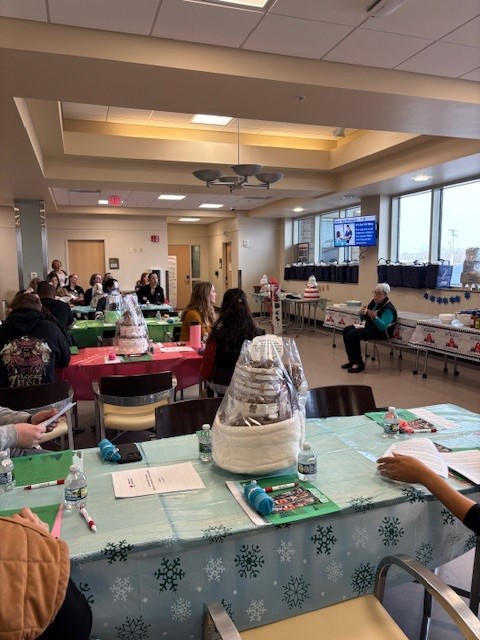
The American Red Cross Northern Ohio Tiffany Circle Women’s Leadership Society, in collaboration with Red Cross Service to the Armed Forces, recently hosted a memorable event with the Cleveland VA Medical Center at their Parma location. This special occasion, known as “A Very Merry Baby Shower,” was dedicated to honoring and supporting our women veteran Moms-to-Be.
The event was a beautiful partnership between the Tiffany Circle, the VA, Blue Star Moms, and the Auxiliary Moms. Together, they created a welcoming and supportive environment, providing baby bundles filled with essential items such as diapers, wipes, bottles, bath wash, Desitin, pacifiers, blankets, onesies, and much more. These thoughtful gifts were a testament to the community’s commitment to caring for our veteran mothers.
Our expectant mothers were treated like VIPs throughout the event. One of the highlights was the Mind and Body Workshop, presented by Red Cross volunteer Jackie Otte. This workshop offered valuable relaxation and breathing techniques, equipping the moms with skills that will be beneficial both now and in the future.
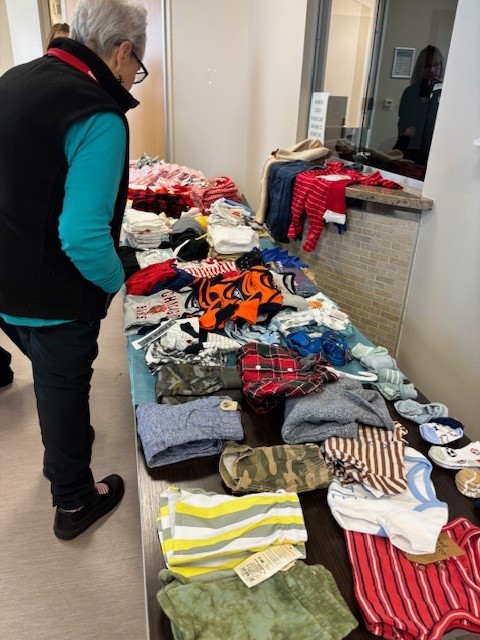
Upon arrival, each guest received a raffle ticket, giving them a chance to win beautifully crafted diaper cakes and a variety of $25 gift cards, other miscellaneous baby items and a stroller, all generously donated by supporters. Additionally, there was a grab table featuring hand-knitted blankets and outfits, as well as a table filled with gender-specific clothing. The moms were encouraged to take anything they needed from these tables, ensuring they left with plenty of useful items for their new arrivals.
“A Very Merry Baby Shower” was more than just an event; it was a heartfelt expression of gratitude and support for our women veterans. It brought together different parts of the community to celebrate and assist those who have served our country, making it a truly special day for everyone involved.
By Mike Parks, Rear Admiral (Retired) U.S. Coast Guard Regional CEO American Red Cross of Northern Ohio
Cynthia and Mike Parks
Friends and family of the American Red Cross of Northern Ohio—greetings!!! This week our nation will celebrate Thanksgiving Day. Throughout the years, Thanksgiving has always been one of my favorite holidays—family & friends, food & football, feasting & fellowship–what’s not to like (especially if you’re alliterative)??
As I’ve enjoyed more Thanksgivings over the years, I’ve come to truly appreciate the real meaning of this national holiday filled with so many traditions—that is giving thanks and sharing gratitude!! We have so much to for which to be grateful!!
I hope everyone can take some time during this holiday week to reflect on our blessings and share our gratitude. Every day so many people rely on the support and services provided by the American Red Cross. For those who will be continuing to serve our communities over the holiday—thank you for your sacrifice!!
So, wherever this Thanksgiving holiday finds you, please know I’m grateful for you! I wish you and your loved ones a most wonderfully memorable and Happy Thanksgiving!! Please stay safe and well—enjoy this special time!! Best wishes… Mike
Posted by Ryan Lang, Red Cross board member and volunteer
By Ryan Lang, Red Cross board member and volunteer
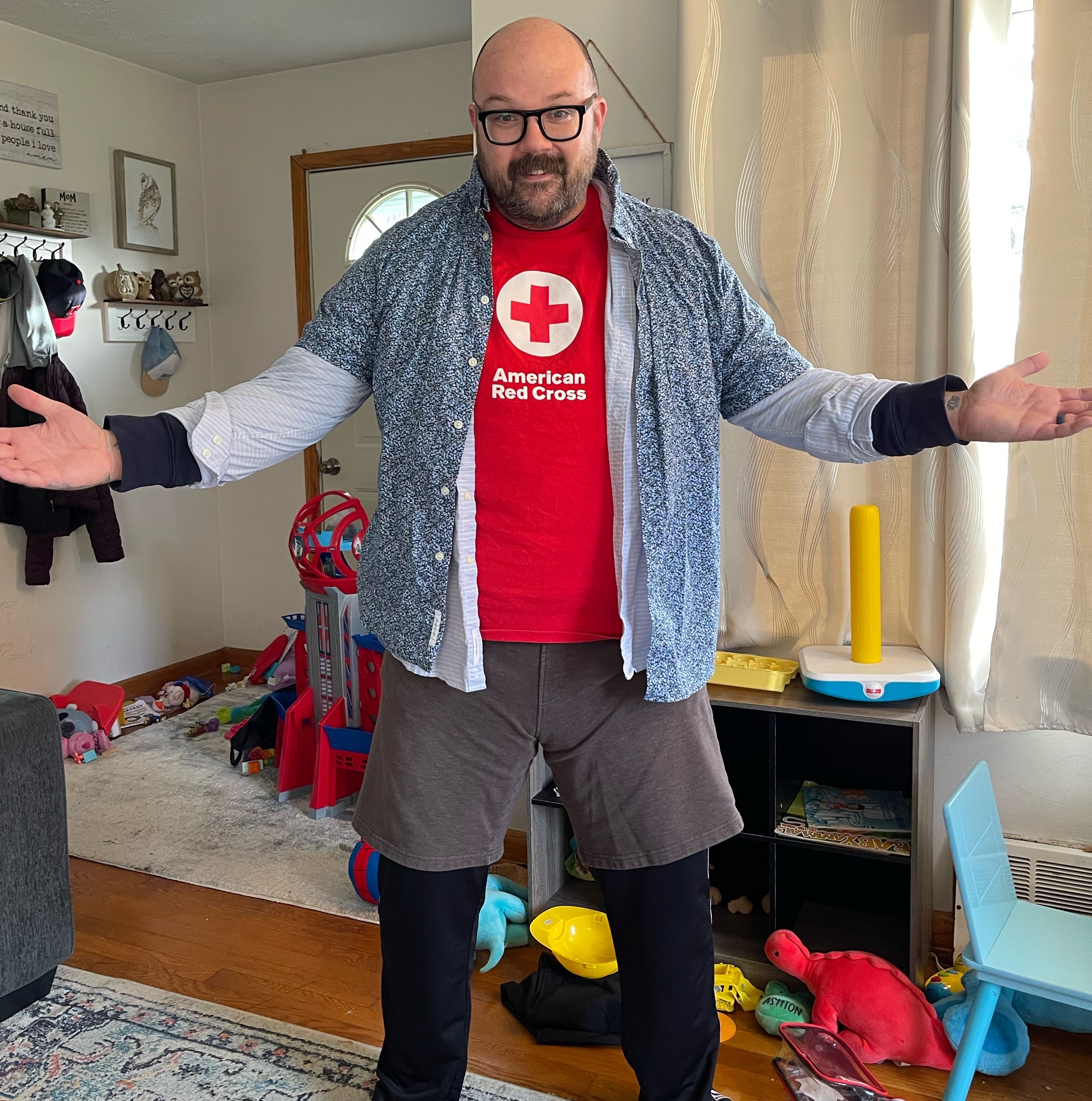
Look at me! I’m a blood donor, could I be wearing any more clothes?!
Ryan Lang, Blood Donor and Friends enthusiast
The short answer: yes! I could have a fun pair of “Friends” socks courtesy of the American Red Cross when I donate blood over the next few weeks.
To celebrate 30 years of the iconic TV show “Friends,” the Red Cross is asking donors to grab their bestie and make donating blood a holiday tradition. Those who come to give now through December 8th, 2024, will receive two pairs of custom “Friends” + Red Cross socks, while supplies last – one to keep and one to give to a friend.
Friends x Red Cross socks
Everything’s better with friends, especially giving lifesaving blood. Not only does it strengthen the bond of friendship, but it also doubles the impact in the community.
A couple of things to remember before donating:
Sleep! Whether that’s taking a great nap with your friend, a la Joey and Ross in “The One with the Nap Partners,” or a good night’s sleep in your own bed, be sure and rest up.
Hydrate! And we’re not talking about a latte at Central Perk. Water is essential. Plan on drinking an extra 16 ounces of H20 the day of your donation.
Eat! Iron rich foods are recommended, like eggs, meat, spinach, and more. Remember, Joey doesn’t share food, and you shouldn’t either – not on donation day.
So grab a friend and visit redcrossblood.org to schedule your donation appointment today! And if you download the Red Cross Blood Donor app, you and your friend can track where your donation goes through the “blood journey” feature.
Posted by Ryan Lang, Red Cross board member and volunteer
By Gail Wernick, Regional Volunteer Services Officer, American Red Cross of Northern Ohio
As I begin my 15th year with the American Red Cross, I would like to share a message of appreciation to the truly special Red Cross team and volunteers with whom I have had the privilege of working to deliver our mission.
This fall I deployed for the first time in-person to be a part of the Hurricane Helene Disaster Relief Operation in Asheville, North Carolina. On deployment, I joined a team of dedicated Red Crossers to share volunteer opportunities with surrounding communities. Due to intermittent internet availability, the team often connected with new volunteers personally to complete volunteer intake to begin volunteering as soon as possible! The Disaster Event Based and Local Community Volunteer teams supported volunteer scheduling, with more than 200 calls/texts to coordinate and prepare for the volunteers’ engagement. The team created volunteer recognition messaging and unique ways to say THANK YOU! Each day, some more than 12 hours, was filled with new experiences, learning quickly, and adjusting to the evolving needs of the disaster operation. I will always remember my Red Cross deployment experience and the kind people I met, who inspired me and helped make a meaningful difference each day.
Thank you for delivering service in the community to help your neighbors when needed most. Your efforts are greatly appreciated, and we are most grateful for your service as a Red Cross Disaster volunteer.
Featured in the photo above, Red Cross volunteer deployment team members, disaster event based and local community volunteers from Asheville, North Carolina.
Glen McCandless, a disaster event based volunteer, featured on the far right in the photo above, volunteered at the AG Center every day for two weeks consecutively. He said, “Volunteering at the shelter and helping others in the midst of so much devastation is like salve for the soul.”
The Red Cross shelter supervisors we met extended their sincere appreciation for the dedicated disaster volunteers from the local community who tirelessly volunteered, many whose own lives and homes have been impacted by the disaster, to prepare and serve meals and offer support. Whether a volunteer gave two hours or several days of their time to help, we are grateful to them for helping deliver the Red Cross mission!
More than 1,400 Disaster Event Based Volunteers joined the Red Cross in North & South Carolina this October and November, engaging in more than 640 volunteer commitments to provide comfort, care and hope by assembling and distributing emergency supplies, preparing and serving meals, setting up and cleaning up and supporting residents impacted by Hurricane Helene.
The Red Cross is here to help make your volunteer experience the best it can be! Please continue to volunteer with us and encourage your friends and family to join you. Thank you for exploring and sharing our most-needed ongoing volunteer opportunities at www.redcross.org/volunteer. We are working hard to prepare for, respond to and help communities recover from disaster. Become a part of the Red Cross Disaster Action Team at www.redcross.org/dat.
Everyone knows (or should know!) that the American Red Cross excels at recruiting volunteers for a variety of important activities: giving blood; offering shelter, food and support for disaster victims; teaching swimming and lifesaving; responding with first aid and CPR/AED.
May 2, 2024. Lawton, Oklahoma.
The American Red Cross provides comfort kits to all new recruits soon after their arrival at Ft. Sill, Oklahoma.
Often, Red Cross volunteers are the first faces new service members see after they take their Oath of Enlistment and the last before they say goodbye to their families prior to deployment. A Red Crosser will be there to share how the Red Cross can support military members and their families through the Hero Care Network and other programs.
Photo by Scott Dalton/American Red Cross
Did you know we also recruit licensed behavioral health professionals to help members of our armed forces and their families deal with the challenges of deployment and life on the home front?
The Red Cross Resiliency Program is a suite of free activities, virtual workshops and small-group discussions that focus on skill-building and stress-management techniques. Facilitators get special training from the Red Cross on military life and culture.
Dr. Alaina Foster, a veteran of the U.S. Air Force, manages Service to the Armed Forces and International Services for the Northern Ohio Region. She’s impressed with programs that build on the resiliency veterans already have.
“I recently attended a Mind/Body workshop that taught me helpful breathing techniques I can use without anyone noticing. I’m glad I was able to participate!”
The Resiliency Program focuses on three areas:
Coping with Deployments: A Psychological First Aid Course – Facilitator-led instruction, role play and group discussion for adult family members of service members facing upcoming deployment, current deployment and/or recent deployment.
Adult Reconnection Workshops – Support for service members, veterans and their families to effectively cope with the challenges related to the transitions within military life through hands- on interactive activities. Topics include stress solutions, trauma talk, emotional grit, and tools for the caregivers of wounded, ill and injured service members and veterans.
Child Reconnection Workshops – Providing developmentally appropriate evidenced based strategies to help military children navigate the challenges of transitions within military life.
Obviously, the quality of these programs depends on skilled facilitators. Our military members, veterans and their families deserve trained professionals.
Debra Kellar, who specializes in volunteer engagement for the Red Cross in northern Ohio, is eager to recruit more facilitators.
“Volunteers who have careers as licensed behavioral health professionals are an asset to the Red Cross workforce. Their specialized training allows us to connect with active military members and their families through workshops that are tailored to the unique experiences/culture of this audience.”
If you’re a licensed behavioral health professional who feels called to help our men and women in uniform, and their families, build reconnection and resiliency skills, please email NEOvolunteer@redcross.org or call 216-431-3328.
Edited by Glenda Bogar, Red Cross volunteer
Posted by Ryan Lang, Red Cross board member and volunteer
By Mike Parks Rear Admiral, U.S. Coast Guard (Retired) Chief Executive Officer, American Red Cross, Northern Ohio Region
Friends and family of the Northern Ohio Red Cross! Next Monday, November 11th, we will recognize Veterans Day (no apostrophe because it’s not a day that “belongs” to veterans but a day for “ honoring all veterans.”)
Mike Parks
I was recently speaking to a group of young folks and was asked what Veterans Day means to me. As I started to answer the question, I found myself taken back to my youth and earliest memories of the first federal holiday in November. As a young boy, I always paid attention to the days on the calendar in our kitchen that had red numbers on them—those meant NO SCHOOL!! As a Boy Scout, it also meant those were days when I put out our American flag in its holder on the front porch.
As I got older, I remember going with my Dad to the local American Legion Hall (Post 92) for their special Veterans Day dinner. As was true of many men of his generation, my Dad, a West Point graduate, Korean War veteran and Purple Heart recipient, rarely spoke of his time in the Army. Admittedly, I was too foolish back then to really engage him and ask about his service and sacrifices for our country. At those dinners, I got to listen to other men, wearing their iconic American Legion “garrison caps” adorned with writing and ribbons, tell stories of their exploits while wearing the cloth of our nation. I gained meaningful insight into what I imagined my Dad experienced and developed a much greater appreciation for veterans. How I wish I could have just one more conversation with my Dad about his time in the Army so I could also thank him for putting his life on the line so I could live the with the freedoms I so often take for granted.
If we’re fortunate to still have family and/or friends that are veterans, I encourage us all to recognize the valor, courage, and sacrifice of these patriots, as well as their families that have given so much. If appropriate, I urge us all to engage these veterans about their service—while they’re still with us. In the words of former President Ronald Reagan, “Freedom is never more than a generation away from extinction. We didn’t pass it to our children in the bloodstream. It must be fought for, protected, and handed on to them to do the same.” Let us commit to always remember and honor the contributions made by our nation’s veterans, not just on November 11th, but each and every day of the year.
By Ryan Lang, American Red Cross board member and volunteer
Relief efforts continue throughout the Southeast weeks after Hurricanes Helene and Milton ravaged the Carolinas, Georgia and the Gulf Coast of Florida. The storms left a trail of damage totaling hundreds of billions of dollars and counting. At least 250 people were killed and dozens more are still missing.
American Red Cross workers and volunteers have been on the ground throughout the region since before the storms hit, operating shelters and assisting with cleanup. Those are the Red Crossers you’ve seen. But there are many more you haven’t seen, working tirelessly to reunite family members separated by the storms.
The Red Cross is one of many groups that work behind -the -scenes of a disaster to help reunite loved ones. We support requests for reunification that come in through our national call center including emergency welfare inquiries, family reunification requests and military inquiries.
Emma Banton, Regional Mass Care Manager
As of October 19, more than 11,500 inquiries have been made to help find missing residents in the Southeast. Regional Mass Care Manager for the Red Cross of Northern Ohio, Emma Banton, was assigned to help reunite people who are looking for their missing family members. She says the deployment has been extremely rewarding, but mentally and emotionally difficult at times.
“To be the person who can assist with reconnecting a family with their loved ones has been a tremendous feeling,” Emma said. “Unfortunately, so many lives were lost in this tragic disaster that the work of reunification does not always have the ending we hope for.”
Those cases that wind up working out as intended, with families and friends reuniting, are the reasons Emma and others do what they do. “Thank you for all that you do for the people affected by the hurricane,” one grateful family member wrote. Another person sharing their good news simply wrote, “They are OK,” letting Emma know she’d been in touch with her loved ones.
Monica Bunner, Red Cross disaster volunteer
Monica Bunner is a long-time disaster responder who has assisted with several national disaster relief operations. Monica said of her time as a reunification volunteer, “There is no greater demonstration of (the Red Cross’) commitment than to reunite loved ones who are emotionally struggling after a disaster.”
“It’s also a great opportunity for those who want to deploy but cannot be boots on the ground,” Monica added. “Equally important are the many team members who do the research, talk with the seekers and prepare (each) case virtually.”
To find out more about reunification, or if you need help finding a loved one in the aftermath of a disaster, click here.
October. Sunlight arcs lower, days shorten but become more golden, rain and winds cool but whisper “live!” I walk along a wooded path, rhythmic crunch of my steps over fallen leaves occasionally accented by the staccato cracks of a falling acorn. For all autumn’s beauty and inspiration, however, the leaves, breezes, and moonlit evenings also usher in the beginning of flu season, as we spend more time indoors and air becomes dryer. As I stroll along the path, I feel pleased with my more mature, more risk-averse self, as I recently received my flu shot. It only took a few minutes, a brief jab followed by a dull ache a few hours later, but it will likely prevent several days of fever-ridden-runny-nose regret in the next few months.
While influenza viruses spread year-round, flu activity typically peaks between December and February, and it takes about two weeks for the flu vaccine to become fully effective. The Centers for Disease Control and Prevention (CDC) recommends getting the vaccine before influenza starts spreading in your community. Ideally, everyone should be vaccinated by October’s end.
Here are additional tips to help stop the flu from spreading:
Cover your nose and mouth with a tissue or sleeve when coughing or sneezing and throw the tissue away after use. If a tissue isn’t available, cough or sneeze into your elbow, not your hands.
Wash hands often, especially after coughing or sneezing. If soap and water are not available, use an alcohol-based hand-sanitizer.
So please, if you have yet to receive your vaccine, do so now, and avoid risking achy, fever-ridden, runny-nose regret later.
All photos credit: Tim Poe
Editor’s note: You can donate blood if you’ve had a flu shot and you have no symptoms and are fever-free. You can always check your eligibility to donate at 1-800 RED CROSS.
Husband and wife team-up to respond to storms far from home
By EILENE E. GUY, American Red Cross volunteer
Jeff and Laura Mann were on what you would call a “mission of mercy” when I reached them by phone, headed for the hospital in flood-ravaged Asheville, N.C., to pick up specialized medical equipment for a baby in an American Red Cross shelter in Burnsville, another hour away.
Jeff Mann, inside the Red Cross disaster vehicle, hands supplies to wife Laura in Burnsville, North Carolina
The couple are what the Red Cross calls a “fulfillment team.” Jeff says they’re “a store on wheels.”
They deliver consumables like toilet tissue, paper towels and baby formula as well as essentials like pillows, blankets, and special need items to shelters in northwestern North Carolina, where the number of storm refugees continued to grow.
When we talked, a week after Hurricane Helene swept from the Gulf to the East Coast, the Manns were still seeing helicopters – some ferrying evacuees to shelters and others airlifting food and water to isolated communities.
Jeff, a retired YMCA executive director, is a veteran disaster responder. “This is my 15th, 16th (response) – I don’t know,” he told me with a chuckle. He’s served in evacuation shelters, warehouses, supply units. “I’m quite a rover… wherever I’m needed.”
Jeff Mann was interviewed by news reporters at the Akron Canton Airport before his deployment to Guam in response to Typhoon Mawar 2023
Laura, on the other hand, is on her first deployment. She’s been on the board of the Heartland, Stark, Muskingum Lakes chapter of the Red Cross for years and taken lots of disaster response training. But this is the first time her work as a CPA has allowed her to take off for two weeks.
She’s excited to be helping bring relief to a region devastated by hurricane winds and unprecedented flooding. It’s a plus that she’s working with her husband.
“Laura and I are bonding,” Jeff offered. “It’s our 39th anniversary this week,” Laura explained. “This is a good marriage test.” They both laughed comfortably.
The couple, who call Louisville, Ohio, in Stark County home, are finding conditions in mountainous North Carolina challenging. Many roads, even if passable, are one lane where downed trees have been hacked back just enough so Jeff can squeeze his box truck through. Cell phone service and GPS are spotty.
“We were headed for the hospital in Asheville the first time and GPS died at the edge of town,” Laura recalled. “There were no streetlights and we didn’t have a clue. We just had to figure it out.”
Laura Mann at a Red Cross warehouse
A typical day has them at a Red Cross warehouse in Greenville, S.C., at 7 in the morning to load up, with a list of special orders to be picked up at local big-box stores. Then they head north to Asheville and on to shelters as far as Boone, another two hours away.
“We go up one side of the (Blue Ridge) mountains and back down the other,” Laura said. They were still in the truck, on the way back to Greenville, when we chatted at 9 o’clock in the evening last week.
The Manns are among the more than 2,000 trained Red Cross disaster responders providing shelter, food, emotional support, replacement medical devices and prescriptions, and other urgent needs to storm victims across five states. At the same time, some 200 Red Cross reunification staff have fielded thousands of requests for help locating loved ones.
Red Crossers and our partners have given out nearly 480,000 meals and snacks in shelters and from mobile feeding trucks. With partner organizations, they’ve provided more than 35,000 overnight stays.
None of this disaster response, which will go on for months as the Red Cross helps individuals and families plan the next steps in their recovery, would be possible without the generosity of the American people. Please consider making a financial donation by going to redcross.org, calling 1-800-RED-CROSS.
If you’d like to get trained and become part of the hands-on relief effort, as Jeff and Laura Mann are doing, visit NEOvolunteer@redcross.org or call 216-431-3328 to learn about all the different roles that might interest you.













 NOHredcross