By Eric Alves, Regional Communications Specialist, American Red Cross of Northeast Ohio
March 25, 2020- The COVID-19 outbreak is all anyone can talk about in Northeast Ohio. Beyond the immediate health emergency, the virus is threatening to create additional future public health emergencies due to the current blood shortage.
As of March 23, about 7,000 Red Cross blood drives have been canceled across the country due to coronavirus concerns, resulting in more than 200,000 fewer blood donations. This is why the Red Cross is asking all healthy and eligible individuals to donate lifesaving blood.
Jenna Ostrowski with Regional CEO Mike Parks
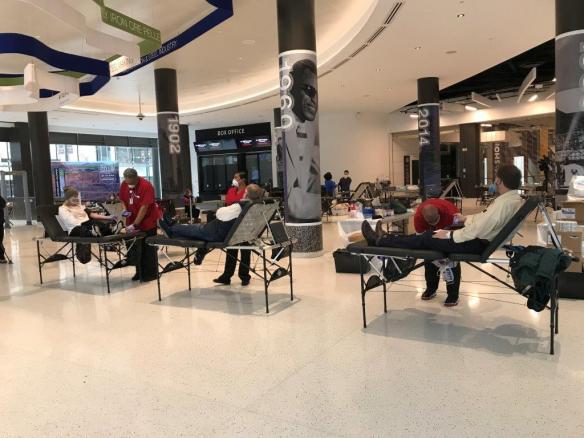
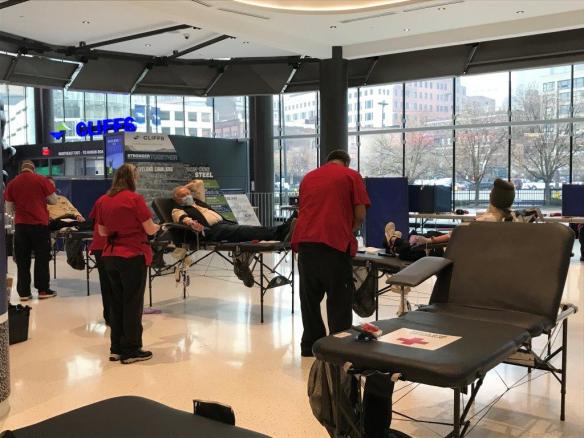
On March 20, the Cleveland Clinic lent a helping hand to put an end to the blood shortage by opening their doors to host a much needed blood drive.
One of the donors present at the blood drive was Jenna Ostrowski, a medical technologist in the Automated Hematology Department. This moment was a milestone for Jenna, as she was a first time blood donor, who was motivated to take the leap to officially become a blood donor due to the need following the outbreak.
“I figured now is the time, since so many people need blood. It’s a good opportunity for caregivers since the drive is right here at the Clinic,” stated Jenna.
Red Cross of Northeast Ohio Regional CEO Mike Parks was present at the blood drive, thanking Cleveland Clinic President Tomislav Mihaljevic for opening the Cleveland Clinic’s doors to host the blood drive and to thank donors like Jenna for giving the gift of life.
Tomislav Mihaljevic speaking with Mike Parks
Everyone at the Red Cross understands why people may be hesitant to come out for a blood drive, but we want to assure the public that we are taking additional precautions to ensure the safety of our donors, volunteers and staff.
Volunteers and staff are checking the temperature of everyone before they enter a drive to make sure they are healthy. Hand sanitizer is available for use before entering the drive, as well as throughout the donation process. We are also spacing beds, where possible, to follow social distancing practices between blood donors.
Red Cross employees follow strict safety procedures, including wearing gloves and changing them often, wiping down all donor-touched surfaces and equipment and preparing the arm for donation with an aseptic scrub.
If you are a first-time donor, like Jenna, click here to learn some helpful best practices.
If you are healthy, feeling well and eligible to give blood or platelets, please make an appointment to donate as soon as possible by using the Red Cross Blood Donor App, visiting RedCrossBlood.org or calling 1-800-RED CROSS (1-800-733-2767).
COVID-19 social distancing measures provide opportunity to be prepared
By Eric Alves, Regional Communications Specialist, American Red Cross of Northeast Ohio
March 23, 2020 — As individuals and families remain at home at a higher rate due to the COVID-19 outbreak and social distancing measures, the American Red Cross is urging all Northeast Ohio residents to take the time to prepare for future disasters.
Here are some safety tips to practice and follow while everyone is home together:
Home Fire Safety
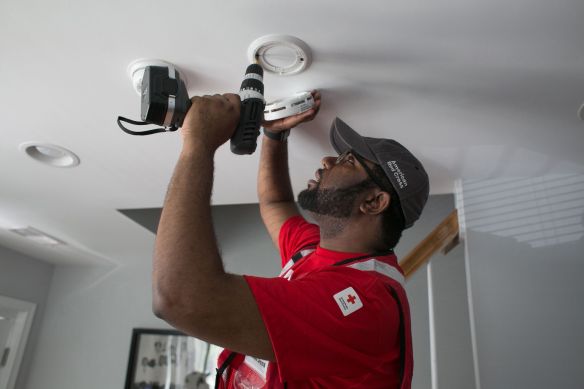
Install smoke alarms on every level of your home, inside bedrooms and outside sleeping areas.
Test smoke alarms every month. If they’re not working, change the batteries.
Talk with all family members about a home fire escape plan, make sure everyone has two exits out of every room.
Practice your fire escape plan and have everyone meet at the designated safe location. Make sure everyone escapes in two minutes or less.
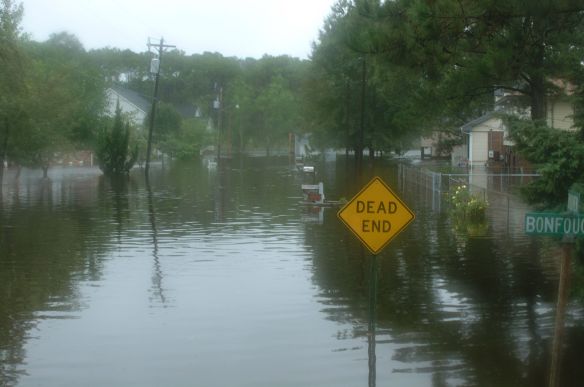
Talk with your family about what to do if a flood watch or warning is issued. Discussing floods ahead of time helps reduce fears, especially for younger children.
It seems that all we hear of late is “COVID-19,” and many wonder if it has taken the place of our normal American Red Cross activities. It has NOT! Residents experiencing fires continue to be assisted both on scene and in follow-up casework.
I am taking a moment today to emphasize the work being done by our incredible Disaster Health Services team. This group of volunteer nurses—most of whom are still employed full-time in roles ranging from pediatrics to geriatric nurse practitioner—continue to help our disaster clients who have lost medications, durable medical equipment, glasses, etc. We have new graduates, retirees and everyone in between, each bringing his or her personal gift of nursing knowledge and caring to bear through remote client contact.
Renee Palagyi
Beginning March 14, several members of the team took on an additional task of “Disaster Action Team (DAT) Responder Screening.” Each responder in the Northeast Ohio region was called and asked a series of questions, provided guidelines on increased virus risk based on certain medical conditions and asked if they were still willing to continue to respond to clients in need. The professional approach of our nurses helped allay fears while providing solid information based on Centers for Disease Control and Prevention guidelines.
Not surprising, but certainly incredibly gratifying, was the response we received from those volunteers screened. Overwhelmingly, in fact, approximately 90% stated their willingness to continue as DAT responders in the face of this pandemic. The majority of those not able to respond during this crisis were screened out by our nurses for medical reasons, not by their fears of becoming ill. They noted they felt reassured by the client screening process we have in place and the knowledge that Red Cross has at heart the well-being of our strongest asset, our volunteers.
We are all in this for the long haul, and I am pleased to lead this team of dedicated nurses who continue to give their time despite their own increased work and personal demands.
Edited by Glenda Bogar, American Red Cross volunteer
By Samantha Pudelski, American Red Cross volunteer
Editors note: The American Red Cross now faces a severe blood shortage due to an unprecedented number of blood drive cancellations during this coronavirus outbreak. Through March 17, nearly 4,000 Red Cross blood drives have been canceled across the country due to coronavirus concerns, resulting in more than 100,000 fewer blood donations. Healthy individuals are needed to donate now to help patients counting on lifesaving blood.
March 18, 2020- You’ve seen the advertisements and signs before—the ones that list upcoming American Red Cross blood drives in your area. You may drive past the sign on your way home or see something about a local drive on your social media feed. Like many people, I am not fond of needles. This is why for many years I went without donating blood.
This year, I was determined to put my nerves aside to take part in my first blood drive. I found a local site and signed up for a time slot, hoping that scheduling an appointment would help avoid any lines. When I arrived, there were several people donating and several more getting their screenings completed.
Laurie Brungeau giving blood during the launch of the Haitian Red Cross blood collection center in Port-au-Prince. The Haitian Red Cross suffered serious damage during the earthquake, but thanks to their hard work–and capacity-building investments from partners like the American Red Cross — they have stregthened and become more sustainable over the years. Photo: Garry Calixte/American Red Cross
After registering and completing my pre-screening, it was time to donate. The nurse asked me which arm I prefer, to which I answered, “Whichever arm that you can find a vein.” The nurse asked me if I have had trouble with nurses finding my veins in the past. They have but I didn’t think that would be an issue for donating. These volunteers do this regularly and are pros, right?
While the nurses at the donation site were, in fact, seasoned experts, the two nurses who checked still had trouble finding a viable vein to use in my arm. Out of caution for my well-being, they told me I wasn’t able to donate. I was incredibly disappointed that of all reasons to be turned away as a donor, it was my lack of a viable vein!
This experience showed me just how important it is for those who can donate blood to do so. After sharing my experience with a few friends, I learned that many of them had similar experiences. From my friends and the nurses at the blood drive, I learned a few best practices I wanted to share for those looking to donate:
Drink lots of water before you donate – the day before and the day of your donation.
Avoid caffeine to avoid detracting from #1.
The magic number for your iron level is 12.5. They test this before you actually start your donation to make sure you have the minimum level.
Complete the RapidPass online before you donate to save time at the blood donation location. This contains the pre-donation packet reading and health history questions donors need to complete.
Bring some music or reading when you donate. It only takes 8-10 minutes to do the actual blood donation but having something to do can help pass the time, especially if you are nervous.
Knowing these things, I plan to go back again soon to see if I can donate. I hope my story encourages you to donate as well.
Currently, there is an urgent need for blood due to the Coronavirus outbreak. Right now, eligible and healthy donors are strongly urged to make an appointment to give soon. To schedule an appointment and for information on enhanced blood donation safety related to Coronavirus, visit: https://www.redcrossblood.org.
By Eric Alves, Regional Communications Specialist, American Red Cross of Northeast Ohio
March 16, 2020- While residents in Northeast Ohio were taking precautions to remain safe from the coronavirus, members of the American Red Cross of Northeast Ohio Disaster Action Team were assisting residents facing the worst day of their lives, as disasters do not adhere to social distancing measures.
During the weekend of March 13-15, the DAT team responded to disasters in four of the five chapters of the Northeast Ohio Region, with disasters occurring in Columbiana, Cuyahoga, Erie, Lake, Richland, Stark and Trumbull counties.
The Red Cross assisted 32 adults, 29 children and provided $12,460 in immediate financial assistance.
While we all take extraordinary steps to contain the coronavirus, the Red Cross is asking all healthy individuals to donate blood, to help maintain the nation’s blood supply as blood drives across the country continue to be cancelled.
Over the last few days, we have seen blood drive cancellations grow at an alarming rate. Through March 13, about 1,500 Red Cross blood drives have been canceled across the country due to coronavirus concerns, resulting in some 46,000 fewer blood donations. We expect that number to rise.
We understand why people may be hesitant to come out for a blood drive, but want to reassure the public that we are taking additional precautions to ensure the safety of our donors and staff.
We are checking the temperature of staff and donors before entering a drive to make sure they are healthy. Hand sanitizers are available for use before entering the drive, as well as throughout the donation process. We are also spacing beds, where possible, to follow social distancing practices between blood donors.
Red Cross employees follow strict safety procedures, including wearing gloves and changing them often, wiping down all donor-touched surfaces and equipment and preparing the arm for donation with an aseptic scrub.
A blood shortage could impact patients who need surgery, victims of car accidents and other emergencies, or patients suffering from cancer. One of the most important things you can do to ensure we don’t have another health care crisis on top of the coronavirus is to give blood.
If you are healthy, feeling well and eligible to give blood or platelets, please make an appointment to donate as soon as possible by using the Red Cross Blood Donor App, visiting RedCrossBlood.org or calling 1-800-RED CROSS (1-800-733-2767).
Breakfast ceremony held at the Global Center for Health Innovation
By Jim McIntyre, American Red Cross
March 13, 2020- Nine people and one Labradoodle were honored at the 2020 Greater Cleveland Hero Awards breakfast on Thursday, March 12, at the Global Center for Health Innovation in Cleveland. And Ronn Richard, the President and CEO of the Cleveland Foundation was recognized at the Community Leader Award winner.
Read more about the Hero honorees, and the events that led to the recognition below:
Sixteen-year-old Elise Kilmer of Burton was in her room with her Labradoodle Saige last November, when suddenly, Saige began to bark continuously. When Elise opened her door, Saige bounded down the stairs to the kitchen. Elise followed, and found her grandmother lying on the floor unresponsive. Elise recalled her American Red Cross training, and applied it during this critical situation. First, she called 9-1-1. Then, she checked for a pulse and began performing CPR, continuing until medical personnel arrived. Her grandmother credits Elise with saving her life. Elise is also a Red Cross-trained lifeguard. She was also presented with a Certificate of Merit, the highest award the American Red Cross offers to someone who used their Red Cross training to save a life. Watch Elise’s story here.
Elise Kilmer
Cleveland Heights Police Officer Josh Robertson, the first to arrive at the scene of a home fire in July, was told by a distressed mother that her 6-year-old son was trapped inside. Disregarding the heavy smoke inside the home, and without the benefit of any protective clothing or equipment, Robertson pushed his way into the home and crawled on the floor in an effort to find the boy. He couldn’t see the child, but he heard the sound of moaning and followed it until he felt the boy, grabbing him by his clothes and dragging the child to safety, despite being overcome by smoke. He and the child survived. Watch Josh’s story here.
Josh Robertson with Regional CEO Mike Parks and Greater Cleveland Chapter Board of Directors Chairman Chris Mapes
Sandra Patrick of KeyBank has played a crucial role in helping meet the demand for blood, which is vital to the survival of hospital patients undergoing surgery, cancer treatment and other medical conditions. Patrick has organized blood drives at two KeyBank office locations for more than 10 years, and she has been instrumental in increasing sponsorship and participation. She is currently the point of contact with the Red Cross for 12 different blood drives, and recently expanded the drives to include other building tenants. Beyond her management of blood drives, Patrick has also recruited other KeyBank employees to help with Sound the Alarm, the Red Cross initiative to save lives by installing free smoke alarms. Watch Sandra’s story here.
Sandra Patrick
On the morning of Thursday, Sept. 19, a Jack Casino surveillance team member was working when he went into full cardiac arrest. Within a minute, coworker Charles Fuller called for assistance and began administering CPR. Less than a minute later, security training instructor Jacqueline Duthie arrived to assist, and within a minute of that, security manager Hassan Ali arrived with an AED. It was the first time he had been called to use the lifesaving device since receiving CPR/AED training four years earlier. Fuller, Duthie and Ali continued to provide medical attention until paramedics arrived. The stricken coworker survived, and doctors confirmed that without the immediate lifesaving response, the outcome most likely would have been much different. Watch Charles, Jacqueline and Hassan’s story here.
Charles Fuller, Jacqueline Duthie and Hassan Ali
Amanda Berry endured one of the most horrific experiences imaginable, being held captive for 10 years after being kidnapped at age 16. But she never lost hope, and 10 years later, she and her toddler daughter escaped their prison, and helped lead two other female captives to freedom as well. Since that time, Berry has dedicated her life to raising her daughter, and to help find missing persons who may be experiencing the same horrors she did. She appears on Fox 8 News, looking into a camera, describing those who have gone missing, and asking viewers for help finding them. Berry is not a trained broadcaster or news reporter, but she fearlessly puts herself out there to help others, because she genuinely cares about them, even though they are strangers. She knows they all have family members who are awaiting their return—just as her family members did. Despite her traumatic past, Berry is making the most of her present, and is looking forward to a bright future for herself, her daughter and others she may have a role in helping return home. Watch Amanda’s story here.
Amanda Berry
Nine-year-old Troy Cavadas of Columbia Station was watching his dad try to burn a tree stump with kerosene outside their home in early November when fuel splashed on them both, setting their clothes on fire. Troy had just learned how to stop, drop and roll at school less than a month earlier. He didn’t panic and was able to put the flames out on his clothing. He then yelled, “Roll, Daddy, roll, roll!” But the fire kept growing. Troy then grabbed a garden hose and soaked his dad with water until the flames went out. Firefighters call Troy a hero.
Part two of this hero story involves the firefighter who taught Troy the fire safety skills that helped save him and his dad. Columbia Township volunteer firefighter Brett Wilson visited Troy’s school just one week before the 23-year-old firefighter lost his life trying to help two people involved in a car crash. Wilson was electrocuted after coming into contact with a downed power line. Troy’s father, Jed, credits Wilson with saving his life. Brett’s parents, Barb and Gary Wilson, accepted the award on behalf of their hero son. Watch Troy and Brett’s story here.
Troy Cavadas and Brett Wilson’s parents Barb and Gary accepting the award from Regional CEO Mike Parks and Greater Cleveland Chapter Board of Directors Chairman Chris Mapes
Ronn Richard’s Community Leader Award was presented by Regional Red Cross CEO Mike Parks, and Chris Mapes, President and CEO of Lincoln Electric and Chairman of the Red Cross of Greater Cleveland.
Ronn Richard accepting the Community Leader Award from Mike Parks and Chris Mapes
The event was hosted by long-time Cleveland television journalist Denise Dufala.
Denise Dufala with Chris Mapes
To nominate a hero for the next Hero Awards, complete the online form.
Visit our Flickr page to view more photos from the 2020 Greater Cleveland Chapter Heroes and Community Leader Award.
Edited by Glenda Bogar, American Red Cross volunteer
March 11, 2020- With confirmed coronavirus disease cases in Northeast Ohio and the state of Ohio declaring a state of emergency, and with schools across the region closed and events postponed due to precautions, the American Red Cross strongly urges healthy, eligible individuals who are feeling well to give blood or platelets to help maintain a sufficient blood supply and prevent shortages as concerns about the outbreak of coronavirus disease 2019, or COVID-19, rise in the U.S.
Cold and flu season has already impacted the nation’s ability to maintain its blood supply. As the number of coronavirus cases grows in the U.S., the number of people eligible to give blood for patients in need could decrease further.
“We’re asking the American people to help keep the blood supply stable during this challenging time. As communities across the country prepare for this public health emergency, it’s critical that plans include a readily available blood supply for hospital patients,” said Chris Hrouda, president, Red Cross Blood Services. “As fears of coronavirus rise, low donor participation could harm blood availability at hospitals, and the last thing a patient should worry about is whether lifesaving blood will be on the shelf when they need it most.”
Donating blood is a safe process and people should not hesitate to give or receive blood. There are no data or evidence that this coronavirus can be transmissible by blood transfusion, and there have been no reported cases worldwide of transmissions for any respiratory virus, including this coronavirus, from a transfusion.
The Red Cross only collects blood from individuals who are healthy and feeling well at the time of donation – and who meet other eligibility requirements, available at RedCrossBlood.org. At each blood drive and donation center, Red Cross employees follow thorough safety protocols including wearing gloves, routinely wiping down donor-touched areas, using sterile collection sets for every donation, and preparing the arm for donation with an aseptic scrub. These mitigation measures will help ensure blood recipient safety, as well as staff and donor safety in reducing contact with those who may potentially have this respiratory infection.
Blood drive hosts play important role Blood drive hosts also play a critical role in maintaining a sufficient blood supply and are asked to keep hosting blood drives for patients who rely on lifesaving blood. The need for blood is constant, and volunteer donors are the only source of blood for those in need of transfusions.
The Red Cross, with the help of its blood drive hosts and blood donors, can help ensure the safety and availability of the U.S. blood supply for patients including accident and burn victims, heart surgery and organ transplant patients, and those receiving treatment for leukemia, cancer or sickle cell disease.
“Keep giving, keep hosting blood drives,” said Hrouda. “Patients across the country need our help.”
To learn more about hosting a blood drive for patients in need, please visit RedCrossBlood.org.
Red Cross committed to blood supply safety
The top priority of the Red Cross is the safety of our valued staff, blood donors and blood recipients, and we are committed to transparency with the American public during this evolving public health emergency. There are no data or evidence that this coronavirus can be transmissible by blood transfusion, and there have been no reported cases worldwide of transmissions for any respiratory virus including this coronavirus, from a transfusion.
Nonetheless, the Red Cross has implemented new blood donation deferrals out of an abundance of caution. Individuals are asked to postpone their donation for 28 days following:
Travel to China and its special administrative regions, Hong Kong and Macau, as well as Iran, Italy and South Korea;
Diagnosis of COVID-19, contact with a person who has or is suspected to have the virus.
As the situation evolves, the Red Cross will continue to evaluate all emerging risks in collaboration with the U.S. Food and Drug Administration, Centers for Disease Control and Prevention and industry partners to determine if additional intervention strategies are needed. Together, we stand ready to keep the American public informed and prepared.
Blood donation process
A blood donation takes about an hour from start to finish, but the actual donation itself only takes about 8-10 minutes. Donors can also save up to 15 minutes at the blood drive by completing a RapidPass®. With RapidPass®, donors complete the pre-donation reading and health history questionnaire online, on the day of donation, from a mobile device or computer. To complete a RapidPass®, follow the instructions at RedCrossBlood.org/RapidPass or use the Red Cross Blood Donor App.
To donate blood, individuals need to bring a blood donor card or driver’s license or two other forms of identification that are required at check-in. Individuals who are 17 years of age in most states (16 with parental consent where allowed by state law), weigh at least 110 pounds and are in generally good health may be eligible to donate blood. High school students and other donors 18 years of age and younger also must meet certain height and weight requirements.
Camden was 3 weeks old when he received his blood transfusion Aug. 22, 2019. He spent 20 of his first 23 days of life in and out of the hospital three different times. Once he was discharged and readmitted into the same hospital two times, not including his birth, we were finally sent to University Hospitals Rainbow Babies & Children’s Hospital. He had many blood tests every day and by the time he reached 3 weeks old, his blood had reached dangerously low levels. I will never forget the wave of emotions that came over me when they came into the room and told me that.
My first question as his mother was “Can I donate?” That was when I was informed that I was not able to donate because of the cleaning process that the blood must go through, as well as the virus CMV that 90% of the population carries. I was completely at the mercy of some kind stranger to save my newborn son’s life.
Today Camden is 6 months old and living at home, instead of a hospital! He is the happiest baby I have ever met and loves to smile and laugh. He loves his milk, to roll, and to chew on anything and everything you will allow! Camden is doing very well. He is just being monitored. Receiving the blood transfusion seems to be the turning point in his illness.
I am unsure how you measure units of blood but at 3 weeks old, he received two full syringes of blood. (The very large ones put into the transfusion machine).
Camden’s illness completely rocked his family. He is the first grandchild on both sides of the family and the first great grandson on his father’s side. I stayed in the hospital with him the whole time he was there, and his dad stayed until he had to return to work. My husband had run out of time off, unfortunately. The rest of his family visited often.
Since then his mom will tell anyone who will listen about the importance of donating blood, for the babies! His mom and dad also have donated twice since things calmed down and plan to donate regularly for the rest of their lives.
I always say “thank you,” with tears in my eyes to people who donate regularly. I hugged a total stranger at a blood drive the other day because I found out she was CMV negative and donates as much as possible. I also always tell people that it really makes a difference and that I wouldn’t have my son today if it wasn’t for a complete stranger’s kindness.
I have posted many times on social media to motivate people to donate. I always inform them that babies do not make blood for the first two to three weeks of their lives so any baby with illnesses at birth are at risk of needing a transfusion. I also include information about the CMV virus so they know only a very select few people who donate can actually have their blood given to a baby.
I believe most people think, “If someone I know needs it, I’ll donate” but it does NOT work that way. A completely anonymous donor has to have given at least a week before it is received so it can go through the very important process of cleaning and testing the blood so it is safe for you or your loved one to receive. My son had been inside me three weeks prior and they would not take my blood to give to him. I especially want to motivate people for the babies. But as mothers it never really matters how old our children are, they are always our babies.
When you donate, you save someone else’s baby. It’s as simple as if you or a loved one were in need, you would want someone else to think it was worth their time to spend 20 minutes one day to donate. I know a lot of people have fear of needles, but I just ask them to imagine the fear a mother experiences when she finds out her child, especially a newborn, needs a blood transfusion. When you donate blood, you save someone else’s baby, someone else’s spouse, someone else’s parent, or just someone else. IT IS WORTH IT! IT IS FREE! IT IS IMPORTANT!
Edited by Glenda Bogar/American Red Cross volunteer
March 6, 2020- I’ve had the privilege of serving on the board for the Summit, Portage and Medina County Red Cross for nine years. As part of that, I’ve been honored to emcee the annual Acts of Courage and H. Peter Burg Community Leadership Award event with my co-host and husband, radio personality Tim Daugherty.
Sue Wilson and Tim Daugherty
Acts of Courage honors individuals who have shown extraordinary courage, compassion, character, and humanity. These stories never cease to have a profound effect on me and every single person in the room.
The 24th annual Acts of Courage honored the following individuals:
Matt Martincin and Chris Deeks
Matt Martincin and Chris Deeks with Summit, Portage and Medina Counties Chapter Executive Director Rachel Telegdy
As smoke billowed from a second-floor apartment building, early in the morning of June 12, 2019, Medina police officers Matt Martincin and Chris Deeks arrived to see two women trapped in an apartment. Despite having a smoke alarm in the apartment, there were no batteries in the alarm.
After attempts to have the women jump failed, Matt and Chris found a ladder on the back of a contractor’s vehicle and used the ladder to rescue the two women and all seven of their pets.
Here is Chris and Matt’s story:
Gregg Whiteman
Gregg Whiteman with Rachel Telegdy
What began as an ordinary day at GOJO headquarters in Akron, quickly turned to anything but ordinary.
While in a meeting, Gregg Whiteman received a call from a colleague. Realizing how unusual it was to receive a call from someone who knew he was in a meeting, Gregg answered his phone. He quickly realized that something was wrong and that the co-worker needed his assistance.
Remaining on the phone, Gregg was able to gather the proper information to realize exactly where his colleague was, despite his inability to speak coherently.
Thanks to his persistence, Gregg was not only able to find his co-worker lying on the floor of an office, behind a closed door, but his quick response and immediate call to 911 ensured that the co-worker in need was able to be taken to the hospital, where he was given medication to prevent permanent damage from the stroke he was suffering.
Here is Gregg’s story:
Brian Linder
At the end of a workday in downtown Akron, Brian Linder was walking across the skywalk to the garage to go home. As he was hurrying along to avoid the frigid February cold, Brian spotted an individual unconscious and not breathing.
Rachel Telegdy with Brian Linder
Having just completed a CPR refresher course a few months prior, Brian began to administer CPR until paramedics arrived on the scene.
Here is Brian’s Story:
Jacob Thompson
On February 24, 2019, there was a high wind advisory for drivers. That day, Jacob Thompson was returning to the Kent State University campus following United States Coast Guard drill training in Port Clinton, Ohio.
As he was driving, the high wind took hold of a trailer and threw a semi-truck that was driving in front of Jacob into the center guardrail.
Jacob immediately pulled his vehicle to the side of the road. Upon approaching the vehicle, he was able to see the driver alive, but confused and unable to get out. Jacob then began to remove the top and debris from the truck in order to access the cab so he could pull the driver to safety from the overturned vehicle.
Jacob is currently deployed on active duty and was unable to attend the event. However, prior to deploying, Jacob was able to receive his award and taped an acceptance video, which was shown during the evening’s activities.
Paul Diven
In October, Stan Hywet maintenance worker Paul Diven saw a crowd gathering during the annual Ohio Mart arts fair. When he made his way to the commotion, he noticed volunteer Bruce DeBarr, who requires oxygen, not breathing.
Rachel Telegdy with Paul Diven
Understanding time was of the essence, Paul began to troubleshoot to find the issue with Bruce’s oxygen tank. Once Paul spotted that a part was installed incorrectly, he properly installed the part and began to hear the oxygen flowing, helping Bruce regain consciousness. Once Bruce made a full recovery, Paul returned to work at Ohio Mart.
Doug Price, Marcus Council and Barb Fisher
On May 9, 2019, the Akron Fire Department responded to a home fire, with reports of a child trapped in a basement.
Marcus Council and Doug Price with Rachel Telegdy
With the home engulfed in flames and the basement full of smoke, Akron firefighters Lt. Doug Price and Marcus Council entered the home in search of the young girl. Despite low visibility, Doug was able to find the child unconscious and lying on the ground and covered. Doug and Marcus removed the child from the burning home. She was transported to the hospital, where she was able to regain consciousness and make a full recovery.
Barb Fisher with Rachel Telegdy
It was later determined that the child remembered the fire safety instructions she was taught a week earlier by her teacher Barb Fisher, ultimately helping to save her life.
Here is Doug, Marcus and Barb’s story:
Jason Strunk, Leslie Snyder and Seth Bond
While waiting at a red light on his way to helping an elderly family friend grocery shop in Akron’s Middlebury neighborhood, Jason Strunk heard gunfire ring out in the street. That is when Jason saw a mother being shot by her boyfriend, while trying to protect her three children, including an infant.
Jason Strunk with Rachel Teledgy
Without hesitation, Jason jumped out of his car and began to wrestle with the armed individual. At this time, Leslie Snyder and Seth Bond arrived and witnessed what was happening. Seth began to assist Jason in trying to apprehend the shooter, while Leslie attended to the injured mother and her children.
Seth Bond and Leslie Snyder with Rachel Telegdy
During the exchange, the shooter’s gun jammed. As the shooter returned to his vehicle to find and return with a knife, Jason grabbed the two older children and placed them in his car, while Leslie placed the mother and baby in her car, while applying pressure to the mother’s wounds. Jason and Leslie were able to drive the family to safety until first responders and paramedics arrived.
Here is Jason, Leslie and Seth’s story:
Each of these stories share one common theme: that the people involved don’t consider themselves “heroes.” And THEY are the ones who are grateful for being able to help someone. Wow.
Another highlight of this event is the H. Peter Burg Community Leadership Award, presented to those who best exemplify Pete Burg’s leadership qualities, his compassion for people and his dedication to the lifesaving mission of the Red Cross. This year’s award recipient is Steve Hendricks.
Steve Hendricks receiving the award from Rachel Telegdy and H. Peter Burg’s daughter Amy Burg Cole
Steve is market president of the Northeast Ohio region for S&T Bank. He served on the Red Cross of Summit, Portage and Medina Counties board of directors for 9 years and held many leadership positions including board president. After terming off the board, he remains active with the chapter, serving on multiple committees and engaging his team at S&T Bank in Sound the Alarm events throughout the Summit, Portage and Medina Counties. In addition to his Red Cross work, Hendricks serves on multiple boards throughout the area, including the Akron Area YMCA board of trustees. He is also a graduate of Leadership Akron, Class 25
Akron Area YMCA performing “What a Wonderful World”
Among the tributes honoring Steve, children from the Akron Area YMCA youth program surprised Steve with a performance where they used American Sign Language to sing “What a Wonderful World.”
The festivities came to an end with a visit by the Akron Fire Department’s fire pup mascot and Northeast Ohio Region Program Disaster Program Officer Tim O’Toole sharing with all those in attendance the importance of smoke alarms and home fire escape plans.
Tim O’Toole
You too can be a local hero. If you are interested in taking a Red Cross training, such as CPR, life guarding and babysitting, please visit redcross.org/take-a-class to see upcoming classes and to register.
You can also be a hero to someone in need by donating life saving blood. Visit RedCrossBlood.org to find a blood drive near you and to schedule an appointment to give now.
To view more photos from the Summit, Portage, and Medina Counties Chapter Acts of Courage event, visit the Red Cross of Northeast Ohio’s Flickr page.
March 4, 2020- Let’s say you’re enjoying a quiet evening at home with family or friends and one of you suffers a cardiac emergency. Dr. Mariann Harding wants to increase the odds that someone there can give the victim—possibly you—a fighting chance to live.
Dr. Harding is a professor of nursing technology at the Kent State University (KSU) Tuscarawas campus. So all her students are learning the critical skills to handle such an emergency. Now she’s discovered a way to expand that number of responders many times over.
This year, through the American Red Cross, 18 members of her nursing honor society are presenting Hands-Only CPR. They are teaching non-medical members of their communities how to maintain vital circulation in a stricken person until trained responders arrive.
“Our goal is 200 people touched with this training this year,” said the professor, who likes to be called Mariann. “It’s going very smoothly. I think we’re going to make it.”
Mariann became acquainted with the Red Cross two and a half years ago by way of a local leadership workshop. She decided she could bring something worthwhile to the organization with her medical and educator background.
She joined the board of her local Stark and Muskingum Lakes Chapter and learned about the many preparedness and prevention programs of the Red Cross, including Hands-Only CPR. She realized her students would be ideal volunteer teachers to spread the word about this lifesaving technique.
Hands-Only CPR done by a bystander is recognized as being as effective as CPR with rescue breaths for the first crucial minutes after a cardiac event. “It’s better to use a stopgap that’s 90 percent effective than to do nothing,” Mariann said of the hands-only technique.
KSU provided a grant to buy compression training “torsos” for her project. Last year she and 16 honor nursing students taught nearly 230 people—from teenagers to elderly churchgoers. She’s convinced, “Everybody can do something.”
The project has given her nursing students a shot of confidence in their own abilities to build healthier communities, and it’s introduced them to other Red Cross programs. “One of my students signed up to help with the smoke alarm installations and another one is interested in becoming a presenter for the safe sitter program.”
As for Mariann, “I’m so enjoying my involvement with the Red Cross. I look forward to doing more.”
To learn about the many Red Cross programs that empower Americans to prevent, prepare for and respond to emergencies, or to become a volunteer, visit redcross.org or contact your local Red Cross chapter.
Edited by Glenda Bogar, American Red Cross volunteer