Mom makes plea for diverse blood donors

By Theresa Carter, guest blogger and proud supporter of the American Red Cross of Greater Akron and the Mahoning Valley

In the U.S., it is estimated that over 100,000 people – the majority of whom are of African descent – have sickle cell disease and may require blood transfusions throughout their lifetime to help manage their disease.

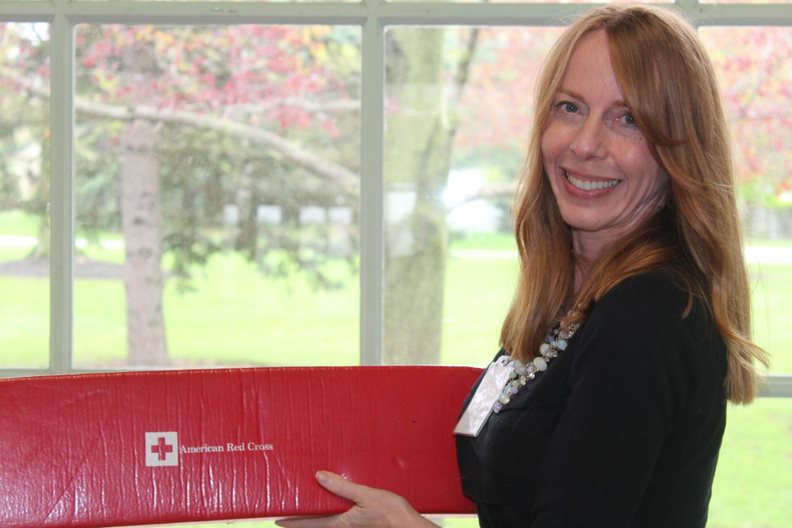
Theresa Carter, speaking at the Acts of Courage Awards in March, 2022

The American Red Cross has launched a national initiative to grow the number of blood donors who are Black to help patients with sickle cell disease and improve health outcomes.

Sickle cell disease is an enduring – and often invisible – health disparity in the U.S. Despite the discovery of the disease more than a century ago, there has been fewer health resources available to help those currently suffering from sickle cell disease in comparison to similar diseases.

The Red Cross currently provides sickle cell trait screening on all donations from self- identified African American donors. This additional screening helps the Red Cross identify compatible blood types more quickly to help patients with sickle cell and provides our African American donors an additional health insight during a time when health information has never been more important.

This cause is near and dear to my heart because both my daughters have sickle beta thalassemia disease, a minor form of sickle cell. You see, I have a sickle trait and their father has the thalassemia trait. We had no clue until our children were born that we had these traits and that our girls would have this disease. Therefore, screening is so very important…. just to know; to understand the cause and then educate ourselves so that we can be our best advocates if and when the time arises for medical care.

Garvin and Theresa Carter with daughters Erin and Cesily

Please take action today and schedule a blood donation appointment by visiting RedCrossBlood.org, using the Blood Donor App or calling 1-800-RED CROSS.

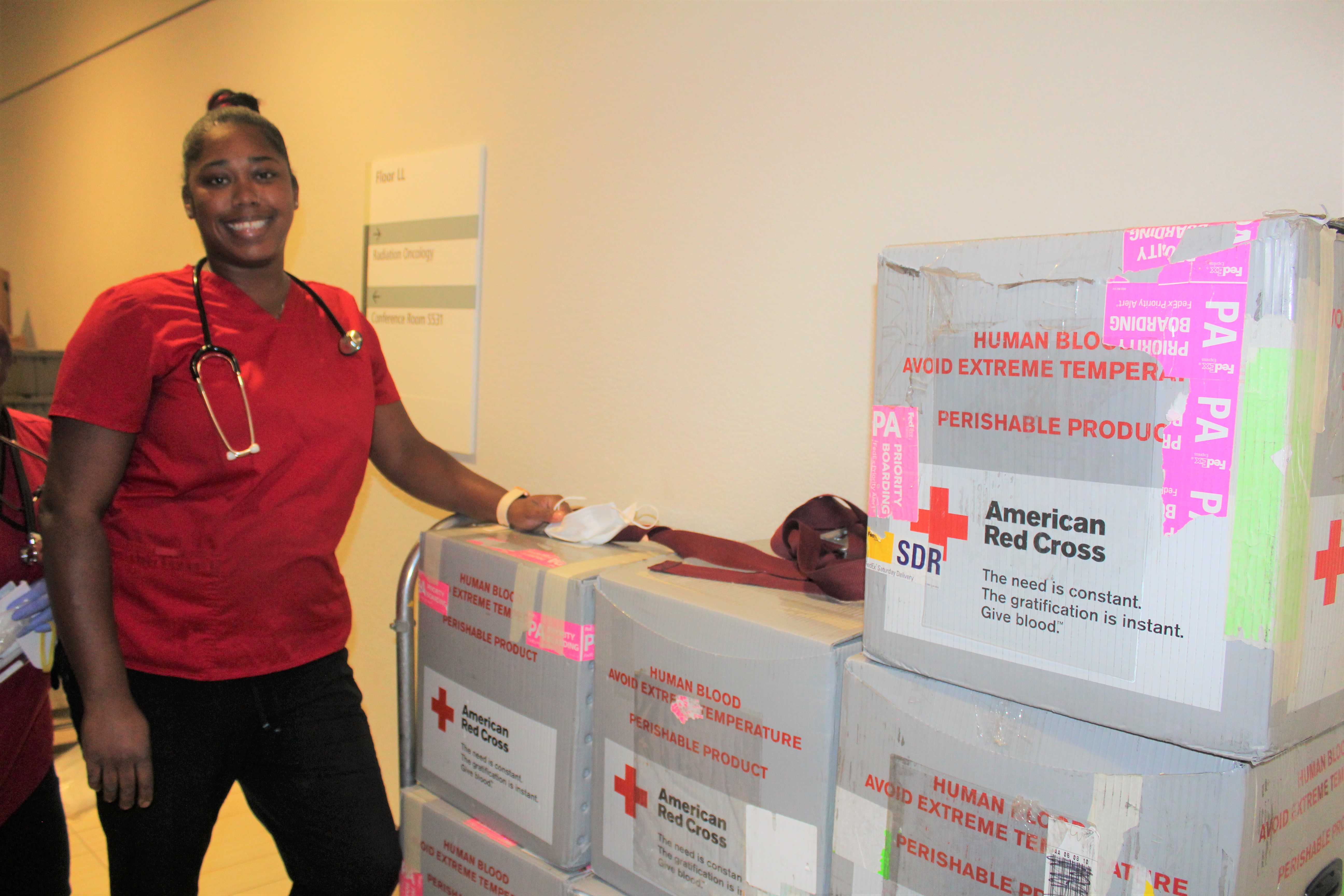
Editor’s note: Regular blood transfusions are critical to managing extreme pain and life threatening complications faced by many. Unfortunately, they may develop an immune response against blood from donors that is not closely matched to their own. However, because most individuals who are Black have unique structures on their red blood cells that are not often found in other donor populations, 1 in 3 African American blood donors is a match for people with sickle cell disease.

Sickle cell disease distorts soft, round blood cells and turns them hard and crescent-shaped, which can cause severe pain. “When cells harden, they can get caught in blood vessels, potentially leading to stroke and organ failure,” says Dr. James Westra, Regional Medical Director. “Transfusions provide healthy blood cells, unblocking blood vessels and delivering oxygen, minimizing crises patients with sickle cell may face.”

Seasonal changes can trigger pain crises for those battling sickle cell – possibly increasing the need for lifesaving blood transfusions. As summer ends, book a time to give blood by using the Red Cross Blood Donor App, visiting RedCrossBlood.org or by calling 1-800-RED CROSS (1-800-733-2767). As a thankyou, all who come to give through Sept. 18 will get an exclusive Red Cross T-shirt, while supplies last.

Posted by Ryan Lang, American Red Cross board member and volunteer

Planning ahead for National Preparedness Month

By Ryan Lang, Red Cross volunteer

January 17, 2022 (MLK Day): Walking into the office, stomping my feet to get the snow and the slush and the slop off of my boots, I thought to myself, That’s the worst commute to work I’ve ever experienced. What normally takes 25 minutes took roughly an hour and a half through the driving snow and treacherous road conditions. 

February 2, 2022: After spending more than an hour shoveling more than a foot of snow from my driveway at 2 in the morning, I tried to drive to work. Didn’t make it. In fact, I only made it to the end of my driveway before my vehicle became stuck in the street. Thanks to the help of New Franklin Police Officer Shearer, I was safely guided back into my driveway, but there I stayed. There was no way I was making it to the office. 

Two of the largest winter storms I can remember hit Northeast Ohio in a matter of two weeks, and both had me feeling less prepared than I’d ever felt before. 

From that point on I vowed to take preparedness more seriously, and not just for the winter season. After all, I’m a dad now – what better reason?

As we’ve seen countless times in Northern Ohio, across the country, and around the world, storms can affect our lives very quickly and very seriously. That is why the American Red Cross is urging you to prepare for emergencies, right now, during National Preparedness Month all September long.

HOW TO GET READY FOR A DISASTER

It takes just three simple steps to help prepare your household for potential disasters –

1) Get a Kit – First, build your emergency kit with a gallon of water per person, per day, non-perishable food, a flashlight and a battery-powered radio. Also include a first aid kit, medications, supplies for infants or pets, a multi-purpose tool and personal hygiene items. And don’t forget to add copies of important papers, cell phone chargers, blankets, maps of the area and emergency contact information.

2) Make a Plan – Next, plan what to do in case you are separated from your family during an emergency and what to do if you have to evacuate. Make sure to coordinate your plan with your child’s school, your work and your community’s emergency plans. Include your pets in your emergency plans. Remember, if you and your family need to evacuate, so does your pet.

3) Be Informed – Finally, stay informed by finding out what emergency situations may occur where you live, work and go to school, how local officials will contact you during a disaster and how you will get important information, such as evacuation orders.

Depending on the people in your household, there might be additional considerations to take into account as part of your emergency planning. Older adults or people with mobility, hearing, learning or seeing disabilities may need to create a support network of people that can help during an emergency. Create a plan tailored to their capabilities, any help they may need and who can provide it, especially if they need to evacuate or if the power goes out for several days.

Disasters can be scary for children. Take time to talk with your kids about preparing for common emergencies, how to stay safe and what to expect. The Red Cross has free programs and tools to help, visit redcross.org/YouthPrep for more information.

HELP GET YOUR COMMUNITY PREPARED

You can help ensure your community is ready for an emergency by volunteering, donating blood or learning lifesaving skills. Visit redcross.org to learn more.

Red Cross volunteers play critical roles in their local communities, including helping families affected by home fires and other disasters get back on their feet. Join us as a Disaster Action Team volunteer to help make sure that families don’t have to face tough times alone.

Learn lifesaving skills so you can help people in a crisis until medical professionals arrive. Sign up for first aid, CPR or other classes available online or in-person. 

A strong blood supply is key to preparedness for disasters and medical emergencies, and donors can ensure blood is on the shelves the moment it’s needed. As a thank-you, all who come to give Sept. 1-18 will get a limited-edition Red Cross T-shirt, while supplies last. Plus, those who race to give Sept. 1-30 will automatically be entered for a chance to win a VIP NASCAR experience, including two tickets to a 2023 race, and will also receive a coupon for a free haircut by email, all thanks to Sport Clips Haircuts.* Donors can schedule an appointment to donate using the Red Cross Blood Donor App, by visiting RedCrossBlood.org or by calling 1-800-RED CROSS (1-800-733-2767). If you are unable to give blood you can volunteer to support blood collections. Visit redcross.org/volunteer to learn more.


Volunteers share their pets to help members of the military and veterans

By Eilene E. Guy, American Red Cross volunteer

Pet visitation has long been offered by the American Red Cross as a service to the armed forces. In the Northern Ohio Region, the pet visitation program was recently expanded.

Pre-deployment event at Youngstown Air Reserve Station

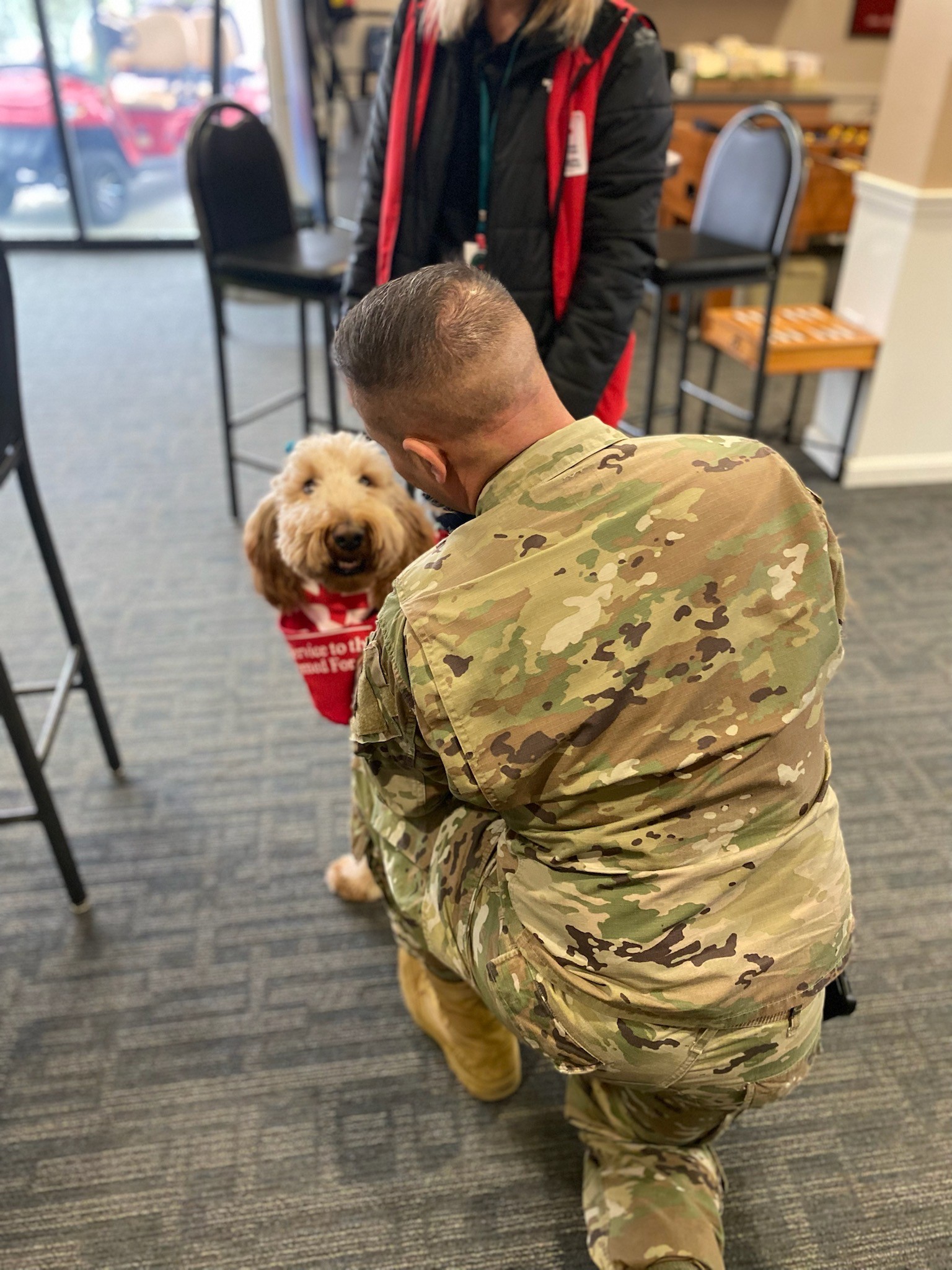
Bree, a Goldendoodle, and Shane, a Rough Collie, are trained members of the Red Cross Animal Visitation Program (AVP) here in northern Ohio. They – along with their owners, Paul and Katie Svasta of Canfield – bring comfort to members of all branches of the military who deploy from or return to the Youngstown Air Reserve Station. The dogs are also welcome at family days at the air base.

Paul and Katie Svasta with Bree and Shasta

“Bree is spot on,” Paul said. “She can identify somebody who needs her. She’ll pull me over to the person, and if that person gives me the go-ahead, she’ll lean right up next to them, for
them to pet her or hug her.

“It breaks the tension, the anxiety. That unconditional connection,” he said. “It’s rewarding, that something so simple can give so much comfort.”

Paul and Katie began acclimating Bree to therapy work five years ago, when she was a puppy, so she’s the pro of the pair. Shane got a slow start because pandemic protocols interrupted the conditioning all therapy dogs go through. “But he’s coming along,” Paul said affectionately.

The animal visitation program has been operating at the Youngstown base, which hosts the 910th Airlift Wing, for a number of years. The Svastas are part of a team of more than three dozen handlers and their dogs who attend events there.

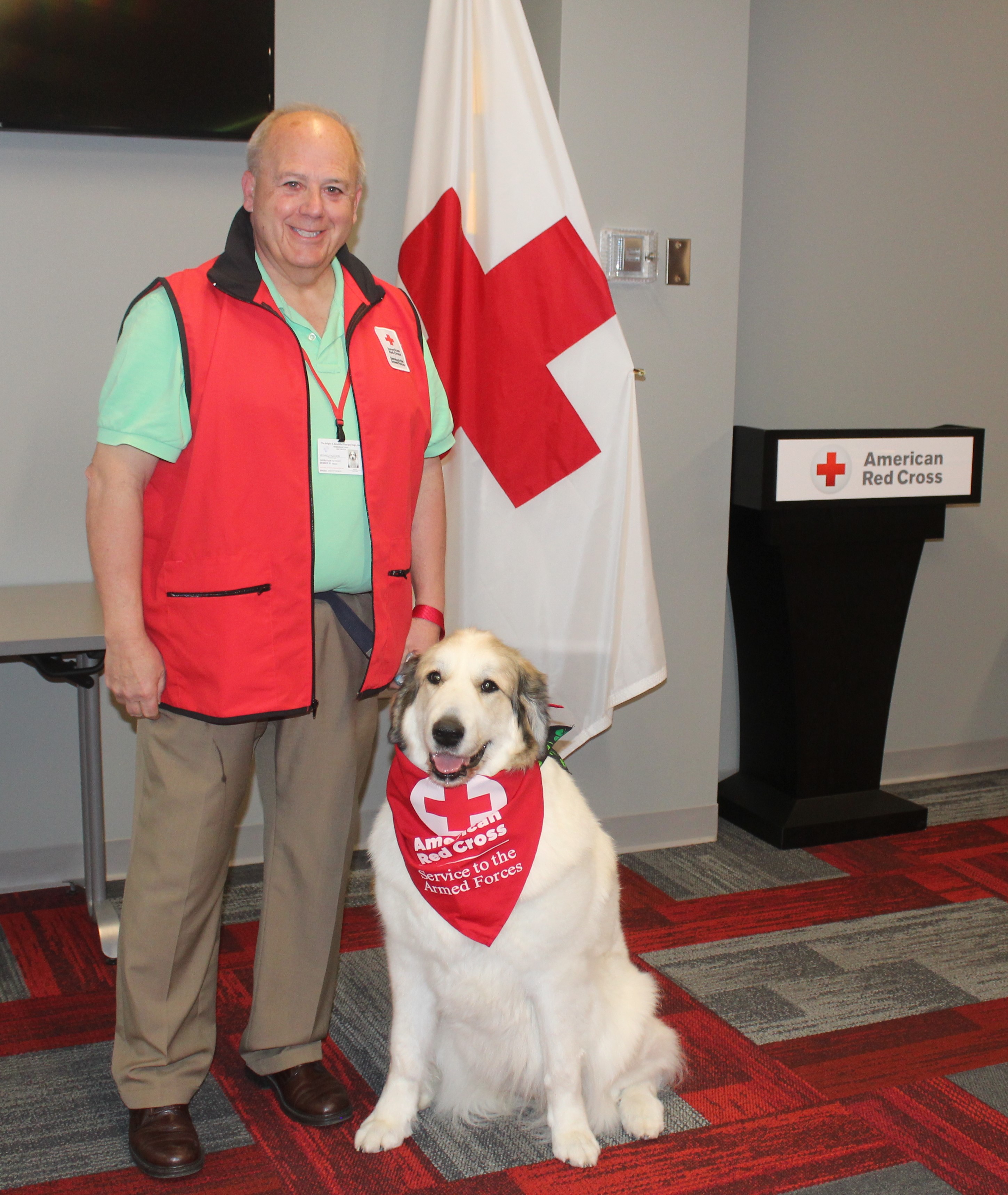
Red Cross volunteer Kate Mazzolini and Sully

Recently, Jessica Tischler, manager of Red Cross Service to the Armed Forces in northern Ohio expanded the visitation program to send canine therapy teams into the northeast Ohio VA healthcare system, to lift the spirits of hospitalized veterans.

“We’re so grateful that our volunteers are willing to share the love these animals offer during their visits,” Jessica said. Now she’s looking to make contact with more dog owners who already have therapy experience, as the Svastas did.

The Red Cross has been training and dispatching therapy dogs into military hospitals to comfort wounded warriors and veterans undergoing treatment since shortly after World War II.

Red Cross volunteer Michael Falatach and Macee

At Walter Reed National Military Medical Center, Jen O’Keefe and her Leonberger (“They were bred to look like lions.”) Digory carry on the tradition. Digory is a three-legged cancer survivor, so he’s a uniquely positive presence, especially for amputees.

“We (Digory and I) can’t fix people, but we can help lift the anxiety, the stress, for patients, their families – and for the staff,” she said. “The staff is a huge part of our job.

“For me, this is the highlight of my week,” she said. “This is how I de-stress from my job as an emergency veterinarian. I don’t often get to bring good news, but with Digory, I know we’re welcome.”

If you’d like more information about the animal visitation program or any of the other volunteer opportunities with the Red Cross, go to redcross.org/volunteer.

Posted by Ryan Lang, Red Cross volunteer

Buckeye native shines light on humanitarian needs worldwide

By Eilene E. Guy, American Red Cross volunteer

When there’s a humanitarian crisis somewhere around the world, the American Red Cross sends Jenelle Eli to bear witness.

In the spring, Jenelle – who hails from Trumbull County, in the Mahoning Valley of northeast Ohio – spent a month aboard the Ocean Viking in the middle of the Mediterranean Sea. She was reporting on the rescue of hundreds of desperate migrants trying to reach safety in flimsy boats.

Ivan Jimenez Garra, Mexican Red Cross and Jenelle Eli, American Red Cross survey damage in Jojutla, a small Mexican city that suffered massive damage when a 7.1 magnitude earthquake struck in September 2017. Photo credit: Daniel Cima/American Red Cross

Then she spent July in Warsaw, reporting to the world on the arrival in Poland of hundreds of thousands of refugees from warfare in Ukraine.

With more than a dozen years in disaster and refugee communications, Jenelle has become a highly skilled and widely respected voice.

In May, she spoke at the United Nations about the importance of humanitarian aid, drawing on her first-hand experiences with Red Cross relief efforts around the world.

Recently, the professional organization PRNews recognized her as one of the 2022 Top Women in its Industry Innovators category.

“It’s not easy to get attention from audiences about humanitarian crises – especially because there are just so many taking place at one time,” Jenelle said. “People get disaster fatigue and start tuning out all the hurt that’s happening in the US and around the world. Yet, harnessing people’s attention for good is the only way that things are going to change.

“I’m really pleased that the professional world of PR recognizes the importance of humanitarian communication – and that communicating in a way that ensures dignity for refugees is key.”

Jenelle Eli delivers humanitarian aid to Ines (right) and her neighbors in Morelos, in the wake of a 7.1 earthquake in 2017.  Photo credit: Daniel Cima/American Red Cross

This is how Jenelle describes her mission: “Right now, there are more people displaced from their homes than at any other point in history. I studied refugee issues in school and have devoted my career to raising awareness about people’s needs on migratory routes and even once they’ve reached safety. I raise my hand for international missions because I know that getting refugees’ stories out and elevating their voices is the only way to truly create space for empathy.

“Humanitarians’ work speaks for itself; I simply pull out the megaphone.”

“For nearly two decades, Jenelle has vowed to amplify the stories of displaced survivors through a lens of empathy and empowerment rather than victimization and pity,” said Emily Osment, Red Cross senior media relations manager.

“Through her work, Jenelle has helped secure ports of safety for stranded migrants at sea, enforced the importance of upholding the Geneva Conventions as a neutral, impartial aid actor in the midst of war, protected the identities of vulnerable families fleeing violence and ensuring lifesaving blood reaches patients during national shortages here at home.”

Now, Jenelle has moved from senior director of media relations at American Red Cross national headquarters in Washington, D.C., to a six-month stint as head of media relations and advocacy at the headquarters of the International Federation of Red Cross and Red Crescent (IFRC) Societies in Geneva, Switzerland.

In this role, she’s directing efforts to focus attention in 192 IFRC member countries on the needs of the world’s most vulnerable people.

“I do want people to know that they don’t have to deploy to crisis zones to make a huge difference! EVERYONE can have a humanitarian impact in their own way – whether that’s volunteering in their own community, donating money, raising awareness, or choosing a career responding to crises.

June 30, 2019. Cox’s Bazar, Bangladesh. Kids make ‘heart’ symbols alongside American Red Cross team member, Jenelle Eli, in Kutupalong—a displacement camp in Cox’s Bazar, Myanmar.  Photo credit: Brad Zerivitz, American Red Cross

“In the US, if you want to help refugees, volunteer for an organization helping to reconnect them with separated family members (like the Red Cross!) or a group that welcomes newly- arrived refugees in small cities and helps them navigate their new lives here. There are loads of ways to be a humanitarian.”

To learn more about American Red Cross activities worldwide, powered by the generosity of volunteers and donors, click here.

National Senior Citizen Day: Why should you care?

By Doug Bardwell, Red Cross volunteer

What, you’re not a senior citizen? Stay with me, as I bet you know one . . . or two.

When President Reagan signed Proclamation 5847 in 1988, he set the date as August 21 to be celebrated as National Senior Citizen Day. He proclaimed the date to raise awareness of issues that affect senior citizens, including quality of life.

One of the best things you can do for a senior is to make sure they stay busy. Tests have shown that the more a person stretches their mind to learn new tasks or talents, the sharper they will be in their later years. It’s also a known fact that social interaction is important to seniors— especially if they live alone.

Wouldn’t you know it – the American Red Cross has the perfect solution for both recommended strategies. Volunteers are needed in all sorts of fields, and the Red Cross will be happy to train seniors in anything they choose to take part in. There are opportunities to go out and about the community as well as those that can be done by someone homebound.

Red Cross Volunteer Doug Bardwell – Tennessee

Interested in sitting and chatting with new people?

The Blood Ambassador position could be a perfect fit. You could be engaging with the community at a registration table at a local blood drive. There are dozens of blood drives every day in different neighborhoods, so there’s likely one a few minutes from their home. Volunteer as many days as you like. Watch video to learn more.

Interested in driving?

The Red Cross could use your past professional training to help teach life-saving skills or deliver medical or spiritual care to those in need.

Interested in humanitarian assistance?

You hit the bonanza here. Opportunities abound to:

  • Drive to local neighborhoods to provide financial assistance to those who’ve experienced a home fire. (Don’t worry about the money. The Red Cross provides that – you just hand it out.) Watch video.
  • Help pass out water and snack at large community events or to first responders at disaster events.
  • Make phone calls as a caseworker to provide follow-up care to those who are trying to pull their lives back together after a fire or other disaster.
  • Help assemble self-help pamphlets and toiletry kits for disaster victims.
  • Teach fire safety at local schools with the Pillowcase Project for third through fifth graders. Learn more.
  • Assist at a disaster shelter or warming center, serving any of three meals a day to those without shelter. Watch video.
  • From home, help families reconnect during natural disasters by working with the Red Cross Family Reunification Network. Watch video.

Actually, there are so many more opportunities beyond the ones mentioned above. How about a quiz to see what’s available near you? Take quiz. Then, start the volunteer process here and make being a senior citizen both rewarding and life-changing for the better.

Edited by Glenda Bogar, Red Cross volunteer

Posted by Ryan Lang, Red Cross volunteer

Five ways you can give back this World Humanitarian Day

By Samantha Pudelski, American Red Cross volunteer

August 4, 2022. Fleming-Neon, Kentucky. American Red Cross volunteer Angela Daniel distributes a hot meal to those affected by the Kentucky flooding disaster. Emergency Response Vehicle make their way to various locations, bringing nourishing food and a word of encouragement to communities as they begin to recover. Photo by Kevin Suttlehan/American Red Cross

World Humanitarian Day is a day when we are all encouraged to come together and advocate for the well-being, survival and dignity of people who have experienced or are experiencing crisis around the world. This year’s theme from the United Nations is “It Takes A Village”—reminding us that whenever there are people in crisis, there are others who are there to help them. This year, they shine a light on the hundreds of thousands of volunteers, professionals and crisis-affected people who deliver urgent health care, shelter, food, protection, water and much more.

It’s a perfect day to recognize the thousands of dedicated volunteers and workers of the American Red Cross. They deliver lifesaving assistance every hour of every day, responding to an average of more than 60,000 disasters every year.

As we reflect on the meaning of this day, we are also encouraged to take action as humanitarians ourselves. This World Humanitarian Day, the Northern Ohio Region of the Red Cross has five ways you can give back and help to make the world a better place.

A blood donor giving blood at the 2022 Cleveland Browns blood drive in July

Donate Blood
Did you know that every two seconds someone in the U.S. needs blood or platelets? Giving back by donating blood can help ensure those who are in need of blood transfusions, including individuals undergoing surgery, cancer treatment, treatment for chronic illness and traumatic injuries.

If you are able to donate blood, it is a relatively easy process –
It only takes about one hour and 15 minutes, with the actual donation of whole
blood taking approximately eight to ten minutes.
Individuals can donate blood more than once per year. you can donate every
In most states, donors can start donating at age 17 and some states allowing
16-year-olds to donate with a signed parental consent form. You also must be
at least 110 pounds and be in good health.
Blood donor drives are held at locations throughout Northern Ohio. To find an
upcoming blood drive near you, click here.

Volunteer
Volunteering your time for a cause you believe in can have a huge impact on your community and the world. The Red Cross offers a variety of ways that you can give back depending on your skills, interests and time available. In fact, 90% of the Red Cross workforce are volunteers. They support areas such as blood drives, blood donation transports, health, mental health and spiritual needs, administrative support roles, supporting our armed forces and working with those who affected by natural disasters.

Make a Donation
Many non-profit organizations rely on generous donations from supporters. For many organizations, every dollar donated makes a difference. Some organizations, like the Red Cross, provide other ways for individuals to donate in addition to financial contributions.

June 22, 2018. Washington, DC. CPR stock photos by Roy Cox for the American Red Cross.

Learn a Lifesaving Skill
The Red Cross has been teaching emergency and safety training for more than a century. You can learn first aid, be trained in administering CPR or using an AED, to be prepared for when a need for these skills arises. You can review and sign up for a class here.

Advocate
Advocacy is an important way you can be a humanitarian. In order to advocate, it is equally important to educate yourself on the topics, organizations or causes you would like to advance. Here are a few simple ways you can get started.

Follow organizations on social media. For example, you can follow the Red Cross and the Northern Ohio Region of the Red Cross on Facebook, Instagram, Twitter, LinkedIn and TikTok just to name a few. Not only do they post facts and updates about the work that they are doing, but they also provide links for more information.
Participate in events like Turn and Test and other events that help to spread the word about a particular cause. Share information with friends and family and learn about causes that they are passionate about.

Read about the work of three Red Cross humanitarians here.

Edited by Glenda Bogar, Red Cross Volunteer

Posted by Ryan Lang, Red Cross Volunteer


The 8-year-old veteran and other tales

Lighthearted anecdotes for National Tell a Joke Day

By Tim Poe, American Red Cross volunteer

“M-O-U-S-E!” An 8-year-old sang, making the toy I had given him dance on the table. His grandmother, whose apartment was one of several impacted by a fire the previous night, stood next to me. Two other American Red Cross members and I had spent the day in the building, assisting those affected by the disaster.

American Red Cross volunteer Tim Poe at the annual toy giveaway for families that experienced a home fire

As part of our assistance, I asked the grandmother questions that help us find resources for those impacted by a disaster. With each question, the child paused the doll’s dance to tell me how to spell names and something about the person.

“Are you or any member of your family a veteran?” I asked the grandmother. As she shook her head no, the child looked up, wide eyed, and shouted, “I’m a veteran!”

“No, you’re not, dear,” the grandmother said, patting his shoulder.

“Am too!” he shouted. “I don’t even like meat!”

The moment was a delight and much needed by all of us in the room.

In my various roles volunteering with the Red Cross, there have been many such lighthearted, fun moments. Today is National Tell a Joke Day, and while the Red Cross and its services are no joke, fun moments do happen. Here are a few.

American Red Cross volunteer Tim Poe at the annual toy giveaway for families that experienced a home fire

Before the pandemic, I took part in distributing toys for the holiday season for children whose families had been affected by disasters. Several tables were filled with toys, and we would help families pick something out. One child excitedly ran to all the tables, looking, but not selecting anything. He turned to me and asked, “Where are the drones?” The parents, alarmed, standing behind, subtly shook their heads but appeared relieved when I explained we didn’t have anything quite so fancy. After his initial disappointment, he seemed thrilled with a toy truck and crayon set.

One of the many benefits of being a Red Cross volunteer is working alongside unique, caring people with differing perspectives. Stories such as Christy Peters’ grandparents and tattoos emerge from our communications meetings.

This makes it a continuous learning experience, even about communicating. After a particularly strange sequence of events, and a fellow volunteer and I finished up and returned to a Red Cross vehicle. As I searched for words to begin processing the roller-coaster ride we had taken, she summed it up.

“Dude!” she said.

I can be verbose, but sometimes a single word is all that’s needed.

On another call, to an apartment where the fire was fortunately contained to a single unit and no one was hurt, an elderly lady emerged from her apartment, saw us, and stopped. “Mm hmm,” she said, pointing to a door. “That’s the one you want. And tell them never leave a candle burning and go out for a sandwich! Could’ve killed us all!” While to my knowledge the Red Cross has not offered this specific fire prevention tip, it’s good advice.

Edited by Glenda Bogar, American Red Cross volunteer
Posted by Ryan Lang, American Red Cross volunteer

As many students head back to school, Red Cross offers important safety tips

By Christy Peters, American Red Cross Regional Communications Manager

If you’re out this weekend, making a quick Target or Wal-Mart run, be prepared to witness a strange phenomenon – the panicked, school supplies shopping parent. We’ll be wide eyed and shaky, searching for a plastic folder, with three holes but no prongs, in a specific color that 500 other parents have also been looking for since school supply lists came out. That’s right folks, it’s back to school time!

My son will be in first grade this year, so I’m slightly less nervous than I was when he started his academic journey last year as a kindergartener. Of all my fears (and there were many) one of the biggest was him riding the bus. Watching him climb on and sit in that huge seat was enough to send me into a full-on panic attack. Unfortunately, so was watching the many drivers who sped past the bus as it was slowing down to get him or didn’t stop at all.

The American Red Cross Northern Ohio Region wants everyone to stay safe as students head back to school. Below are several reminders for riders, walkers and those of us sharing the roads and sidewalks with them. Take a moment to review these important tips and go over them with your kids returning to school.

CELL PHONES A DISTRACTION The National Safety Council (NSC) reports distracted walking can be dangerous, even deadly. Teach your students the following:
– Don’t text or talk on your phone while walking. If you must text, move out of the way of others and stop on the sidewalk.
– Never cross the street while using an electronic device.
– Do not walk with headphones in your ears.
Drivers can be distracted too. Never use a phone while driving. Help keep children
safe by eliminating all distractions.

TAKING THE BUS
– Students should get to their bus stop early and stand away from the curb while waiting for the bus to arrive. Young children should be supervised.
– Board the bus only after it has come to a complete stop and the driver or attendant instructs them to get on. They should only board their bus, never an alternate one.
– All students should stay in clear view of the bus driver and never walk behind the bus.

WALKING TO SCHOOL
– Cross the street at the corner, obeying traffic signals and staying in the crosswalk.
– Never run out into the street or cross between parked cars.
– Use a route along which the school has placed crossing guards.
– Parents, walk with young children and those taking new routes or attending new schools, for the first week to ensure they know how to get there safely. Arrange for the kids to walk to school with a friend or classmate.

GOING BY CAR
– Everyone should always wear a seat belt.
– Younger children should use car seats or booster seats until the lap-shoulder belt fits properly (typically for children ages 8-12 and over 4’9”), and ride in the back seat until they are at least 13 years old.
– If a teenager is going to drive to school, parents should mandate that they use seat
belts.

RIDING A BIKE There may be more young people on bikes as the school bells ring. They should:
– Wear a properly fitted helmet and bright clothing.
– Ride on the right side of the road, with traffic, in a single file.
– Come to a complete stop before crossing the street; walk bikes across the street.
– Stay alert and avoid distracted riding.

SLOW DOWN Drivers should slow down, especially in residential areas and school zones, and know what the yellow and red bus signals mean. Yellow flashing lights indicate the bus is getting ready to stop, that motorists should slow down and be prepared to stop. Red flashing lights and an extended stop sign indicate the bus is stopped and children are getting on or off.

Motorists must stop when they are behind a bus, meeting the bus or approaching an intersection where a bus is stopped. Motorists following or traveling alongside a school bus must also stop until the red lights have stopped flashing, the stop arm is withdrawn, and all children have reached safety. This includes two and four-lane highways. If physical barriers such as grassy medians, guide rails or concrete median barriers separate oncoming traffic from the bus, motorists in the opposing lanes may proceed without stopping.

KEEP LITTLE ONES SAFE Keeping all students safe is the primary concern for everyone, but there are special steps for parents of younger kids and those going to school for the first time:
– Make sure the child knows their phone number, address, how to get in touch with their
parents at work, how to get in touch with another trusted adult and how to call 911.
– Teach children not to talk to strangers or accept rides from someone they don’t know.

Finally, download the free Red Cross First Aid app for instant access to information on handling the most common first aid emergencies. You can find it by searching for ‘American Red Cross’ in your app store or at redcross.org/apps. Learn and practice First Aid and CPR/AED skills by taking a course (redcross.org/takeaclass) so you can help save a life.

Posted by Ryan Lang, American Red Cross Volunteer


Volunteers show their versatility and willingness to help

Northern Ohio disaster workers in Kentucky assist at the scene of a car crash

Arden Tohill and Al Irwin are volunteers who responded to the call for help from the people of Eastern Kentucky, after devastating flooding there in late July. Among the first to deploy to the devastated region, they have been driving an emergency response vehicle through “the hills and hollers of Eastern Kentucky,” as Arden puts it, delivering much-needed food, water and other essential supplies. But last Saturday, their day took an interesting and unexpected turn, as Arden wrote in an email:

Al Irwin, left, and Arden Tohill – Photo credit: Jim McIntyre/American Red Cross

Interesting day, Saturday. On the way back to the kitchen, we were among the first to come upon a traffic accident. Al (Irwin) is still a licensed EMT, so there was no question about stopping.

Some firemen, who were nearby doing wellness checks, heard the crash and came flying on their 4-wheelers. The only problem was that they weren’t packed for a medical situation. One of them saw that I had my nitrile serving gloves on and asked if we had any more so I ran back to the ERV, grabbed the box of gloves we had just purchased and the first aid kit for the minimal supplies we had. 

After they got the passenger out, Al was holding her head steady to prevent spinal injury until an ambulance arrived with a collar. Al had me take over while he went on to something else.  In a few minutes a doctor who was out running household errands popped in to examine the passenger.  He asked if anyone happened to have a small flashlight so that he could check pupil reaction . Of course I had one, so I passed head-holding to a fireman and dug the light out.

After they finally got the driver out and boarded, we started passing out water to the first responders.

Al Irwin and Arden Tohill preparing to distribute meals to residents in flood-stricken Kentucky at Carr Creek Elementary school in Knott County – Photo credit: Remy Kennedy/American Red Cross

We don’t know the condition of the passenger, but we do know that Arden Tohill and Al Irwin are two talented, dedicated volunteers and true humanitarians, as illustrated by the account above. We are grateful for their service to the Red Cross.

Editor’s note: As of Monday, August 8, more than 430 trained Red Cross disaster workers were on the ground in Kentucky helping to provide a safe place to stay, food to eat, critical relief supplies and emotional support for those affected by this tragedy. Volunteers are also replacing prescription medications, eyeglasses or critical medical equipment, like canes and wheelchairs, which were left behind in the rush to get to safety.

  • Sunday night, the Red Cross and our partners provided comfort and care for almost 500 residents in numerous shelters across Eastern Kentucky. In the last week, the Red Cross and our partners have provided a total of more than 4,500 overnight stays for residents forced to leave their homes.
  • With the support of local partners, the Red Cross has helped to provide some 56,000 meals and snacks to people in need. In addition, we’ve given out thousands of critical relief items to nearly 800 households.

People in Eastern Kentucky are really hurting

People from Northern Ohio are really helping

They are working in shelters; they are distributing food and water; they are arranging logistics and they are establishing communications.  10 American Red Cross volunteers from Northern Ohio are playing crucial roles in the massive effort to bring comfort and care to people in eastern Kentucky, following deadly flooding last week. Our thoughts are with everyone who has been affected by the flooding that has upturned lives and destroyed homes across at least nine counties in the state.

Photo credit: Mike Parks, American Red Cross

Nearly 250 trained Red Cross disaster workers are on the ground, and more help is on the way.  Sunday night, almost 640 residents took refuge in one of the many shelters being supported by the Red Cross and other partners. The Red Cross is providing a safe place to stay, food to eat, emotional support for those affected by this tragedy, and is helping with replacing prescription medications, eyeglasses or critical medical equipment that were left behind in the rush to get to safety.

Northern Ohio volunteers: Al Irwin and Arden Tohill drove an emergency response vehicle to Kentucky on Saturday. Mahogany Coward is helping with logistics from the University of Kentucky.

More than 15,400 people are without power, and as many as 60,000 are either without water or under a boil advisory.

This deadly flooding — along with the recent heavy rainfall in Missouri, explosive wildfires in California and the ongoing Northwest heatwave — are clear examples of how more intense climate-related disasters are happening more often. Over the last two years, on average, the Red Cross responded a new, major disaster every 10 days. We see firsthand how families and communities are suffering and depending on us for help – with our volunteers continuously on the ground, setting up shelters, arranging for hot meals and offering comfort for people forced from their homes.

You can help people affected by disasters like floods, fires and countless other crises by making a gift to Red Cross Disaster Relief. Your gift is a commitment to helping people in need, and every single donation matters.

Donations enable the Red Cross to prepare for, respond to and help people recover from disasters big and small. Visit redcross.org, call 1-800-RED CROSS, or text the word REDCROSS to 90999 to make a $10 donation.