Excessive heat a reminder to enjoy the end of summer safely

Although fall is right around the corner, you’d never know it from the recent high temperatures we’ve been experiencing in northern Ohio. Many people don’t realize excessive heat causes more deaths than all other weather events. As many of us squeeze in our final summer activities in the coming weeks, remember to stay safe when temperatures rise.
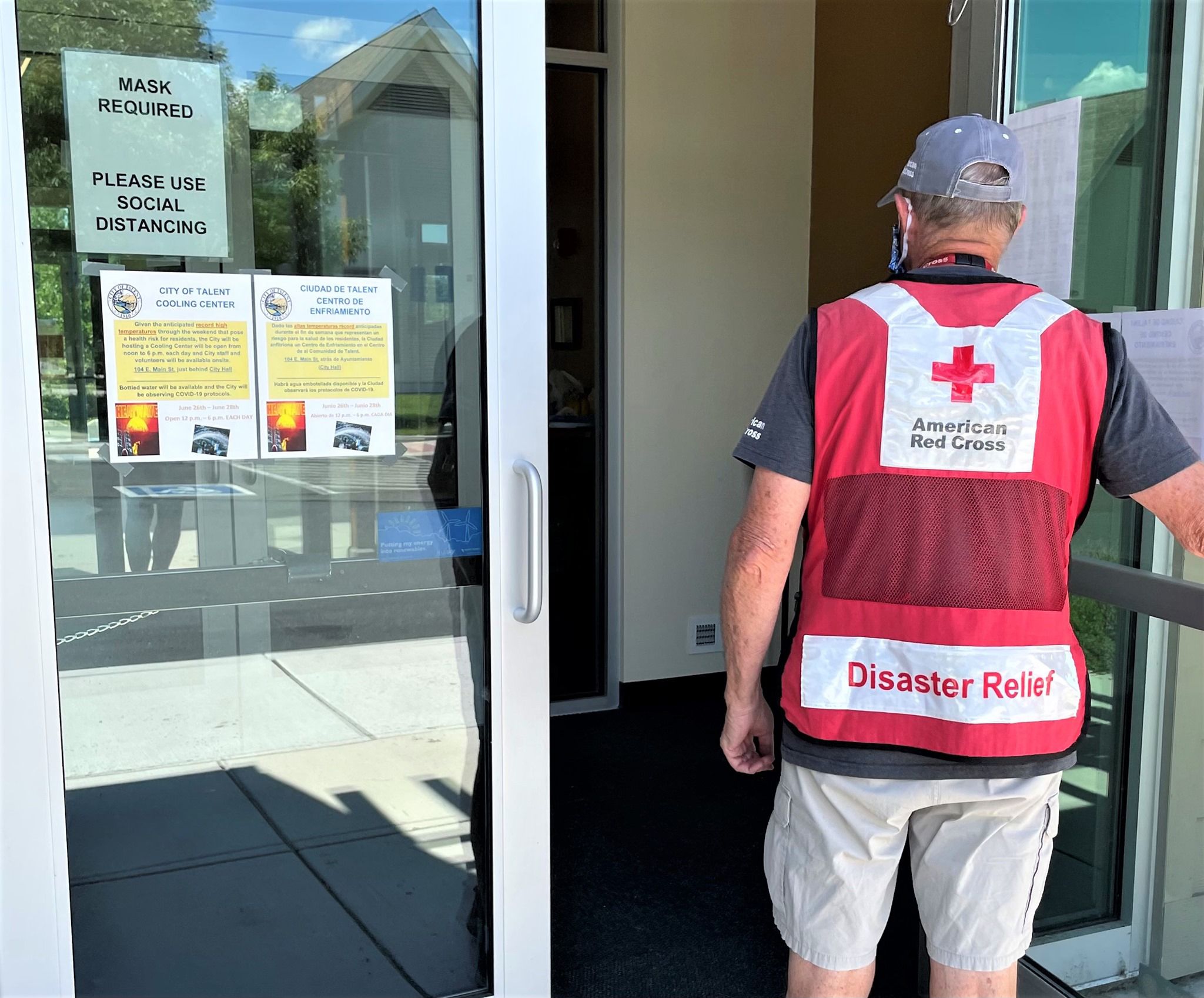
June 27, 2021. Talent, Oregon. Red Cross volunteer Chuck Albin delivering water and snacks to a cooling center in Talent, Oregon. Photo by Patty Albin/American Red Cross

Hot cars can be deadly so never leave children or pets in your vehicle. The inside temperature of the car can quickly reach 120 degrees. Check on family, friends and neighbors who do not have air conditioning, who spend much of their time alone or who are more likely to be affected by the heat. If someone doesn’t have air conditioning, they should seek relief from the heat during the warmest part of the day in places such as schools, libraries, theaters and malls.

And, don’t forget your pets! Read our recent blog on how to protect your pets during extreme heat. Also, download the Red Cross Pet First Aid app so you’re prepared in a pet emergency.

Extreme heat can often lead to thunderstorms and power outages. If thunder roars, go indoors! Watch for darkening skies, lightning flashes or increasing wind. If you can hear thunder, you are close enough to be in danger from lightning. Postpone outdoor activities if thunderstorms are likely to occur. If a severe thunderstorm warning is issued, take shelter in a substantial building or in a vehicle with the windows closed. If you are in a building, keep away from windows. Get out of mobile homes as they can blow over in high winds and do not take a bath, shower or use plumbing.

Wishing everyone a safe and enjoyable end of summer!

Take action this World Humanitarian Day

By Samantha Pudelski, Red Cross volunteer

August 19 is World Humanitarian Day, when we recognize those around the world who help people affected by global crises. In 2021, a record 235 million people required humanitarian assistance according to USAID. Life-threatening crises around the world such as hunger, poverty and conflict are intensifying due to forces such as climate change.

Northeast Ohio native Jenelle Eli, American Red Cross joins Ines and her neighbors in Morelos, Mexico in receiving humanitarian aid from the Red Cross in the wake of a 7.1 earthquake in 2018.

Organizations around the world, including the American Red Cross, International Federation of the Red Cross (IFRC) and Red Crescent Societies, provide humanitarian aid to help communities affected by intense storms, hurricanes and devastating wildfires that have increased in frequency, especially in the last few years. They also are working to provide climate-smart disaster risk reduction—helping communities reduce their risks, increase their resilience and prepare for emergencies that may happen in their region.

Annually, on average, natural hazards cause 67,000 deaths, affect 199 million people and drive 126 million individuals into poverty according to the IFRC. Climate change is causing the number of disasters to increase drastically—doubling the average number of disasters in the last 40 years.

April 7, 2020. Nassau, New Providence, Bahamas. The American Red Cross helped expand the Bahamas Red Cross home meal delivery program to include more people put at risk to food insecurity due to the COVID-19 outbreak causing government implemented lockdowns and 24-hour curfews.

You may be asking yourself, how can I help here in Ohio? There are a few things you can do:

  • Learn more about the effects of climate change and the work organizations like the Red Cross and IFRC are doing to help those who are impacted by disasters. Share what you learn with family and friends.
  • Donate to the Red Cross to help provide aid to victims of disasters and education to communities on how to prepare for future events.
  • Volunteer with the Red Cross in your community and/or consider becoming a member of the Disaster Action Team.

Read more about World Humanitarian Day here.

Edited by Glenda Bogar, American Red Cross volunteer

Local volunteers and blood donors needed for busy disaster season

Many weather experts predict a destructive wildfire and hurricane season this year. The American Red Cross needs volunteers to help people who are affected by these disasters.

“We’re preparing for another extremely busy disaster season, and it’s critical to have a trained, ready volunteer workforce to make sure we can provide relief at a moment’s notice,” said Mike Parks, Regional CEO, American Red Cross of Northern Ohio. “This year’s wildfire season is already very active and dangerous because of the severe drought and dry woodlands across the west. And experts are predicting we could see 10 or more hurricanes in the upcoming weeks.”

“We’re preparing for another extremely busy disaster season, and it’s critical to have a trained, ready volunteer workforce to make sure we can provide relief at a moment’s notice.”

Mike Parks, Regional CEO, American Red Cross of Northern Ohio

SHELTER VOLUNTEERS AND HEALTH PROFESSIONALS NEEDED

The Red Cross needs new volunteers to support disaster shelters. Volunteers will help with reception, registration, food distribution, dormitory, information collection and other vital tasks inside disaster shelters. Both entry and supervisory-level opportunities are available.

The Red Cross also needs volunteers who can work in disaster shelters to address people’s health needs and provide hands-on care in alignment with their professional licensure (registered nurse and licensed practical nurse/licensed vocational nurse). Daily observation and health screening for COVID-19-like illness among shelter residents may also be required. If you are an RN, LPN, LVN, APRN, NP, EMT, paramedic, MD/DO or PA with a current and unencumbered license, this position could be right for you.

Red Cross volunteer Dave Wagner looks out damage from the Dixie Fire on the outskirts of Greenville, CA, a small town that was devastated by the fire on Saturday, August 7, 2021. Many of the evacuated residents found shelter with the Red Cross in nearby Quincy and Susanville, CA.
Photo by Scott Dalton/American Red Cross

DISASTER ACTION TEAM MEMBER

Local Disaster Action Teams provide 24-hour emergency response to local disasters, particularly home fires, ensuring that those affected have access to resources for basic necessities such as food, shelter and clothing. If you are team-oriented and want to help your neighbor, the DAT responder may be just the thing for you.

Disaster Action Team members from Northern Ohio respond to a fire in Lakewood on Aug. 4, 2021.

At 1 p.m. today, the Red Cross will host a Facebook Live event where our experts will discuss the various volunteer roles and how you can get involved in helping families after disasters here locally and across the country. Tune in to learn more and get your volunteer questions answered.

Last year, the Northern Ohio Region provided immediate emergency assistance to more than 5,100 people after nearly 1,200 home fires and other disasters.

If you can’t join us this afternoon but are interested in helping your community when disasters occur, you can sign up online or contact our area offices at 216-431-3328 or neovolunteer@redcross.org.

BLOOD AND PLATELET DONORS NEEDED

Wildfires, record-breaking heat and a busy hurricane season can also impact the nation’s blood supply. On top of the toll extreme weather events take on the lives of millions, disasters can cause blood drive closures or prevent donors from being able to give safely. Eligible donors can help overcome the critical need for blood and ensure blood is readily available by making an appointment to give by using the Red Cross Blood Donor App, visiting RedCrossBlood.org, calling 1-800-RED CROSS (1-800-733-2767) or enabling the Blood Donor Skill on any Alexa Echo device.

During National Immunization Awareness Month, ensure your vaccinations are up to date

By Tim Poe, American Red Cross volunteer

Some moments remain in memory with surprising detail. While recent, I suspect receiving the COVID-19 vaccine will remain in mine. Not so much for the injections themselves but for the relief, plans and hope they brought. Even after the first shot, I looked forward to seeing friends, attending family gatherings, hearing live music, traveling and everyday things like grocery shopping without risk assessments. While the Delta variant and vaccine hesitancy are delaying these plans, I cling to a cautious optimism, am grateful that many have some defense against the virus, and am in awe at how quickly and effectively science and knowledge respond to grave threats.

I realize how fortunate I am to have grown up without risk of measles, polio, tetanus and several other diseases, thanks to immunizations. Many are not so fortunate. This is something that the American Red Cross and partner organizations are continuously working to remedy. I am also reminded that we must keep up with our vaccinations. Since August is National Immunization Awareness month, now is an excellent time to ensure your and your family’s vaccinations are up to date.

In addition to the COVID-19 vaccine, other immunizations are needed, especially as many resume pre-pandemic behaviors. Gatherings carry influenza risk, especially in fall and winter, so do not forget your flu shot this year. Travel is also booming, and those traveling abroad should be properly immunized for the destination. (For more information on travel preparedness, read this blog.)

The Centers for Disease Control and Prevention (CDC) states that all adults need vaccines for COVID-19, influenza, Td or Tdap (tetanus) and others, depending on circumstances. In addition, routine vaccinations throughout childhood help prevent 14 diseases. In fact, the CDC says, “among children born from 1994-2018, vaccinations will prevent an estimated 936,000 early deaths, 8 million hospitalizations and 419 million illnesses.”

Vaccine effectiveness and the need for vigilance is especially clear with measles and rubella (German measles). Measles, an exceptionally contagious and severe childhood disease, surged in 2019, though an effective vaccine exists. The World Health Organization (WHO) reports that global measles cases increased to 869,770 in 2019 with 207,500 deaths. While cases were lower in 2020, the WHO says the pandemic disrupted vaccination and prevention efforts. As of November 2020, it estimates “more than 94 million people were at risk of missing vaccines due to paused measles campaigns in 26 countries.”

September 27, 2018. Nairobi, Kenya. Prince Osinachi sits in a Red Cross volunteer’s arms after receiving routine immunizations in Nairobi, Kenya.

The Red Cross and its partners in the Measles & Rubella Initiative are working to create a world free of these diseases. The vaccine is safe, effective and one of the most cost-effective health interventions available. Since 2001, the initiative has vaccinated 2 billion children, preventing over 23 million measles-related deaths. Learn more here. Please consider donating if you can help with this effort.

Your doctor and county board of health can help with vaccinations. For more information on vaccination clinics at the Cuyahoga County Board of Health, CLICK HERE. If you need a COVID-19 vaccine, visit the CDC’s website.

Edited by Glenda Bogar, Red Cross volunteer

Three R’s plus a dose of Three C’s

Cover up, Caution around traffic, Car seats

By Doug Bardwell, Red Cross volunteer

As of this writing, Cleveland, Akron, and Massillon have declared that all returning students will be required to wear masks until further notice. With the Delta variant as dangerous as it is, that’s the only way to protect those too young to be vaccinated.

But that’s not all

The virus isn’t the only thing parents and caretakers need to be aware of. Accordingly, the American Red Cross has issued a list of ten tips to help make this school year a safe one.

  1. If your student rides a bus to school, they should plan to get to their bus stop early and stand away from the curb while waiting for the bus to arrive. 
  2. Students should board the bus only after it has come to a complete stop and the driver or attendant has instructed them to get on. They should only board their bus, never an alternate one.
  3. All students should stay in clear view of the bus driver and never walk behind the bus. 
  4. Cross the street at the corner, obey traffic signals and stay in the crosswalk.
  5. Never dart out into the street or cross between parked cars.
  6. If children go to school in a car, they should always wear a seat belt. Younger children should use car seats or booster seats until the lap-shoulder belt fits properly (typically for children ages 8-12 and over 4’9”), and ride in the back seat until they are at least 13 years old.
  7. If a teenager is going to drive to school, parents should mandate that they use seat belts. Drivers should not use their cell phone to text or make calls, and avoid eating or drinking while driving.
  8. Some students ride their bike to school. They should always wear a helmet and ride on the right, in the same direction as the traffic is going. 
  9. When children are walking to school, they should only cross the street at an intersection, and use a route along which the school has placed crossing guards. 
  10. Parents should walk young children to school, along with children taking new routes or attending new schools, at least for the first week to ensure they know how to get there safely. Arrange for students to walk to school with a friend or classmate.

“Parents and kids are both eager to get back to normal and return to the classroom as a new school year starts,” said Mike Parks, Regional CEO, Red Cross of Northern Ohio. “But don’t forget to make safety a top priority.”

While most people realize that the Red Cross responds to disasters, we try equally hard to promote safety at home, at work, and at school; so your donations are always welcome.

Browns fans step up to help address severe blood shortage at annual Cleveland Browns Blood Drive

For Cleveland Browns fans across northeast Ohio, the opening of Training Camp this past weekend was a welcome site after COVID-19 disrupted so much last season. And, while lots of exciting action was taking place in Berea, fans across Northern Ohio were also showing their love for the hometown team by helping save lives.

The annual Cleveland Browns Blood Drive was held this past weekend at 12 locations across northern Ohio. The blood drive is part of Browns Training Camp weekend each year and is one of the largest blood drives in the region. This year was no exception. Fans stepped up in a big way to help address a continuing severe blood shortage, donating 571 pints which have the potential to help more than 1,700 patients, as each pint can help up to three individuals.

Many fans came to give at FirstEnergy stadium, home of the Cleveland Browns. Christopher Haddock, of Euclid, is the city Fire Chief and knows firsthand the importance of giving blood. “I was in a car crash in 2006 and needed 15 pints of blood. I’m giving back,” said Haddock. “And I bleed orange and brown.”

Chris Haddock donates blood at FirstEnergy Stadium during the Cleveland Browns Blood Drive July 31
Bridget C. Miller Harper gives blood during the annual
Cleveland Browns Blood Drive

Bridget C. Miller Harper works in the transplant department at University Hospitals. “My mom taught me to give back,” she said. “I feel I’m giving back to my patients.”

Shelby Kulick, Therese Kaye and Abigail Seaman began donating blood together while in college at Baldwin Wallace. Back then, they received free burritos after giving. Even though there’s no more free food, the friends continue to donate together.

Shelby Kulick, Therese Kaye and Abigail Seaman at FirstEnergy Stadium
for the Cleveland Browns Blood Drive

The support of the Cleveland Browns and their fans was crucial as the Red Cross continues to face a severe blood shortage and has an emergency need for donors. For those who couldn’t give blood this past weekend, the Red Cross urges donors of all blood types – especially type O and those giving platelets – to make an appointment to give now to help ensure hospital shelves are stocked with blood products to meet patient needs.

During the month of August, the Red Cross is partnering with the Bonnaroo Music and Arts Festival and Apple Music for two different promotions to encourage more people to come and give. Read our recent blog post to learn more. And, to see more photos from this past weekend, check out our Flickr album. To find a blood drive near you or for more information, visit RedCrossBlood.org. Go Browns!

The power of personal connections: Transitioning back to in-person disaster response

By Tim Poe, American Red Cross volunteer

As we emerge from the COVID-19 pandemic, many American Red Cross services are transitioning back to being in-person, especially in Disaster Response and Sheltering. While virtual response and other safety measures helped the Red Cross effectively respond to disasters during the height of the pandemic, in-person assistance was missed. As Mike Arthur, regional mass care and logistics manager for Northern Ohio, explained, the ability to provide hot coffee and a hug can mean a great deal.

In addition to Mike, I spoke with Tom Revolinsky, Red Cross disaster program manager for Northeast Ohio, and volunteer Mark Cline, whose many responsibilities include serving as lead for Disaster Action Team (DAT) and Sheltering Applications in Northern Ohio. Each spoke about how effective an in-person connection is for Red Cross responders and clients recovering from a disaster.

Red Cross volunteers respond to an apartment fire

Tom said the transition began a month ago and is going very well. The DAT team is ensuring volunteers are comfortable with the change, and it is safe. As we learn more, he said, we will adapt to ensure everyone’s safety.

Currently, 80% of disaster responses in our region are in-person. For the other 20%, virtual response remains the best option. Northern Ohio DAT has been highly active. Over the past two weekends they responded to 14 home fires, assisting 73 people.

Mark said an in-person meeting gives a chance to better connect with those in need of assistance, as it is much more personal. Similarly, Tom spoke of how meeting in-person better provides the opportunity to give hope, show someone cares and help with recovery. 

Tom recalled how after an exceptionally busy day, he received a late-night call to respond following a home fire. Upon arrival, he met a woman, in tears, sitting in front of her burned-out house. His being there greatly helped, provided comfort, and she soon moved from tears to smiles. Tom said it was empowering for him.

Disaster responder Jan Cooper assists resident Gabriella Asseff after a condo fire in Westlake

I had similar experiences during my time with DAT. The instances when I could see a person begin to recover, to smile and hope again, remain with me.

As for sheltering following a large disaster—fortunately not common in our region—Mike and Tom said congregate housing is now the first option. This will ensure enough space is available, as many hotels are currently near capacity. Safety protocols will be in place. Both Tom and Mike said the Red Cross remains flexible and adapts to each situation, and non-congregate housing remains an option.

Such adaptability has been a hallmark of the Red Cross. When the pandemic necessitated virtual responses to disasters, the DAT team responded. Additionally, technology implemented during the pandemic is also helping with in-person responses.

For many of us, the pandemic underscored the importance of personal connections, especially following a disaster. Thankfully, Northern Ohio DAT responders can provide that again, offering financial assistance along with comfort, hugs and hope.

Red Cross employees walk to raise funds, build friendships

By: Mary Williams, Events Specialist, American Red Cross

There is a certain something that drives every Red Cross volunteer. There is much to be said about the focused care they give to each disaster client, blood donor, military member/veteran/military family member from the first moment until the last.

That is not necessary a trait that you attribute to your co-workers.

But on April 30, four of my co-workers and I found ourselves at the Wooster office to (social distance style) walk the “last mile” of a 75-mile journey we had started together on April 1. The office had been identified as the central point to our scatter-shot lives, with each of us driving anywhere from 45-minutes to 2-hours to gather in celebration.

There were eight of us who walked 75-miles to promote the mission of the Red Cross (though only five of us could get together in Wooster); Erica van Pelt, Carolyn Wild, Sarah Leonhard, Staci Thomson, Emily Probst, Cheryl Wolfe, Maggie Lenhart, and myself. Through our own family and friend networks we earned a total of $1,510. And beyond that, we began to form a bond that came from encouraging each other each step of the way.

Each time I would think, ‘it’s cold and I don’t want to go out to walk two-miles’, there would be a picture of one co-worker or another, bundled up and outside. We shared pictures of our walking companions – dogs, children, and lots of sarcastically earnest gifs of encouragement. Little by little we learned more things about each other, that we would not have learned otherwise. Time and geography have long conspired to keep many of us perfect strangers, but these 75 miles have brought us closer together. And for that, I am eternally grateful.

And what amazes me the most about this group is that they truly don’t see what an amazing accomplishment it has been for each of them to push beyond what they do as part of their day-to-day work responsibilities, to further blur the lines of work-life and home-life by completely steeping themselves in that thing – that heart – that volunteers demonstrate. For each of these women, it seems that to work here, is to fully encompass the mission and values of the Red Cross as part of your own essence.

It’s just what they do.

It’s just what we do.

Tiffany Circle members in Northern Ohio help support female military serving in Africa

By: Donna Gracon, American Red Cross Philanthropy Officer

The Northern Ohio Region of the American Red Cross recently gathered on Zoom to hear regional leaders, including CEO Mike Parks and Tiffany Circle member Patty Flowers, describe their deployment experiences as they helped communities by responding during the unprecedented wildfire and hurricane season in 2020.

During the virtual session, the region launched its Holiday Mission Project to help female members of the U.S. military serving in Djibouti, a country in East Africa. Learning of the difficulties these military heroes face in securing personal care and hygiene products due to inaccessibility caused by COVID-19, Tiffany Circle members stepped up by purchasing items from a locally created Amazon Wish List.

Donna Gracon, Red Cross Philanthropy Officer, stands among the packages of items purchased for female members of the military serving in East Africa.

“How special it is to be a part of a group of women who so willingly volunteer their resources and join together to support others during the holidays and also during all seasons,” said Northern Ohio Tiffany Circle Chair Laurie Laidlaw Deacon.

In attendance was Julia Bianchi, who immediately engaged help from Tiffany Circle sisters in South Florida and the National Capital & Greater Chesapeake Region of the Red Cross who also contributed to the effort. In total, 450 items were shipped to the Red Cross office at Camp Lemmonier, the primary base of operations for the U.S. Africa Command in the Horn of Africa.

“It sometimes becomes apparent that women in the military feel overlooked or forgotten,” said Kelsey Smith, senior regional program specialist/site lead for the American Red Cross at Camp Lemonnier. “Generous donations that specifically target the needs of women are uniquely impactful, as they remind our female service members that their sacrifices and dedication do not go unnoticed. Females that serve deserve to be heard, supported and celebrated equally. By ensuring their health and wellness are maintained, we create a stronger and more resilient military community as a whole.”

Lt. Andrea Wright, Capt. Ellen Bramblee and Lt. Col. Abigail Lee at the Red Cross office at Camp Lemonnier in Djibouti, East Africa.

To learn more about the Tiffany Circle and how the philanthropic power of its women leaders advance the mission of the Red Cross, click here.

Edited by Glenda Bogar, American Red Cross Volunteer

Giving blood gives time to those fighting cancer

By Sue Wilson, American Red Cross volunteer

February 4, 2021- If you or someone you love have gone through a health scare of any kind, you know firsthand how your perspective changes in the blink of an eye. When my husband got his cancer diagnosis, we were shocked. We thought there was a simple explanation for his symptoms. We thought the biopsy was a routine test they were doing along with some others. We were in a state of disbelief when the doctor said that not only was it cancer, but it was advanced. He died a year later.

Cancer has a way of making time an all-consuming obsession. The realization that every minute is important, every day should be cherished, and that time is a precious commodity is never far from my thoughts. 

When you think about fighting cancer, the first thing you may think of is chemotherapy, radiation or surgery. What so many don’t realize is that many cancer patients undergoing chemo will likely have a need for blood. In fact, five units of blood are needed every minute to help someone going through cancer treatment. Patients fighting cancer use nearly one quarter of the nation’s blood supply – more than patients fighting any other disease. And, yet, only 3% of people in the U.S. regularly donate blood.

You may not have put the two together before but giving blood can help patients fight cancer. There simply aren’t enough people regularly donating blood to meet the ongoing need. That’s the message the American Red Cross wants to spread.

We know that not everyone is eligible to donate blood, so a financial donation is also encouraged. By making a financial gift in any amount, you’re helping to give patients and their families time, resources and the hope they need to fight back.

My grief had me vacillating between a depressive despair that made me want to do nothing and a manic desire to do anything and everything to help others who were suffering. But I didn’t know where to start. Donating blood is a start. It’s a meaningful way to honor someone you love who is battling or has battled cancer. To learn more and to schedule a blood donation appointment, visit RedCrossBlood.org.

To make a financial gift, visit redcross.org/donate.

Edited by Glenda Bogar, American Red Cross volunteers