

Earlene and Dick Kincaid with Heidi, their rescue dog Photo credit: Jim McIntyre/American Red Cross
Tuscarawas County Couple Help Create Safer Neighborhoods
Dick and Earlene Kincaid have been American Red Cross volunteers for nearly eight years. They have responded to hurricanes, tornadoes and floods in Texas, Massachusetts, Tennessee, Illinois, New York, New Jersey and Alabama as members of the Red Cross National Disaster Action Team, providing hot meals and comfort to thousands of people made suddenly homeless by extreme weather. Their most recent deployment was to Flint, Michigan in response to the water crisis there.
But the work they’ve done in their own backyard has made the biggest impact in the lives of their neighbors.
The Kincaids have installed more than 1,100 smoke alarms in homes in the Stark County and Muskingum Lakes Chapter since October 2015. In a previous article, posted last December, it was noted that they had installed 750 alarms in fewer than three months. With more than 1,100 installations now to their credit, Dick and Earlene installed more than half the total annual number of smoke alarms for the entire Chapter, in fewer than six months!
Dick wields the drill and installs the alarms while Earlene provides valuable fire safety information to residents. She said, “Most of these people don’t have working smoke alarms, or they don’t have any at all.” The Kincaids work mostly on weekends, when people are more likely to be home. They spend about 15 minutes in each home, installing alarms on each floor. And they average about 100 installations a week.
Not bad for a couple who survived a motorcycle crash in 2007.
“I flew like a bird, but my landing sucked,” Dick says with a grin. Earlene says she rolled better, suffering only a broken shoulder and some scrapes. Dick says he spent 18 days at the Cleveland Clinic, undergoing 5 surgeries to save his leg, and spent another 9 months in a hospital bed in the living room of their home in Magnolia, Ohio.
Dick retired from Timken as a steelworker that same year. Once he got back on his feet, Dick and Earlene Kincaid began their careers as Red Cross volunteers, responding to national disasters and local home fires. But their Operation Save-A-Life efforts are taking up most of their volunteer time now.
“We’ve had people who have had three little kids in a trailer home, and no smoke alarms. They burn so fast,” Dick says. “If we can save any lives at all, that’s good enough.”


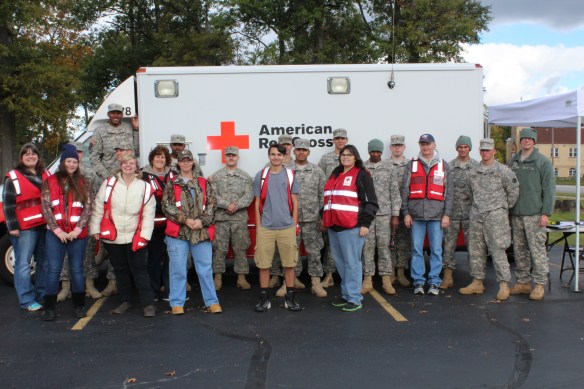
 On the First Day of Christmas, the Red Cross recommends that you install a SMOKE ALARM. Smoke alarms should be installed on every level of a home; outside bedrooms on the ceiling or high on the wall, at the top of open stairways and at the bottom of enclosed stairs and near (but not in) the kitchen. It is important to check your Smoke Alarms every month and replace their batteries when Daylight Savings Time begins in the spring and ends in the fall.
 On the Second Day of Christmas, the Red Cross recommends that you install a CARBON MONOXIDE (CO2) ALARM. Carbon Monoxide Alarms should be placed in hallways throughout the home. They should also be placed in recreational vehicles and on boats.
 On the Third Day of Christmas, the Red Cross recommends that you install a FIRE EXTINGUISHER. Install A-B-C type Fire Extinguishers in the home and teach all household members how to use them.
 On the Fourth Day of Christmas, the Red Cross recommends that you install a FIRE ESCAPE LADDER. Homes with more than one floor should have at least one Fire Escape Ladder stored on all floors, other than ground level. Store these ladders where they are easily accessible.
 On the Fifth Day of Christmas, the Red Cross recommends that you assemble a
  On the Sixth Day of Christmas, the Red Cross recommends that you assemble a
  On the Seventh Day of Christmas, the Red Cross recommends that you acquire a WEATHER RADIO. As the voice of the National Weather Service, a Weather Radio provides continuous broadcasts of the latest weather information directly from a National Weather Service Forecast Office. During severe weather routine broadcasting is interrupted and special watch and warning messages are issued.
 On the Eighth Day of Christmas, the Red Cross recommends that you get a
  On the Ninth Day of Christmas, the Red Cross recommends that you attend
  On the Tenth Day of Christmas, the Red Cross recommends that you purchase HOUSE NUMBERS. Each home should have its number posted clearly on the front door, over the doorway, or elsewhere on the front so emergency responders can easily locate it. Lives and property can be saved simply by using adequate house numbers placed where emergency workers can find them. You can purchase numbers at your local hardware store.
 On the Eleventh Day of Christmas, the Red Cross recommends that you purchase a FLASHLIGHT. As simple as a Flashlight is, it can become a very important tool to use during and after a disaster. Every family disaster supplies kit should contain a flashlight and spare batteries.
 On the Twelfth Day of Christmas, the Red Cross recommends that you create an
  There is nothing more frustrating (or hilarious, depending on how you view it) than going through your 72-hour kit and seeing a huge pack of newborn diapers intended to fit your 15-month-old toddler.
 NOHredcross