April is Pet First Aid Awareness Month. It’s the perfect time for pet lovers to take the American Red Cross Cat and Dog First Aid online course and download the Pet First Aid App.
“All pet owners, pet-sitters and dog walkers should know what to do in an emergency until veterinary care is available,” said Deborah C. Mandell, VMD, DACVECC, member of the American Red Cross Scientific Advisory Council, and professor at Matthew J. Ryan Veterinary Hospital of the University of Pennsylvania. “The Red Cross Cat and Dog First Aid online course and the Pet First Aid App are both easy and convenient ways to learn life-saving skills.”
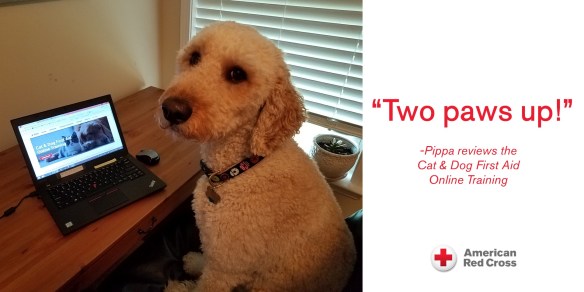
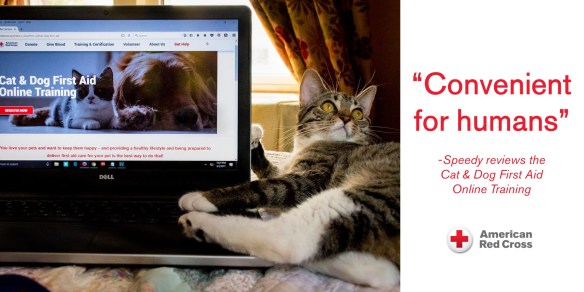
Take the course. People can access the course on their desktop or tablet at redcross.org/catdogfirstaid and go through the content at their own pace. It takes approximately 30 minutes to complete the course. Participants can stop and pick up where they left off if Fluffy needs a treat or it’s time to take Fido out to the dog park. The interactive course includes:
How to determine a pet’s normal vital signs so that owners can notice if there are any irregularities;
Step-by-step instructions and visual aids for what to do if a pet is choking, needs CPR, has a wound, or is having a seizure; and
Information on preventative care, health and tips for a pet’s well-being.
Download the app. The free Pet First Aid App provides instant access to expert guidance on how to maintain your pet’s health, what to do in emergencies, and how to include pets in your emergency preparedness plans.
The app will also help cat and dog owners keep their pets safe by learning what emergency supplies to have, when they should contact their veterinarian, and where to find a pet care facility or pet-friendly hotel. Users learn how to assemble a pet first aid kit and an emergency kit. Owners have access to step-by-step instructions, videos and images for more than 25 common first aid and emergency situations including how to treat wounds, control bleeding, and care for breathing and cardiac emergencies.
The Pet First Aid App can be downloaded by texting ‘GETPET’ to 90999, by going to redcross.org/apps, or by searching for ‘American Red Cross’ in app stores.
We reached our Giving Day goal, and will be able to help 28,678 families thanks to the generosity of our donors. This brief video illustrates just a few of the ways your donations will help people when they face emergencies like home fires, hurricanes and flooding.
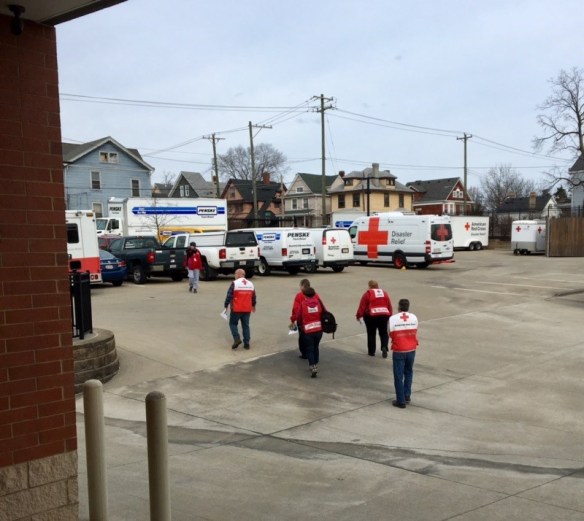
Just this week, disaster workers responded to the Rainbow Terrace apartment building fire in Cleveland, where residents from 30 units were forced to flee before dawn on Monday, March 26. The Red Cross provided more than $8,200 dollars to help 63 residents meet their immediate needs. While many of the residents are being housed in once-vacant apartments throughout the complex, they lost all of their possessions in the fire.
While Giving Day is over, the need for disaster relief is constant. Red Cross workers respond to three home fires every 24 hours, on average, in Northeast Ohio. The need for volunteers to assist people in their darkest hours is constant, too. To learn more about volunteering, visit redcross.org/neo, and click the Volunteer tab. You can also make a donation to disaster relief, to help people who suffer from disasters, big and small.
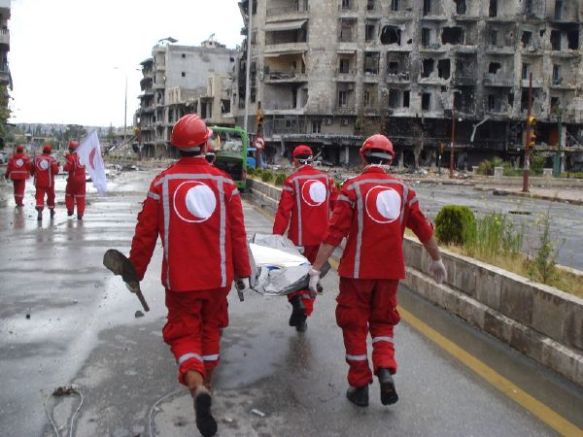
The Syrian war entered the 8th year just a week back. This deadly war not only led to a loss of over 350,000 lives in the past seven years, but also the displacement of 5.6 million Syrian people.
More than 60,000 of them have gone missing.
Therefore, this war drew to itself the attention and intervention of international humanitarian organizations, the United Nations, and other human rights defenders from all across the world. But the violence in Syria didn’t spare even these aid workers and peacekeepers who worked for these organizations locally. Many of these aid workers or UN staff members have been either abducted or are missing. Some of these staff members were also the local Syrians. Through 2017 alone, 28 UN staff members have been missing in Syria or have been abducted by different armed gunmen. There are many more missing who work with other aid organizations like the Red Cross/ Red Crescent and ICRC (International Committee of the Red Cross).
Wars are always political, but the pain and destruction associated with them is unquestionably personal. Likewise, the pain suffered by the families of these staff members who are missing in Syria and other conflict regions of the world is beyond solace.
Every year, March 25th is recognized as the International Day of Solidarity with Detained and Missing Staff Members. The commemoration of this day began after the abduction of a UNRWA (United Nations Relief and Works Agency) journalist Alec Collect in 1985, who was working in the near East for Palestinian refugees. Due to the increasing number of incidents of violence against peacekeepers and aid workers working in different conflict zones all across the world, it has become essential to observe this day.
This day is an international day of solidarity with the families of those who lost their loved ones, and sometimes their only breadwinners. Henceforth, providing a significant reminder every year on this day that measures should be taken to stop the intensified violence against peacekeepers worldwide and stop their enforced disappearances is very critical.
This day is also a reminder for other people who are not directly linked to conflict to work towards world peace. This day is a reminder that wars do no good to anyone. This day is a reminder that it’s a war that creates refugees. It is a war that leads to enforced disappearances and killing. It is because of a war that we lose our loved ones.
Anyone Can Contribute a Gift for the Babies of NEO Veterans
By Jim McIntyre/American Red Cross
The Tiffany Circle is helping veterans from Northeast Ohio start the circle of life for their yet-to-be-born babies.
Laurie Laidlaw Deacon, Chair of the Tiffany Circle in Northeast Ohio, speaking in a suite at Quicken Loans Arena
The Tiffany Circle, a community of women leaders and philanthropists who advance the Red Cross mission through a focused investment of time, talent and treasure, is hosting a baby shower for female veterans who are currently being served by the Northeast Ohio VA Healthcare System. Some 50 veteran moms-to-be will receive the gifts purchased through a special account on Amazon.
“We are proud to provide this service to brave women veterans in our area,” said Laurie Laidlaw Deacon, Chair of the Tiffany Circle in the Northeast Ohio Region. “And we appreciate our partnership with the Veteran’s Administration Healthcare System, for helping us identify the women who served our country, and who will soon be caring for a newborn.”
Sue Fuehrer, CEO of the Northeast Ohio VA Healthcare System, and Mike Parks, Regional CEO of the Red Cross
Sue Fuehrer, CEO, Northeast Ohio VA Healthcare System, said “We at VA are grateful to the Red Cross, Northeast Ohio Region, for hosting the Tiffany Circle Baby Shower to support our women veterans and their newborns. Our local Red Cross is always there for our veterans and their families in so many ways, and VA is thankful for their strong support on behalf of our nation’s heroes.”
The baby shower will take place at the Louis Stokes Cleveland VA Medical Center on May 19th. Tiffany Circle member Donna Rae Smith, a member of the Greater Cleveland Board of Directors, and veteran Danielle Krakora of the Northeast Ohio VA Healthcare System promoted the baby shower on WKYC’s Lakeside Today broadcast on Thursday, May 9.
Members of the Northeast Ohio Tiffany Circle kicked-off the event at Quicken Loans Arena on Monday, March 19, when they gathered to watch the Cleveland Cavaliers play the Milwaukee Bucks.
Northeast Ohio Region Tiffany Circle members Laurie Laidlaw Deacon, Rosemarie Hoover, Kathy Coleman, Donna Rae Smith, and Luci Schey Spring. Photo credit: Jessica Tischler/American Red Cross
The Cavs won, 124-117.
Tiffany Circle members pledged to help local veterans win, too, by supporting the baby shower. If you’d like to buy a gift for the baby shower for expecting veterans, shop here.
Though it has lost its luster as a headline to news outlets across the continental U.S., the damage done during Hurricane Maria, six months ago today, continues to affect those who have begun to pick up the pieces of their lives on Puerto Rico and the U.S. Virgin Islands.
Clearly, once the churning eye of the storm looked off toward the ocean, the devastating power of mother nature continued to wreak havoc on the islands. Touching not only those affected by the winds and rain of the hurricane herself, but also those who try to continue to build their life day-by-day. Big name stores have shuttered, tourism remains low, and by all accounts, tens of thousands remain without power.
But the Red Cross remains a vital part of the effort to help — and provide hope for — those affected in the cyclical devastation of this disaster.
Along with our partners, the Red Cross has served more than 12.8 million meals and snacks and distributed over 5.9 million relief items across Puerto Rico and the U.S. Virgin Islands.
September 30, 2017. Barceloneta, Commonwealth of Puerto Rico. Red Cross volunteers distribute water, food and other basic necessities to families affected by Hurricane Maria. Photo by Sergio Rojas for The American Red Cross 30 de Septiembre de 2017. Barceloneta, Estado Libre Asociado de Puerto Rico. La Cruz Roja entrega agua, comida y otros articulos de primera necesidad a las familias de Barceloneta afectadas por el Huracán María.
September 30, 2017. Barceloneta, Commonwealth of Puerto Rico. Red Cross volunteers distribute water, food and other basic necessities to families affected by Hurricane Maria. Photo by Sergio Rojas for The American Red Cross 30 de Septiembre de 2017. Barceloneta, Estado Libre Asociado de Puerto Rico. La Cruz Roja entrega agua, comida y otros articulos de primera necesidad a las familias de Barceloneta afectadas por el Huracán María.
September 30, 2017. Barceloneta, Commonwealth of Puerto Rico. Red Cross volunteers distribute water, food and other basic necessities to families affected by Hurricane Maria. Photo by Sergio Rojas for The American Red Cross 30 de Septiembre de 2017. Barceloneta, Estado Libre Asociado de Puerto Rico. La Cruz Roja entrega agua, comida y otros articulos de primera necesidad a las familias de Barceloneta afectadas por el Huracán María.
September 30, 2017. Barceloneta, Commonwealth of Puerto Rico. Red Cross volunteers distribute water, food and other basic necessities to families affected by Hurricane Maria. Photo by Sergio Rojas for The American Red Cross 30 de Septiembre de 2017. Barceloneta, Estado Libre Asociado de Puerto Rico. La Cruz Roja entrega agua, comida y otros articulos de primera necesidad a las familias de Barceloneta afectadas por el Huracán María.
Photos by Sergio Rojas for The American Red Cross
Red Cross volunteers have provided more than 50,000 mental health and health services to support and care for those affected.
The international community continues to play an important role in the recovery efforts. More than 30 Red Cross disaster responders from around the globe deployed to Puerto Rico and the U.S. Virgin Islands to help deliver aid. These responders came from Red Cross societies in Colombia, Costa Rica, Finland, Mexico, Spain, and from the International Federation of Red Cross and Red Crescent Societies.
To support all of the urgent humanitarian needs of the Red Cross, click here to start a monthly donation. Thank you!
By Patrick Kunklier, Communications Volunteer and Board Member
Once a year, Giving Day brings American Red Cross supporters together to help families who have been impacted by a home fire or other disaster, such as floods, hurricanes and tornadoes. Together, we provide urgently needed Red Cross services to help families get back on their feet.
Your Giving Day gift can provide hope and critical relief, like food, supplies, shelter and other essentials to people who need it most.
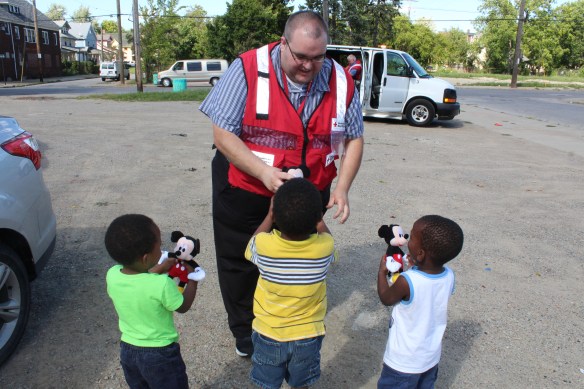
Disaster Program Manager Jeremy Bayer offers Mickey Mouse toys to children, following a fire in their home in Cleveland.
“The Red Cross 2018 Giving Day goal is to help 25,000 families. Your support provides families with food, blankets, and other essentials,” said Mike Parks, CEO of the Northeast Ohio Region. “And you don’t have to wait until March 28 to be part of Giving Day. Whether you donate $10 or $500 or more, the tax-deductible gift you make today will count toward the Red Cross Giving Day goal.”
Parks added, “Please also encourage your family and friends to give a gift to help the families who urgently need Red Cross assistance after a home fire or other disaster.”
Click here to donate. Donations made via this link for Red Cross Giving Day will be used for Red Cross Disaster Relief, which supports victims of big and small disasters. Check out this video to see exactly how donations to disaster relief are used.
And use #help1family on your social media accounts to let others know you’re supporting Giving Day.
If you have any questions, please contact Red Cross Donor Services at 1-800-RED-CROSS or submit your request via the financial donation inquiry form so that your inquiry is promptly addressed.
On behalf of the families you will help, thank you for your generosity.
Lt. Jeff Layne and Officer James Craft – The commitment police, fire and rescue workers have for their community knows no days off, as Akron Fire Department Lieutenant Jeffrey Layne discovered on a sunny day in April. Lt. Layne was off duty getting ready to enjoy a bike ride by Summit Lake with his wife and a friend when an SUV appeared out of nowhere and drove off the pier into the cold, murky water. Lt. Layne called out to pedestrians nearby to call 9-1-1 and immediately jumped into the lake. Approaching from behind, Lt. Layne recognized car seats from the back window and feared the worst.
Akron Police Department Police Officer James Craft was on duty and just driving past Summit Lake when the call came in that a vehicle had gone into the water and may have a family on board. Arriving at the scene, Officer Craft wasted no time removing his vest and jumping into the frigid water to assist Lt. Layne.
As more rescue personnel began arriving on the scene, Officer Craft used his ASP baton to break the rear window and fire rescue officers atop the vehicle broke out the passenger window allowing them to come to the relieving conclusion that there were no other passengers in the vehicle aside from the driver. With the water now up to the driver’s chin Officer Craft grabbed hold of the driver and pulled him out of the vehicle through the broken window. The driver began to panic and wrapped his arms around Officer Craft, pushing him under the water. Officer Craft regained his position with the driver and with the assistance of additional rescue personnel on the dock, was able to get the driver onto the shore to safety. The driver was saved thanks to these two men’s quick action, courage and determination.
Wade Wooten – A strange haze filled the sky outside of Wade Wooten’s home. Feeling a sense of alarm, Wade decided to step outside and investigate immediately being overwhelmed by smoke. Looking to his right, he saw plumes of thick black smoke and flames pouring out of his neighbor’s air conditioning unit. Wade ran to his neighbor Nikki’s apartment and banged on the door while shouting her name, but there was no response. Wade stayed calm and recalled his years of experience serving in the U.S. Navy and the training he received in the fire and rescue division.
Wade’s first objective was to locate his neighbor. He rammed the door with all his might and forced it open. Smoke barreled out, he waited a beat and began to crawl low to the ground searching for Nikki, who was shouting for help from her bedroom on the second floor. Realizing he could not reach her from the front, due to the smoke and flames, Wade ran around to the back entrance, climbed the wall and jumped to Nikki’s second floor balcony where she was trapped. He grabbed Nikki and tried to lead her back out to the balcony, but Nikki was struggling as her four small dogs were still somewhere inside. Wade looked her in the eyes and told her they had to go and as they stepped back onto the balcony it gave way and the two went tumbling to the ground. Without even catching a breath, Wade lifted his neighbor Nikki into his arms and carried her to the front of the building to await Fire and Rescue professionals.
His sense of valor showed through on that cold February day. Wade and Nikki both received treatment for smoke inhalation.
Unfortunately, Nikki’s four small dogs were lost in the fire. Following the fire Wade gave her another life-saving gift, his dog, whom Nikki had gifted to Wade three years prior, to help her through her time of grief.
Blake Osborn – Blake Osborn and his wife, Miranda, were hiking the Glens Trail in the Gorge Metroparks on a beautiful Labor Day weekend. A certified wilderness expert, and a Kent State University Adventure Center Program Officer, Blake guided Miranda on an offshoot of the official trail in order to get a better view of the river. Out of the corner of his eye Blake noticed a man at the bottom of a rocky hill sitting with a shoe off. Thinking this was strange, he yelled down to him, “Are you hurt? Do you need help?” The man responded, “no”. Blake then noticed some red on the rock next to the man. He decided to go down to the bottom himself to check it out. Blake called out to nearby hikers to dial 9-1-1, not knowing what he might encounter down below.
The path down to the bottom of the gorge was rocky and steep but at the bottom, Blake knew immediately that this man was in perilous condition. The man, Anthony, had fallen down the hill, gashing his forehead and breaking his ankles, arm and pelvis. Anthony was in shock and the gash in his forehead was bleeding heavily. Blake acted on instinct with his years of wilderness training coming to the forefront. Not having any supplies on him but the clothes on his back, he quickly removed his shirt and tied it around the man’s head then placed himself in a position to keep his head and neck still, fearing a spinal injury.
Blake stayed calm and worked on keeping Anthony awake and alert while simultaneously fighting off yellow jackets who had become enticed by the pair. Nearly two hours later, the fire department was able to reach the two men by boat and Anthony was taken to the hospital for treatment.
Blake’s training and recognition of the fallen hiker’s impaired state, and unquestionable courage to put his own self in danger, helped to save Anthony’s life.
Officer Jason Strainer and Dr. John Bober – On May 24, 2017, Dr. John Bober was sitting in his office at Akron Children’s Hospital’s Division of Pediatric Psychiatry and Psychology when he noticed a man and woman sitting at a table outside his window having a friendly discussion. A loud thump brought Dr. Bober’s attention back to the pair, but the man was lying on the ground and the woman was screaming above him.
Nearby, Akron Police Department Officer Jason Strainer and his partner Officer Kent Shively, were walking their normal beat when they noticed the commotion. As Officer Shively called EMS, Officer Strainer and Dr. Bober simultaneously reached the man, checked and found the individual unresponsive. They began performing CPR. Dr. Bober went to retrieve the AED from inside the offices. They placed the leaders from the AED on the individual’s chest and administered a shock. Officer Strainer and Dr. Bober continued to perform CPR until EMS arrived. EMS transported the individual to the hospital where he survived another few days allowing his family a chance to say their goodbyes. Officer Strainer and Dr. Bober’s calm demeanors and use of CPR and AED training were exemplary.
Laura Deubel, Matt Petrick, Dan Flowers, Karen Sheppard, and Jennifer Dyer – Just after 10 a.m., Laura Deubel ran from her office at the Akron-Canton Regional Foodbank to investigate a call that a volunteer had fainted. As soon as she saw the scene, she shouted “Code Blue!” to another office worker, who repeated the phrase over the plant’s speakers. Trained, designated staffers dropped their duties and raced to the distribution warehouse, where they found beloved volunteer, Horace Lewis, on the floor. The 87-year-old volunteered with Bridging the Gap Ministries. The training that employees had hoped to never use in a real situation kicked in.
Foodbank president, Dan Flowers, and Matt Petrick were the first of the safety team to arrive at Horace’s side. Dan and YMCA volunteer, Christin Domonkos, searched for a pulse but found none. While Dan rushed to retrieve the AED off the wall, the team went into action. Matt and the two YMCA volunteers Christin and Shana DeBerte began CPR, Jennifer Dyer supervised the group and kept the gathering crowd at bay, Laura stayed by Horace’s side offering reassurance and calm. Karen Sheppard operated the AED. Upon attaching the AED, and hearing the detailed instructions given by the machine, the team felt a sense of instant relief. Soon, the paramedics arrived and took Horace away in an ambulance.
Dan and the team are adamant that the AED made all the difference, not only for its life-saving technical components but also for its ability to take control of a situation and guide a person through it all. However, an AED machine cannot operate alone and if it wasn’t for the team’s thorough CPR training and their fast action Horace would not be alive today.
Eathan Cobbin – It was a normal, happy day at Brown Middle School. Eathan Cobbin and his best friend Christian Neff were eating lunch with friends in the cafeteria when everything suddenly went terribly wrong. As Eathan looked on, Christian took a bite of his string cheese and immediately began to cough and gag as though he was choking. His face turned deep red and, Christian later recalls, he feared he would soon lose consciousness. Looking around, Eathan realized that the teachers were too far away to see what was happening and everyone else seemed frozen with fear. Eathan knew that it was up to him to save his friend. Without thinking twice, he leapt across the table and tried to recall how to perform abdominal thrusts from the safety signs he often saw in restaurants and doctor’s offices. This knowledge proved vital, after a few attempts the cheese was dislodged and expelled. While the two boys were most assuredly shaken from this experience, Christian made a fast and full recovery and their relationship has never been stronger.
If you know a someone who has performed a heroic act in 2018, please nominate them for our next event. You can do so online or by paper nomination form at: www.redcross.org/neoheroes.
It’s fitting, but not intentional, that National Good Samaritan Day fell the day before we honored Greater Cleveland Heroes.
The day is also known as Good Samaritan Involvement Day. It is a day for unselfish actions to help those in need and to celebrate kindness.
The term “Good Samaritan” comes from the Bible parable where a Samaritan helped a stranger who had been robbed and beaten and left to die by the side of the road. The Samaritan not only cleaned the man’s wounds and clothed him, but took him to an inn where he paid for the man’s care.
About 500 people attended the 2018 Greater Cleveland Heroes Award ceremony at the Huntington Convention Center of Cleveland, where the Cleveland Indians received the Community Leader Award. See our photo album of the event here.
In a nutshell…
Patrolman Christopher Olup and Sergeant Robert Prochazka
Patrolman Christopher Olup and Sergeant Robert Prochazka of the Willowick Police Department risked their own lives to enter a burning house and pull a disabled man to safety.
Nurse Janine Smalley of the Cleveland VA Medical Center volunteered to treat thousands of veterans in Puerto Rico following the devastation of Hurricane Maria.
Gilbert DiSanto of Miceli Dairy used an AED and performed CPR to save the life of a man who had collapsed near the company’s headquarters in Cleveland.
Janine Smalley
Gilbert DiSanto
Jared Lee
Dana Walling
Dana Walling was a customer at Classic BMW in Willoughby Hills when he helped two wounded police officers subdue a gunman.
Jared Lee of the MetroHealth System improvised by using the drawstring from his scrubs as a tourniquet on a severely injured victim of a car crash.
John and Jan Durkalski
Jan Durkalski performed CPR and ran for help after her husband collapsed during a run in the Cleveland Metroparks, saving his life.
These seven individuals are the very definition of “Good Samaritans,” and we are proud to honor them for their selfless acts.
Combine rapidly melting snow with heavy rainfall, and there’s always the possibility for river flooding. Last February, those conditions occurred throughout the upper Midwest states.
From our Northeast Ohio chapters alone, 28 disaster staff were deployed throughout Ohio, Indiana and Michigan. First and foremost, shelters were opened for those whose homes were in danger of flooding. A safe and warm place to stay was extremely welcomed by those affected. Health service related needs were also attended to by our other volunteers.
Red Cross volunteers prepare to assist flood victims in Cincinnati, Ohio. Photo provided by Monica Bunner/American Red Cross volunteer
Monica Bunner, a Disaster Action Team member from the Summit, Portage & Medina chapter, was one of the first from this area to be deployed. Originally dispatched to a moderate-sized shelter in a high school in southern Ohio, she and her team provided a warm place to stay overnight as well as a place to come during the day to warm up, shower and recharge both the body and the cellphone.
Monica recalls one of the first residents to come to the shelter (and probably the last to leave) was an elderly gentleman who needed to be woken up at 3:30 am each day. He would then walk into town and work 16-hour shifts at a fast food restaurant. Arriving back at the shelter in the evening, he would have dinner and immediately retire, only to repeat the cycle the next day. His resilience to the situation touched everyone who met him.
Volunteers in New Richmond, Ohio
Another resident had been living in a trailer near the water, and as the level of the river rose, he recounted that a number of kittens living below his trailer started poking their heads up through the vents in his floor. He quickly reached down to grab as many as he could and brought them with him to the local animal shelter. Each day he would leave the shelter and walk back to his neighborhood looking for other kittens to save. In all, he rescued eight kittens during the week Monica worked at the shelter.
After a week, Monica was reassigned to DES (Distribution of Emergency Supplies) across Ohio, Kentucky and Indiana, sometimes driving as much as three and one-half hours to reach affected areas.
Red Cross volunteers like Monica respond to emergencies thousands of times each year. It is only through the generous donations of Americans that we can always be ready to respond whenever an emergency threatens. Please consider donating today at redcross.org/neo.
This year, March 10 can be a face-saving and a life-saving date – a two-for-one, if you will. How many other dates can make that claim?
Save Face
If you hadn’t noticed already, Daylight Saving Time comes on March 11. So, traditional wisdom suggests that you turn your clocks ahead one hour before you go to bed on Saturday, March 10. That’s the number one way to save face Sunday morning, when you might otherwise show up an hour late for worship service or your weekly breakfast date with friends.
Save a Life
The American Red Cross can’t stress enough the need to check your smoke alarms at least twice a year. They’ve even come up with a handy tagline to help you remember – TURN and TEST. Simply stated, each time you TURN your clocks forward or back, also remember to TEST your smoke alarms.
Two of the biggest contributors to lost life in a fire situation are 1) lack of smoke alarms in the home and 2) worn out batteries or total lack thereof.
Every day, seven people die in the United States due to a home fire. Remember, you only have two minutes to escape most home fires without serious or fatal results. That’s why it’s important to have an escape plan for your home – and to practice it.
If you’ve read this far, you deserve a bonus. Please refer to it as Daylight Saving Time, not Daylight Savings Time. It’s not plural, despite what many people say. It’s one of those things that probably more than half the people get wrong – but now you know! (Check here for more interesting Daylight Saving Time trivia.)

 The app will also help cat and dog owners keep their pets safe by learning what emergency supplies to have, when they should contact their veterinarian, and where to find a pet care facility or pet-friendly hotel. Users learn how to assemble a pet first aid kit and an emergency kit. Owners have access to step-by-step instructions, videos and images for more than 25 common first aid and emergency situations including how to treat wounds, control bleeding, and care for breathing and cardiac emergencies.











 NOHredcross