Turkey day hazards: Don’t let your holiday meal go up in smoke

By Kathryn Dean, American Red Cross volunteer

Juicy, flavorful, and tender meat.  Crispy, golden-brown skin.  For a perfect holiday centerpiece that cooks in under an hour, the deep-fried turkey seemed like a miracle.  If you lived through the 1990s, you probably remember the phenomenon that spread through the country like wildfire. 

Triggered in part by Martha Stewart featuring this Cajun method of cooking on her television show and in her magazine, it sparked a craze amongst Americans who were looking for easier ways to cook their Thanksgiving turkeys. 

Unfortunately, this method came with a steep price.  An increase in fires and injuries resulted from improper use of this technique, and many homes burned down as a result.  If you’ve never seen a video of a turkey fryer quickly going up in flames, do yourself a favor and Google it now. 

But the danger isn’t limited to outdoor frying.  In the United States, Thanksgiving Day and the day before are the top two most likely days for cooking fires to happen in the home.  44% of all house fires in the U.S. can be attributed to cooking fires, making it the leading cause of home fires and home fire injuries.
COOKING SAFETY TIPS: The American Red Cross recommends these cooking safety tips to reduce your risk of fire during this holiday season.

  • Never leave the kitchen unattended when frying, grilling, or broiling food.
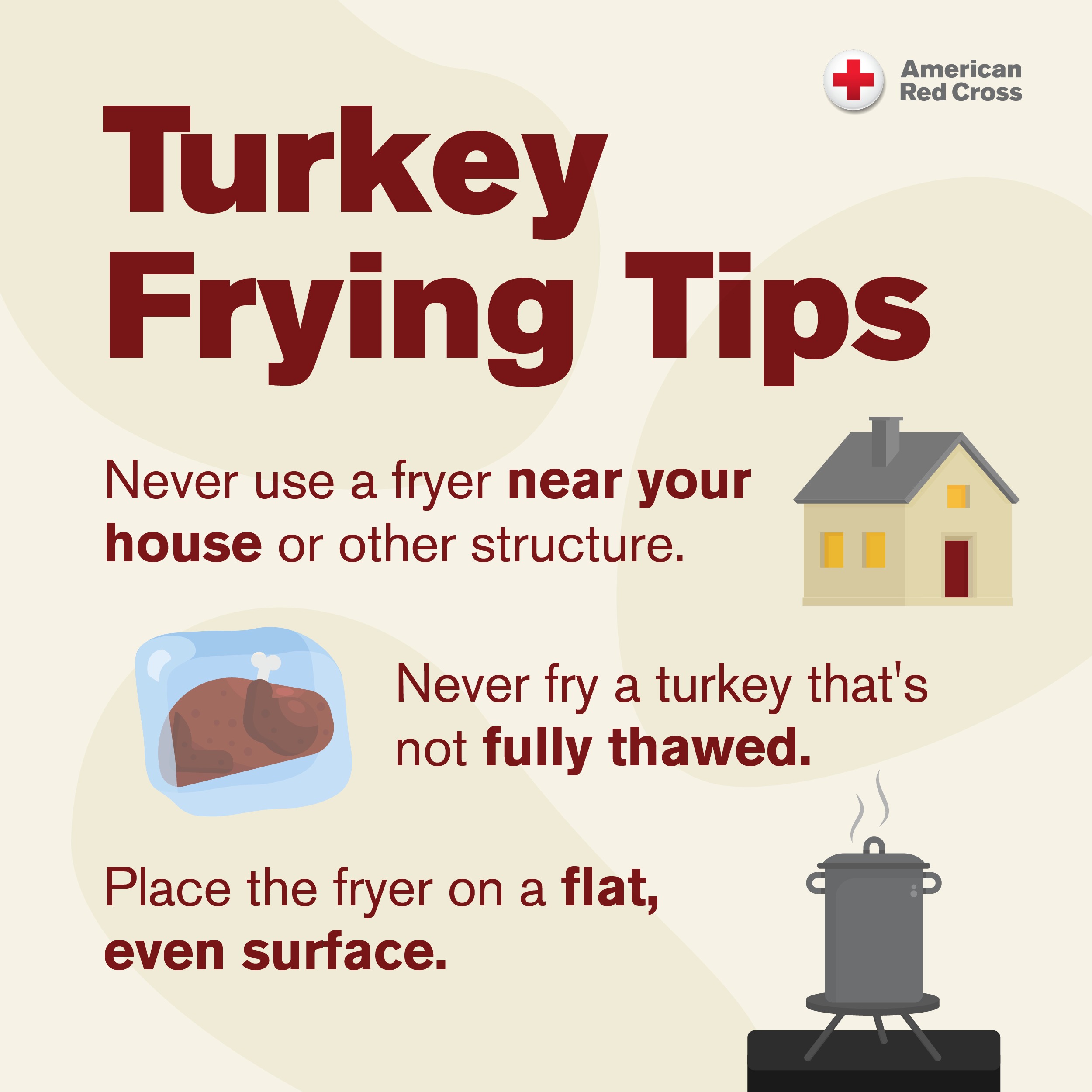
  • Keep grills or deep fat fryers at least 10 feet away from home structures while in use.
  • If you are using a turkey fryer, remember that proper safety requires a completely thawed turkey and oil that is at the correct temperature and level.
  • Set a kitchen timer to remind you when the stove is on.
  • Keep children and pets at least three feet away from all cooking appliances and cords.
  • Remove flammable items, like wooden utensils, curtains, potholders, and oven mitts, from the vicinity of the stovetop.
  • Pull up sleeves and avoid loose clothing that can get in the way while cooking.
  • Keep a fire extinguisher near any area where cooking is being performed.  Do not use water to put out a grease fire.
  • Check that all appliances are off before going to bed at night.

Fall is a great time to check that you have working smoke detectors in your home. Test your units monthly, and replace batteries annually (on units that allow you to do so).  Replace any units that are over 10 years old.  If you need help replacing or installing smoke detectors, the Red Cross may be able to help. Click here to find out how to request a free smoke alarm in Northern Ohio. Wishing everyone a wonderful Thanksgiving!

Preparedness starts at home: Urging Northern Ohio residents to prepare for emergencies now

September is National Preparedness Month, and the American Red Cross Northern Ohio Region is urging everyone to protect their loved ones and their homes by getting ready now.

Most people may not realize it, but the nation’s number one disaster is home fires. On average, the Northern Ohio Region responds to 3 home fires every 24 hours. Last fiscal year, the Red Cross responded to over 1,000 home fires in the region, issuing more than $1.1 million in direct financial assistance to impacted residents. Help your family prepare by testing your smoke alarms each month and practicing your escape.

Red Cross volunteers installing a smoke alarm inside a home in Cleveland.

“National Preparedness Month is a great time to ask whether your family would be ready if something unexpected happened tomorrow,” said Mike Parks, Regional CEO, Red Cross of Northern Ohio. “It’s not about being scared; it’s about being smart and looking out for the people you love. Taking a few simple steps now so that you have a plan can make all the difference when it matters most.”

HOW TO GET READY Disasters don’t wait for the “right time” — they can happen in the middle of the night, during your commute or while your kids are at school. Protect your family by making a plan to stay safe, gathering important supplies and knowing how you’ll stay connected by taking these steps:

  • Depending on the emergency, you may need to stay where you are or go somewhere else to stay safe. If you may need to leave, think about where you’ll go, how you’ll get there, where you’ll stay and what you’ll take with you. Plan well in advance if you’ll need help leaving or use public transportation.
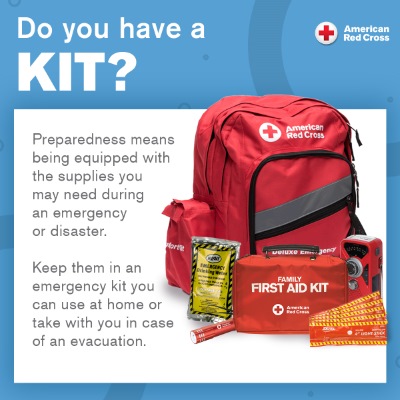
  • Next, gather and organize critical supplies — like food, water and medicine — into a go-kit and a stay-at-home kit. Make sure to include backup batteries and chargers for your devices (cell phone, CPAP, wheelchair, etc.), a battery-powered or hand-crank radio, and critical personal records.
  • Your go-kit should include three days of supplies that you can take with you. Your stay-at-home kit should have two weeks of food and water, and a one-month supply of medications, if possible.
  • Customize your kit to meet your household’s specific needs. If you have young children, don’t forget formula and diapers. If you have pets, include leashes, carriers, food, bowls, litter and a litterbox.
  • Finally, make a plan to reconnect with loved ones if you are separated or if the phone or internet is down. Write down important phone numbers on a contact card and carry it with you.

Download the free Red Cross Emergency app for weather alerts, safety steps for different emergencies and expert advice in both English and Spanish. Don’t forget to sign up for local government emergency alerts to get critical local information — like evacuation notices — during an emergency.

People can also help their community be better prepared for disasters by giving bloodtaking a class in lifesaving skills like CPR, or becoming a Red Cross volunteer. Visit redcross.org or call 800-RED CROSS (800-733-2767) to learn more today.

“Whether it’s a fire in someone’s home or a storm that destroys an entire town, disasters can happen anywhere, at any time,” Parks said. “Taking a few minutes now to get ready will help you protect your loved ones if the worst happens.”

High winds, heavy rains, crashing trampolines — be prepared for spring storms

By Tim Poe, American Red Cross volunteer.

Early April, a family gathering for an 81st birthday as an early spring storm rattles, patters and howls, not unlike the taps and rumbles at the windows as I write this. A bellowing whoosh and deep crash, a house-shuddering boom. I stand, thinking a tree has fallen, and look out the window to see a black-and-chrome mass fall from the sky, striking cars in a cacophony of shattering glass and bending metal. A family member repeatedly shouts, “What was that?!” I step outside and piece together what has happened. A neighbor’s trampoline, windblown, smashed into and knocked down a portion of fence, rose up, crashed onto the roof, where one of its legs protrudes from the hole it has just made, rose again and plunged onto the cars.

This was the scene last April, turning a birthday celebration into a flurry of activity to ensure everyone was safe, mitigate damage from the compromised roof, assess damage and make plans on how to proceed. Now that spring has returned along with its storms, we must be prepared for whatever they bring, whether high winds, tornadoes, heavy rains, flooding or falling trampolines.

As we have written before, preparation is key. The American Red Cross is responding to an increasing number of disasters and expects this trend will continue. The National Oceanic and Atmospheric Administration also recently reported that Ohio set a record for tornadoes in 2024.

Here are tips for planning and staying safe.

  • Practice drills with everyone in your household.
  • Contact your local office of emergency management to learn what hazards may affect your community. Sign up for free emergency alerts from your local government. Remember, a WATCH alert means be prepared; a WARNING means take action.
  • Get inside a sturdy building, one with walls and a foundation, before a thunderstorm hits. Plan to shelter in the basement or a small, interior, windowless room on the lowest level to provide additional protection from high winds.
  • If you are in a mobile, manufactured, trailer home or RV, identify a sturdy building you can access quickly.
  • In certain emergencies you may need to travel to safety. Decide where you will go, how to get there and what you will need to take. Make additional plans if assistance or public transportation is needed.
  • Include pets in your plans.
  • Plan to reconnect with loved ones should you become separated or communications are down. Carry a contact card with important phone numbers. Also consider including a list of medications.
  • Plan to stay informed even if the power is out. Backup batteries, devices to charge cell phones and battery-powered or hand-crank radios are helpful.
  • Prepare both stay-at home and go kits. The go-kit should have three-day’s worth of critical supplies, while the stay-at-home kit should have two weeks of food and water and a one-month supply of medications/medical supplies.
  • Keep personal, financial and medical records in a safe, easily accessible place.
  • Make a list of items outside you will need to tie down or put away. (Yes, including trampolines).
  • Learn First Aid and CPR.
  • Download the Red Cross Emergency App.

More information is available here. As always, please prepare and stay safe, and call on the Red Cross if needed.

Edited by Glenda Bogar, American Red Cross volunteer

Three things pet owners should do this April

By Samantha Pudelski, American Red Cross volunteer

Every April we recognize Pet Month, a time for pet owners to celebrate the animals they love in their life. The American Red Cross of Northern Ohio shares three ways people can become better caretakers and bond with their pets this month.

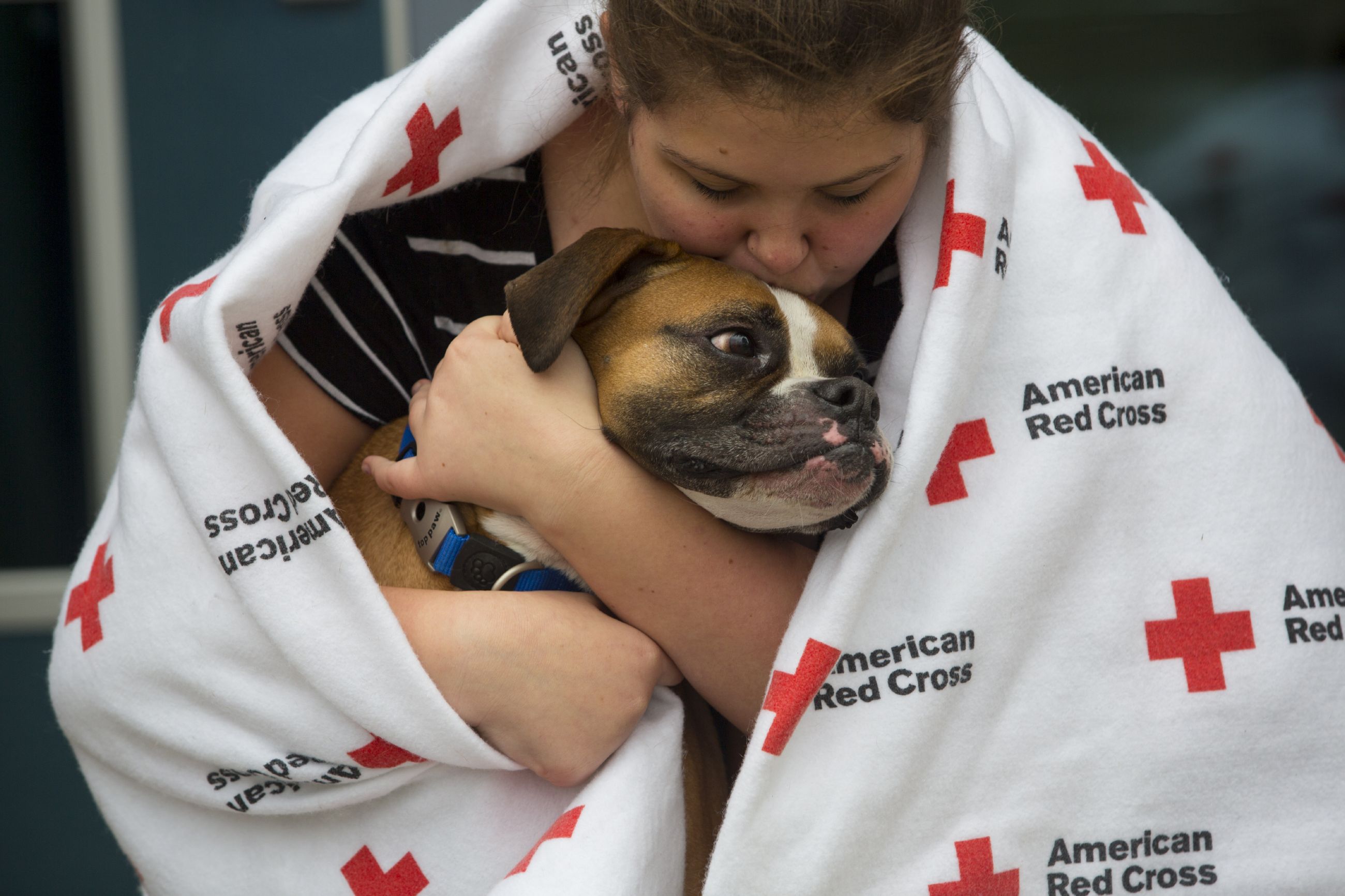
Superstorm Sandy 2012

Kaitlyn Miller and her rescue boxer, Coulton taking refuge in a Red Cross shelter.
Photo by Les Stone/American Red Cross

1. Take a Pet First Aid Class

The Red Cross offers an online course to learn how to understand vital signs, preventive care and caring for pets in critical emergency situations. The 35-minute course provides the basics in caring for cats and dogs, including:

  • Checking pet’s vital signs.
  • Conducting preventive care for your pets.
  • Recognizing and providing first aid for the most severe experiences a pet may experience.

Upon completion of the course, you’ll receive a Red Cross digital certification.  Register here.

2. Learn How to Keep Your Pets Safe During a Disaster

East Palestine, Ohio 2023 This resident of East Palestine, Ohio took refuge with her pet in a Red Cross shelter following a train derailment and chemical spill. Photo credit: Jim McIntyre/American Red Cross

In the event of an emergency, be sure to be prepared with everything your loved ones, including your pets, need to evacuate. The Red Cross has put together some tips to help you keep your pets safe in the event of a disaster.

Please note the tips below are mostly for cats and dogs. For more information on disaster planning for other types of pets and livestock, please visit https://www.ready.gov/pets or Humane Society.

  1. Remember, if it isn’t safe for you to stay in your home during an emergency, it’s not safe for your pets either.
  2. Include supplies your pet needs in your emergency kit, including:
    1. Sturdy leashes/harnesses and/or carriers to transport your pets safely.
    1. Food, water, bowls, and a manual can opener if your pets eat canned food.
    1. Cat litter and a pan for feline friends.
    1. A first aid kit.
    1. Copies of medical records and any medications your pets need in a waterproof container.
    1. Current photos of your pets just in case they get lost.
    1. Information on when your pets eat, medical conditions, any behavioral issues and contact information for your veterinarian in case you have to board or foster your pets.
    1. Pet beds and toys, if possible.
  3. Make an evacuation plan for you and your pets.
    1. Many hotels do not accept animals, other than service animals. Make sure you identify places along your route that will accept pets in an emergency.
    1. Some Red Cross shelters cannot accept pets due to health and safety needs. Service animals for people with disabilities are allowed.

For more tips on preparing for your pets in an emergency, visit the Red Cross page for preparing for emergencies.

3. Have a Dog? Join our April Walking Challenge to Support Disaster Relief

Get outside with your furry friend this spring and help support those impacted by disasters. The Red Cross is hosting a 30 Mile Dog Walk Challenge in the month of April. It’s free to join and you can score a collapsible dog bowl for joining.

Visit the Red Cross website to learn how you can sign up.

7 Tips To Keep Your Holiday Season Safe, Merry and Bright

By Sam Pudelski, Red Cross volunteer

The holiday season is upon us and for some, decorations are already trimming their homes. While December is known as the most wonderful time of the year, it’s also the peak time for home fires. 

The American Red Cross has put together some simple safety tips to help protect your home and family.

  • Opt for battery-operated candles. If you do use candles, never leave burning candles unattended and keep them away from anything that can burn. Make sure to keep candles out of reach of children and pets.
  • Inspect all holiday light cords to make sure they aren’t broken or frayed. Avoid stringing too many strands of lights together. You should not have more than three light strings per extension cord.
  • Make sure all outdoor decorations are made for outdoor use. Fasten lights securely to your home, trees and bushes. If you’re using any metal fasteners, like hooks or nails, make sure they are insulated to help prevent electrocution or fire hazard.
  • If you have an artificial tree or garland, check for a fire-resistant label. Keep them away from fireplaces, radiators and other sources of heat. Never use electric lights on metallic trees.
  • If you plan to get a live tree, test its needles to make sure it is fresh. Bend the needles on the tree up and down to make sure no needles fall off. Make sure to water the tree regularly to prevent it from drying out.
  • Don’t hang stockings or decorations on the mantel if you plan to light the fireplace.
  • Install smoke alarms on every level of your home and outside each sleeping area. Test your alarms once a month and replace the batteries at least once per year. Additionally, you should practice your two-minute fire safety plan with everyone in your household.

If you cannot afford smoke alarms or aren’t physically able to install one, the Red Cross may be able to help. You can request a smoke alarm from the Northern Ohio Region of the Red Cross here.

Tips to Help Keep This Halloween a Treat

By Sam Pudelski, American Red Cross volunteer

It’s Halloween season here in Northern Ohio, and while kids are prepping to get tons of treats, adults should also prepare to make the evening a safe and fun event. Here are 10 things to keep in mind when trick-or-treating this holiday.

  1. Make sure trick-or-treaters can see and be seen. Use face makeup instead of masks, which can make it hard to see when wearing them. Make sure trick-or-treaters can be seen be using a flashlight to light their way, adding reflective tape to costumes and trick-or-treat bags and wearing light-colored clothing.
  2. Use costumes that are flame-resistant.
  3. Never let children trick-or-treat alone. A parent or responsible adult should accompany young children door-to-door. Make sure adults know where kids are going and do not get too far ahead.
  4. Be cautious around animals, especially dogs.
  5. Walk, don’t run from door to door. Avoid walking in the street and stick to sidewalks. If no sidewalk is available, walk at the edge of the roadway, facing traffic. When crossing the street, stop and look both ways. Don’t cross between parked cars. If trick-or-treating in a city, do not take alleyways.
  6. If you are driving, use extra caution. Kids may forget to look both ways before crossing amongst all of the excitement.
  7. Only visit homes that have a porch light on. Accept treats at the door and never go inside a home. Before eating goodies, make sure adults check all of them, removing loose candy, open packages and any choking hazards. Throw away any items with brand names you are not familiar with.

If you are handing out goodies at your home for trick-or-treaters:

  • Light the area well so visitors can see where they are walking.
  • Clear obstacles someone can trip over. Sweep leaves from steps and sidewalks.
  • Use caution when carving pumpkins. Adults should do the carving, and young kids should draw the face on the pumpkins instead of doing the carving. Do not use a candle to light a pumpkin. Opt for a flashlight or glowstick instead.

With these tips, we hope you all have a safe and fun Halloween! For more tips on first aid, weather alerts and more, download our American Red Cross apps by searching for the Red Cross in your app store or visiting redcross.org/apps.

Preparing for the unimaginable

Things to consider during National Preparedness Month

By Doug Bardwell, American Red Cross volunteer

As disasters become more frequent and more costly, the American Red Cross is
answering the calls of those in need, both here in Northern Ohio and around the world.
Just last week, here in Northern Ohio, the Red Cross assisted 62 families affected by the severe storms, providing more than $42,500 in financial aid.

Meanwhile, across the rest of the country, more than 1,000 Red Crossers answered the
call after historic wildfires, rainfall, and flooding ravaged people’s homes from the East
Coast to Hawaii in 21 separate major relief efforts. Again, the Northern Ohio region of
the Red Cross stepped up – providing 10 responders willing to travel great distances in
service of the Red Cross mission – to alleviate human suffering.


August 30, 2023. Perry, Florida. Red Cross disaster responder, Dariana Molina, assesses damage caused by Hurricane Idalia in Perry, Florida. Photo by Scott Dalton/American Red Cross

As unimaginable as these events have been, the reality is that as a humanitarian
organization, we are responding to nearly twice as many major disasters today as we
did 10 years ago. In the first half of 2023, there have been a record 15 disasters costly
in excess of a billion dollars each. As the disasters increase in size, and as more people
are displaced, the financial burden goes up correspondingly.

Having responded to numerous national disasters myself, I have been both broken-
hearted and proud at the same moment, as many disaster victims explain that our Red
Cross teams have provided the only assistance they’ve received immediately after the
disaster.

Four things you can do this September for National Preparedness Month
1) Prepare your family by preparing an emergency kit, ready to go at a moment’s
notice. Have a family plan on how and where everyone will meet up in case of a
disaster. Stay informed about potential disasters in your area, and learn what
your local government will do, should you need to evacuate. Visit
redcross.org/prepare for more information or download the free Red Cross
Emergency app, which also provides real-time weather alerts, open Red Cross
disaster shelter locations and more.
2) Donate blood. With each major storm, numerous blood drives are canceled,
reducing the supply of blood nationwide, and endangering others who rely on
blood for their medical conditions. Find a donation site near you at
redcross.org/blood.
3) Consider becoming a volunteer to help either locally or nationally. There are
jobs for all types of talents and ages, and training is comprehensive and free. Whether you can donate an hour a day or a couple of hours a month, chances
are there is a position for you with your local Red Cross office. Learn more about
positions available in your area at nohredcross.org/volunteer/
4) Cash Donation If time or family commitments prevent you from volunteering,
please consider a cash donation. Through fiscal year 2027, the Red Cross needs
to spend more than $1 billion on its climate crisis work, encompassing disaster
relief, international services and sustainability programs. Every donation helps
those who need it most, and no amount is too small. Go to redcross.org/donate.

Edited by Glenda Bogar, Red Cross volunteer

Posted by Ryan Lang, Red Cross Board Member and volunteer

It’s August – time for everyone to learn – not just schoolchildren

By Doug Bardwell, American Red Cross volunteer

Here are 16 tips to help to educate the whole family:

Driving

In Northern Ohio, as children return to school earlier and earlier each year, it’s not
unusual in August to see children lined up, waiting for school buses. That means drivers
need to readjust their driving habits.

As youngsters wait for the bus for the first time, many have never been asked to stand
in one spot without dancing around or chasing their nearby friends. It’s not unusual to
see one of them dart off the curb and into the street without looking. Lesson: if you see
young children on the street corner – slow down and watch for unexpected behavior.

As young drivers with new driver’s licenses start to drive to school for the first time, they
can be easily distracted between the car radio, their cellphone, and/or friends they see
along the way. Lesson: remind them before they leave every day in August to be on the
lookout for little ones who might dart out between parked cars.

Grandparents may be pressed into service with school starting again, playing chauffeur
to their grandchildren. As darling as they can be, resist adjusting the rearview mirror to
have extended conversations with your little loved ones. Lesson: for every second you
are peering into the backseat, someone else’s child could run out in front of your moving
vehicle.

Grandparents must also be aware of current driving regulations regarding car seats,
booster seats, etc. Lesson: In Ohio, State law requires:

  • Infants and young children must ride in a child safety seat until they are 4 years old, AND, weigh at least 40 pounds.
  • Every child ages 4-8 who is no longer in a car seat must use a booster seat until he/she reaches 4’9” tall.
  • Children and teens, ages 8-15, who are not in booster seats must use adult seat belts.

This grandparent recalls traveling with our children unstrapped in a car bed on the back
seat. Fortunately, their guardian angels watched over them. Don’t even think about trying that now.

Awareness

“There are some special steps parents of younger kids should take, especially if they
have youngsters going to school for the first time,” said Mike Parks, Regional CEO.
Lesson: “They should make sure the child knows their phone number, address, how to
get in touch with their parents at work, how to get in touch with another trusted adult and
how to dial 911. And teach them not to talk to strangers or accept rides from someone
they don’t know.”

The American Red Cross always stresses the importance of having an emergency plan before disaster strikes. Lesson: Back-to-school time is an excellent opportunity to think about “What-If”. As you imagine different scenarios, who can you enlist to help out?

Neighbors, other parents, friends, relatives? Make sure to have current contact information for each of them.

Want more?

Here are another 10 “Get-ready-for-school” tips.
For more emergency preparedness suggestions, visit http://redcross.org/prepare.

Posted by Ryan Lang, Red Cross board member and volunteer

Stay safe this summer: Readying yourself for a road trip

By Doug Bardwell, American Red Cross volunteer

With summer approaching, our family’s favorite activity is taking road trips. We are so blessed to be in Northern Ohio since we can find awesome destinations no matter which direction we head.

However, despite all the choices, the one thing I’ve learned is that you need to be prepared for emergencies. The “it won’t happen to me” syndrome is a risky one, and who needs the guilt of knowing better but not taking precautions?

Getting ready

I’m a nut for lists. For years, I’ve been using spreadsheets (either Excel or Google Sheets). I’ll make a master list, and at the end of each trip, I’ll add whatever items that we should have taken. Then when the next road trip comes up, we won’t forget that item a second time. I’ve been keeping them for years, and my lists cover just about anything we could need. We don’t take every item on every trip by any means but at least we forget very, very little.

One item we always pack, and fortunately have only needed a few times, is a First Aid kit. I’ve actually got multiple ones that vary in size for my bike bag, my backpack and the car. While I’ve been a pretty safe person, there have been numerous times we’ve been able to come to the rescue of others, who weren’t quite so prepared.

Another lesson I learned in an American Red Cross Safe Driving course is to adjust your rearview mirrors out farther than most people do. Basically, while sitting behind the steering wheel, lean as far left as comfortable, and then set your left rearview mirror so you can just barely see the left fender of your car. Then lean right as far as comfortable and set your right mirror the same way. That radically improves your chances of not hitting someone in your blind spot. I know it’s saved me at least four times.

Lastly, get enough sleep before you set out on a long road trip. When I haven’t done that, the instant I feel myself getting drowsy, I’ll find a place to pull over and try to take a quick nap. I set my alarm on my watch for 15 minutes, and that’s a perfect time to be refreshed enough to drive another couple of hours. Any longer than 15 minutes is too long (strange sleep science).

For more information

The American Red Cross just issued a 20 Steps to Help You Stay Safe this Summer article for road trips, swimming, backyard grilling and camping. Item number 18 is definitely one that could save your life. Then enroll in a Red Cross first aid and CPR/AED course, either online or in person.

Edited by Glenda Bogar, Red Cross volunteer

Posted by Ryan Lang, Red Cross Board Member and volunteer

Severe weather safety tips to help you stay safe

By Samantha Pudelski, American Red Cross volunteer

Warmer weather will be arriving in Northern Ohio…eventually! We’ll be swapping snowstorms for thunderstorms and rain. While our region doesn’t experience hurricanes (this is the beginning of hurricane preparedness week), our area does experience severe storms that can bring tornadoes or flash flooding. Before severe weather strikes, refresh your severe safety knowledge with these tips from the American Red Cross.

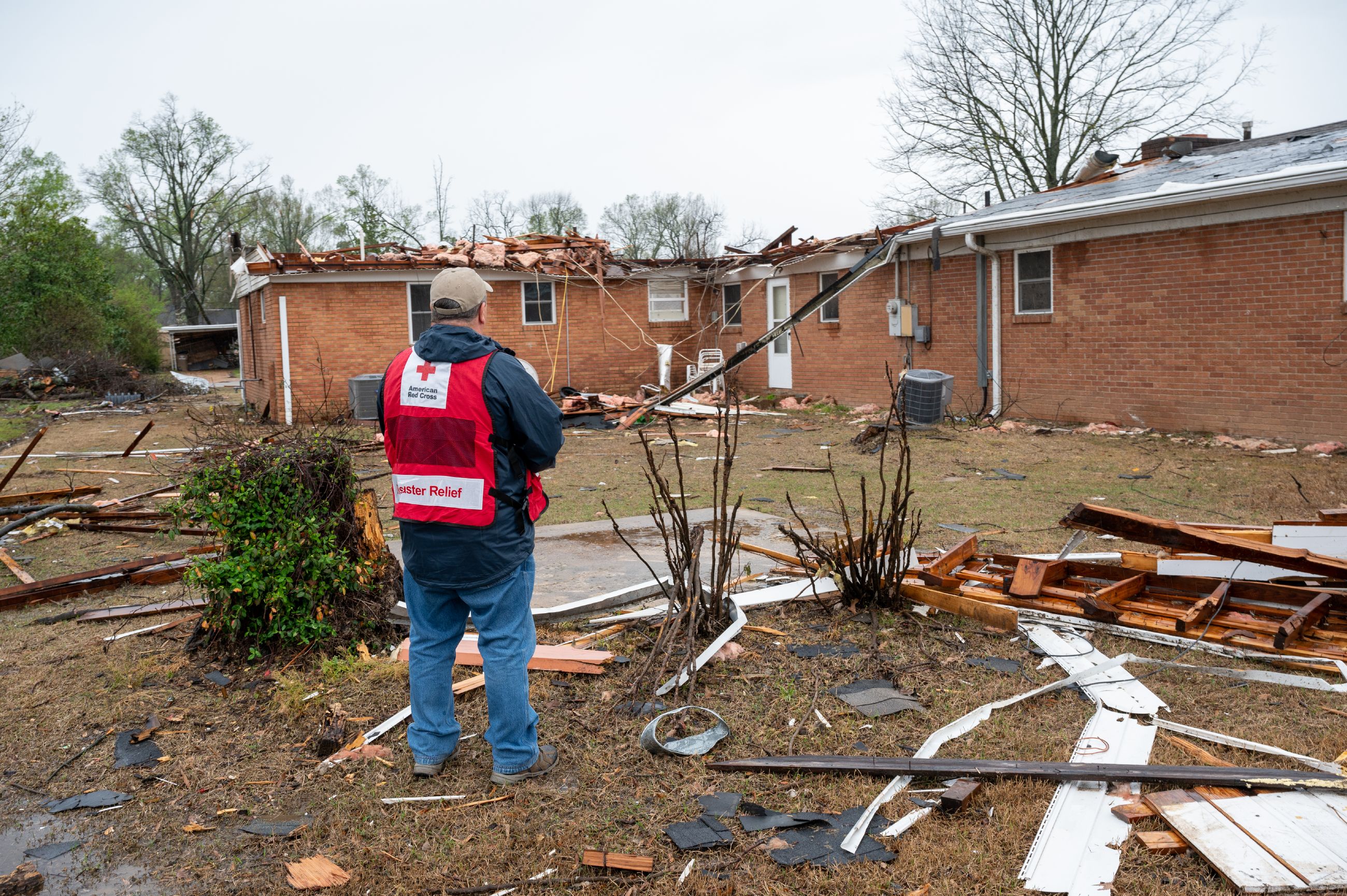
April 5, 2023. Wynne, Arkansas. The tornado that struck Wynne, caused extensive damage to scores of homes in the town. Photo by Kevin Suttlehan/American Red Cross

Before Storms Strike:

  • Identify a sturdy building that you can take shelter in. A sturdy building has walls and a foundation.
  • Ideally, the building should have a basement, or a small, interior room without windows on the lowest level of the building.
  • Mobile, manufactured, trailer homes and recreational vehicles (RVs) are not safe in high winds.
  • If you reside in one of these structures, make sure to identify a building nearby that you can take shelter in quickly.
  • Hold practice drills with everyone in your household to make sure everyone knows what to do and where to go before a storm hits.
  • Sign up for free emergency weather alerts from your local government or weather service.
  • In case there is a power outage, make sure to have a backup battery to charge your cell phone and a battery-powered radio.
  • Know the different types of weather alerts:
    Severe thunderstorm watch: Means severe weather is possible in the area. Be prepared to act fast.
    Severe thunderstorm warning: Means a severe thunderstorm is in the area and to take action to get to safety.
    Tornado watch: Means tornadoes are possible in the area. Be prepared to act fast.
    Tornado warning: Means a tornado is near, and you must take immediate action to get to a safe location.
    Flood watch: Means that flooding is possible in the area.
    Flood warning: Means flooding is forthcoming or currently happening in the warning area.
    Flash floods warning: Means that a flash flood is imminent or currently happening. It is even possible that a flash flood can occur in an area not immediately receiving rain.


When Storms Are Predicted in Your Area or Currently Happening

  • Look for storm signs such as darkening skies, lightning flashes and windy conditions. If you hear thunder, head indoors. Once you can hear thunder, the storm is close enough to be in danger of lightning strikes.
  • If a severe thunderstorm warning is issued in the area, take shelter in a substantial building.
  • Mobile homes can blow over in high winds.
  • Keep away from windows.
  • Don’t take a bath, shower or use plumbing.
  • Avoid using electrical equipment and telephones.
  • If you are driving, try to find a way to safely pull off the road and park. Stay in your vehicle until the heavy rain ends. Turn on your emergency flashers so other vehicles can see you.
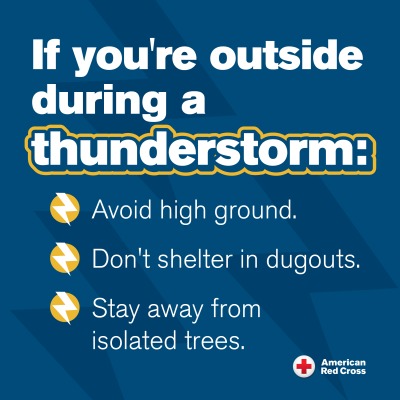
  • If you are outside and are not able to seek shelter in a building or car, avoid high ground, water, tall or isolated trees and metal objects. Sheds, picnic shelters, dugouts and metal objects, like bleachers, are not safe places to seek shelter.
  • If someone is struck by lightning, call 911 immediately. If someone sustains a lightning strike they need professional medical care. Check the individual for burns and other injuries. If they stop breathing, begin CPR immediately. It’s safe to touch them, as individuals struck by lightning do not retain an electrical charge.
April 5, 2023. Wynne, Arkansas. Red Cross volunteer Don Baker surveys tornado damage to homes in Wynne, AR. Photo by Kevin Suttlehan/American Red Cross

Tornado Safety

If a tornado warning is announced for the area you are in:

  • Move to the lowest level of your home or a sturdy building, ideally a basement. If you aren’t able to move to a lower level, find a small interior room with no windows.
  • Mobile, manufacturer, trailer homes and RVs are not safe in the event of a tornado or high winds.
  • Monitor local weather and news on your phone or radio.

    When Flooding is Predicted or Seen
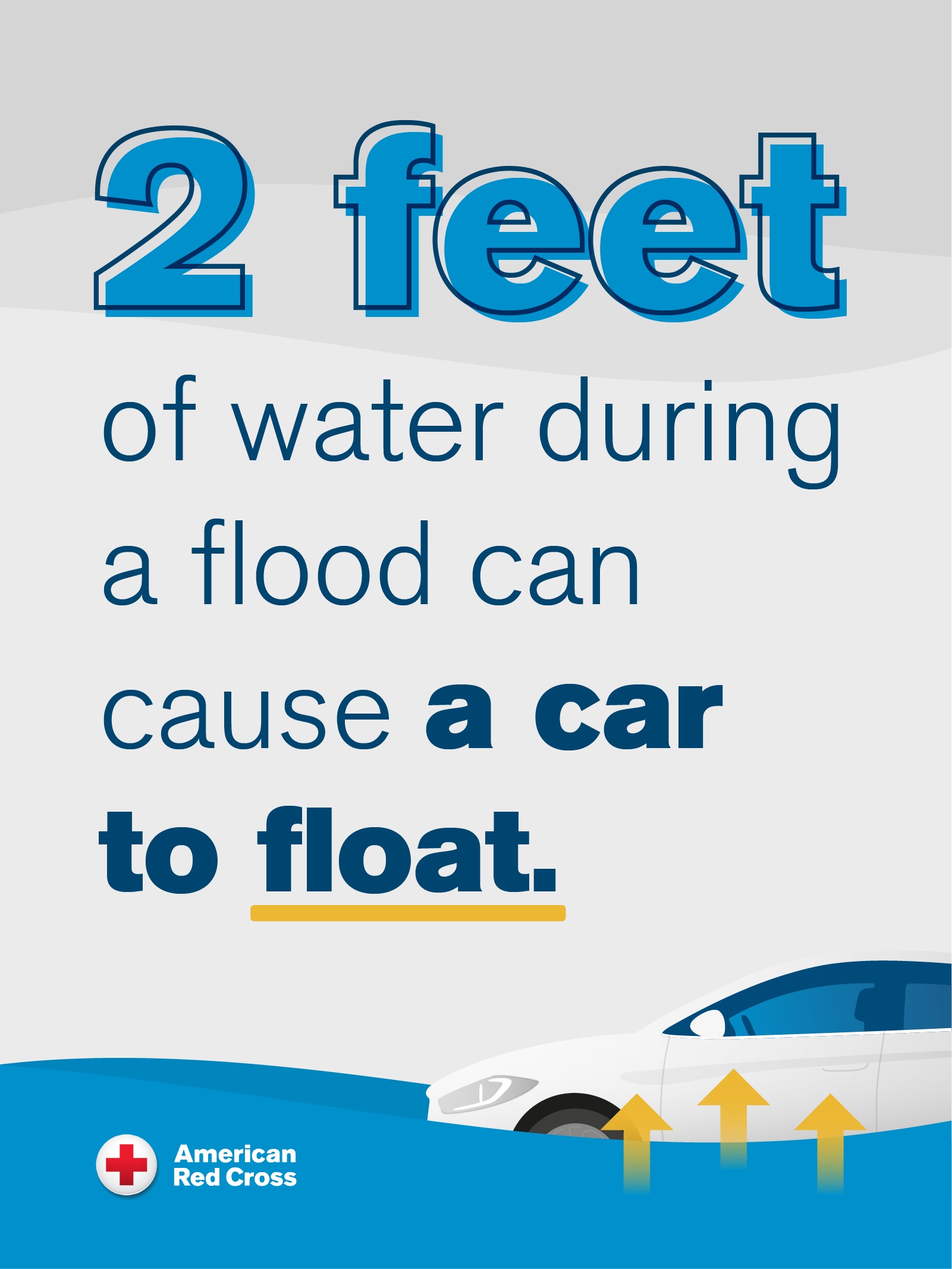
  • Turn around, don’t drown! Stay off the roads and do not attempt to drive through a flooded portion of the road. Just six inches of fast-moving water can knock you over, and most vehicles can be swept away by less than two feet of water.
  • If you are caught on a flooded road and the waters are rising around you, get out of the car quickly and move to higher ground.
  • Tune in to your local radio or news for the latest weather updates.
  • If your area is a risk flood area, prepare to evacuate quickly in the case it becomes necessary.
  • Follow your local officials direction if you are asked to evacuate.
  • Stay away from flooded areas, as they may contain snakes, insects and other animals. Keep children and pets away from these areas.

    For more information on weather safety and about volunteer opportunities to help those affected by severe weather, visit https://www.redcross.org/local/ohio/northern-ohio.html.

    Edited by Glenda Bogar, Red Cross volunteer
    Posted by Ryan Lang, Red Cross board member and volunteer