Thank you from the bottom of our hearts!

By Gail Wernick, Regional Volunteer Services Officer, American Red Cross of Northern Ohio

As I begin my 15th year with the American Red Cross, I would like to share a message of appreciation to the truly special Red Cross team and volunteers with whom I have had the privilege of working to deliver our mission.

This fall I deployed for the first time in-person to be a part of the Hurricane Helene Disaster Relief Operation in Asheville, North Carolina. On deployment, I joined a team of dedicated Red Crossers to share volunteer opportunities with surrounding communities.  Due to intermittent internet availability, the team often connected with new volunteers personally to complete volunteer intake to begin volunteering as soon as possible! The Disaster Event Based and Local Community Volunteer teams supported volunteer scheduling, with more than 200 calls/texts to coordinate and prepare for the volunteers’ engagement. The team created volunteer recognition messaging and unique ways to say THANK YOU!  Each day, some more than 12 hours, was filled with new experiences, learning quickly, and adjusting to the evolving needs of the disaster operation. I will always remember my Red Cross deployment experience and the kind people I met, who inspired me and helped make a meaningful difference each day.

Thank you for delivering service in the community to help your neighbors when needed most. Your efforts are greatly appreciated, and we are most grateful for your service as a Red Cross Disaster volunteer.

Featured in the photo above, Red Cross volunteer deployment team members, disaster event based and local community volunteers from Asheville, North Carolina.

Glen McCandless, a disaster event based volunteer, featured on the far right in the photo above, volunteered at the AG Center every day for two weeks consecutively. He said, “Volunteering at the shelter and helping others in the midst of so much devastation is like salve for the soul.”

The Red Cross shelter supervisors we met extended their sincere appreciation for the dedicated disaster volunteers from the local community who tirelessly volunteered, many whose own lives and homes have been impacted by the disaster, to prepare and serve meals and offer support. Whether a volunteer gave two hours or several days of their time to help, we are grateful to them for helping deliver the Red Cross mission! 
More than 1,400 Disaster Event Based Volunteers joined the Red Cross in North & South Carolina this October and November, engaging in more than 640 volunteer commitments to provide comfort, care and hope by assembling and distributing emergency supplies, preparing and serving meals, setting up and cleaning up and supporting residents impacted by Hurricane Helene. 

The Red Cross is here to help make your volunteer experience the best it can be! Please continue to volunteer with us and encourage your friends and family to join you. Thank you for exploring and sharing our most-needed ongoing volunteer opportunities at www.redcross.org/volunteer.  We are working hard to prepare for, respond to and help communities recover from disaster. Become a part of the Red Cross Disaster Action Team at www.redcross.org/dat.

As extreme weather events increase, so does the need for Red Cross services and volunteers

2024 is predicted to be an extremely active year

By Tim Poe, American Red Cross Volunteer

Polyrhythms of raindrops drum at the window, accented by rolling bellows of thunder, a severe late May storm approaches. Lights flicker. I am relieved the roof, damaged weeks ago, has finally been repaired. Yet as a Northern Ohio resident I am fortunate, as the region is less prone to natural disasters. Earlier, I watched reports from the latest of this spring’s tornado outbreaks. Amidst the catastrophic scenes, as always, American Red Cross volunteers and staff members are there, ensuring those impacted have food, shelter, care, comfort, and resources to begin recovering.

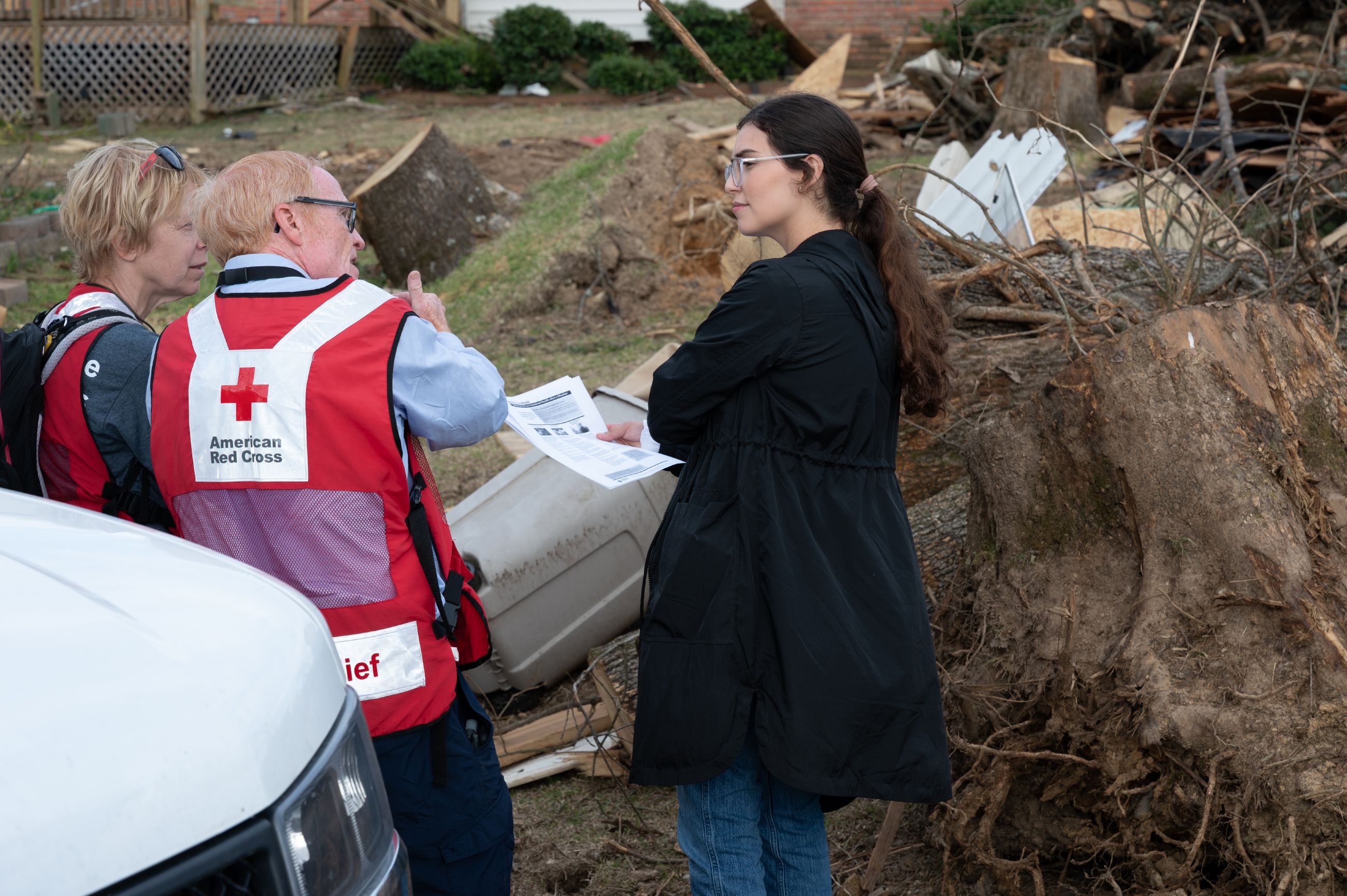
March 30, 2023. Amory, Mississippi. Red Crosser Eric Besson examines damage to a home on Thursday in Amory, Miss. As many as 2,000 structures across Mississippi received major damage or were destroyed by tornadoes on March 24. More than 380 trained Red Cross disaster workers are on the ground in Mississippi, Georgia and Alabama, as the nonprofit organization works with partners to make sure everyone has a safe place to stay, meals, emotional support and comfort in the aftermath of deadly tornadoes on March 24. Photo by Scott Dalton/American Red Cross

As extreme weather events become more frequent and severe–and 2024 is predicted to be an exceptionally active year–the need for Red Cross services is increasing. Already, the Red Cross responds to almost twice as many large disasters than it did a decade ago, and in just the last 10 months, 125 volunteers from Northern Ohio have assisted residents affected by hurricanes and wildfires across the U.S. Four Northern Ohio volunteers are currently deployed to Texas and Iowa.

As eventful as 2023 was, with weather-related disasters forcing an estimated 2.5 million people from their homes, one-third of them for longer than a month, according to the New York Times, 2024 may be even more severe.

The National Oceanic and Atmospheric Administration (NOAA) reports that, as of May 8, 2024, the US has had seven confirmed weather/climate disaster events, each with losses over $1 billion, resulting in the deaths of 70 people. The NOAA also states there were 384 preliminary tornado reports in April, more than double the 1991-2020 average and the second highest April count on record.

March 31, 2023. Rolling Fork, Mississippi. Red Crosser Yolanda Gainwell visits with Karebya Christmas on Friday outside Christmas’ heavily damaged home in Rolling Fork, Miss. Christmas was home with her three children – ranging in age from 2 to 11 years old – when the tornado arrived. Just like Christmas’ grandmother taught her, she brought the family into the bathtub and put a pillow on top of them. No one was injured, but her home suffered major damages, disrupting their lives, as well as the self-owned business she ran from the home. On Friday, Christmas received help at a drive-through distribution center, where the Red Cross and partners distributed rakes, shovels, totes, clean-up kits, flashlights, batteries and more. Displaced, Christmas is staying at a hotel in Ridgeland, Miss. until at least Monday. As she finished talking with Gainwell, Christmas thanked her for coming to talk with her at her home, but with the damage rendering it uninhabitable, she hesitated to call it a home. “I don’t know what to call it – my blessing in disguise, maybe,” she said. Photo by Scott Dalton/American Red Cross

As summer approaches, the likelihood of an extremely active hurricane season and above-average wildfire season looms. Jim McIntyre, Regional Communications Director for the American Red Cross, Northern Ohio Region, recently conducted an interview with meteorologist Trent Magill of WEWS News 5. Jim and Trent discussed recent events, the need for planning and Red Cross services, and the outlook for the hurricane and severe storm season. Trent states, “everything we’re seeing shows above average intensity,” and that “it’s going to be a rough season.” Continuing, Trent says “Everyone should have a plan.”

Hopefully, you are wondering what you can do. For one, make sure you are prepared and have a plan. For another, please consider volunteering with the Red Cross. Volunteers account for 90% of the Red Cross workforce and represent a wide array of cultures, backgrounds, ages, gender identities, lifestyles, and beliefs, just like those we serve. Everyone is welcome, and free online training is provided.

April 9, 2023. Little Rock, Arkansas. William Burkey, a member of the Red Cross disaster mental health team, and Jamie Harms, a member of the disaster health services team, work together to bring comfort and hope to Paula Rocha, whose home was damaged by a tornado that struck Little Rock, Arkansas, and several nearby towns. Photo by Kevin Suttlehan/American Red Cross

Three key positions are especially needed: Disaster Action Team volunteers, who help families in need following a disaster; Shelter Services volunteers, who support day-to-day activities in an emergency shelter; and Disaster Health or Mental Health Services volunteers, who use their professional skills as licensed healthcare providers to assist those impacted by a disaster. Please consider joining, as I can personally attest you will work alongside outstanding people and the see difference Red Cross services provide.

Posted by Ryan Lang, American Red Cross board member and volunteer

    Northern Ohio volunteer delivered supplies and hope in the wake of Hurricane Ian

    By Michael deVulpillieres, American Red Cross

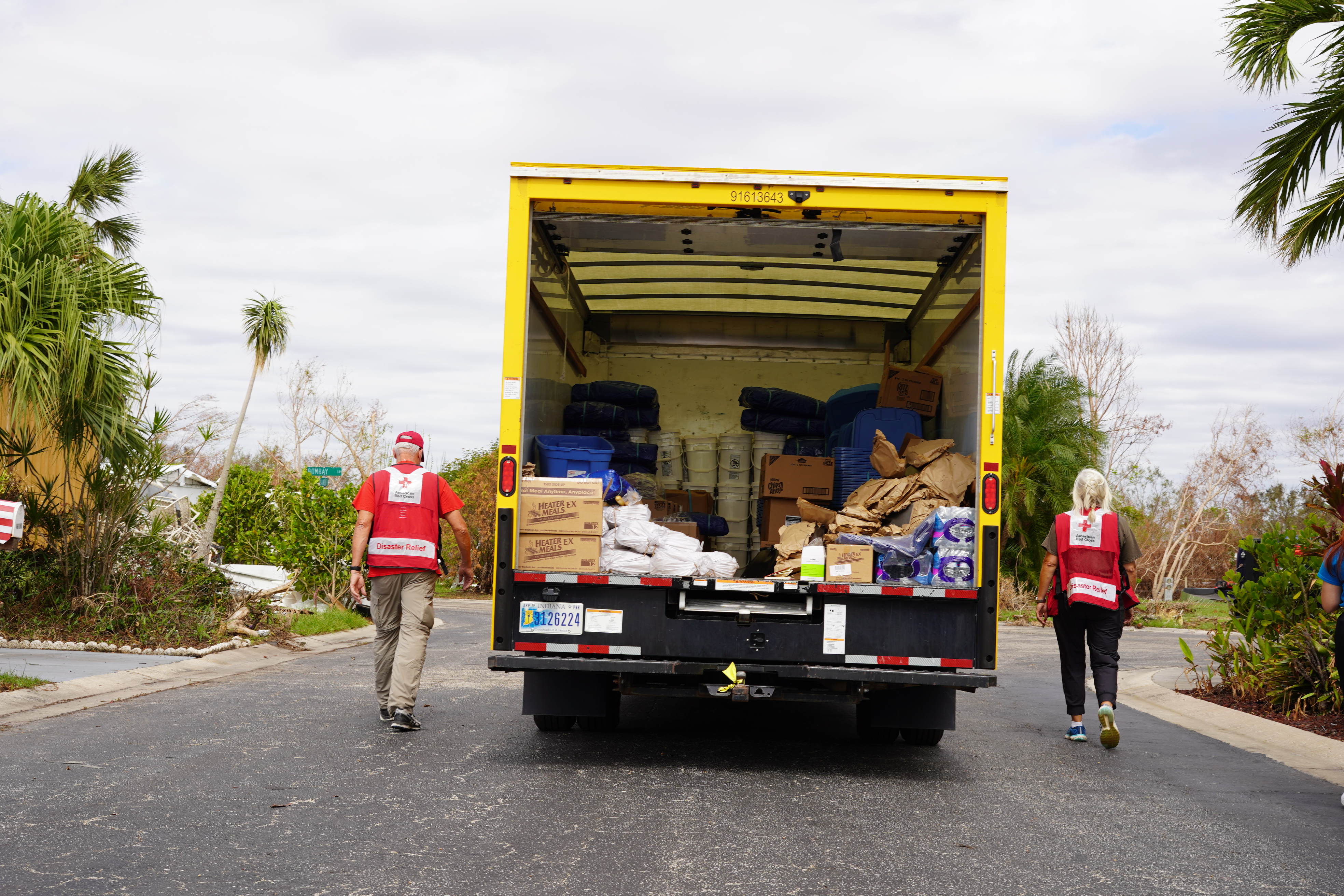
    Destruction was everywhere as a large truck with an American Red Cross logo taped to its side made its way slowly through Coastal Estates, a small Fort Myers neighborhood lined with single family homes, most either wiped out entirely or badly damaged by Hurricane Ian.

    On one side of the street, a stray cat wandered inside a blown-out manufactured home. A few doors down, the driver paused at the sight of a metal roof wrapped around a palm tree.

    “Within 30 minutes, we had five feet of water here,” Reba Fennessy told Red Cross volunteers Lisa Mize and David Tolander. “It was so scary.”

    American Red Cross volunteers David Tolander of Iowa and Lisa Mize of Huron, Ohio deliver relief supplies to a small neighborhood in Fort Myers, Florida, hit hard by Hurricane Ian. Photo credit: Michael deVulpillieres, American Red Cross

    Mize, who is from Huron, Ohio, and Tolander, from Waterloo, Iowa, first met a week earlier after arriving in Southwest Florida to be part of the hurricane relief efforts. They were assigned to deliver supplies together in some of the hardest hit parts of the state.

    Their presence meant more than the much-needed free relief items like tarps, bins, brooms, rakes, batteries, bleach and trash bags that filled their truck. Mize and Tolander also represented the reassurance that help would continue to be available as long as needed.

    “We’re here where the Gulf (of Mexico) meets the Bay (of the Caloosahatchee River), so we got a double whammy,” Catherine Casby said. The storm surge, pushed by 160-mile-an-hour winds, destroyed so many of the homes around hers. Though damaged, her small house is still standing.

    Catherine Casby, a resident of Fort Myers, Fla., hit hard by Hurricane Ian, speaks with Red Cross volunteer Lisa Mize. Photo Credit: Michael deVulpillieres, American Red Cross

    Casby spends her days clearing debris, cleaning up inside, and keeping an eye on her neighbors. “We look after each other,” she said of her tight-knit community. In fact, the night Ian made landfall, Casby braved the winds and flood waters to check on residents next door, injuring her leg in the process.

    While Mize, who works as a nurse back home, was handing out supplies, she asked Casby about her noticeable limp. Casby said she spent a few days in the hospital after the storm and is slowly recovering.

    “That’s the hardest part, the stories,” Mize said of the physical and emotional scars left by Ian. Yet during her Red Cross deployment, Mize has learned how to “laugh and smile, even in the worst of it.” Her positive disposition and sense of humor lifted the spirits of those around her.

    “The people are so appreciative of seeing anyone here,” Tolander said. “Many told us the Red Cross was the first and only people they’ve seen (helping).”

    Fennessy recalled how, a week after landfall, the Red Cross was in Coastal Estates providing warm meals. “It made us feel that someone cared,” she said, her voice breaking up with emotion.

    Before accepting some cleanup supplies from the truck, Fennessy looked up at Mize in the back of the vehicle and said, “If I could come up there, I’d give you a hug.” Mize promptly climbed down to share an embrace.

    Despite having just met a week earlier, Mize and Tolander talked and joked as if they’d known each other for years. There was a seamlessness about the way they worked together.

    “We’ve clicked really well,” said Mize, who recently joined the Red Cross. “This is my first deployment. But Dave has been on a lot, so he’s taught me quite a bit.” She paused. “He taught me that it’s OK to cry sometimes.”

    American Red Cross relief is free to anyone with disaster-caused needs, thanks to the generosity of the American people. To become a trained disaster volunteer, like Mize and Tolander, go to redcross.org/volunteer or call 1-800-REDCROSS.

    If you would like to support the Hurricane Ian response financially, visit redcross.org or CruzRojaAmericana.org, text the words IAN to 90999 to make a $10 donation, or call 1-800-HELP NOW.

    Edited by Eilene Guy, American Red Cross volunteer
    Posted by Ryan Lang, American Red Cross board member and volunteer

    Helping those in need after a disaster is challenging but rewarding

    By Mike Arthur, Regional Mass Care & Logistics Manager, American Red Cross of Northern Ohio

    I’m grateful to live in northern Ohio, one of the safest areas of the country from a weather-related disaster standpoint. We don’t have to worry about a hurricane coming and wiping our homes away. We are unlikely to walk out our front doors and have trouble breathing due to smoke from a nearby wildfire.

    I have never worried about the fate of my family and myself, where we would live and work after a disaster destroyed my home and place of work. I have never had to make a decision about which of my hard-earned belongings I need to take with me when I evacuate. I have never had my community devastated. Every year thousands of families have their lives changed drastically when their homes and communities are affected by disasters large and small.

    Mike Arthur, during the Red Cross response to hurricane Harvey in Houston, Texas in 2017
     

    I’m also grateful that I get the opportunity to help people in need. As a Regional Mass Care & Logistics Manager, I get to put the skills and talents learned over the course of my life to good use leading and supporting the American Red Cross workforce in meeting the needs of our clients locally and nationally.

    I get to deploy for a few weeks each year making an immediate difference in someone’s life. Deployments to large disasters are tough but incredibly rewarding. The hours can be long. The food is not always five star. I sometimes sleep on a cot in a staff shelter with my fellow workers. It can be stressful. Compassion fatigue is a risk.

    Residents wait to receive clean up supplies from the Red Cross after hurricane Harvey in 2017.

    I look forward to each deployment and go as often as I can. I feel like I make a difference. I have made incredible friends across the country. I have great stories to tell. I get to bring hope to those in need. I help provide a safe place to sleep and food in bellies, and sometimes, most importantly I can provide a warm hug, bright smile and a sympathetic ear. My life is fuller because of my deployment experiences. I hope you will take to opportunity to join me out in the field this year and experience the magic of helping.

    Help those in need when they need it most by becoming a volunteer with the Red Cross. To find a volunteer opportunity that’s right for you, visit redcross.org/volunteer.

    Edited by Glenda Bogar, Red Cross volunteer

    Volunteer Response from NEO Continues to Grow

    Red Cross Relief Operations Continue In Texas and the Southeast

    The dual disasters caused by Hurricane Harvey and Hurricane Irma have mobilized thousands of Red Cross workers, including 60 from Northeast Ohio.

    Among the volunteers providing assistance to residents of Texas is Manny Andrews of Akron.

    IMG_3752

    Akron resident and Red Cross volunteer Manny Andrews

    Manny can be seen in this video, helping distribute meals to people in neighborhoods near Houston, where the need for help continues to be great, more than three weeks after Hurricane Harvey made landfall.

    “They’re just basically cleaning up, and we’re just providing food for them,” said Manny, who  has served with the United States Marine Corps.  “It definitely feels good to know at least I’m doing something.  It’s not a lot, but it’s something they appreciate.”

    SMLXVol

    Red Cross volunteer Jennifer Hatfield with a hurricane-impacted resident in Brunswick, GA.

    Among the Northeast Ohio volunteers helping people affected by Hurricane Irma is Jennifer Hatfield of Ashland.  She is seen in this photo, talking with a woman who was fishing in the Fancy Bluff Creek in Brunswick, Georgia.

    It’s the first time the Ohio State Highway Patrol dispatcher has been assigned to a large disaster relief operation.  “We’re helping a lot of Georgia’s impoverished population,” Jennifer said.

    The recovery effort is expected to last for months, and the Red Cross is committed to providing the services needed to help people put their lives back together.  But it’s going to take the help of many trained volunteers.  Zero to Hero training sessions continue to be held throughout Northeast Ohio.  Visit redcross.org/neo and click the VOLUNTEER tab to begin the application process.

    Here is the latest information on the Red Cross hurricane relief efforts:

    Hurricanes Harvey and Irma

    • In the last three weeks, the Red Cross and community partners have provided more than 934,000 overnight stays in emergency shelters due to hurricanes. Shelters were opened in 8 states, Puerto Rico and the U.S. Virgin Islands.
    • The Red Cross has served more than 3 million meals and snacks to people in need.
    • More than 6,400 Red Cross disaster workers and almost 300 emergency response vehicles are on the ground right now, helping thousands of people affected by these storms.
    • More than 73 million hurricane and flood alerts have been issued through Red Cross mobile apps for Hurricanes Harvey and Irma.

    Hurricane Harvey

    • Overnight, more than 4,600 people stayed in 25 Red Cross and partner shelters across Texas and Louisiana. To date, there have been nearly 394,000 overnight shelter stays provided for Hurricane Harvey.
    • Along with our partners, we have served more than 2.3 million meals and snacks in Texas and Louisiana.
    • More than 3,500 Red Cross disaster workers are on the ground in Texas and Louisiana, with almost 280 more on the way.
    • More than 170 emergency response vehicles have been activated to help deliver meals and relief supplies across the hardest hit areas of Texas and Louisiana.
    • Mental health and health services professionals have provided nearly 76,000 contacts to provide support and care to people in Texas and Louisiana.
    • We’ve distributed nearly 655,000 relief items like diapers, bug spray, cleaning supplies, coolers, and comfort kits containing deodorant, toothbrushes, toothpaste and other hygiene items, in Texas and Louisiana.
    • The Red Cross has already distributed $45 million in financial assistance to more than 100,000 qualified households who needed immediate help. This assistance has helped more than 365,000 people including more than 10,000 households headed by military veterans.

    Hurricane Irma

    • Overnight, almost 3,600 people were provided refuge in 55 government and Red Cross shelters across Florida, Georgia, Puerto Rico and the U.S. Virgin Islands. This includes:
      • In Florida, more than 3,200 people in 47evacuation shelters.
      • In Georgia, 24 people in one shelter.
      • On the U.S. Virgin Islands, 162 people in four evacuation shelters.
      • In Puerto Rico, more than 182 people in three evacuation shelters.
    • To date, evacuation centers have provided more than half a million (541,000) overnight stays to people needing a safe place to go.
    • Along with our partners, we have served more than 747,000 meals and snacks across six states, Puerto Rico and the U.S. Virgin Islands.
    • We’ve distributed more than 88,000 relief items like diapers, bug spray, cleaning supplies, coolers, and comfort kits containing deodorant, toothbrushes, toothpaste and other hygiene items across six states, Puerto Rico and the U.S. Virgin Islands.
    • Mental health and health services professionals have provided more than 16,000 contacts to provide support and care to those affected across six states and the U.S. Virgin Islands.
    • Nearly 3,000 Red Cross workers are responding to Irma now, with more than 300 more volunteers on the way.
    • More than 120 emergency response vehicles have been activated to help.


    Two Hurricane Relief Efforts Underway

    Here are the latest updates.

    Hurricane Harvey 2017


    Over 5,800 Red Cross workers from across the country continue to assist with the relief effort, including 41 individuals from Northeast Ohio. With many more expected to arrive.

    Almost 190 emergency response vehicles have been activated to help deliver meals and relief supplies throughout Texas. 100 more are activated to respond to the communities affected by Irma.


    Hurricane Harvey 2017

    Overnight, an estimated 108,000 people were provided refuge from Hurricane Irma in as many as 530 government and Red Cross evacuation centers across 6 states, Puerto Rico and the U.S. Virgin Islands.


    Additionally, more than 5,000 people sought refuge in 30 Red Cross and partner shelters across Texas. To date, there have been more than 364,000 overnight shelter stays for Hurricane Harvey.

    Hurricane Harvey 2017

    If  you would like to volunteer as a member of the Red Cross team, whether in your community or across the nation, get started on your volunteer application, today. Visit redcross.org/neo and click on VOLUNTEER.


    From Hurricanes to Home Fires – Get Prepared in September

    Hurricane Harvey 2017By now you know may think that you know all about hurricanes — massive storm systems that form over the water and move toward land. Threats from hurricanes include high winds, heavy rainfall, storm surge, coastal and inland flooding, rip currents, and tornadoes. These large storms are called typhoons in the North Pacific Ocean and cyclones in other parts of the world. The Atlantic hurricane season runs from June 1 to November 30, with the peak occurring now, between mid-August and late October. The Eastern Pacific hurricane season begins May 15 and ends November 30.
    It may seem like you’re well versed on basic preparedness tips, such as:

    • Know where to go if ordered to evacuate.
    • Put together a go-bag: disaster supply kit, including a flashlight, batteries, cash, first aid supplies, medications, and copies of your critical information if you need to evacuate
    • If not in an area that is advised to evacuate and you decide to stay in your home, plan for adequate supplies in case you lose power and water for several days and you are not able to leave due to flooding or blocked roads.
    • Make a family emergency communication plan.

    And with Ohio not being a coastal state, you may feel that you don’t have to worry about any of these things!

    But you should.

    Hurricane Harvey 2017Coming right smack in the middle of the peak of Hurricane season, is Preparedness Month. Celebrated every September, it is the perfect time for you, your family, and your community learn how to BE PREPARED.
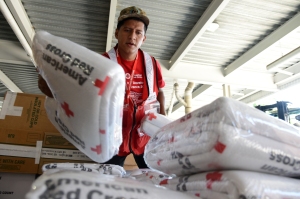
    Prepare for the things you may experience as an Ohioan: tornadoes, flooding, extreme winter weather, power outages, or a home fire.

    Step one:
    Build a Kit or Do an Annual Supply Check

    Make sure your emergency kit is stocked with the items on the checklist below. Most of the items are inexpensive and easy to find, and any one of them could save your life. Headed to the store? Download a printable version to take with you. Once you take a look at the basic items, consider what unique needs your family might have, such as supplies for pets, or seniors.

    After an emergency, you may need to survive on your own for several days. Being prepared means having your own food, water and other supplies to last for at least 72 hours. A disaster supplies kit is a collection of basic items your household may need in the event of an emergency.

    Basic Disaster Supplies Kit

    To assemble your kit, store items in airtight plastic bags and put your entire disaster supplies kit in one or two easy-to-carry containers such as plastic bins or a duffel bag.

    A basic emergency supply kit could include the following recommended items:

    • Waterone gallon of water per person per day for at least three days, for drinking and sanitation
    • Food – at least a three-day supply of non-perishable food
    • Battery-powered or hand crank radio and a NOAA Weather Radio with tone alert
    • Flashlight
    • First aid kit
    • Extra batteries
    • Whistle to signal for help
    • Dust mask to help filter contaminated air and plastic sheeting and duct tape to shelter-in-place
    • Moist towelettes, garbage bags and plastic ties for personal sanitation
    • Wrench or pliers to turn off utilities
    • Manual can opener for food
    • Local maps
    • Cell phone with chargers and a backup battery

    Download the Recommended Supplies List (PDF)

    Additional Emergency Supplies

    Consider adding the following items to your emergency supply kit based on your individual needs:

    • Prescription medications
    • Non-prescription medications such as pain relievers, anti-diarrhea medication, antacids or laxatives
    • Glasses and contact lense solution
    • Infant formula, bottles, diapers, wipes, diaper rash cream
    • Pet food and extra water for your pet
    • Cash or traveler’s checks
    • Important family documents such as copies of insurance policies, identification and bank account records saved electronically or in a waterproof, portable container
    • Sleeping bag or warm blanket for each person
    • Complete change of clothing appropriate for your climate and sturdy shoes
    • Household chlorine bleach and medicine dropper to disinfect water
    • Fire extinguisher
    • Matches in a waterproof container
    • Feminine supplies and personal hygiene items
    • Mess kits, paper cups, plates, paper towels and plastic utensils
    • Paper and pencil
    • Books, games, puzzles or other activities for children

    Maintaining Your Kit

    After assembling your kit remember to maintain it so it’s ready when needed:

    • Keep canned food in a cool, dry place
    • Store boxed food in tightly closed plastic or metal containers
    • Replace expired items as needed
    • Re-think your needs every year and update your kit as your family’s needs change.

    Kit Storage Locations

    Since you do not know where you will be when an emergency occurs, prepare supplies for home, work and vehicles.

    • Home: Keep this kit in a designated place and have it ready in case you have to leave your home quickly. Make sure all family members know where the kit is kept.
    • Work: Be prepared to shelter at work for at least 24 hours. Your work kit should include food, water and other necessities like medicines, as well as comfortable walking shoes, stored in a “grab and go” case.
    • Vehicle: In case you are stranded, keep a kit of emergency supplies in your car.

    Help NEEDED…More Volunteers

    Red Cross volunteer Kim Sterling of Ashtabula met Red Cross President and CEO Gail McGovern after being deployed to Austin, Texas

    There are currently 30 volunteers from Northeast Ohio in or en route to Texas to provide relief to those affected by Hurricane Harvey. Some of them have been featured in the local media:

    http://www.wkyc.com/news/local/five-ways-you-can-help-make-a-difference-for-harvey-victims-in-need/469042466

    http://www.medina-gazette.com/Medina-County/2017/08/31/Medina-County-natives-involved-in-Harvey-efforts.html

    http://www.news5cleveland.com/news/local-news/oh-summit/two-local-red-cross-volunteers-head-south-to-help-thousands-forced-from-their-flooded-homes

    Volunteers continue to leave for the hurricane zone to provide sheltering, meals, and other services to residents who were forced from their homes.  And more volunteers will be needed in the coming weeks, to continue providing assistance to the tens of thousands of residents affected by Hurricane Harvey.

    Red Cross volunteers are trained to provide the services needed before, during and after disaster strikes.  New training sessions are being scheduled.  If you are interested in becoming a Red Cross volunteer, and helping people like the volunteers featured in the media stories above, visit our volunteer page to begin the application process.

    Volunteering Spans Generations for One Red Cross Family

    Grandfather, Grandson in North Carolina Helping with Hurricane Response

    Alejandro Reynoso is trying to teach his grandson a lesson. His classroom is a Red Cross emergency response vehicle.

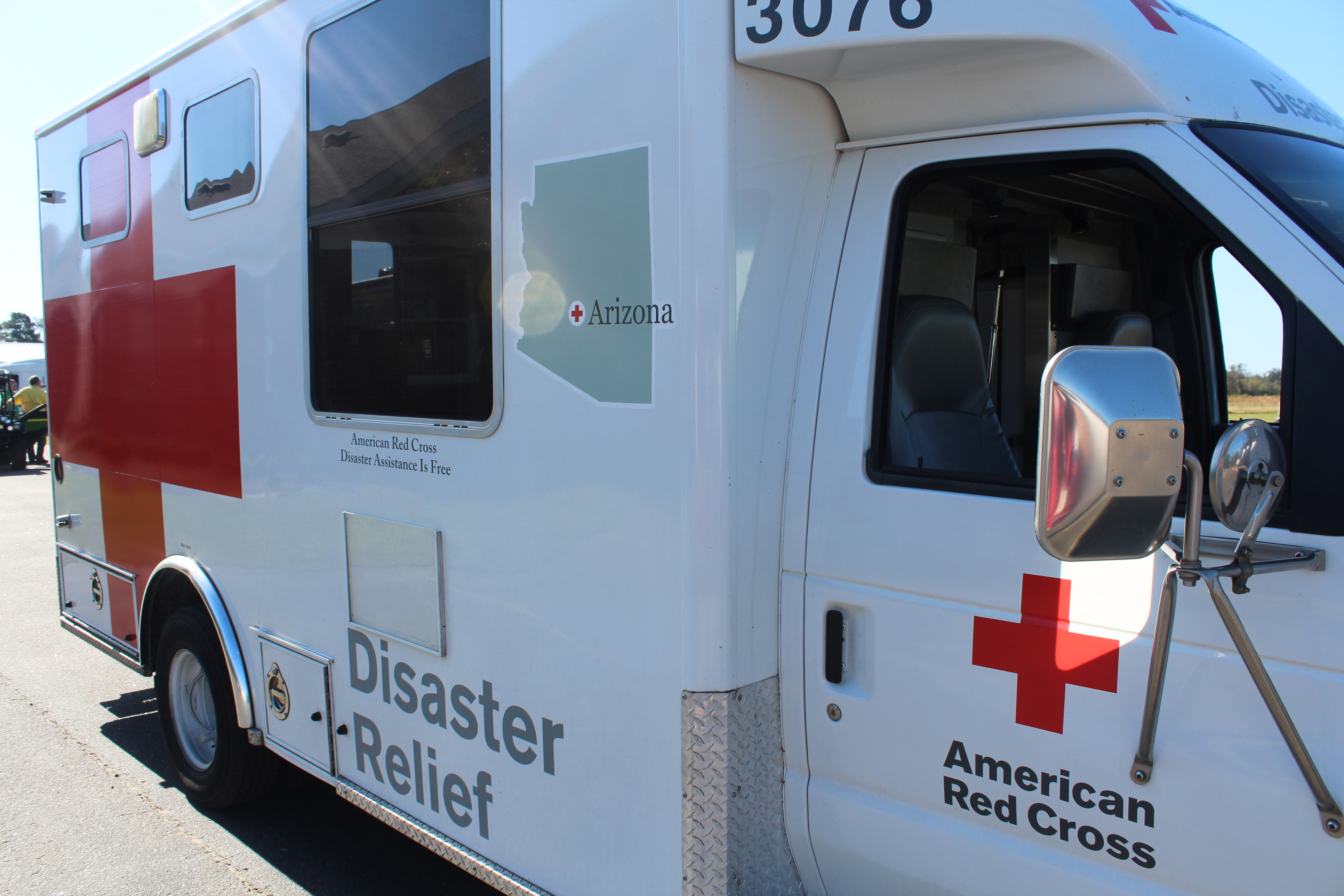
    Mr. Reynoso and his grandson, 18-year old Dominic drove the ERV from Arizona to North Carolina to help people affected by Hurricane Matthew.

    img_2675

    “I think we should all take some time to contribute to society,” Mr. Reynoso says.  “It’s more of a duty.”

    Dominic just graduated from high school, and isn’t sure what he wants to do in the future.  But for the present, he and his grandfather are busy dishing out bratwurst and baked beans, canned pears and potato chips to North Carolina residents impacted by flooding and other storm damage.

    They make a good team.

    “That lady told me she hadn’t eaten in three days,” Dominic says of one flood-affected resident, who received food prepared by the Southern Baptist Disaster Relief organization.  He gave her two meals and a case of bottled water.  “She said she has no water either.”img_2663

    Mr. Reynoso is a Vietnam veteran who left his engineering firm to volunteer in North Carolina.  “That’s the price you pay.  It’s unconditional.  The reward is being asked to come back.”

    That is the lesson he hopes to impart on his grandson.

    If you would like to volunteer for the Red Cross, log onto redcross.org.

    img_2756

    Photos and story: Jim McIntyre/American Red Cross

    Volunteers from Across the U.S. Help in N.C.

    Red Cross volunteers have come from all over the U. S. to help residents affected by flooding following Hurricane Matthew. About three dozen workers are from Northeast Ohio

    Flooding in North Carolina is expected to persist through the weekend, as rivers continue to crest six days post-hurricane.

    At the Western Prong Baptist Church in Whiteville, North Carolina on Thursday, October 13, volunteers from several states arrived in Emergency Response Vehicles to deliver meals prepared at the mobile kitchen set up by the Southern Baptist Convention.

    img_2502

    A dozen states were represented by Red Cross volunteers, who traveled to North Carolina, some of them driving for days, to help residents by distributing food, water, and clean-up kits.

    Volunteers came o the kitchen in ERVs from Arizona, Kansas, Mississippi, Missouri, Nevada, New Hampshire, Ohio, Oklahoma, Oregon, Tennessee, Texas and Utah.  They have been trained by the Red Cross to help deliver mass care during disasters.

    This slideshow requires JavaScript.

    New volunteers can be trained to drive ERVs, run shelters, and many more essential services provided by the Red Cross during times of crisis.  If you’re interested, log onto  redcross.org/neo and click the volunteer tab to begin the application process.