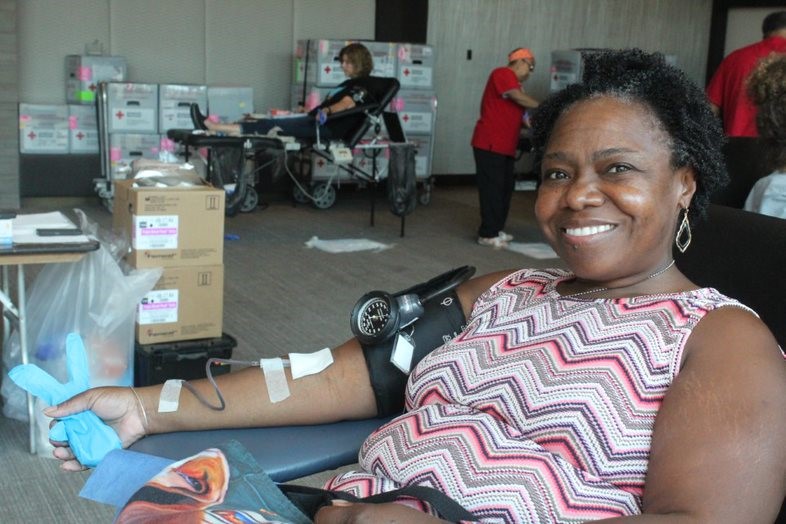
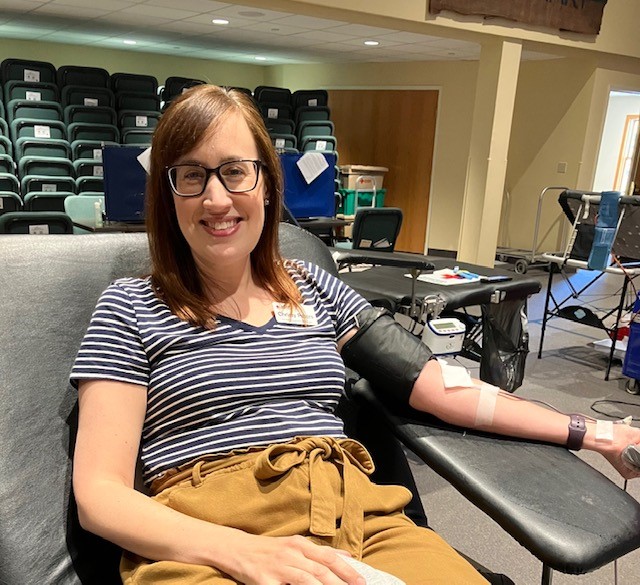
Stay well this flu season and donate blood

By Kathryn Dean, American Red Cross volunteer

Flu season is here and it’s time to start thinking about receiving your annual flu vaccination. According to the Ohio Department of Health, flu season in Ohio typically runs from October to March. However, you can get the flu at any time of the year. The American Red Cross recommends that you protect yourself and your loved ones by getting your annual flu vaccination this year.

“Vaccination is really the most effective way to protect yourself against influenza,” said Dr. Christine Schmotzer, vice chair of system pathology operations at University Hospitals in Cleveland and a member of the Board of Directors for the Red Cross of Northeast Ohio. “The flu vaccine is known to be effective at both preventing flu illness and decreasing the severity of flu illness.”

With a national blood shortage declared on Sept. 11, the Red Cross is in need of healthy donors to help meet the blood needs of more than 70 area hospitals and their patients in Northern Ohio. Only around 3% of the general population is eligible at any given time to donate blood due to a variety of factors, and when people become ill, eligibility drops even more. As flu numbers begin to climb across the country, it’s vital that healthy members of the community stay well by getting their annual vaccinations.

“It’s important to note that we recommend getting the flu vaccine every year to maximize the protective benefits,” Dr. Schmotzer said. “The protective effects of the virus decrease over a period of months, so they do not last strongly into the next season. Also, the virus changes frequently between seasons, so vaccine manufacturers modify the strains of virus in the vaccine to match the protection from season to season.”

Around 500 units of blood are needed per day in Northern Ohio and with the current shortage, it’s more important than ever to come out and donate. The Red Cross recommends that as long as you are feeling healthy and symptom-free on the day of donation, it is okay to donate. There is no wait time between flu vaccination and blood donation. This includes vaccination against COVID-19 and respiratory syncytial virus (RSV).

From now until Oct. 20, the Red Cross will be providing a $15 Amazon gift card to anyone who comes to donate blood as a thank you for your support. Visit RedCrossBlood.org or use the Red Cross Blood Donor App to schedule an appointment or find a blood drive near you.

Edited by Glenda Bogar, Red Cross volunteer

Posted by Ryan Lang, Red Cross board member and volunteer

Blood drives held for Sickle Cell Awareness Month

Three separate blood drives were scheduled in Akron, Ohio for the final three days of September to collect lifesaving blood and to raise awareness of sickle cell disease.

About 100,000 people in the United States have sickle cell disease. The disease affects 1 out of every 365 Black or African American births.

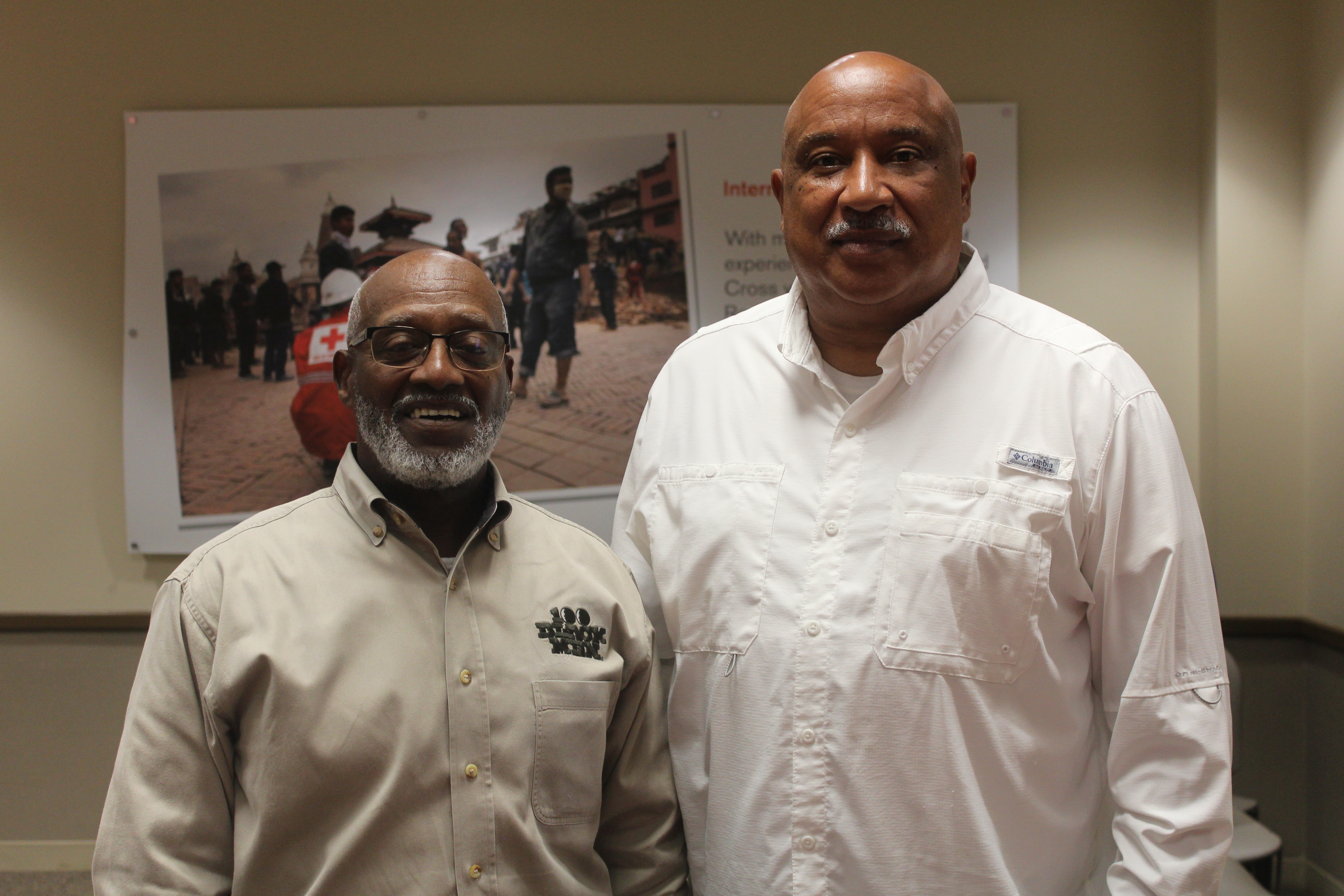
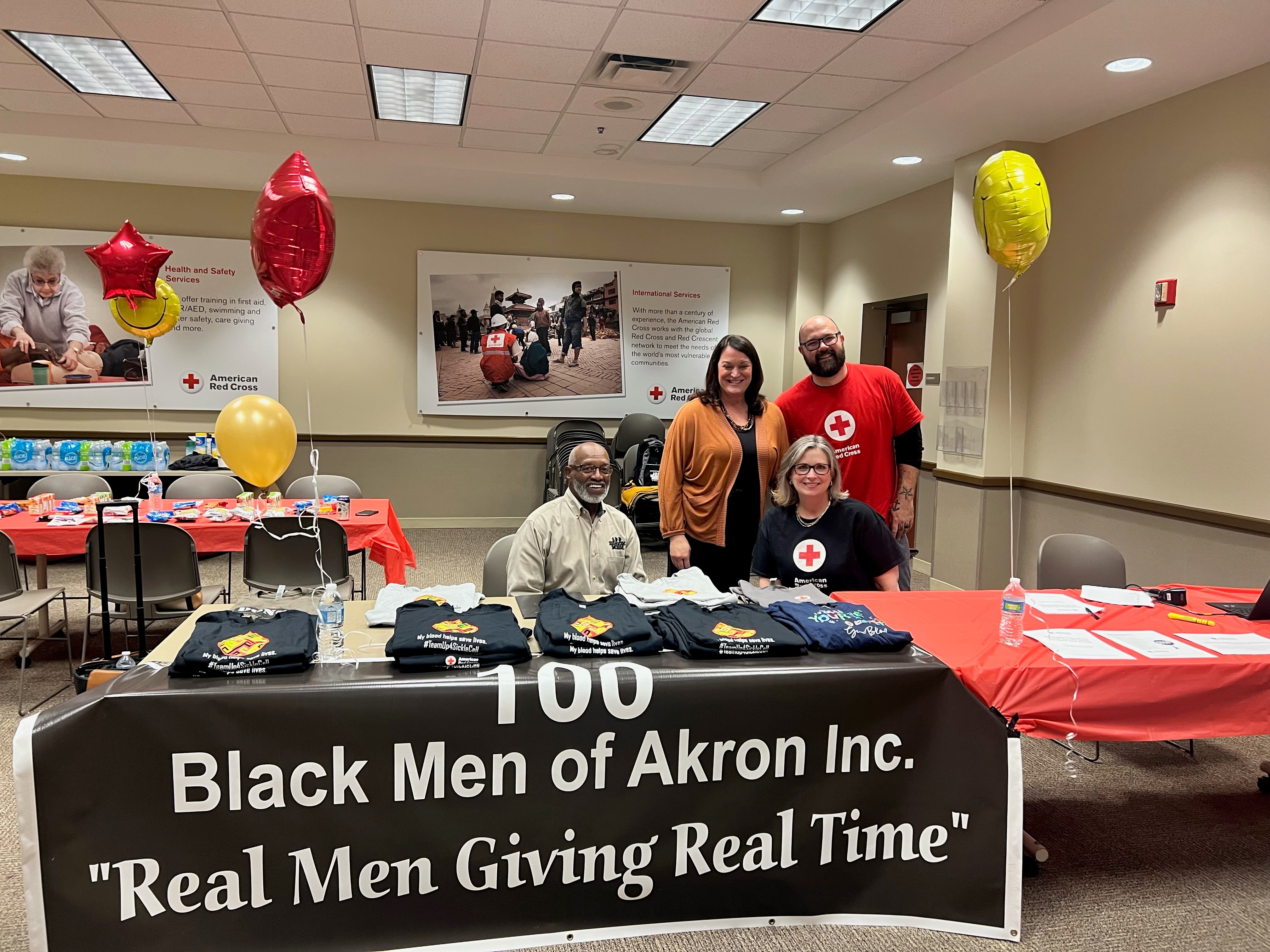
Michael Irby, President of the 100 Black Men of Akron, Rachel D’Attoma, Executive Director
Greater Akron and The Mahoning Valley, Ryan Lang, Red Cross board member and volunteer, Amy Cole, Red Cross board member and volunteer

People with sickle cell disease may need as many as 100 units of blood each year. Blood donations could help alleviate the symptoms of someone living with sickle cell disease, or even help save their life.

On Thursday, September 28th , the organization 100 Black Men of Akron hosted a drive at the headquarters of the Red Cross of Greater Akron and the Mahoning Valley. Michael Irby, President of the local organization, said hosting the blood drive fits with the national group’s mission.

Michael Irby, President of 100 Black Men of Akron with Charles Brown, Red Cross board member and Deputy Mayor of Akron, (retd.)

“Being out in the community, not just mentoring but partnering is important to us,” he said. “Blood drives fit right into our narrative of health and well-being.”

Michael said hosting the blood drive was especially important, not just because September is Sickle Cell Awareness Month, but also because of the shortage of blood nationwide.

The American Red Cross declared a national blood shortage on Sept. 11, citing a critically low blood supply level that dropped nearly 25% since early August.

When supplies are low it can often take weeks for inventories to rebound. The Red Cross estimates that 10,000 additional blood products must be collected each week over the next month for the blood supply to reach sufficient levels and meet hospital and patient needs.

On Friday, September 29th , the Akron Public Schools and Delta Sigma Theta Akron Alumnae Chapter and the Active Chapter at the University of Akron scheduled a blood drive at the Akron Public schools board office. And on Saturday, September 30th, a blood drive sponsored by the Akron National Panhellenic Council was scheduled at the Greater Akron and the Mahoning Valley Chapter headquarters. It’s the second blood drive for sickle cell awareness hosted by the group, following an initial blood drive last June.

If you feel healthy and well, please consider scheduling a blood donation by visiting redcrossblood.org, or by calling 1-800-RED CROSS (1-800-733-2767.) You can also schedule an appointment on the Red Cross blood donor app.

Donors of all blood types are urgently needed, and there is an emergency need for platelet donors and type O blood donors to make an appointment to give now to ensure patients across the country continue receiving critical medical care. And for people with sickle cell disease, blood from people of the same race or similar ethnicity is important in ensuring the best transfusion results, with the least potential reaction.

Posted by Ryan Lang, Red Cross board member and volunteer

An apprehensive volunteer turned regular blood donor: How Ashley Hopkins discovered just how special her blood is

By Ryan Lang, American Red Cross board member and volunteer

More than 20 years ago, if you’d asked Ashley Hopkins about donating blood, you may have gotten a cringe coupled with a shake of the head. While she’d grown up around blood donors and blood drives (her father was a firefighter, now fire captain), donating herself was never really an option.

Ashley Hopkins, American Red Cross board member, volunteer and blood donor

“Back then I had a crazy fear of not even needles, but needles taking blood out — it just freaked me out so I never did it,” Ashley said. 

So how did someone with a healthy fear of the blood donation process wind up a volunteer for the American Red Cross Blood Services and a regular donor? 

“I went to volunteermatch.org and put in my zip code, and (blood services) came up as a flexible option with weekend availability.” So despite Ashley’s apprehensions, it was a perfect match, and as she’d soon find out, even more perfect than she’d initially thought. 

Ashley started out working weekend blood drives. “I did a background check and then shadowed someone for a couple of blood drives and then I was on my own,” she said, noting that back in 2012 things were “a little bit different.” 

At one of those blood drives at the Canfield fair (Ashley’s favorite blood drive), she was working a few days in a row with one specific blood rep who asked her why she’d never donated before.

“I don’t know, it just seemed kinda scary,” Ashley replied. But that same day she decided to roll up her sleeve and donate — on the bus at the fair, which Ashley highly recommends. “It is heaven,” she advocated. 

When you donate blood, the Red Cross tests your blood. And that’s when Ashley found out how special hers was. “I did not know that they were testing for a specific allele (genetic information present in your DNA) in your blood that is an antibody.” After donating Ashley got an email saying that her blood was CMV negative, which is quite rare. 

Red Cross board member and volunteer Lou Joseph with Ashley Hopkins

From RedCross.org: CMV is generally harmless to adults but can be fatal to babies. For this reason, babies needing transfusions as part of their medical care should only receive blood from donors who have not been exposed to CMV (CMV negative).

And being O-Positive, Ashley’s blood is even more special, as she’s compatible with roughly 80 percent of people who need blood! Even more of a reason for her to donate regularly — every 56 days, if she can. 

When asked what she’d say to someone who is apprehensive about donating for the first time, especially someone who is nervous or scared, Ashley simply said, “Volunteer at a blood drive!” She said seeing it happen and helping with the process helped her overcome her fear of not just needles, but the whole process.

To find a blood drive near you, CLICK HERE. To learn about volunteer opportunities with the Red Cross, CLICK HERE.

Edited by Glenda Bogar, American Red Cross volunteer

Raising awareness in Akron for patients with sickle cell disease

When patients living with sickle cell disease face a sickle cell crisis, blood transfusions can make a lifesaving difference. That’s why the Akron National Panhellenic Council partnered recently with the American Red Cross to grow the number of blood donors who are Black to help patients with sickle cell disease, the most common inherited blood disorder in the U.S.

28 donations were collected at the Akron NPHC blood drive on Saturday, June 23, to help raise awareness for patients living with the disease. Nine sororities and fraternities took park in the drive.

Jasina Chapman, first-time blood donor and organizer of the Akron NPHC blood drive for sickle cell awareness

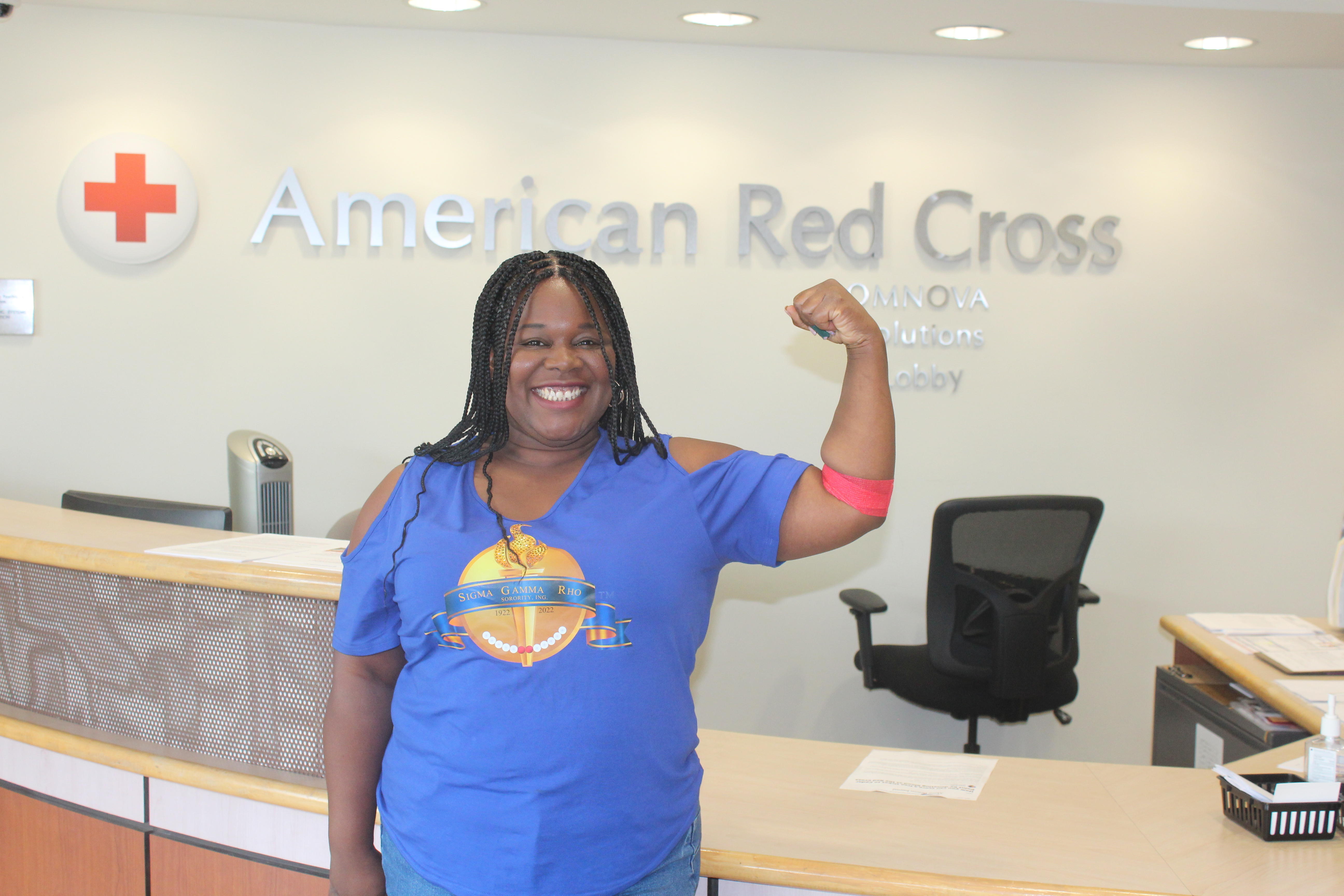
“We mobilized all of our groups to get them to either donate or volunteer,” said Jasina Chapman, who donated blood for the first time at the drive. As the Community Service Chairperson for the Eta Delta Sigma Chapter of Sigma Gamma Rho Sorority, Inc. and the Akron NPHC, she helped organize the blood drive.

“We are African American leaders in our community,” she said. “We need to activate African Americans to donate blood.”

More than 100,000 people live with sickle cell disease nationwide, and the majority of patients are of African descent. The disease distorts soft, round blood cells and turns them hard and crescent-shaped, which can cause extreme pain. When hardened, the cells can get caught in blood vessels, potentially leading to stroke and organ failure. Blood transfusions are often used in treatment, and many individuals who are Black have distinct markers on their red blood cells that make their blood donations the most compatible match for helping patients with sickle cell disease. One in three African American blood donors is a match for people with sickle cell disease.

Christa Nuru, one of 28 donors at the Akron NPHC blood drive

How to donate blood:
Simply download the American Red Cross Blood Donor App, visit RedCrossBlood.org, call 1-800-RED CROSS (1-800-733-2767) or enable the Blood Donor Skill on any Alexa Echo device to make an appointment or for more information. All blood types are needed to ensure a reliable supply for patients. A blood donor card or driver’s license or two other forms of identification are required at check-in. Individuals who are 17 years of age in most states (16 with parental consent where allowed by state law), weigh at least 110 pounds and are in generally good health may be eligible to donate blood. High school students and other donors 18 years of age and younger also have to meet certain height and weight requirements.

Blood and platelet donors can save time at their next donation by using RapidPass ® to complete their pre-donation reading and health history questionnaire online, on the day of their donation, before arriving at the blood drive. To get started, follow the instructions at RedCrossBlood.org/RapidPass or use the Blood Donor App.

Why am I a blood donor? Why not?

A dedicated donor reflects on World Blood Donor Day

By Doug Bardwell, American Red Cross volunteer

As I was asked to write this article, I tried to remember back when I made my first donation, some 56 units and 26 years ago. At the time, I was working in Terminal Tower, and I decided to give when a co- worker said something as simple as, “Hey, I’m going over to donate blood. Want to come along?”

Doug Bardwell

I’m sure I asked about qualifications, but he assured me that they’d give me a quick physical check and make sure I was able to donate. That’s all it took, and I was on my way to becoming a blood donor. “Why not?”


The blood donor center was set up in an unoccupied office space in Tower City Center. I was actually amazed at how quick it was to make my donation. No drama, just a pint of blood lighter when I left and a sticker to show I had donated.

Outta sight – outta mind

Nobody asked again until 2003, right after the Invasion of Iraq. While having a discussion about the war with a friend, he said that he had heard someone saying the only thing we could do to help our troops was to donate blood or donate money.

With a growing family, I had more of the former than the latter, so I checked around to see where and when the closest donation site would be opening. Donation number two was scheduled, but this time, someone at the Red Cross site asked about how often I donated. They made mention of the idea of donating around Christmas each year as a way to give someone else a gift that might save a life but cost me nothing. That sounded like a great idea, so I put a yearly note on my Day-Timer calendar for each December.

You can do more, you know?

It was another conversation with a Red Cross worker that finally spurred me to do more when they said, “You know, you can donate every eight weeks, don’t you?” Well, no, I guess I didn’t, but that started it rolling, trying to donate as frequently as my schedule would permit.

I also realized at that time that if I hadn’t been asked by someone else to go the first time, I might have never donated at all. I then started talking about donations to family members and other friends.

I do the coming events A/V screens in our church’s foyer and lobby, so I started making sure that all upcoming blood drives were advertised on our screens each time they were scheduled. Posting on social media, I’d mention the date and time with a “Won’t you join me next Tuesday?” type message.

So, I’ll end with the same message that started me – “Hey, want to come along?” There are dozens of locations available each week. It’s honestly easy to do, and you could save as many as three lives each time you donate.

Posted by Ryan Lang, Red Cross board member and volunteer

A legacy of giving

By J.D. Brink, American Red Cross volunteer

I first gave blood because my father had given.

He gave because my sister had leukemia.

He may have given blood before that, but I was too young to know. On Labor Day 1986, my sister Ashley was diagnosed with leukemia at St. Vincent’s Medical Center in Toledo. She was three years old at the time. I was not quite ten.

Ashley and David Brink

Leukemia is a cancer of the bone marrow. Since the bone marrow is where blood cells are manufactured, patients with leukemia have a severe lack of them. Red blood cells deliver oxygen throughout the body. White blood cells fight infections. Platelets stick together to form blood clots so we don’t bleed to death. For those with leukemia, these are all in tragically short supply.

I don’t remember a lot from that time. But I do remember her smile, her dancing, her wonderful personality. I think most of my mental images of Ashley come from pictures and home movies. And in the vast majority of them, Ashley is bald. A smiling, beautiful, three- and four-year old girl with no hair. Her hair loss was caused by the chemotherapy used to treat her cancer. Not only did it take hair, it killed her blood cells too. Because of this, Ashley received many blood transfusions. My dad’s blood was not compatible, so he gave so that others could get what they needed.

Ashley and David Brink

I have retained some memories of my own from that time. The handmade sign that hung in our mudroom, just inside the backdoor, warning of every one of Ashley’s low cell counts, asking them to take their shoes off and minimize germs coming into the house. Another was a big handwritten list of rules for my brother and I from Grandma Brink, taped to the closet door. Guidance when Ashley and our mom spent weeks or months at a children’s hospital in Wisconsin. I remember my Uncle Pork (not the name on his birth certificate) staying with us when both parents were there. And I remember all of us staying at the Milwaukee Ronald McDonald House, which is a wonderful charity that supplies a place for families to live while their children are hospitalized away from home. We even spent a Christmas there.

Ashley had a bone marrow transplant on Halloween, 1987. Since all the nurses were in costume, she insisted on dressing as a witch that day, too.

She passed away January 15, 1988. She was only four years old. Her light shined amazingly bright for someone so young with so much pain in her life.

I’ve had a good cry writing this article, reliving memories that had long been forgotten. It feels good.

My father, David Brink, passed away September 20, 2021. Cancer was a factor. My grandma’s list of rules was still on the closet door when we cleared out his house. In his lifetime, he’d donated gallons of blood. I think it was nine gallons. Maybe twelve? (We know how unreliable my memory is.) He signed up to be a bone marrow donor, too, but was never matched for it. But he would have done it, gladly.

I started donating blood as soon as I was legally able, at 18. My first time was in the high school gym, during my school day.

I give because of everything you’ve just read. So did my dad. I hope my son will someday, too.

If you’d like to make an appointment to donate blood or platelets, please visit redcrossblood.org or call 800-RED CROSS.


https://leukemiarf.org/leukemia/statistics/
https://my.clevelandclinic.org/health/diseases/4365-leukemia

Posted by Ryan Lang, Red Cross board member and volunteer

Plea for blood donors who are Black to give during Black History Month

Donors essential for helping patients with sickle cell disease

By Sabrina Spikes, American Red Cross Blood Donor Recruitment Manager

Sickle Cell disease is the most common genetic blood disease in the U.S., affecting about 100,000 people—primarily affecting Black and African American individuals. Though there is no widely available cure, the Red Cross supports one of the most critical sickle treatments of all—blood transfusions. For many patients, a close blood type match is essential and is found in donors of the same race or similar ethnicity.

Blood donor Bridget C. Miller Harper at the 2021 Cleveland Browns blood drive

Blood transfusions from individuals of the same race or similar ethnicity and blood type are the most effective way to help patients experiencing a sickle cell crisis. Since the majority of people with sickle cell are of African descent, blood donations from Black individuals are essential in helping those suffering from this disease.

When provided blood from a donor of similar race or ethnicity, patients have fewer chances of complications. In the donor recruitment department here at Red Cross, we encourage individuals in the Black community to host blood drives and give blood. By collaborating with our community partners, we also provide and encourage blood donation education to increase the likelihood of a successful blood donation.

Blood donor Keith Lofton of Olmsted Falls donated in Rocky River in 2022

While working with community organizations, I have talked to many persons with sickle cell disease. They report experiencing anemia (a shortage of red blood cells), fatigue and severe pain crises. Often the only treatment available to alleviate this pain is blood transfusion. Some individuals with sickle cell disease can require up to 100 pints of blood per year. This makes minority blood donation critical.

Donating blood can make a difference in the lives of patients battling sickle cell disease, but also cancer, and other chronic illnesses. When we increase the number of blood donors who are Black, we diversify the blood supply – a critical step to improving health and wellness in the community. Together, we can raise awareness of the impact and need by hosting a blood drive or visiting redcrossblood.org to sign up to donate at a blood drive in your community.

Posted by Ryan Lang, American Red Cross board member and volunteer

No more donor deferrals related to ‘mad cow’ concerns

John Dowell, blood donor

By EILENE E. GUY, American Red Cross volunteer

During this National Blood Donor Month, I’d like to salute American Red Cross blood donor John Dowell, even though he out-ranks me.

John, who makes his home in Lakewood, finished his service in the U.S. Air Force as a senior airman/sergeant. When he returned to civilian life, he tried to donate blood but couldn’t because he had been at RAF Upper Heyford near Oxford, England, from March 1981 to March 1983.

For decades, the U.S. Food and Drug Administration banned blood donations from folks who had spent time in certain European countries during the 1980s and ‘90s, to prevent transmission of a deadly brain infection commonly known as “mad cow disease.”

The Red Cross, of course, respected that ban, which meant turning away potentially hundreds of thousands of donors, including many in the military community who had served overseas.

Last year, the FDA lifted the final section of its “mad cow” ban after finding there had been no reported cases of the brain disease associated with time spent in the United Kingdom, France and Ireland.

“As soon as I heard about it (lifting of the ban), I was right down there to donate the next day,” John said.

John comes from a family of dedicated blood donors – mom, dad and sister – so he started donating when he was in high school. “I was just a couple of pints short of a gallon when I went into the air force,” he said.

John Dowell donating blood 2022

“I believe in it. It’s important to have that spare blood on the shelf,” he said. “I don’t try to recruit people – if you want to donate, fine. If not, I’ve got your back,” he added with a chuckle.

But John is active in a couple of Facebook groups populated by the military community. When he posted about the lifting of the “mad cow” donor ban, “I got a big response, an overwhelming response. ‘Hey, that’s great to know. Thanks for putting out the word’,” his Facebook friends replied.

So, I want to salute Sgt. John Dowell for his service, in uniform and as a civilian, doing his bit to be sure there’s “blood on the shelf” for those who need a lifesaving transfusion.

If you, or someone you know – military or civilian – has been deferred from giving blood because of the “mad cow” (variant Creutzfeldt-Jakob Disease) criteria, you can contact the Red Cross Donor and Client Support Center at 1-866-236-3276 for more information.

During National Blood Donor Month, please consider joining the ranks of folks, young and old, who serve their country in a profound way. I salute you.

To find a blood drive near you, go to http://www.redcrossblood.org or call 1-800-REDCROSS.

Posted by Ryan Lang, American Red Cross volunteer and board member

This is the way to start a New Year

By Doug Bardwell, Red Cross volunteer

If this were a typical January, we’d still be talking about how difficult it is to maintain New Year’s resolutions, how The Ohio State Buckeyes coulda/shoulda won the NCAA College Football National Championship, and who’s going to make it to the Super Bowl. (Spoiler alert – not the Browns.)

January is also National Blood Donor Month, celebrating all those who volunteer to donate blood and platelets to help save lives. But due to recent weather events, those precious donors are even more critical than ever.

Approximately 10 Red Cross blood drives across Northern Ohio were canceled due to extreme weather during the week of Christmas in December. These cancellations resulted in a shortfall of more than 260 blood donations.  Many more blood drives were canceled elsewhere across the country due to the weather, resulting in even more potential donations going uncollected.

Christy Peters, blood donor and Regional Communications Manager with the American Red Cross

This isn’t a typical January

Instead, our thoughts and prayers tonight were centered on those on the west coast. Four years ago this week, I volunteered with the Red Cross for the horrific Paradise fire outside Chico, California. It was so dry there that the fires spread faster than firefighters could manage, and there wasn’t enough water to save the town.

Now it’s too much water, as California braces for repeated ‘atmospheric rivers’ and ‘bomb cyclones,’ where 10 percent of the US population is under severe storm advisories. Think about that – 10% of our entire country is in fear of weather catastrophes, from flooding to sinkholes to landslides.

Red Cross workers outside a shelter in Northern California

For the Red Cross, many more blood drives could be canceled over the next week as those gigantic rain events cross the state and people try to find safe roads to escape the floodwaters.

But the need doesn’t stop

Winter is typically one of the most challenging times to collect blood products, even without the insane weather. So, now would be an ideal time to make a New Year’s resolution that can save up to three lives with each of your donations. A typical whole blood donation takes less than 30 minutes.

Donors of all types are needed, particularly type O donors, the most needed blood type by hospitals for emergency surgeries. Statistics show that one in seven patients entering a hospital needs a blood transfusion, yet only 3% of Americans actually donate.

Now’s the time

Whether you are a first-timer or a returning hero, everyone who donates before January 31 will be automatically entered to win a trip for two to Super Bowl LVII in Arizona, with pre-game activities, game day tickets, airfare, three-night hotel accommodations, and $500 gift card.

Join a winning team – make a blood or platelet donation. Book now using the Red Cross Blood Donor App, visiting RedCrossBlood.org, or calling 1-800-RED CROSS (1-800-733-2767).

One of the greatest gifts you can give is your time – Resolve to volunteer today

Jack Higley has been volunteering for more than 60 years

By Eilene E. Guy, American Red Cross volunteer

Still looking for a last-minute gift in honor of that hard-to-please person? Or thinking ahead to a New Year’s resolution that will really mean something?

How about something only you can give? How about the gift of your time?

American Red Cross volunteers give their precious time every time they help a family displaced by a home fire, donate blood or take a Red Cross first aid/CPR/AED course so they can save a life in an emergency.

Jack Higley, American Red Cross volunteer

Jack Higley of Aurora, Ohio, has racked up an uncountable number of hours over the span of 60-some years of volunteering with the Red Cross. He first stepped up when a fraternity brother was in a serious accident and urgently needed blood. “Back then, it was direct donation,” he recalled. “They took it out of my arm and right into him.” The experience inspired his fraternity to start scheduling regular blood drives.

Four years later, he started teaching Red Cross life guarding classes at a YMCA. Then, he went to donate blood in Madison, where he taught high school government. W; when the staff learned he had experience organizing blood drives, they asked for his help. He’s been at it ever since: he’s credited with donating just shy of 40 gallons of life-saving blood and for organizing countless drives.

“It makes me feel good,” he said, adding, “There’s always a need. My dad had 17 heart attacks and he used a lot of blood for the surgeries he had – stents, by-passes.

“People live because somebody donated.”

Although Jack can no longer donate because of health conditions, he enjoys staffing blood drives as a blood donor ambassador. “I like to be around the canteen (the refreshment area where blood donors are invited to enjoy juice, water and cookies immediately following their donation). I can relate to the people, talk to them. Some of them donate faithfully every two months. They’re my people.

“Jack’s Red Cross experience is an example of the generosity of spirit our volunteers show every day,” said Susan Gordos, who coordinates volunteers in support of blood drives and blood services across Ohio. “We have so many opportunities for people to give the gift of their time, to be sure life-saving blood is there when it’s needed.”

So, how about giving the gift of your time? The Red Cross of northern Ohio is always looking for blood donor ambassadors and blood transportation specialists.

As an ambassador, you’re the friendly face that greets donors, helps them sign in , and answers questions. You might even staff the canteen, like Jack, to chat with donors after they give blood.

Watch this video to hear from others about why they’ve volunteered in this role. Training is free, but the hospitality you provide is priceless.

Or you might find that being a blood transportation specialist is a good fit. These folks are a critical link, driving blood products to hospitals.

If you have a valid state driver’s license and at least three years of licensed driving experience, you are eligible to volunteer as a blood transportation specialist. You can choose regular routes, stand-by emergency deliveries or both. It’s a great opportunity for couples, friends or family members.

As Jack said, “Many of us are going to need blood, unfortunately. If you need it, the Red Cross has it, but everybody has to work together to make it happen.”

To take the first step of giving the gift of time, visit www.redcross.org/volunteertoday.

Have a happy, healthy holiday season. And may you have a rewarding 2023 – perhaps as a new Red Cross volunteer.

Edited by Glenda Bogar, Red Cross volunteer
Posted by Ryan Lang, Red Cross board member and volunteer