
By Ryan Lang, American Red Cross
For Nasir Ahmad, deployment was nothing new. As a retired member of the United States Air Force, Nasir had been on multiple deployments. But his most recent trip overseas with the American Red Cross Service to the Armed Forces was new territory. Previously, Nasir was carrying out his mission as a service member. This time, he’d be providing a service to other service members along with his Red Cross team.

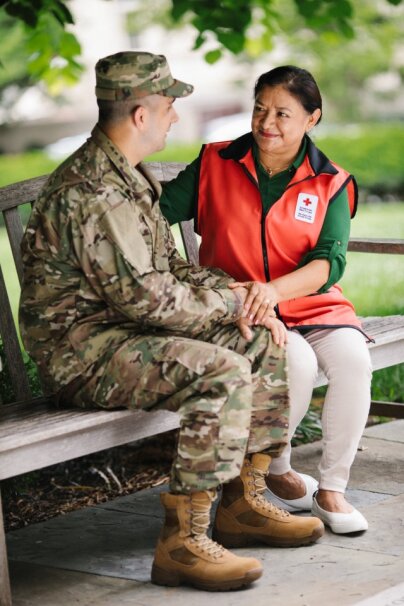
The Service to the Armed Forces (SAF) branch of the Red Cross focuses on active service members, veterans, and their families, providing various humanitarian services and resources. Nasir explains that his primary focus is on emergency communication, which looks different in Northern Ohio compared to in Iraq, where Nasir was recently deployed for six months.
“You become directly involved in the process (of emergency communication) when you’re overseas,” Nasir said. At home, in the Northern Ohio Region, most of the work Nasir and the SAF team does is over the phone, whereas in Iraq, it’s often face to face. “It’s just different when your overseas and the service member has a conversation with you,” Nasir explained. He spoke of one example where a female service member was having a personal emergency, on the base, at 9 o’clock one night. As he and the rest of the team were settling down for the evening, there was someone who needed direct care. That is the work of SAF in action.
“When I was in the Air Force,” Nasir, who was an aircraft mechanic, said, “we had that mission, that focus, and when you go with your squadron, there’s nothing else. Now, with the Red Cross, I get to focus on the service member and assisting them and being there for them, and I’m really enjoying this mission.”

When asked whether his experience in the Air Force prepared him for deployment with the Red Cross, Nasir said it did because of his shared connection with the service members he is there to help. “But don’t feel like you have to be a service member of former service member to do this,” Nasir said. “It’s really a beautiful thing to not have that connection and still be willing to go over there and assist and be there and support our service members.”
There are all types of SAF volunteers. Many who have prior military backgrounds, others who have family members who have served, but also there are those who have no background or personal connection to the military. “I’ve seen some volunteers who deploy with no connection,” Nasir said. “That’s why I commend them so highly because at least I had my buddies with me.”
But in preparing for a deployment with the Red Cross SAF team, Nasir explains that is when relationships are built and friendships are formed, often life-long friendships. “We form our own team,” Nasir said, “and it reminded me of going with my unit.”

The team Nasir deployed with, “Team 55,” had only met online prior to their case work and other Red Cross training at Camp Atterbury, in Edinburgh, Indiana. “In the same room it was different,” Nasir said. “We had Red Crossers who had deployed before… and they were absolutely essential.” Even with his previous military experience, specifically deploying overseas, Nasir said he approached his training as a first timer. “They were so valuable to my experience. It being my first time overseas with the Red Cross… I leaned on the Red Crossers who had done this before. Those were the ones who were leading the way.”
To hear more of Nasir’s story, click here to listen to our Be A Hero podcast. To find out more about volunteer opportunities with the Red Cross Service to the Armed Forces, click here.

 NOHredcross