Virtual Volunteers Provide Very Real Services

By EILENE E. GUY American Red Cross Volunteer

In the wake of an unprecedented number of large disasters last year, the plight of hundreds of thousands of displaced people touched the hearts of Americans near and far.

Dozens of American Red Cross disaster responders from Northeast Ohio answered the call to help, but not all of them left the Buckeye State.

“I couldn’t see going all the way to another state to sit in a cubicle and talk to people on the phone when I could do it just as well from right here,” said Red Cross volunteer Charles “Charlie” Emick of Mount Eaton.

Charlie is an experienced disaster caseworker who helps Wooster-area individuals and families after a home fire or other local emergency. He put that experience to use last year for flood victims a thousand miles away.

“People don’t realize I’m not right there,” he said. “A lot of times, they’re just tickled to death to talk to someone who cares about what they’ve been through.

“I had one lady (on the phone), she wasn’t injured, but she had to wade out through water up to her elbows and she saw a water moccasin swimming toward her. The more she tried to swish it away, the more it came toward her. She finally got to a shallow spot and got out of the water and she said all she could do was scream.

“I told her, I’m afraid of snakes too,” Charlie said with a chuckle.

“Some clients expect that you can put things back the way they were before,” he observed. “But with others, it’s like you’re talking to a neighbor across the street. They’re just so glad someone cares.”

Charlie uses computer data bases to screen clients for eligibility for the limited financial assistance Red Cross can give if victims don’t qualify for federal assistance through FEMA.

He can also connect them with Red Cross health and mental health services as well as local resources listed in the national computer-based Client Assistance Network.

Sandy Perry-Johnson of Warren is another member of the Red Cross “virtual volunteer” team.

“I’m in awe of people who can leave home and go to help, but I can’t do that right now because of my family responsibilities here,” she said.

For the past year, Sandy has been helping Youngstown-area disaster victims figure out what they need and connecting them with resources to meet those needs. She knows that recovery from a disaster can be a confusing, emotionally draining and complicated process.

She appreciates that the Red Cross gives her a way to help, long-distance. “Now I can do casework with people from Louisiana right from my home,” she said following the disastrous flooding there.

“During our response in Louisiana (last year), we committed a great amount of resources to designing and implementing a virtual casework process that enables volunteers to remotely assist those in the disaster area,” said Timothy J. O’Toole, Red Cross regional disaster officer for northeast Ohio.

“Our use of virtual volunteers opens up opportunities for a whole lot more people to help with disaster relief,” he explained. “Plus it lets us provide the most services for the money we spend, making the best use of our donated dollars.”

Virtual volunteers supplemented the work of more than 4,200 Red Cross responders in Louisiana, who, in one month, served more than a million meals and snacks, operated shelters that provided some 72,000 overnight stays, and distributed more than 679,000 relief supplies such as bottled water, insect repellant, cleaning supplies and bleach.

Meanwhile, Crystal Wagner of Akron put her 15 years of disaster experience to work to “virtually” help Red Crossers who actually went to Louisiana. She considers herself a “lifeline” for volunteers who run into roadblocks on the way.

“We had so many brand new volunteers who have no clue what to expect,” she said. It’s a surprise to many that if they run into a problem en route, experienced volunteers like Crystal are just a phone call away, day or night.

“For example, I had this poor guy from Pennsylvania who was headed for Baton Rouge. When he got to Atlanta, there was no connection to Baton Rouge, so they put him on a plane to New Orleans,” she recounted. To make a long story short, Crystal spent several hours sorting out transportation and housing snafus for the first-time volunteer so that he could fulfill his mission – to help Louisiana flood victims.

Crystal knows how to navigate the hurdles of deployment: She’s been all over the country on 69 disasters herself. But now, at age 70 with an elderly mother to look after at home, she’s enthusiastic about being part of the Red Cross disaster response “virtually.”

She fondly recalls her own first deployment, to New York City after 9/11. “I had only been on a plane once, I had never been to New York City… Everything that could go wrong did,” she said. But she stayed for five weeks and learned two lessons she cherishes.

“They needed me,” she said. “And I found out there’s nothing in this world I can’t handle.”

Now Crystal doesn’t have to leave home to experience the joy of helping those who need her.

During the month of March, which has been designated Red Cross Month for the past 70 years, we salute the dedicated volunteers who help fulfill the Red Cross mission.

To find out more about becoming a Red Cross disaster volunteer, contact your local Red Cross chapter or go to redcross.org/neo and click on the “volunteer” tab.

The Red Cross relies on the generosity of the American public for its funding. To help people affected by disasters big and small, visit redcross.org, call 1-800-REDCROSS, or text the words RED CROSS to 90999 to a make a $10 donation. Designated donations are the first dollars used to support Red Cross response efforts. If costs exceed designated donations, Red Cross Disaster Relief funds will be used to cover the difference.

Donations enable the Red Cross to prepare for, respond to and help people recover from disasters near and far.

Sandusky Women Answer the Call

Looking back 100 years at the Lake Erie / Heartlands Chapter

By Doug Bardwell, American Red Cross Volunteer

img_2181

From the Centennial Mound in Washington Park, Sandusky

In March 1916, as a U.S. expedition of more than 10,000 troops were chasing Pancho Villa back into Mexico, and Company B of the National Guard was being federalized to control our border at El Paso, Texas, the Red Cross Sandusky Chapter was being formed.  Realizing we might also be deploying troops to Europe, the National Office was requesting more and more chapters to join the organization.

By June 1916, fifty women had already expressed interest in joining at a meeting held in the Carnegie Library in Sandusky. They began making “ditty” bags for the men of Company B.  Described in the Sandusky Star-Journal as “…most convenient and attractive little affairs. Fashioned of the familiar khaki, with blue braid binding, and red flannel leaves, they each hold 6 needles, 6 safety pins, 3 darning needles, 2 rows of common pins, a spool each of khaki and white thread, six each of khaki colored and white buttons, and a pair of scissors.”

Saturday, August 19, 1916 at 3:00 p.m., with charter-in-hand, more than one hundred volunteers gathered at G.A.R. Hall in Sandusky to elect officers and directors for this newest Chapter of the American Red Cross. Plans were formulated for their first regular meeting which would take place in October.

At the October meeting, the guest speaker was Miss Elizabeth Perkins, field secretary of the National Red Cross, recently back in the US after serving in hospitals along the French front. She brought a request for “comfort bags” that could be given to the troops in the French hospitals. 50,000 were needed nationally, and it would be a proper project for the new chapter. They were needed by November 15 to be shipped and received in time for Christmas distribution.

Each 9” x 12” bag would contain a pair of socks, a razor or pocket knife, handkerchief, pencil, writing tablet, pipe (no tobacco), harmonica or game (no playing cards), box of hard candy or bouillon cubes, wash clothes, cake of soap, pocket mirror, and a comb or jar of Vaseline. Each bag would have a card included with the name of the donor.

Unfortunately, while the chapter was waiting for its charter, all the dues collected to that point had been sent in to the national office, and the chapter found itself without operating funds. Suggestions were received that the entire Erie County should be included in the chapter, giving them a larger base of members and financial support.

Eventually, the Lake Erie / Heartland Chapter of the Red Cross would expand to what today includes Ashland, Erie, Holmes, Huron, Lorain, Richland and Wayne Counties.  That’s quite an expansion from the original small chapter in Sandusky, so, you could say they certainly took those directions 100 years ago, to heart.

What hasn’t changed, is that the Red Cross can still use more volunteers and more donations. Visit redcross.org/neo to get involved.

March is Red Cross Month

Cleveland Mayor Issues Proclamation; Terminal Tower Bathed in Red

giving_day_thank_you_b_1200x1200_final1We at the American Red Cross are recognizing the country’s everyday heroes during Red Cross Month.
March is Red Cross Month, the perfect time to honor our Red Cross volunteers, blood donors and financial contributors who bring hope to people facing life’s emergencies,” said Mike Parks, CEO, Northeast Ohio Region.  “During Red Cross Month, we thank them for their tremendous support.”

March has been recognized as Red Cross Month for more than 70 years. All of our presidents have designated March as Red Cross Month to recognize how the American Red Cross helps people across the country and around the world.

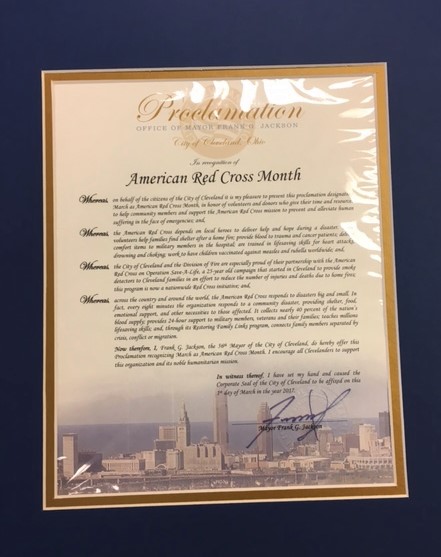
Cleveland Mayor Frank Jackson has issued a proclamation recognizing March as Red Cross Month as well.

mircm-jackson-proclamation

And the iconic Terminal Tower in downtown Cleveland was bathed in red light to mark the start of Red Cross month on March 1st.

facing-forward-1

Volunteers and staff members in Tremont, with the Terminal Tower in the background.  The building was lit in red to recognize March as Red Cross Month.    Photo credit: Cal Pusateri/American Red Cross Volunteer

The Red Cross depends on local heroes to fulfill its mission. Every eight minutes, Red Cross disaster workers respond to a community disaster, providing shelter, food, emotional support and other necessities to those affected. We provide 24-hour support to members of the military, veterans and their families at home and around the world. Nearly 14,000 donations of blood must be collected every day to meet patient needs. We train millions of people in first aid, water safety and other lifesaving skills. And we support the vaccination of children around the globe against measles and rubella.

In fiscal year 2016, the Northeast Ohio Region responded to 967 local emergencies, assisted 1,641 members of the military and their families and trained 64,598 people in lifesaving skills. And people from this area donated 144,089 units of blood.

“It’s easy to become a Red Cross community hero,” said Parks. “Be ready for an emergency by creating a preparedness plan for your home. Test your smoke alarms and tell your neighbors to do the same. Or sign up to be a Red Cross volunteer or make a financial donation.”

More information about how people can support the organization is available on redcross.org/neo. The Red Cross is not a government agency and relies on donations of time, money and blood to do its work. An average of 91 cents of every dollar the Red Cross spends is invested in humanitarian services and programs.


Don’t Be “One of Those” Blood Donors

By Doug Bardwell, American Red Cross Volunteer

I just celebrated my 20th anniversary – 20 years since my first blood donation back on January 21, 1997.  I’ve learned a lot since then, and much of it concerns things I did wrong.  Profit from my mistakes, all made in a relatively short amount of time.

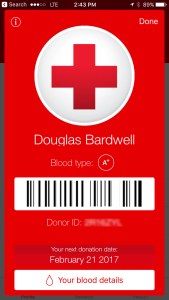
  • While walk-ins are gratefully accommodated, you’re liable to have to wait for an open donation time slot if you haven’t made an appointment. Appointments can easily be made online or with the Red Cross Blood app for your phone.

bloodapp

  • When you are leaving home or office and heading to the donation site, be sure to have your blood donor card or the blood app on your phone. A driver’s license or two other forms of ID could suffice, but without ID, you won’t be allowed to donate. Have your ID ready as you approach the registration table.
  • Drink PLENTY of water and have something nourishing (not fatty) to eat before you donate; BUT, not immediately before you come in. Eating or chewing gum immediately before taking your temperature can cause an incorrect reading and could disqualify or delay you. I recently had a chocolate chip cookie right before donating and it raised my temperature to 99.9 degrees. I then had to wait fifteen minutes while it returned to 98.6. It’s best to have something to eat one-half to one hour before you donate. Also, avoid caffeinated coffee and tea before your appointment.
  • Just like we exercise to keep our bodies in shape, you can pump up your blood’s iron levels by eating an iron-rich diet before donating. A low iron level could keep you from donating.
  • Get a good night’s sleep the night before your donation. Your body rejuvenates your cells while you sleep.
  • Don’t rush. Rushing to get to the donation center can cause stress, which can elevate your blood pressure. Avoid stressful activities.  Breathe, and give yourself time to leisurely get to the donation center. Even if you are a couple minutes late, you’ll be welcomed with open arms.
  • If you’ve got cold or flu symptoms (other than allergies), call (1-800-RED-CROSS) and discuss rescheduling your appointment. You’ll potentially save the trip, and your appointment time can be assigned to someone who walked in without an appointment.
dougdonating

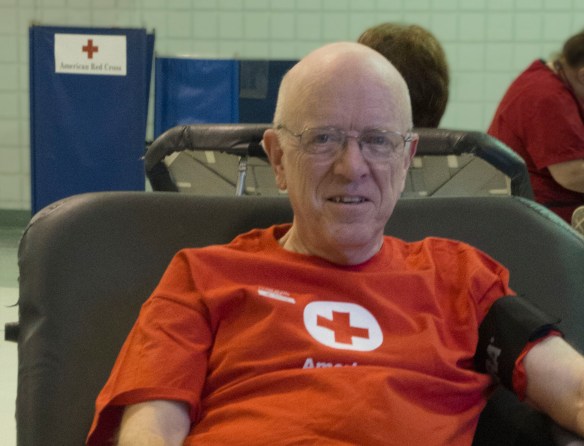
Red Cross Communications Volunteer and long-time blood donor Doug Bardwell

  • Lastly, wear loose clothing with sleeves that can easily be rolled up above the elbow.

Congratulations, you just made sure your donation was a success. But, one last suggestion, don’t try to leave too quickly afterwards.  There are snacks and drinks at that refreshment table in the corner. Pay it a visit. Take some of the time you saved and treat yourself to a snack. It will provide your body with some needed nourishment and you’ll leave feeling better for it.

Don’t forget, the clock is ticking, and you’ll be eligible to donate again before you know it.  Make that appointment today and have another great experience.

Family Grateful for Emergency Military Communications

The message below was sent to a Red Cross volunteer, who provides Service to the Armed Forces:
Thank you soo much for getting my son home with my dad having a massive heartattack whom we were told was not going to make it. Thankfully with all the prayers and support my dad is recovering. The Red Cross is truly a blessing working with the men and woman whom are serving our country. Thank u red Cross for ensuring that my son made it home. I give u a 5 plus rating.
Linking military families during a crisis through Emergency Communications is only part of what we do for members of the military, veterans and their families.  We also link military families to local resources and support services.  We provide training that promotes resiliency and preparedness to help families cope with the challenges of military life. And we support wounded warriors in Veterans Administration (VA) and military hospitals across the nation and around the world, including the Louis Stokes VA Medical Center in Cleveland.
If you are in the military, or have a child serving our country, or are a veteran, download the Hero Care App.  It will connect you to important resources that can help you through both emergency and nonemergency situations.
herocare-app2
For more information, contact Jessica Tischler, Regional Director of Service to the Armed Forces, at 216-426-7525.

Local Artisan Donates the Comfort of Clean to Stark and Muskingum Lakes Comfort Kits

Sometimes all you want is to strip off the day by taking a shower.

comfort-kit-soaps-aubrey-helmuth-miller

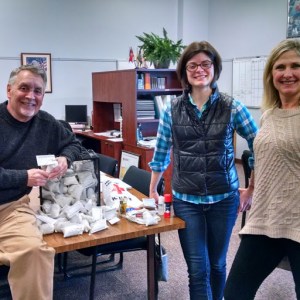
Tim Reichel, Disaster Program Manager, shows off a crate full of REDBUDSUDS shower bars with artisan Aubrey Helmuth Miller and Kim Kroh, Stark and Muskingum Lakes Executive Director. The bars will be included in comfort kits for local disaster clients.

That is especially true for those who experience a disaster such as a home fire.

When Red Cross volunteers respond to the scene, the affected individuals immediate needs are assessed. Will they have access to shelter, food and clothing? Are there any other needs, like eyeglasses or medication, that were lost during the event?

Very often, before volunteers leave, the families will be handed a small bag with “Compliments of the American Red Cross” printed on it. The contents of which can help them begin to feel a little better. These items – shaving cream, razor, toothbrush, shampoo, soap – will help wash away the day so that they can start to focus on their recovery.

Aubrey Helmuth Miller, a Canton-area artisan, wanted to find a way to use her craft to contribute to her community. She took the trimmings of her natural REDBUDSUDS soaps, that would have been discarded as part of the process, and tucked them in to a small muslin bag and brought them to Disaster Program Manager, Tim Reichel at the Stark and Muskingum Lakes Chapter.

While her original intention was to provide clean comfort to those affected by the storms in the southeast, she saw that her soap could make a bigger impact here, in her own community.

Now each family and individual that receives a Red Cross comfort kit, will also receive a satchel of clean comfort courtesy of REDBUDSUDS and Aubrey.

Thank you, Aubrey!

North Randall Residents Receive Help and Hope Following Fire

More than 80 residents of an apartment complex in North Randall received help from Red Cross workers on Tuesday, February 14.

After firefighters responded to an apartment fire at the North Randall Estates, building inspectors had to determine whether it was safe to let residents back in their homes.

Red Cross workers opened a reception center in a Community Room, where waiting residents were given food and comfort.

“They calmed everyone down and walked us through what we need to do,” said resident Ricky Tunstall.  “They were sympathetic to our needs.”

Red Cross volunteers arrived on the scene shortly after the fire was reported mid-morning, and stayed well into the night, determining the needs of the residents, and trying to fill those needs.

Many residents were given immediate financial assistance.  The Red Cross distributed almost $7,000 to help people pay for a hotel room, or to buy food or other necessities.

One resident spent the night in a Red Cross shelter.

4 weeks after the fire, ongoing casework, disaster health services and disaster mental health services were being provided in 23 cases, with the cost of the operation more than $8,300.

On average, the Red Cross responds to three home fires every 24 hours in Northeast Ohio. While all Red Cross disaster assistance is free,  we rely on the generosity of donors to help us provide that assistance for disasters big and small.  Donations to help fund Red Cross disaster relief efforts can be made by calling 1-800-RED CROSS, or by logging onto redcross.org/neo. A text-to-give option is also available.  Text REDCROSS to 90999 to make a $10 donation.

Blood Drive Brings Donors to Landerhaven

The 19th annual Give From the Heart Blood Drive held Tuesday, February 7 at Executive Caterers at Landerhaven was a great success. This drive is one of the largest in the Region and comes at an important time, as the Red Cross is facing a winter blood shortage.

Despite periods of heavy rain and patches of dense fog, more than 570 donors came to give and the blood drive collected 536 pints of blood.

Each pint has the potential to help save three lives.

Our partners at WTAM 1100AM were on-site for live news reports and interviews about the event and the station promoted the drive throughout the day. Cleveland 19 TV also came to the drive to shoot video and ran stories during their newscasts, encouraging donations.landerhaven-3

All presenting donors received a goody bag filled with gifts from sponsors, a $5 Amazon gift card claim code and enjoyed gourmet food courtesy of Executive Caterers.

If you weren’t able to donate at Landerhaven, You can schedule an appointment at the location most convenient to you on the Red Cross Blood App, or by logging onto redcrossblood.org, or by calling 1-800-RED CROSS.

Be sure to watch for the 20th annual Give from the Heart Blood Drive at Landerhaven next year!

First Goal Attained; But the Work Never Ends

(Looking back 100 years at the Stark and Muskingum Lakes Chapter)

By Doug Bardwell, American Red Cross Volunteer

As the nation prepared to celebrate Independence Day, Tuscarawas County was celebrating the formation of their new Red Cross Chapter.  Organized at the beginning of July 1917, the chapter’s initial goal was to raise $30,000 locally.

By this time, the national goal of reaching $100-million had already been attained, but as Red Cross State Secretary D.C. Daugherty explained, “The needs of the Red Cross in doing its great work of mercy are so enormous that every dollar given, no matter how much over the stipulated amount asked, can be used advantageously in its humanitarian mission of relief and succor to suffering humanity, whether its distress be from war, pestilence, famine, flood or fire or any other form of disaster.”

During war time, Daugherty explained that the Red Cross was responsible for maintaining hospitals at the front, base hospitals, convalescent hospitals, as well as hospital ships and hospital trains. In addition, the Red Cross assists Y.M.C.A. recreation camps, extends relief to soldiers’ dependents, and aids the thousands of homeless and helpless victims of war.

Understanding that not only would people abroad be helped, but also the Red Cross would be there for the hometown boys from New Philadelphia, the newly formed chapter was eager to begin doing what it could.  Typical for the time, men formed committees to raise cash donations, and the women began sewing projects to provide hospital supplies.

A workroom was opened in Eagle Hall, above the New Philadelphia City Council offices, for the volunteer women workers. Open four days a week from 9:00 a.m. until 1:00 p.m., the workroom was equipped with sewing machines, tables and chairs. Women were told to bring their own scissors, and they began making hospital supplies and articles of comfort for the soldiers.

Not unlike today, con artists must have been a problem for these early volunteer organizations as well.

On July 3, 1917 a statement was issued in the Daily Times of New Philadelphia, from the national headquarters of the American Red Cross, denouncing the use of chain letters and similar methods of raising money. Members and friends of the Red Cross were urged to neither donate nor assist those fostering such schemes.

Today, you can rest assured that donations made to the Red Cross are well spent. In addition, did you know that the Red Cross now also accepts used automobiles as donations? Learn more at https://neoredcross.org/donate/.

Red Cross Workers

Typical Red Cross workroom during WWI – photo courtesy of CTDA


Operation Save-A-Life Lives Up to its Name, Again and Again

More Lives Saved Across the Country Thanks to Smoke Alarms, Education

159.  That is the number of documented lives saved as of the close of 2016, thanks to the Home Fire Campaign, which the Red Cross rolled out nationwide in 2014.

The campaign is modeled after Operation Save-A-Life, which began as a partnership between the Cleveland Fire Department and the Greater Cleveland Chapter of the Red Cross in 1992.

The 25th anniversary of Operation Save-A Life will be recognized at the 2017 Red Cross Fire and Ice Ball, which takes place on March 25 at the Intercontinental Hotel in Cleveland.
Together with corporations, community groups and other partners, the Red Cross provides residents with valuable fire safety information and installs free smoke alarms in homes where they are needed.32318085516_522639e1c2_z

“Thanks to the tireless work of our volunteers, employees, local fire departments, and other partners in the Home Fire Campaign, today we celebrate 159 documents lives saved,” said Harvey Johnson, Senior Vice President, Disaster Cycle Services.

Partners helping the Red Cross achieve its goal of reducing deaths and injury due to home fires by 25% range from the employees of Lincoln Electric to a group of missionaries from the Akron Stake of the Church of  Jesus Christ of Latter Day Saints.  Eight elders of the  church recently installed 60 alarms in the homes of people in need.

“The group is very dedicated, said Debbie Chitester, Disaster Program Manager for the Summit, Portage, and Medina Counties Chapter.  “I have worked with missionaries on disaster operations across the country. They always come through for us and the people we serve.”

Your group can be a part of Operation Save-A-Life in Northeast Ohio by sponsoring a smoke alarm installation project.  Log onto redcross.org/neoosal, and click on your county to register.

The smoke alarms you install could be the next ones that save a life.