Do you have the skills to save a life?

For National Trauma Awareness Month, consider learning CPR and other lifesaving skills.

By Tim Poe, American Red Cross volunteer.

If someone near you went into cardiac arrest, could you respond? Could you step in and act? Every moment will count, as the chances for survival decrease 7-10% every minute that immediate CPR or use of an automated external defibrillator (AED) is delayed.
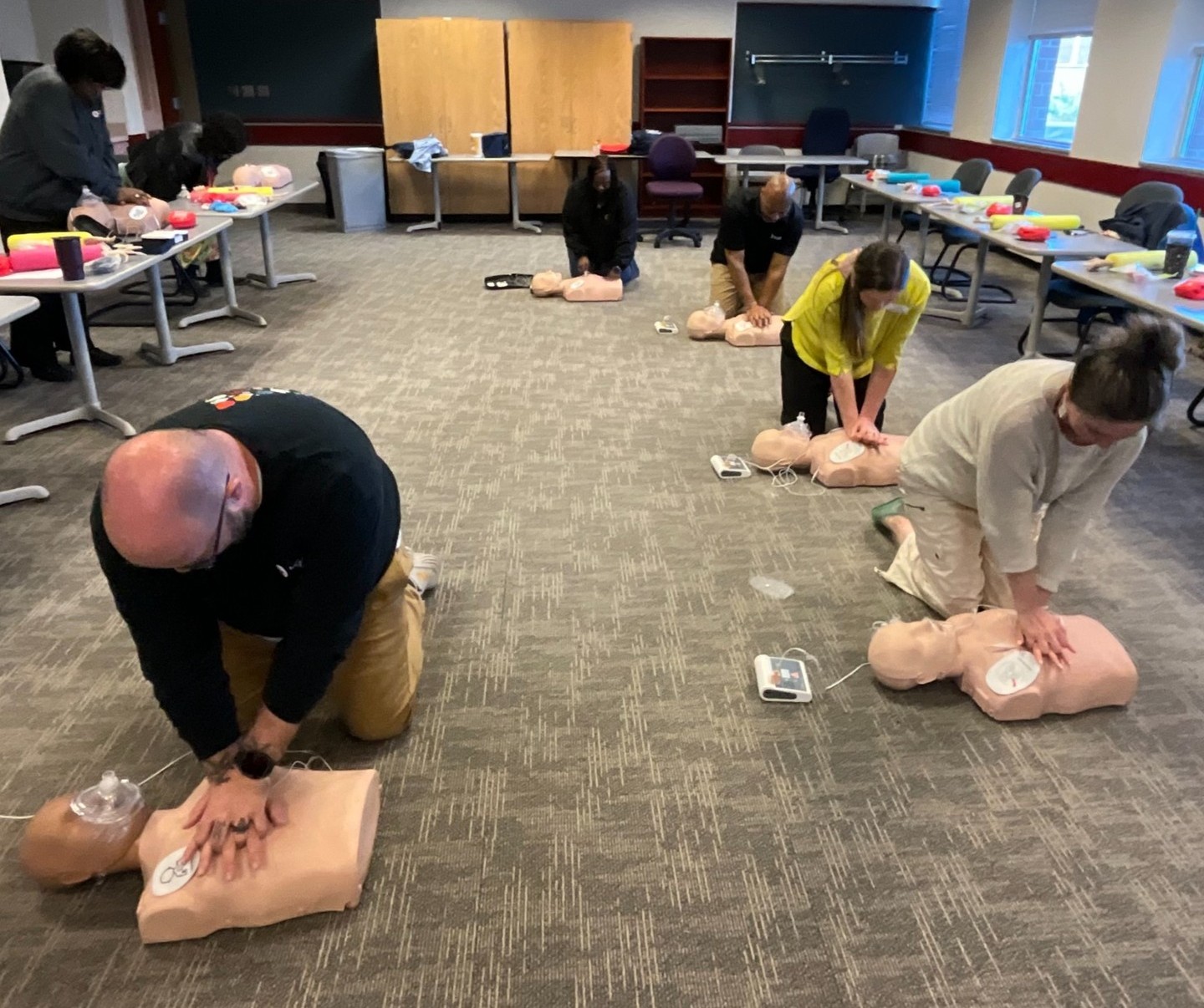
Northern Ohio Region employees taking Adult First Aid / CPR / AED training at the Cleveland office.

This is not a far-fetched scenario. Over 350,000 people in the US suffer cardiac arrest outside of hospitals each year, with a little over 70% happening in the home. Many of the roughly 10% who survive an out-of-hospital cardiac arrest do so because CPR was performed or an AED used within the first few minutes.

High-quality CPR has a significant impact on survival outcomes. In hospitals, survival rates increase to 21%.

May is National Trauma Awareness Month, calling attention to the need to prevent injuries and protect lives. Helping people prepare for, prevent, and respond to life-threatening events is among the American Red Cross’s key services, including classes for CPR and other life-saving skills.

To better understand these classes’ importance, I spoke with Angele Cassiday, who teaches Adult and Pediatric First Aid, CPR, AED, and Babysitting and Child Care. She has taught for 14 years, the last five with the Red Cross.

Angele said, “CPR is a very important skill to know, as cardiac arrest can happen without warning. The most important step is recognizing an emergency and dialing 911. That alone will make a huge difference.”

In some emergencies, however, Angele pointed out that “Too many of us do not know what to do after calling 911.”

“None of us know the odds that someone nearby will go into cardiac arrest, and it can happen without warning in any environment,” Angele said. To illustrate this, she mentioned Damar Hamlin’s cardiac arrest during a football game, as well as Lindsay’s Law, which helps raise awareness of the risks of cardiac arrest in youth athletes.

Several of Angele’s students have used their skills to save lives, from family members to one person’s boss.

For anyone considering taking a CPR, First Aid, or other lifesaving class, Angele highly recommends doing so, including signing up for pediatric classes. “Life is too short,” Angele said. “You need to be able to step in and help somebody whenever you can. Being able to save a life is just so important.”

Angele also recommended getting the Red Cross First Aid app. It is available here or by texting “GETFIRST” to 90999.

Red Cross First Aid/CPR/AED courses will teach you how to perform CPR, help someone who is choking, control bleeding, respond to a heart attack, and more. Classes are offered in several formats, including online, instructor-led classroom, and blended with online content and an in-person skills session. On-site training is available for groups.

You can find more information on taking a CPR and other classes at redcross.org/take-a-class. In addition, Information on Hands-Only CPR in Eight Simple Steps is available here.

Blood donations: Who benefits?

By Samantha Pudelski, American Red Cross volunteer

We’ve all seen the American Red Cross logo at one time or another in our lives. Many of us have seen it promoting a local blood donation drive being held that day as we drove down the road. We all know that blood is needed for us to live–but we may not always think of how many different individuals rely on blood donations, until we or someone we know needs it. In fact, in Northern Ohio the Red Cross provides blood for patients in more than 70 local hospitals in Cleveland, Akron, Youngstown and Toledo.

Platelet donors Al Whitney of Avon Lake and Vinton Smith of Gettysburg, PA

Who are some of the people who rely on blood donations? Below are just a few:

Cancer Patients

Cancer patients may need blood transfusions to implement platelets back into the body after treatments such as chemo or radiation therapy. Certain cancers can also affect a patient’s ability to produce their own platelets.

Trauma Patients

When a patient comes into an emergency department with a trauma injury and there’s no time to check the patient’s blood type, emergency providers use type O negative red blood cells and type AB plasma. O negative blood cells and AB plasma can be transfused into any patient, regardless of blood type. However, less than 7 percent of the population has type O negative blood, and only about 4 percent have type AB Blood. A constant flow of blood donors who have these blood types are critical to keep up with hospital demand, and to help emergency providers save lives.

Glinda Dames-Fincher, of Mayfield Heights has lived with sickle cell disease for more than 60 years and receives regular red cell exchanges as part of her treatment.

Sickle Cell Patients

Sickle cell disease affects about 100,000 people in the United States, and causes red blood cells to harden and form a C-shape. When these cells harden, they can get caught in blood vessels and cause serious complications like respiratory conditions, organ failure, stroke or severe pain. While there is no cure for the disease, there is a critical treatment—blood transfusions. 

Burn Patients

Burn patients may experience blood loss through surgery or anemia. These individuals may need blood transfusion to replace the blood or red blood cells lost. 

Patients Who Have Major Surgeries

Patients who have a major surgical procedure may need a blood transfusion to replace any blood loss that occurred during their surgery.

Patients with Chronic Diseases

Patient with certain chronic diseases or disorders may require blood transfusions. Some may need blood transfusions throughout their lives. 

The next time you see one of those signs, one of our advertisements or think about the Red Cross, take the next step. Schedule an appointment to donate blood. Your donation helps people in your community – and you never know if that person could be standing right beside you. To take that next step now, visit www.redcrossblood.org/give.html/find-drive to find an upcoming blood drive or donation site near you.

Edited by Glenda Bogar, American Red Cross volunteer