Red Cross Volunteer Apps make volunteering easy for current and prospective volunteers

Nationally, there are over one million volunteers for the Red Cross. While many volunteers tend to local community needs by those who have experienced a disaster like a home fire or flood, there are many other ways to work with the Red Cross including supporting the Red Cross Service to Armed Forces, Blood Drives, work at events, community meetings, and more. All are welcome and encouraged to make a difference in their community.  The Red Cross has created two ways to use your mobile device to help you volunteer, the Team Red Cross App and the Volunteer Connection App.
6d4a5-teamredcross

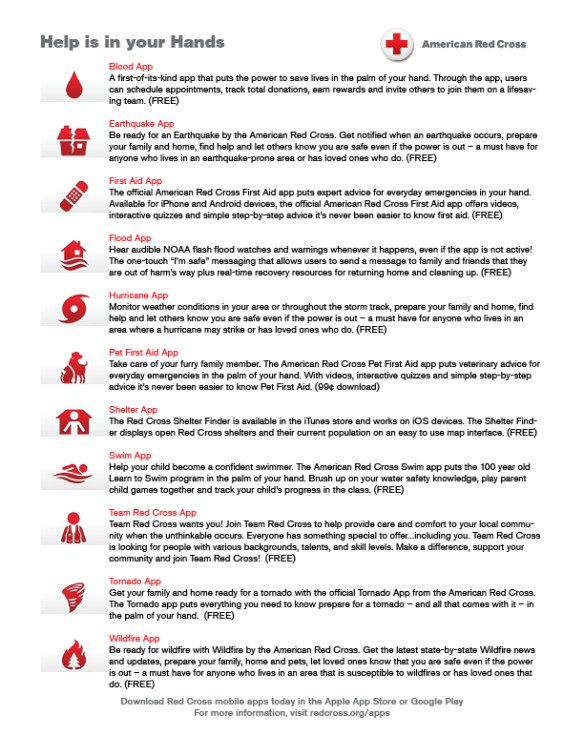
When a large scale disaster hits, the Team Red Cross App makes it easy for you to help the response through just-in-time training.  The app has extensive training materials so you know exactly how to provide help with disaster assessment, feeding, bulk distribution, or other important work to assist those when they need it most.  Using the GPS on your mobile device, the app instantly recognizes where you are and tells you what help is needed in your area.  For more information, visit www.redcross.org/apps.

store-orig-white-on-red

The Volunteer Connection app is for those who are currently volunteers for the Red Cross. The app will help you easily update your profile, log your volunteer hours, schedule your shifts or read up on the latest news from your groups.  The app works with the existing volunteer connection website, but gives you the power to stay connected through your mobile device.  The apps are downloadable for the iPhone and Android servers.

To get started as a volunteer, or learn about additional opportunities visit www.redcross.org/volunteer.
Disaster preparedness for pets too!

When disaster strikes, all members of the family should be prepared with a disaster kit – including your pets.  Keep items in an accessible place and store them in sturdy containers so that they can be carried easily.

Pictured beside Zack and Zoe are leashes, water, food, Vet information, dog toys, a towel, dog treats, medical history, medicine, current picture of Z&Z and a water bowl.

Pictured beside Zack and Zoe are leashes, water, food, Vet information, dog toys, a towel, dog treats, medical history, medicine, current picture of Z&Z and a water bowl.

Your kit should include—

  • Sturdy leashes, harnesses and/or carriers to transport pets safely and ensure that they can’t escape.
  • Food, drinking water, bowls, cat litter/pan and a manual can opener.
  • Medications and copies of medical records stored in a waterproof container.
  • A first aid kit and download the Pet First Aid App
  • Current photos of you with your pet(s) in case they get lost. Since many pets look alike, this will help to eliminate mistaken identity and confusion.
  • Information on feeding schedules, medical conditions, behavior problems, and the name and number of your veterinarian in case you have to foster or board your pets.
  • Pet beds and toy

Click here for a complete list of pet disaster preparedness items: http://www.redcross.org/images/MEDIA_CustomProductCatalog/m3640126_PetSafety.pdf

Pets will look to family members for comfort during all the changes that disasters bring.  Having a plan ahead of time will reduce stress and ensure you that you can care for your furry family members.

New Red Cross app puts power to help save lives in hands of blood donors

The Red Cross is launching a first-of-its kind Blood Donor App that puts the power to save lives in the palm of your hand.

The app makes it easier, faster and more convenient for users to schedule and manage their donation appointments, track the lifetime impact of their donations, and recruit friends and family to roll up a sleeve with them.

As the nation’s single largest supplier of blood and blood products, the Red Cross is uniquely positioned to bring this cutting edge technology to blood and platelet donors. In addition to scheduling and managing blood donation appointments, other features of the app include:
• A blood drive or blood donation locator;
• The ability to sync a blood donation appointment with the user’s calendar;
• Donors can share personalized #selfies about their donation experience through social media;
• Unlock special badges through interaction with the app, make donations and spread the word;
• A chance for donors to come together to form teams, tracking their cumulative impact and viewing standings on the Blood Donor Teams Leaderboard;
• Exclusive offers and discounts from some of America’s best brands, including Shari’s Berries, ProFlowers and 1A Auto, with new rewards added regularly; and
• Uplifting donor and blood recipient stories that show the power of rolling up a sleeve to help save lives.

The Blood Donor App, along with the Red Cross suite of preparedness apps, can be found in app stores by searching for American Red Cross. You can also visit redcross.org/apps or redcrossblood.org/bloodapp, or text* BLOODAPP to 90999 for a direct link to download.

Eligible blood donors do not need a smartphone to schedule an appointment to give blood. Appointments can always be made by calling 1-800-RED CROSS (1-800-733-2767) or by visiting redcrossblood.org.

How to donate blood
A blood donor card or driver’s license or two other forms of identification are required at check-in. Individuals who are 17 years of age (16 with parental consent in some states), weigh at least 110 pounds and are in generally good health may be eligible to donate blood. High school students and other donors 18 years of age and younger also have to meet certain height and weight requirements.

* Message and data rates for texting may apply.

Safe and Well: Remembering the Boston Marathon 2013

As the day of the 2013 Boston Marathon began, I observed Facebook posts pop-up with happy scenes of runners victoriously running past my sister-in-law’s camera. She had volunteered for a second year to be at a hydration station along the route and had started the day really excited to be a part of something so integral to her adopted city.

Her posts applauded her racer friends, cheering them on through social media. Watching as her photos and posts came through my news feed, back here in Ohio it was just a typical day for me– laundry was folded, children were fed, toys were picked up and re-scattered.

Until the frightening news came through, a bomb had gone off at the marathon.

Our family didn’t have a clear concept of where my sister-in-law had been stationed or what was really going on in Boston. Phone calls would not ring through to her due to lines and circuits being jammed with callers. Two states away, we had no other way to confirm that she was okay.

That was, until one of the most beautiful Facebook posts popped up:

“I am NOT downtown. Praying for my friends and their families.”

And then she shared the link:

Safe and Well Share

The American Red Cross offers the Safe and Well system during a disaster to alleviate anxieties and provide peace of mind to individuals looking for loved ones who may have been affected. In the case of Boston, the Red Cross had 466 registrants who were separated that Monday.

The Safe and Well program information is primarily housed on its website, but as part of the registration process individuals may connect to their Twitter or Facebook page. This will allow the system to send out a select message such as “I’m safe” and a link to the main webpage, www.redcross.org/safeandwell. It can be initiated at Red Cross shelters, when individuals may not have access to the internet.

Safe and Well is also an integral part of Red Cross disaster preparedness/response apps, like the Flood, Tornado, Hurricane and Earthquake Apps. The apps can connect to the individuals Facebook or Twitter accounts to send out a message of safety to loved ones.*

As it turned out, my sister-in-law had been at an early hydration station which had closed. When the bomb went off, she was already at home. But without being able to know this, I am so thankful for social media which allowed her to reach out and communicate to her friends and family across the nation.

Our thoughts are with you today, City of Boston. Standing together you are truly strong.

– Mary, NEO Red Cross Communications


*The apps are available through the Google Play and Apple App Stores. For more information, visit www.redcross.org/apps

Learn more about Flood Safety Awareness with a new app from the Red Cross

On average, there are 89 fatalities and more than $8.3 billion dollars in damage each year as a result of flooding. Floods and flash floods are the most common, and costliest, weather related disaster in the United States. The National Oceanic and Atmospheric Administration (NOAA), the organization that monitors and manages weather and ocean related data, predicts that minor flooding will occur this spring in Northeast Ohio. That prediction does not take in to consideration the potential for flash flooding, a type of flooding that occurs when water rises in a short amount of time, quickly with little or no warning.

In an effort to get the word out about the deadly nature of flooding, NOAA and the Federal Emergency Management Agency (FEMA) observe Flood Safety Awareness week from March 16 through 22.

Screen Shot from the Flood App, now available from the American Red Cross.

Screen Shot from the Flood App, now available from the American Red Cross.

To celebrate, the American Red Cross released a free, Flood app.  The app helps users gain more information about how to prepare for and respond to a flood in their area. It features interactive quizzes and awards users with badges that can be shared on social networks.

Want to build an emergency kit in preparation? The app can help with that!

Most importantly, the app can be used during a flood. It provides an audible and location specific alert when a Flood Warning or Watch is in effect, plus a toolbox of helpful features such as turning a smart phone’s camera flash into a flashlight and helping the user post the message “I’m safe” on social networks. It will also map out area Red Cross shelters.

The app is available in the Apple App Store and the Google Play Store or visit redcross.org/apps


Be a Force of Nature: Take the Next Step during National Severe Weather Preparedness Week

In July of 2013, the Red Cross responded to flooding in Barberton, OH.

In July of 2013, the Red Cross responded to flooding in Barberton, OH.

This year, why not take the time to learn how to prepare for severe weather during National Severe Weather Preparedness Week, March 2-8, 2014, sponsored by the Federal Emergency Management Agency (FEMA) and the National Oceanic Atmospheric Administration (NOAA).

Being prepared to act quickly could be a matter of survival. This is especially evident during the threat of severe weather. The deadliest and most destructive tornado of 2013, an EF-5 on May 20 in Moore, Oklahoma and caused more than $2 billion in property damage. Even though severe weather was anticipated days in advance, many in the impacted areas said they did not have a plan and were caught unprepared.

While spring tends to produce more tornadoes, they’re not uncommon in fall. On Nov. 17, a late season tornado outbreak that struck seven Midwestern states became the most active tornado day of 2013 with a total of 74 tornadoes.

Being prepared to act quickly could be a matter of survival. This is especially evident during the threat of severe weather. The Moore Oklahoma ESF 5 tornado is estimated to have caused about $2 billion in property damage. In November 2013 alone, at least 70 tornadoes spanned seven Midwestern states.

Severe weather could happen at any time, anywhere. Even though the Oklahoma tornado outbreak was forecasted for days in advance, and warning lead times for the tornado outbreak averaged nearly 20 minutes, there were still many people in the impacted areas that stated they were unprepared.

Here is what we can do to prepare:

Knowing your risk, taking action and being an example by sharing your knowledge and actions with your social network are just a few steps you can take to be better prepared and save your life and others.

Know Your Risk: Hurricanes, tornadoes, storms – every state in the United States experiences severe weather. Download our Hurricane or Tornado app to receive real time alerts for your location. Also, visit weather.gov to get the latest on weather threats.

Take Action: Take the next step in severe weather preparedness by creating a family communications plan, putting an emergency kit together, keeping important papers and valuables in a safe place, and learning about Wireless Emergency Alerts. Download the Red Cross First Aid app or natural disaster related apps (like the Tornado app) to learn more about preparing for and responding during a storm. To learn more about taking action, participate in a local event on April 30 through America’s PrepareAthon.

Be an Example: Once you have taken action to prepare for severe weather, share your story with family and friends on Facebook or Twitter. Your preparedness story will inspire others to do the same.

Learn more at www.redcross.org, www.weather.gov and www.ready.gov/severe-weather or the Spanish-language web site http://www.listo.gov. We also regularly post weather related stories to our chapter Facebook pages and through @neoredcross on Twitter. Follow the National Weather Service @nws and FEMA @readygov