American Red Cross remains committed to helping everyone as needs increase

By Tim Poe, American Red Cross volunteer
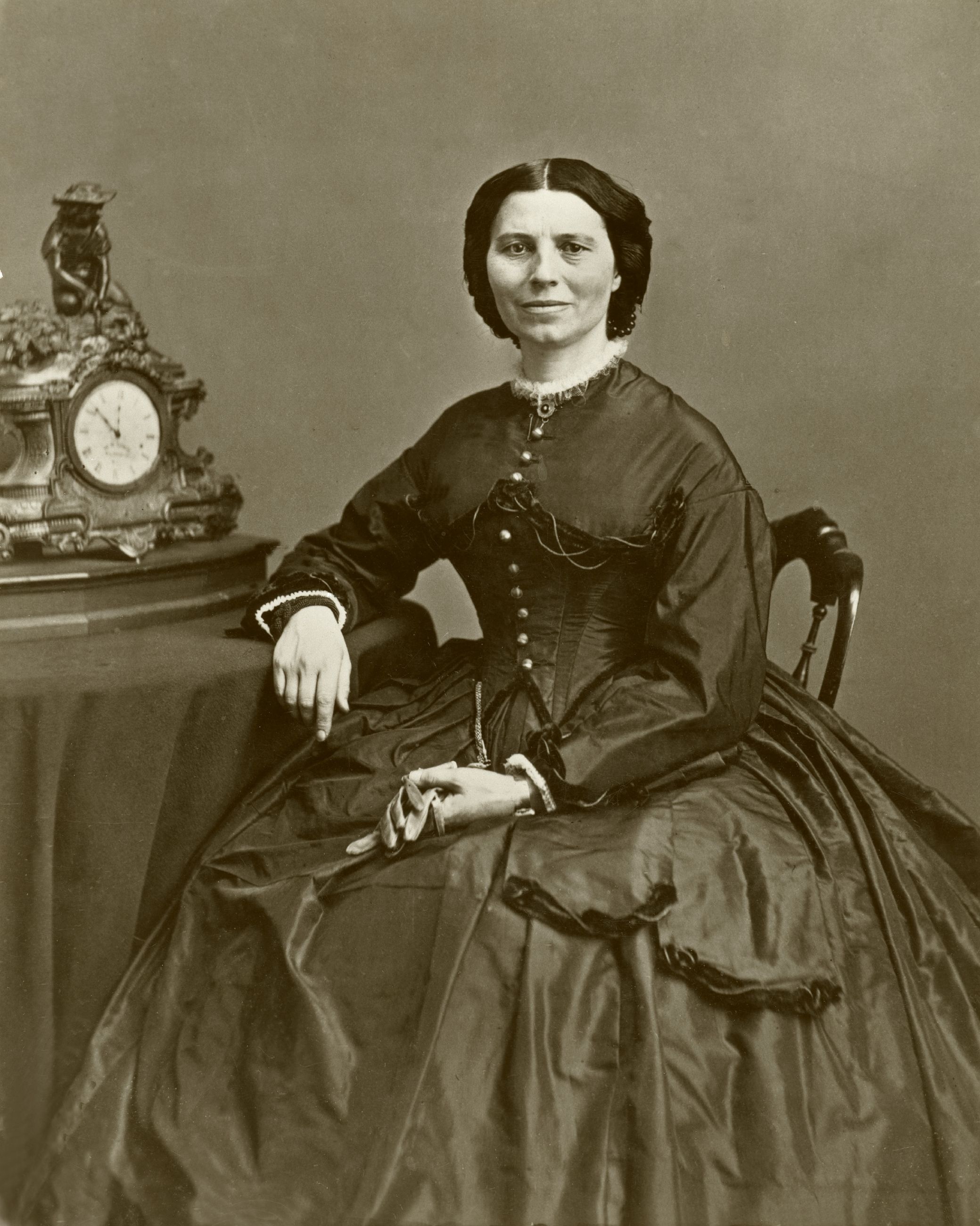
Portrait of Clara Barton, founder of the American Red Cross.

She was bent over, sobbing, frustrated, nearly everything in her family’s apartment destroyed. We sat in an American Red Cross vehicle outside a partially burned apartment complex. It was near the beginning of the school year, and she had recently purchased books, school supplies and clothes for her children. Unfortunately, her neighbor, whom I had helped earlier, had a moment of carelessness. Like most renters I assisted, especially those in lower-income areas, she did not have renter’s insurance. But we were there. One of my favorite moments as a Red Cross volunteer was handing her an aid packet, a lifeline, and seeing her frustration and despair turn to gratitude and resilience. Her family would have a place to stay, would eat, and her children’s clothes and school supplies would be replaced. Her race, gender, legal status, religion, beliefs, class and orientation didn’t matter. She needed help, and the Red Cross provided.

Scenes like this play out an average of three times per day in Northern Ohio, and about 65,000 times per year nationally. Similarly, someone in the U.S. needs blood every two seconds, while U.S. Armed Forces members, veterans and their families receive assistance daily. Our services have never, nor will ever, be contingent on anything other than if someone needs our help.

As March is Red Cross Month, we would like to reiterate that helping everyone has been a core principle since our founding in 1881 and remains central to our Fundamental Values of
humanity, impartiality, neutrality, independence, voluntary service, unity and universality. Clara Barton, who faced discrimination as a woman, believed in “perfectly equal rights–human rights,” and instilled those values in the Red Cross from the outset.

For the past 144 years, the Red Cross remained committed to helping those in need, bringing out the best of humanity in times of crisis.

February 25, 2025. Pike County, Kentucky.
American Red Cross volunteer, Tony Susi, comforts Tina Roberts after she lost her entire home in Eastern Kentucky after devastating floods hit her community just over a week ago.

Red Crossers are on the ground across Kentucky, assessing damage, working with community partners and local emergency management, and providing hot meals, a safe place to stay and other support to residents impacted by flooding.

Photo by Scott Dalton/American Red Cross

The need for Red Cross services and the commitment to help everyone has never been greater. The climate crisis is having a tremendous impact, as the Red Cross is responding to nearly twice as many large disasters as a decade ago, and they are increasing. Additionally, the climate crisis is taking a heavier toll on frontline communities, including low-income families, older adults, communities of color and people with disabilities.

The Red Cross is responding to these challenges through strengthening partner networks;
improving disaster relief capacity; enhancing our engagement with diverse communities, including offering information in Spanish; reaching out to diverse blood donors; continuing our Sickle Cell initiative; and adding health screenings for blood donors at different times throughout the year, currently including screening for Sickle Cell trait and, this month, A1C.

We could use your help. If you can donate blood, give financially or volunteer, your assistance has a tremendous impact. And no matter who you are, please reach out if disaster strikes, as the Red Cross continues its commitment to helping all.

Edited by Glenda Bogar, Red Cross volunteer

Posted by Ryan Lang, Red Cross board member and volunteer
International Women’s Day: Women and the Red Cross

By Eilene Guy, American Red Cross volunteer

March 8 is International Women’s Day, when we focus on the leadership, expertise, nurturing and down-and-dirty sweat labor that women contribute around the world, 365 days a year.

Coincidentally, Women’s Day falls in March – Red Cross Month – when we focus on the wide range of humanitarian services that Red Crossers contribute around the world, 12 months a year.

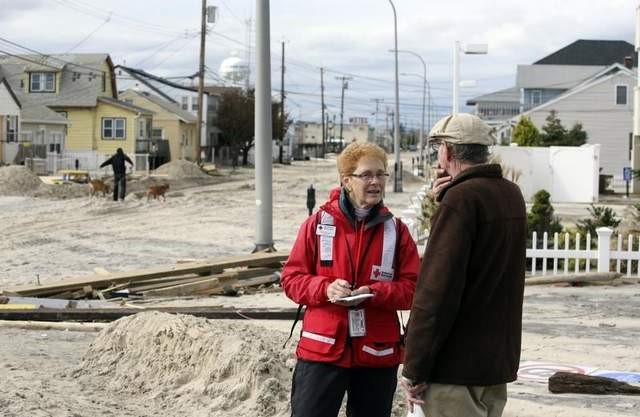
Red Cross volunteer Eilene Guy speaks with a resident of seaside Heights, New Jersey who refused to evacuate during Superstorm Sandy in 2012.

I’m proud to be part of the American Red Cross, which was launched by a woman, is headed by women, and values the talents and dedication of women at every level.

Women like my friend, Red Crosser extraordinaire Winnie Romeril. A volunteer for nearly 30 years, she has taught first aid and CPR, coached International Humanitarian Law classes, and served as a bilingual communicator at disasters all over the United States and across the world:

Sri Lanka and the Maldives; Peru; Haiti, carrying cash from the Red Cross to kick-start earthquake relief efforts with the Haitian Red Cross; the Philippines, where she even helped build a hanging bridge to get relief supplies to a remote village; Canada; Puerto Rico after Hurricane Maria.

She’s been posted to the International Federation of Red Cross and Red Crescent Societies in Geneva, Switzerland, to tell how the Red Cross brings hope across the world, and to Sierra Leone in Africa at the height of the Ebola outbreak, representing the World Health Organization.

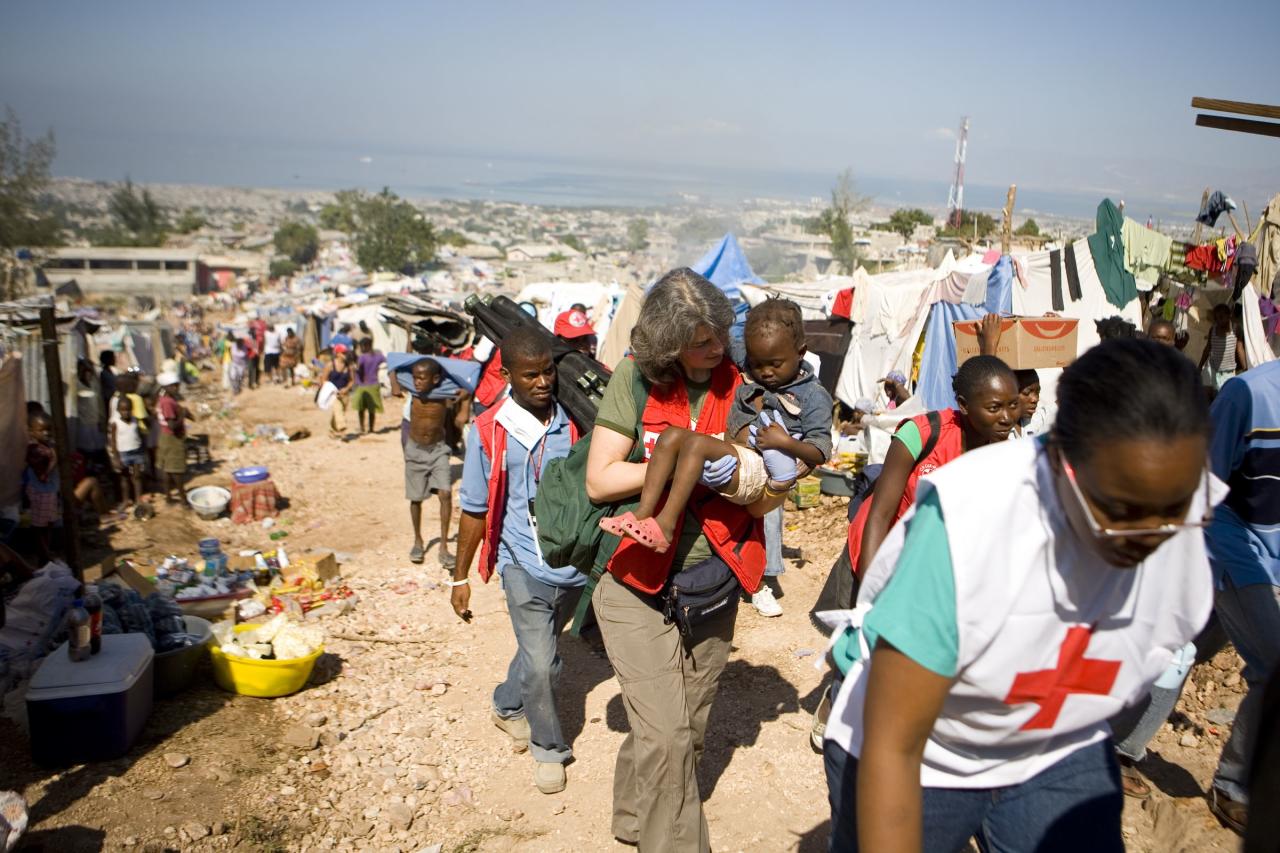
Winnie Romeril, a Red Cross disaster response volunteer, carries a child in Croix Desprez towards a First Aid Post.

Winnie’s courage and skill reminds me of Clara Barton, who started out as a teacher, became one of the first women to work in the U.S. Patent Office, and then took to the battlefields of the Civil War, ministering to the wounded and suffering on both sides of the conflict.

After attending to civilians during the Franco-Prussian War in Europe, she returned to the United States to found the Red Cross, which for more than 130 years has mobilized women – and men – to help prepare for, prevent and respond to emergencies.

Currently, two-thirds of our Red Cross volunteers are women, nearly 70 percent of the paid workforce is women and nearly half of the executive ranks are women.

Bonnie McElveen-Hunter, chairman of the board, and Gail McGovern, president and CEO, top the leadership team.

It’s no small job to head a $2.65 billion organization that Americans rely on to respond to more than 60,000 natural and human-caused disasters a year; collect and test some 40 percent of the nation’s lifesaving blood supply; train millions of people in first aid, CPR, AED, water safety and youth preparedness; and provide more than half a million services to our men and women in the armed forces.

People like me are the hands and heart of the Red Cross too: donating blood, responding to disasters, helping install smoke alarms to make neighborhoods safer, providing leadership at the chapter level and keeping my first aid, CPR and AED skills up to date.

I’m happy to celebrate International Women’s Day by focusing on women – past and present – who provide vital services. I know it happens all over the world every day, in actions big and small.

To investigate what you – woman or man! – can do, please check out redcross.org during Red Cross Month.

Posted by Ryan Lang, Red Cross Board Member and volunteer