Red Cross staff detects health issue in longtime blood donor during routine check in

By Sam Pudelski, American Red Cross volunteer

Peggy Hammond has donated blood for over 40 years. As someone with O+ blood, she understands the importance of giving blood. She started giving blood after a friend had a daughter diagnosed with Apert syndrome and needed regular blood infusions. She realized how extremely important it was to donate blood to help people like her friend’s daughter, who rely on blood donations.

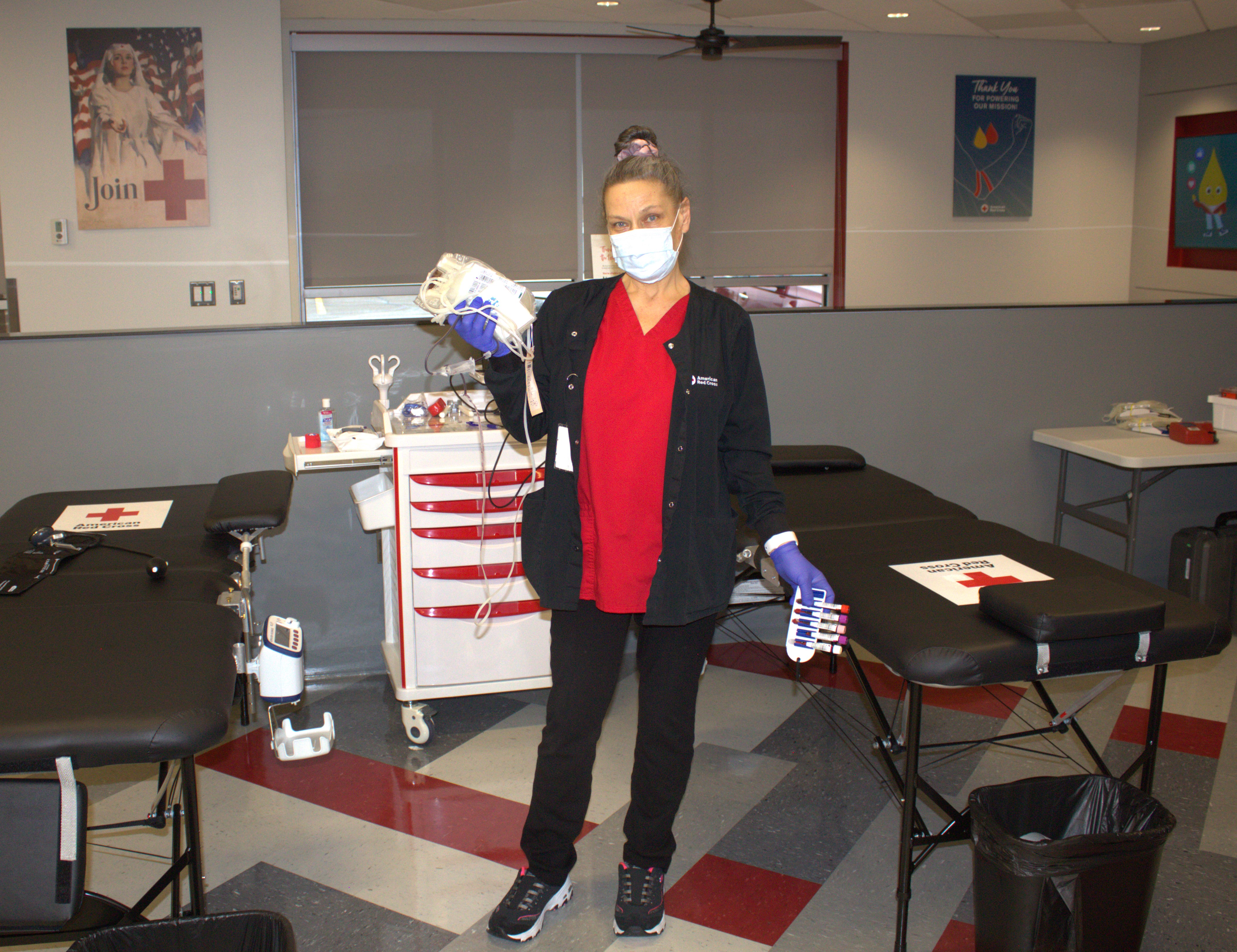
Fast forward a few years, and Peggy was at the American Red Cross Michael T. George Blood Donation Center checking in for her routine blood donation. When she was signing in, the nurse noticed a sore on her head and told Peggy, “I think it’s infected.” The supervisor confirmed it was, and Peggy wasn’t able to donate that day. Over Christmas, she contacted her doctor and after sending a picture of the spot in question, she went in to have it evaluated.

Her doctor determined the sore was not just an irritated spot on the head, but was in fact skin cancer, specifically squamous carcinoma. Approximately 2 out of every 10 skin cancers are squamous cell skin cancers, according to the American Cancer Society. Luckily, the cancer was caught early. Peggy had Mohs micrographic surgery to have the cancerous spot removed. The procedure went well, and with the surgical site healed, she was able to resume her regular blood donations.

She returned back to the donation center to begin her regular blood donations again, and of all people volunteering that day, the same nurse who discovered her spot, was there again! “She saved my life,” Peggy said. She was grateful to have the chance to tell her how much her catch that day helped her.

In speaking with Peggy, it’s evident she’s passionate about giving back and grateful that she’s still able to continue to donate to help others in need. If you are interested in donating blood, the Red Cross holds blood drives across Northern Ohio. To find an upcoming blood drive near you, visit redcrossblood.org.

Edited by Glenda Bogar, American Red Cross volunteer


Get a free pair of shades by goodr when you donate blood or platelets

By Kathryn Dean, American Red Cross Volunteer 

July is finally here, and summer has officially started. For many, this means vacations, cookouts, pool time, and fun with family and friends. For blood banks, this busy season can mean a time of fewer donors and a limited blood supply.   

Every two seconds, someone in the U.S. requires a blood transfusion. This equates to around 29,000 units of blood that are needed every day! Whether it be for cancer patients, accident victims, surgical patients, or new mothers, be a hero for a person in need by donating this precious, lifesaving gift. 

While all potential donors are asked to donate if they can, Type O is urgently needed at this time.   

Type O negative blood, often called the “universal donor,” can be safely transfused to anyone and is commonly used in emergencies when there is no time to determine blood type. With only around 7% of the U.S. population having Type O negative blood, it is often in short supply, even though the need for it is great. 

Special Promotion for donors 

Between July 1-14, consider taking time out of your schedule to donate blood, plasma or platelets, and look cool leaving with a free pair of American Red Cross x goodr “Just My Type” sunglasses, while supplies last! You will also receive a sticker with your blood type to personalize your glasses. Find out more about the promotion by clicking HERE

To donate, simply visit RedCrossBlood.org and enter your zip code or download the free Red Cross Blood Donor App by clicking HERE. Save time on the date of your donation by completing your pre-donation forms at RedCrossBlood.org/RapidPass or by using the Blood Donor App. 

Edited by Glenda Bogar, American Red Cross volunteer

Mother advocating for her “Sickle Cell Warrior”

By Ryan Lang, American Red Cross

Sickle cell disease affects more than 100,000 people in the United States. One out of every 365 Black or African American births is affected by sickle cell. People living with sickle cell disease may need as many as 100 units of blood each year. These are all statistics that Demeatrice Nance was unaware of prior to October 2003, when her daughter Makenzie was born. 

Makenzie Nance, sickle cell warrior

“There were some abnormalities in her newborn screening and the doctor wanted us to come in to talk about it,” Demeatrice said. “That was when they told us that Makenzie had sickle cell disease.”

Demeatrice and her husband were devastated, mostly, she said, because they didn’t know where to start getting the best help for their daughter.

From that point on, Demeatrice was on a fact-finding mission – a quest for knowledge about sickle cell disease. “We did a lot of online research and had a lot of conversations with the doctors. We were also referred to a local sickle cell outreach group that provided a lot of resources for Makenzie and our family,” Demeatrice said.

As Demeatrice delved more deeply into the world of sickle cell disease, she quickly discovered how important blood donors, especially Black blood donors, would be in Makenzie’s life.

Fast forward just two and a half years and Makenzie needed her first blood transfusion. “The doctor told us her hemoglobin had dropped, and it was at a crucial state, and Makenzie needed a blood transfusion,” Demeatrice explained. Then she and her husband got word from the doctor that there was a blood shortage, specifically from African American donors, which was what Makenzie and most all sickle cell patients need.

“The doctor said we’re just gonna try and wait it out and try and locate blood for her,” Demeatrice said. And while it was only about a day before they did locate blood for Makenzie, Demeatrice said it felt like a year. “From that time, donating blood has been a priority to me and educating people about the importance and the reason to donate blood. It’s important that our sickle cell warriors have the blood supply when it’s needed.”

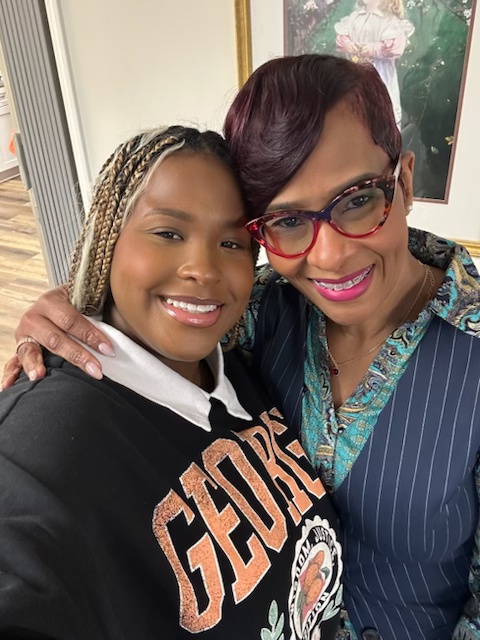
Makenzie and Demeatrice Nance

For the past 15-plus years Demeatrice and her family have been advocating and educating. Advocating for her own sickle cell warrior, Makenzie, and all of the sickle cell warriors who desperately need blood. And educating the public about why they need blood and why the blood supply needs to be maintained through regular donations.

“My first blood drive was small,” Demeatrice said, “but when I shared my story and explained the importance of donating, not just for sickle cell patients, but for cancer patients and trauma victims and others, the numbers started growing.” Demeatrice says she always tells people, “It could by my day today, or it could be your day tomorrow,” which is why she encourages everyone she meets to donate blood.   

As for Makenzie, she’s just graduated with an associate’s degree in health science and is starting her nursing clinicals in the next couple of months. “Sickle cell patients are often told they can’t do a lot of things, but over the past 21 years Makenzie’s done more things than a lot of people ever thought she could do,” Demeatrice said, beaming with pride for her sickle cell warrior.

Click here to hear more of Demeatrice’s story about her journey with Makenzie and sickle cell disease.

To schedule your appointment to donate today, visit redcrossblood.org.  

National Nurses Week: Spotlight on Cynthia Bell, RN MSN

By Kathryn Dean, American Red Cross Volunteer

National Nurses Week is an annual week of recognition of the hardworking nurses in our community and runs every year from May 6 to May 12.  This year, the American Red Cross of Northern Ohio wants to recognize a local Akron nurse, Cynthia Bell, RN MSN, who has dedicated her life to the profession and continues to serve, even in retirement.

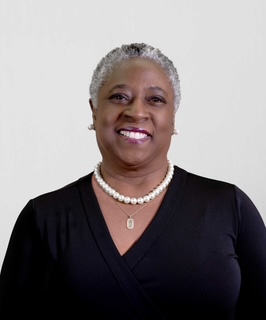
Cynthia Bell

Cynthia was encouraged to start her nursing journey when she was fresh out of high school and trying to determine life’s path.  A chance encounter with an Akron City Hospital administrator at her church changed everything for her.  She was given the opportunity to attend the hospital’s nursing program for free, and she jumped at the chance. 

“I said my parents can’t afford nursing school, and he said, well decide if you want to go, we’ll take care of it.  I said, no brainer.  But did I have any idea what I was getting myself into?“ she recalled. “No clue whatsoever.”

“’You’re going to be responsible for people’s lives’,” Cynthia was told, “and I remember panicking and I was 21 years old.  But I’ve never looked back, I loved every minute of it, it was the best career choice.  It was all in God’s plan because I would never have thought about being a nurse.  It all works for the good.  And I think that’s why I stay in the community, because I know the impact that one person can have on somebody else, and somebody may be having a bad day, and you can just be there for them.” Cynthia reflected.

Cynthia eventually went on to complete her bachelor’s degree at Capital, and then her Masters in psychiatric mental health.  She spent 37 years of her 52-year nursing career at the Cleveland Veterans Administration (VA) Hospital.  “It’s the highlight of my career, I’ve enjoyed every, every minute of being a nurse at the VA,” she beamed. 

At the VA, she was the nurse manager and Assistant Chief of the Homeless Domiciliary.  “We housed 122 veterans, some with mental illness, some with substance abuse, gambling issues, and they could have a combination of those things, and we got them housed and improved their health and set up healthcare for them in the community,“ she explained.  “I just loved being the nurse manager because my nurses ended up giving great care.  You had to be innovative, and compassionate, and tolerant, and it made a difference.”

Now as a retiree, she fills her days with volunteer hours, tutoring students in Akron and working as the President of the Akron Black Nurses, an organization that conducts local health fairs and blood pressure screenings in the community.  She also serves as a Blood Donor Ambassador for the Red Cross, working about 10 blood drives a month. 

Cynthia Bell at a Red Cross blood drive

“I go to the different blood drives, and I greet and help sign in any of the donors that come in, and we often engage in playful or good conversation.  I meet so many different people.  Some have a lot in common and some that have nothing in common.  But we always end up having a good conversation.  It’s a great place to meet people,” Cynthia said.

“I really hope that people continue to see the importance and the need for donating and if they have time, in becoming an ambassador for the Red Cross.  I appreciate the opportunity to serve, and how happy I am being a volunteer.”

Be sure to thank a nurse this National Nurses Week and join me in saying a big thank you to Cynthia for her dedication to nursing and helping her community.  Consider joining other volunteers at the Northern Ohio Region of the Red Cross by clicking HERE to learn about the available opportunities.

Diverse blood supply is more important than ever

By Eilene E. Guy, American Red Cross volunteer

Volunteers are the lifeblood of the American Red Cross. And by extension, volunteers provide lifesaving blood and blood products to millions of people across the nation every year.

This chain of generosity begins at the local level, at an average of 500 blood drives and blood center collections every day. Last year, the Red Cross sent more than 6.3 million blood products to some 2,500 hospitals and other health care facilities.

But in the past two decades, the number of Red Cross blood donors has fallen by about 40%, with a significant drop among those between 16 and 22. As our national population ages and becomes more diverse, building the next generation of donors is critical.  

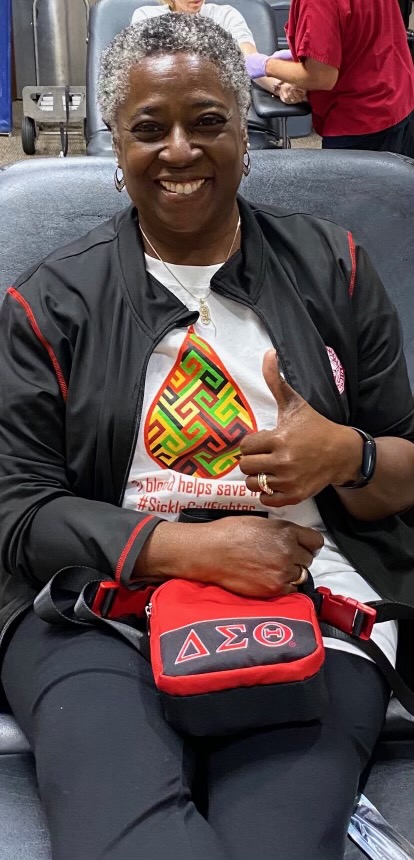
The University of Akron alumni chapter of Delta Sigma Theta, a sorority of scores of African American women, is helping meet that need by sponsoring blood drives.

Earlier this month, their event netted 30 units of blood, which will go to treat as many as 90 patients.

Drives like these are vital to maintain a stable supply of blood for trauma victims, surgery and cancer patients, fragile newborns and those with medical conditions such as Sickle Cell Disease (SCD). This hereditary condition can be life threatening: It leads to anemia (shortage of red blood cells), causing fatigue, organ damage and periodic severe pain, known as a sickle cell crisis.

Blood transfusions from donors of the same or similar ethnicity and blood type are the most effective way to treat a sickle cell crisis. Since most people with SCD are of African descent, blood from Black donors is the gold standard for treatment. In fact, one in three African American blood donors is a match for a patient with sickle cell disease.

As a northern Ohio district manager for Red Cross blood services, Sabrina Spikes works to recruit and educate a larger, broader base of blood donors, including the Black and African American, Latino and LGBTQ+ communities.

“It’s a testament to the work of Delta Sigma Theta that they sponsor at the University of Akron,” she told me. “We need to have diverse partners, to do more education.”

Education is two-pronged:

  • Reaching more people from all racial and ethnic groups to explain the importance of a diverse blood supply. “We know the number one reason people don’t donate blood is that they haven’t been asked,” she said. “We need to explain why a diverse blood supply is important.”
  • Preparing potential donors to have a successful donation experience, by getting them to drink plenty of water and eat iron-rich foods. “Cutting down on caffeinated beverages that slow the absorption of iron – coffee, tea, sodas – helps cut the deferral rate of donors, especially African American women,” she explained.    

To learn more about why a diverse blood supply is so important, tap here. And, to find where you can donate and to make an appointment, go to redcrossblood.org. Someone needs you!

Donate Blood in March and receive a free A1C screening

By: Kathryn Dean, American Red Cross volunteer

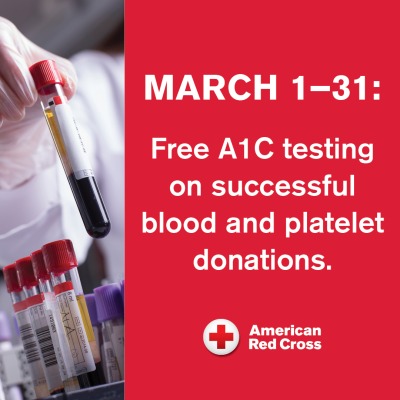
The American Red Cross of Northern Ohio is helping to bridge access to health care for blood donors by providing free A1C testing, commonly used to screen for diabetes and prediabetes, on all successful blood, platelet and plasma donations in March.

One-third of people lack access to regular primary care in the U.S., where diabetes affects 1 in 10 people and nearly a quarter of those living with it have been undiagnosed, according to the Centers for Disease Control and Prevention (CDC). The free A1C screening aims to help address this gap by empowering blood donors with valuable information to maintain their health and well-being.

What is the hemoglobin A1C test?  This is a common laboratory blood test that doctors use to help diagnose diabetes or prediabetes. Unlike a blood glucose test (or blood sugar test) which provides an instant snapshot of your current blood sugar levels, A1C reflects the average blood sugar levels of an individual over the past 3 months. This gives doctors a better idea of where your blood sugar typically lies, outside of the daily fluctuations.

Why is this important for me? It is estimated that there are over 8.7 million people in the U.S. living with undiagnosed prediabetes or diabetes. Type 2 diabetes accounts for over 90% of all cases and often remains symptomless until damage has been done. Untreated diabetes can lead to plaque build-up in the blood vessels which in turn puts you at greater risk for a stroke or heart attack. The eyes, kidneys, nerves, and skin are particularly vulnerable to the effects of decreased blood flow due to high glucose levels in the blood.  Fortunately, prediabetes is reversible with lifestyle changes, so early detection is key.

Blood donor, Audrey Savage
Photo by Michelle Frankfurter for the American Red Cross

How should I prepare for my donation?  No fasting is required for the A1C test or any other special preparation. Just be sure you are feeling well on the day of donation by getting enough rest, staying hydrated, and eating a well-balanced meal.

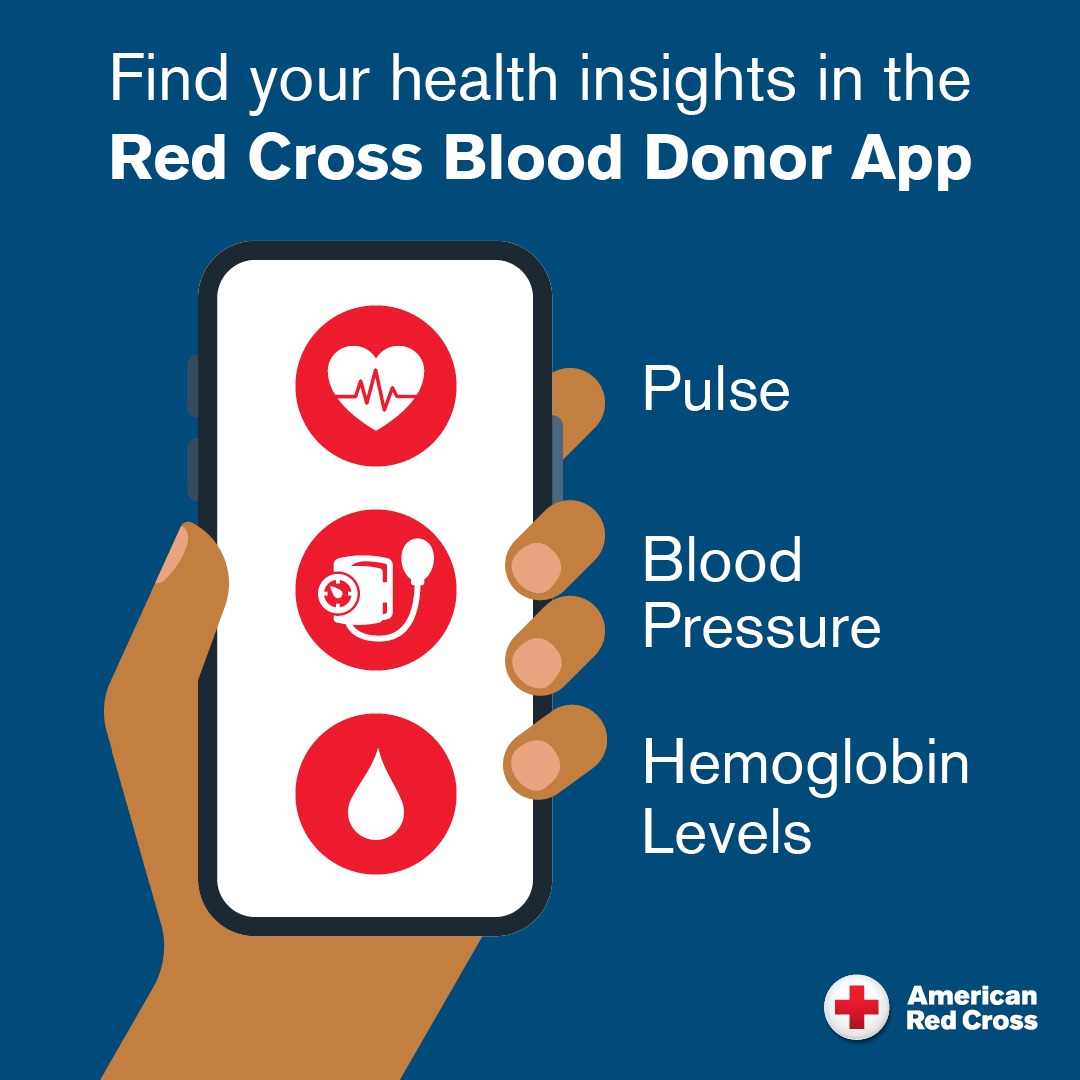
When will I get my results? You can expect your results within one to two weeks of your donation. Results will be posted on the Red Cross Donor App or through your donor’s account at RedCrossBlood.org.

What do my results mean?  An A1C test result of 5.7% or above will require follow-up with your primary care physician. Your doctor will be able to diagnose and guide you through an appropriate treatment plan. 

To learn more about the A1C test, pre-diabetes and diabetes, check out this informational page at the Red Cross website HERE. Download the Red Cross Blood Donor App HERE to schedule your next donation and view your donation history and test results.

Local teacher inspires students to give the gift of life through blood donations

By Kathryn Dean, American Red Cross volunteer

It’s already nearing mid-December and with the holiday season in full swing, the spirit of giving is on many of our hearts and minds. As we grow older, we learn to appreciate the fulfillment that giving to others brings. This year, as we consider ways to give back, either through gifts, service, or charity, let’s remember one other significant way that we can help – by giving the gift of life through blood donations.

Merrylou Windhorst and St. Vincent – St. Mary High school teacher Heidi Tripp

Merrylou Windhorst knows the importance of giving back to the community. She has been doing it throughout her almost 80 years of life (she’ll reach her milestone birthday on Christmas day this year).As a teacher at St. Vincent – St. Mary High School (St. V’s) in Akron and now as a volunteer for the last 50 years, Merrylou has been mentoring students and organizing blood drives through the American Red Cross, giving back to the community that she loves.

Merrylou started out as a student at Our Lady of Elms Catholic school. After graduation, she stayed on as religious sister at the Elms for 11 years before feeling called to do something else. That something else was to become a mother and a teacher, and thus starting her work at St. V’s. During her tenure, she worked as a health and physical education teacher, as well as teaching theology and coaching softball.

Her interest in health and well-being led her to start a program at St. V’s about 40 years ago that she still leads and is still going strong today, the Future Medics program. Recently she has expanded the program to include students from her alma mater, Our Lady of the Elms. In it, students who have an interest in the medical field meet up once a month and learn about career options and hear from alumni who have found success in medicine. Students also help to run three blood drives per school year, something that she brought to the school over 20 years ago.

“As a teacher I’ve always said ‘don’t just think of yourself as a ME, turn the M upside down and it becomes a W, becomes WE’… and that’s kind of what I have done as a teacher and especially at Future Medics and at blood drives. It’s time to give to other people.”

High school students who are 16, with a parent’s permission, can donate blood. Students can also volunteer to work at the blood drives. Either way, they earn service hours for graduation, an important part of the culture at St. V’s. Merrylou is so proud of her students and their willingness to go above and beyond for their community.

“I’m always honored and amazed at these young people at age 16, and it’s gotta be scary to roll up their sleeve and give blood.”

She said with the students help, they often make or exceed their donation goals. Their next blood drive is scheduled for Jan. 22 at the school and is open to the public.

“You think about, when can you save a life? How can we ever in our life, other when you stop and give CPR to somebody on the side of the road, who can say, ‘I’ve saved lives?’”

Recently Merrylou received recognition from the Red Cross for her over 20 years of service in organizing blood drives.

If you’re considering donating and giving the gift of life this holiday season, join us at the annual holiday blood drive at the Sheraton Suites in Cuyahoga Falls on Dec. 17 from 7am-7pm. There will be refreshments and raffles all day, and all donors will receive a free, long-sleeved Red Cross T-shirt!

Edited by Glenda Bogar, Red Cross volunteer

Posted by Ryan Lang, Red Cross board member and volunteer

Needed: Health and Mental Health Professionals to Volunteer

By Eilene E. Guy, American Red Cross Volunteer

Home fires, floods, hurricanes, wildfires. When American Red Cross volunteers respond to these disasters, they offer shelter, food and compassion — as well as health and mental health attention.

The public generally doesn’t see the health and mental health services. For the most part, they don’t show up in coverage of urgent disaster responses. But they’re critical in the first hours and days of helping victims cope with their new reality.

Lost medications, destroyed medical equipment, missed doctor’s appointments, emerging conditions such as COVID or the flu. These are all pressing needs that trained medical professionals know how to meet. And they can administer first aid for victims as well as disaster workers.

Meanwhile, licensed mental health professionals address the emotional side of a disaster, triaging who needs a few sessions with a skilled listener and who needs to be referred to local mental health resources for extended care.

Faced with an almost unprecedented number of natural and human-caused disasters, the Red Cross has launched a targeted recruitment drive: Be One, Bring One. The goal is to enlist volunteers from the medical and mental health fields. Trisha Horvath, RN MSN, from Kirtland, Ohio, is one of the leaders of this drive.

Trisha Horvath, Red Cross Volunteer, RN MSN, from Kirtland, Ohio

“I think all nurses are humanitarians,” Trisha said. “That’s why they do what they do, to alleviate suffering.”

The reality is, the vast majority of licensed medical and mental health professionals don’t have flexibility in their work schedules to volunteer for disaster response, much as they might like to, she said.

So Trisha is helping the Red Cross “think outside the box.” They’re emphasizing the opportunities for virtual “deployments” and the rewards to volunteers in the form of resilience training and CEUs — not to mention the personal satisfaction of helping people in their most vulnerable situations.

The Red Cross is approaching graduate school students and faculty as well as non-traditional workplaces where health and mental health professionals are found, such as insurance companies. Many of these folks already work virtually, so they know how to engage with people remotely.

Gail Wernick, the Red Cross Northern Ohio regional volunteer services officer, emphasizes that volunteer shift scheduling is flexible for on-call and scheduled commitments. Typically, volunteers are expected to be available, as needed, for two weeks every three months.

Gail Wernick, Red Cross Northern Ohio Regional Volunteer Services Officer

Gail’s goal is to have a roster of 21 trained disaster health volunteers with active and unencumbered licenses: RNs, LPNs, Licensed Vocational Nurses, Nurse Practitioners, Advance Practice Nurses, Medical Doctors, Doctors of Osteopathy or Physician Assistants. Tap here for more information or to apply.

Trisha is particularly concerned about what she calls the “dearth of mental health volunteers.” There are currently half of the goal of 17 such volunteers on the Northern Ohio team.

The Be One, Bring One campaign is aimed at currently licensed mental health professionals holding a master’s degree as well as retired mental health professionals who were in good standing when they retired and held a license within five years of onboarding as a Disaster Mental Health volunteer. Tap here for more information and to apply.

“We really appreciate the generosity of our health services and mental health volunteers. Needless to say, when people are struggling to cope with a disaster — – anything from a home fire to a flood or tornado — – immediate health and mental health support can be just as essential as food and shelter,” said Barb Thomas, Northern Ohio regional recovery manager for the Red Cross.

If you’re someone who’d like to help turn tragedy into hope in a rewarding opportunity to share your time and talents, visit redcross.org/volunteer to explore the wide variety of roles you can play, at home or away. And thank you!