Turkey day hazards: Don’t let your holiday meal go up in smoke

By Kathryn Dean, American Red Cross volunteer

Juicy, flavorful, and tender meat.  Crispy, golden-brown skin.  For a perfect holiday centerpiece that cooks in under an hour, the deep-fried turkey seemed like a miracle.  If you lived through the 1990s, you probably remember the phenomenon that spread through the country like wildfire. 

Triggered in part by Martha Stewart featuring this Cajun method of cooking on her television show and in her magazine, it sparked a craze amongst Americans who were looking for easier ways to cook their Thanksgiving turkeys. 

Unfortunately, this method came with a steep price.  An increase in fires and injuries resulted from improper use of this technique, and many homes burned down as a result.  If you’ve never seen a video of a turkey fryer quickly going up in flames, do yourself a favor and Google it now. 

But the danger isn’t limited to outdoor frying.  In the United States, Thanksgiving Day and the day before are the top two most likely days for cooking fires to happen in the home.  44% of all house fires in the U.S. can be attributed to cooking fires, making it the leading cause of home fires and home fire injuries.
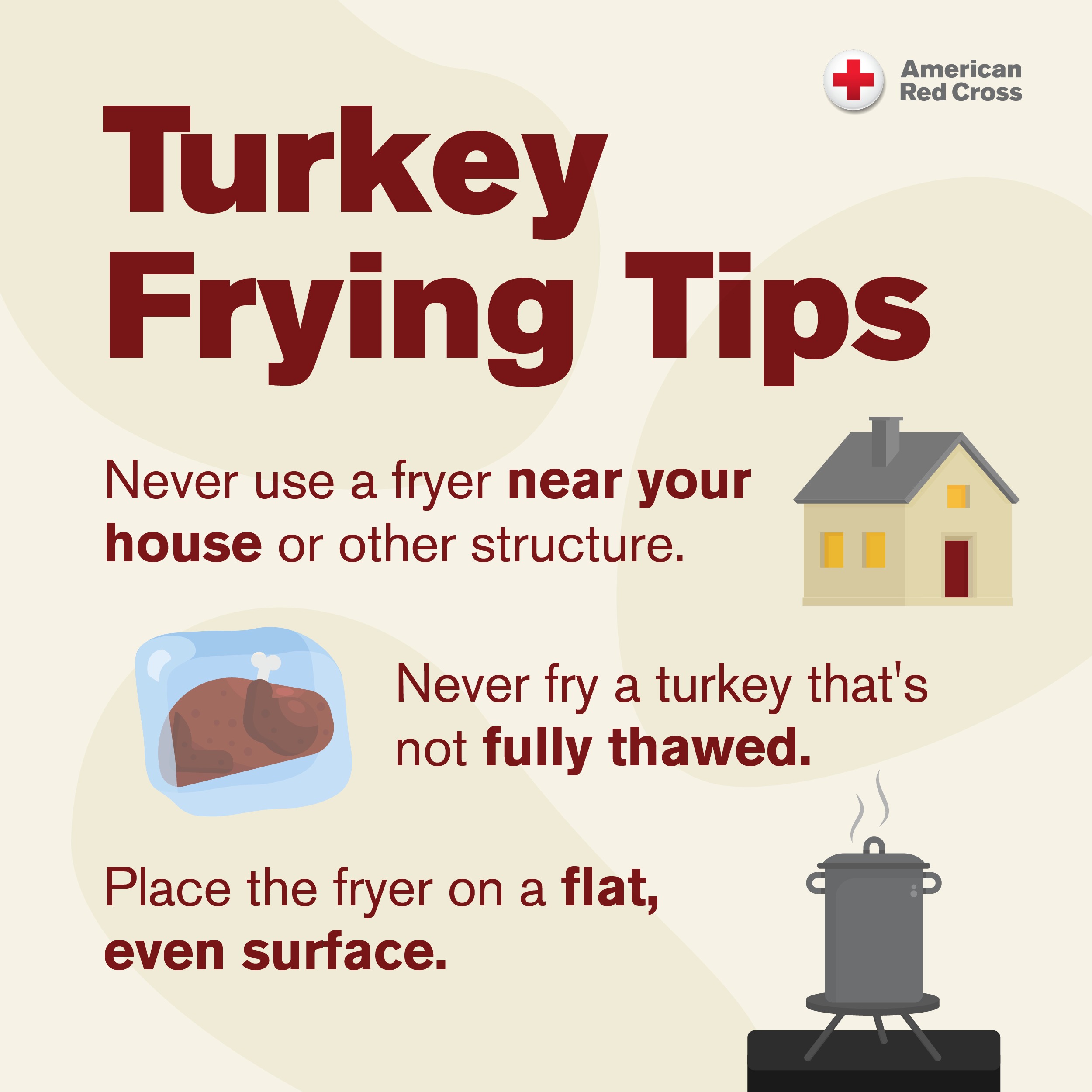
COOKING SAFETY TIPS: The American Red Cross recommends these cooking safety tips to reduce your risk of fire during this holiday season.

  • Never leave the kitchen unattended when frying, grilling, or broiling food.
  • Keep grills or deep fat fryers at least 10 feet away from home structures while in use.
  • If you are using a turkey fryer, remember that proper safety requires a completely thawed turkey and oil that is at the correct temperature and level.
  • Set a kitchen timer to remind you when the stove is on.
  • Keep children and pets at least three feet away from all cooking appliances and cords.
  • Remove flammable items, like wooden utensils, curtains, potholders, and oven mitts, from the vicinity of the stovetop.
  • Pull up sleeves and avoid loose clothing that can get in the way while cooking.
  • Keep a fire extinguisher near any area where cooking is being performed.  Do not use water to put out a grease fire.
  • Check that all appliances are off before going to bed at night.

Fall is a great time to check that you have working smoke detectors in your home. Test your units monthly, and replace batteries annually (on units that allow you to do so).  Replace any units that are over 10 years old.  If you need help replacing or installing smoke detectors, the Red Cross may be able to help. Click here to find out how to request a free smoke alarm in Northern Ohio. Wishing everyone a wonderful Thanksgiving!

Don’t Be the Griswolds

By Mary Falconer-Williams, American Red Cross volunteer

Introduction by Ryan Lang, American Red Cross board member and volunteer

When Clark Griswold’s dad was teaching him everything he knew about exterior illumination, perhaps a lesson on safeguarding his home during the holidays was in order. Anyone who’s seen the classic “National Lampoon’s Christmas Vacation” knows that everything that can go wrong, does go wrong for the Griswolds. But maybe, if Clark had been better prepared with tips from the American Red Cross, things may have gone more smoothly for him.

When you are decorating for the holidays, it’s so tempting – I know! – to load up one plug beyond its capacity. Why would they make it so you can daisy chain a set of lights if they didn’t mean for you to do so? And if I just need the wire to stretch one foot more, why can’t I just plug a power strip into a power strip into the extension cord?

The U.S. Fire Administration states on its website, “In 2021, an estimated 24,200 residential building electrical fires were reported to United States fire departments.”

Additionally, the National Fire Protection Agency indicates that December is the leading month for home fires in the U.S. According to them an annual average of 155 home fires were the result of Christmas tree fires, with electrical distribution or lighting equipment involved in more than two in five home Christmas tree fires.

Another way to make to protect yourself from home fires? You’re your home safely during cold weather. According to the National Fire Protection Association (NFPA), space heaters are most often responsible for home heating fires. Follow these tips on how to safely heat your home:

● If you must use a space heater, never leave it unattended. Place it on a level, hard, and nonflammable surface, such as a ceramic tile floor. Don’t place it on rugs and carpets, or near bedding and drapes.
● Plug space heater power cords directly into outlets — never into an extension cord. Turn the space heater off every time you leave the room or go to sleep.
● Keep children, pets, and anything that can burn at least three feet away from heating equipment.
● Never use a cooking range or oven to heat your home.
● Never leave a fire burning in the fireplace unattended. Make sure any embers in the fireplace are extinguished before going to bed or leaving home. Use a glass or metal fire screen to keep embers in the fireplace.
● Have furnaces, chimneys, fireplaces, wood, and coal stoves inspected annually by a professional and cleaned if necessary.

The NFPA also indicates that Christmas Day and Christmas Eve were the second and third-leading days of the year for home cooking fires, respectively, in 2022. So, as you’re putting the fixings for your holiday meal on the stove, keep these tips in mind:

● Stand by your pan. If you leave the kitchen, turn the burner off.
● What you are cooking. Fires start when the heat is too high. If you see any smoke or the grease starts to boil, turn the burner off.
● Turn pot handles toward the back of the stove so that no one can bump them or pull them over.
● Keep a pan lid or baking sheet nearby. Use it to cover the pan if it catches on fire. This will put out the fire.
● Installing smoke alarms can help save lives, but make sure it is 10 feet or more away from your cooking surface.

RED CROSS TIPS to help protect your family this season, and year-round: test your smoke alarms monthly and practice your home fire escape plan until everyone can escape in less than two minutes — the amount of time you may have to get out of a burning home before it’s too late.

Posted by Ryan Lang, Red Cross board member and volunteer

Red Cross serves up holiday safety tips to keep you thankful

By Eilene E. Guy, American Red Cross volunteer

While preparing the Thanksgiving feast, has anyone in your family ever burned something on the stove, setting off the smoke alarm and forcing you to open windows to the chilly November air?

My family has!

Have you every grabbed a potholder to pull a dish out of the oven, only to discover someone left it wet and the steam instantly scalded your hand?

I have!

These kitchen mishaps are not uncommon. But sadly, some holiday accidents turn disastrous: Thanksgiving and the day before are the top two days for home fires in this country.

Cooking is the leading cause of home fires and home fire injuries, and the second leading cause of home fire deaths. Most cooking fires happen because people leave cooking food unattended. (In my family, it was scorched green beans. I’m thankful the damage was just smoke.)

The American Red Cross urges everyone to keep safety top of mind throughout the hectic holiday season (and beyond):

Stay in the kitchen, especially when you’re frying or broiling food. If you have to leave the kitchen for even a short time, turn off the stove.

The same goes for a grill or turkey fryer outside. Don’t leave them unattended.

Use a timer to remind yourself that the stove or oven is on.

Don’t wear loose clothing or dangling sleeves while cooking.

Keep kids and pets at least three feet away from cooking areas.

Keep anything that can catch fire — potholders, oven mitts, wooden utensils, paper or plastic bags, food packaging, towels or curtains — away from your stove top and oven, or any other appliance that generates heat.

Clean cooking surfaces regularly to prevent grease buildup.

Consider getting a fire extinguisher to keep in the kitchen.

Always check the kitchen before leaving home or going to bed to be sure all stoves, ovens and small appliances are turned off.

Remember my smoke alarm? Smoke alarms save lives. Install a smoke alarm near (but not in) your kitchen, on each level of your home, near sleeping areas, and inside and outside bedrooms if you sleep with doors closed. Use the test button to check them once a month. Replace all batteries at least once a year (unless you have newer alarms with 10-year batteries).

If you can’t afford to buy smoke alarms or you’re physically unable to install them, the Red Cross may be able to help. Contact your local Red Cross for more information.

One more thing: Does everyone in your family know what to do if you do, in fact, have a home fire? Visit redcross.org/fire for more safety information, including a fire escape plan to practice with your family.

Since October 2014, the Red Cross Home Fire Campaign, working with community partners, has saved at least 1,994 lives by educating families about fire safety, helping them create escape plans and installing free smoke alarms in high-risk areas across the country. To learn more about the campaign and how you can get involved, visit redcross.org/homefires.

Posted by Ryan Lang, Red Cross board member and volunteer

Edited by Glenda Bogar, Red Cross volunteer

Ho Ho Ho – No No No

By Doug Bartwell, Red Cross Volunteer

Everyone knows that being prepared for a holiday is the key to truly enjoying it. Conversely, a lack of preparation, not only creates stress, but it also creates accidents. And who needs that on a holiday?

To that end, here are a dozen to-do’s and don’ts, (mostly don’ts) that will make your holidays more merry.

Decorations to avoid if you have pets

Holly, poinsettia, and mistletoe – they are all poisonous to your dog.

As mentioned last month, real candles can be a danger if pets can get near them. Cats can get most anywhere, BTW.

Silver icicle strands are so interesting to pets who like to play with it, but it is a choking hazard for them.

You need to provide live trees with a good supply of water , but cover it so pets aren’t tempted to drink. It can get stagnant easily, and could contain bacteria that will make your pet sick.

Low-hanging ornaments are a temptation for pets. Save that lower space for presents under the tree.

Best practice, if possible, would be to set a pet fence around your tree and gifts.

Serving suggestions

In case you’ve not had dogs before, they love chocolates; but chocolate is extremely toxic and dangerous for them. Teach your children and guests not to offer them to your pups.

If you spike your eggnog, be sure to put a warning label on the bottle or serving pitcher. My dad’s friend poured a big bowl for his dog, and by the time my dad saw him, the poor dog was bouncing off the walls. (True story)

Meal prep and cleanup

Avoid the temptation to buy that big bird a week ahead of time. Many stores let you order in advance and pick up your order from the store just a day or two before your holiday. Saves worrying about adequately defrosting a big bird in time, and keeps a fresh bird from spoiling.

Don’t use the same cutting board for poultry and veggies or fruit, unless you sanitize vigorously between. Avoid bacterial contamination, which could cause your family to get sick.

Keep guests out of the kitchen, especially during flu season. Serve light appetizers elsewhere to keep them from snitching “tastes” of the food as you are carving. Most likely they haven’t washed their hands before tasting.

Reheat your leftovers to 165 degrees throughout or until steaming hot. Soups, sauces and gravies should be brought to a rolling boil for one-minute before re-serving.

Speaking about food safety, the American Red Cross offers all our disaster team members a great food safety course – for free. We could use more team members ready to respond to disasters, and would love to have you join the team. You can learn more here.

Dedicated volunteers spend Thanksgiving week assisting home fire victims

While many of us enjoyed time relaxing with family and friends over the Thanksgiving holiday, American Red Cross disaster volunteers were busy responding to multiple incidents across the Northern Ohio Region. During the week of Thanksgiving, November 22-28, the Red Cross of Northern Ohio responded to 34 home fires, affecting 110 adults and children. We distributed more than $22,000 in immediate assistance to help these families begin the recovery process.


Of the many responses that happened in the past week, three occurred on Thanksgiving Day. Dedicated volunteers in the Northern Ohio Region left their own families and celebrations to assist families facing one of the worst days imaginable. Without the continued commitment of volunteers who are available 24/7 to respond to disasters, the Red Cross could not meet the needs of the many communities we serve.

The Red Cross normally sees an increase in local disasters, especially home fires, during the holiday season and this year is no exception. Cooking accidents and home heating mistakes often lead to fires that leave families stranded during the winter months. The Red Cross encourages the community to celebrate safely in the coming weeks and to read up on our tips to cook and decorate safely.


It’s also important that families are prepared for a home fire that could happen at any time. In most cases, families have less than two minutes to escape a home fire, although many believe they have much longer. The Red Cross encourages you to protect your family by taking two simple steps.

  1. Practice your two-minute escape drill
  2. Test your smoke alarms monthly

In an effort to #EndHomeFires, the Red Cross continues to provide home fire safety information to residents and to install smoke alarms for those who need them. On Monday Nov. 29, volunteers visited 22 homes and installed 67 smoke alarms in Cleveland and East Cleveland. View our photo album here.

For more information on the Red Cross Home Fire Campaign, fire safety tips, or to request a smoke alarm, please visit this site. The Red Cross also has an urgent need for volunteers to respond to local disasters and help in other ways as we carry out our lifesaving mission. Learn more about our volunteer positions and sign up today.

Thanksgiving is almost here!!

If you are like my family members, you can already taste the pumpkin pie and cranberry sauce. But with children and pets (and let’s face it – some grown-ups, too) running around and through the kitchen, paying close attention while preparing the feast is vital to having a safe holiday.

“Cooking is the number one cause of home fires,” said Mike Parks, Regional CEO. “Last year over 40 individuals – more than a dozen of them children – experienced a home fire over the holiday weekend. Education is key in preventing cooking fires.”

TOP TEN COOKING SAFETY TIPS

1. Don’t wear loose clothing or sleeves that dangle while cooking.

2. If you are frying, grilling or broiling food, never leave it unattended – stay in the kitchen. If you just leave the kitchen for even a short period of time, turn off the stove.

3. If you’re simmering, baking, roasting or broiling food, check it regularly.

4. Use a timer to remind yourself that the stove or oven is on.

5. Keep kids and pets away from the cooking area. Make them stay at least three feet away from the stove.

6. Keep anything that can catch fire – pot holders, oven mitts, wooden utensils, paper or plastic bags, food packaging, and towels or curtains—away from your stove, oven or any other appliance in the kitchen that generates heat.

7. Clean cooking surfaces on a regular basis to prevent grease buildup.

8. Consider purchasing a fire extinguisher to keep in your kitchen. Contact your local fire department to take training on the proper use of extinguishers.

9. Always check the kitchen before going to bed or leaving the home to make sure all stoves, ovens, and small appliances are turned off.

10. Install a smoke alarm near your kitchen, on each level of your home, near sleeping areas, and inside and outside bedrooms if you sleep with doors closed. Use the test button to check it each month. Replace all batteries at least once a year. We can help! Learn more about our free smoke alarm and education program, Operation Save-A-Life, at www.redcross.org/neoosal!


Bonus Tip

Download the American Red Cross First Aid App. The app provides users with quick, expert advice on what to do in case of an emergency. See all the Red Cross apps at redcross.org/mobileapps.