Back-to-School Sports Safety Tips

By Sue Wilson, American Red Cross Board Member and Volunteer Partner

August is called the “dog days of summer” for a reason. It’s the hottest month of the year for most parts of the country and this year, especially, much of the nation is suffering wave after wave of brutal heat.Icon Disaster

So when I see high school football players on practice fields, I immediately flash back to the dreaded “two-a-days.” Back in my day (yes, I’m a baby-boomer) our very football-oriented high school coaches worked the players hard in the heat twice a day during the hottest months of the summer. I’d hear about— and even witness—guys in my class pass out, get sick and suffer from what was probably heat stroke or exhaustion, as they worked out in their pads day after day in the heat. I think it was a badge of honor somehow if you made it through. However, I thought it looked barbaric. Back then, we didn’t talk about things like the importance of hydration, or the concern over head injuries and long-term damage from concussions and warming up and cooling down as we practice.

Thankfully, we know a lot more now about sports safety. But whether you are male or female, or play one of the many fall and winter sports indoors or out, back-to-school time is a good time to think about sports safety.

The Centers for Disease Control (CDC) offers some great tips to keep kids safe on the field, the court or wherever they participate in sports and recreation activities. Here are some of these tips and a few others:

Use the right equipment: Make sure kids use the right gear for the right sport and use it for both practice and the game. It is important they use protective gear like helmets, wrist guards, knee or elbow pads.

Make sure the gear fits and is in good shape: Check the equipment to assure it is in

action adult american football angry

Photo by Pixabay on Pexels.com

good condition, fits appropriately and is worn correctly all the time—for example, avoid missing or broken buckles or compressed or worn padding.

Warm up, cool down: Before starting (or ending) any form of activity, it is important to warm up the muscles by stretching, walking and easing into the practice. At the end, the reverse is also important, so slow down and cool down. Diving right into a strenuous activity without a warm-up can cause pulled muscles, strains and potential injuries. 

Get an action plan in place: Be sure your child’s sports program or school has an action plan that includes information on how to teach athletes ways to lower their chances of getting a concussion and other injuries. Get more concussion safety tips.

Be mindful of temperature: On extremely hot or humid days, allow time for the athlete to gradually adjust to the environments to prevent heat-related injuries or illness. Parents and coaches should pay attention to each player’s activity level, give breaks and make sure they are well hydrated and appropriately dressed. The same is true in extremely cold climates. Parents and coaches need to watch for signs of heat stroke or exhaustion and frostbite and hypothermia .

Be a good role model: No one wants to be that crazy sports parent (we all know the type) screaming at the coaches and the kids from the stands. Most coaches in youth sports are volunteers and should be supported and appreciated not verbally abused. You can help promote sportsmanship from the sidelines and the stands by being respectful not only to the coaches, but to your child, their teammates, coaches, opposing teams and the officials. As a good sports parent, you can help promote sportsmanship from the sidelines and in the stands.

Icon App

Icon used on American Red Cross Apps

Prepare for an emergency: As a parent, coach or fan, it is always helpful to know basic first aid and CPR. The American Red Cross offers First Aid/CPR/AED classes and has an excellent First Aid App for your phone. Having this knowledge could be a lifesaver in just about any situation including and beyond sports. Find out more about classes and download one of the many free mobile apps here.

Partners at Lincoln Electric, Euclid Fire Department Help Make Homes Safer

Hundreds of smoke alarms installed during the company’s fourth annual effort

Madison Miller was wearing big rubber gloves – pink, her favorite color – as she helped her mommy clean the house, when she heard a knock on the door.  Outside, four workers from Lincoln Electric asked if they could come in and help make her Euclid home safer.  They were volunteering with the American Red Cross on Saturday, August 4th, as part of a Sound the Alarm home fire safety and smoke alarm installation event.

Madison’s mother, LaceJavone Hill was happy to receive the volunteers, who installed a free smoke alarm on each floor of her home.  The volunteers also told Madison and her mom how to create an escape plan.

IMG_6355

Madison Miller, 6 and her mom LaceJavone Hill

“What you’re really doing is providing an opportunity to save someone’s life,” said Chris Mapes, Chairman, President and CEO of Lincoln Electric, as he rallied the troops before they fanned out across the community.  “You probably didn’t think you’d be spending your Saturday afternoon saving lives.  But that’s what this is all about.”

IMG_6326

Chris Mapes speaks with Lincoln Electric volunteers

It was the fourth year in a row that Lincoln Electric employees and interns volunteered to install smoke alarms and provide fire safety information to residents in the community the company calls home.  This year, nearly 70 interns and employees volunteered for the Sound the Alarm event.

“The first year there were 30.  The next, 40.  Last year there were 50 Lincoln Electric volunteers.  Today, 68 of you are here,” said Mike Parks, Regional CEO of the Red Cross of Northeast Ohio. “Over the last four years, we’ll have installed well over 1,250 alarms in the city of Euclid, making close to 450 homes safer.  You are not only saving lives, you are making this community become more resilient.”

Before the smoke alarm installations took place, the volunteers gathered in the cafeteria at Villa Angela-St. Joseph High School on Lakeshore Boulevard, where they were fed pizza, hot dogs, hamburgers and chicken, barbecued in the parking lot by Euclid Fire Chief Chris Haddock, who expressed his appreciation for the work that was about to take place.

“As the fire department, on a daily basis throughout the year we install smoke alarms,” said the chief.  “But you guys will do more today than we will do all year long.  So you’re really making a difference.”

IMG_6350

Volunteer Justin Grabinski tests the alarm he installed in a Euclid home

By the end of the event, 373 smoke alarms had been installed, making 141 homes safer —including young Madison’s home.  And while the alarms should be tested every month, they are designed to last 10 years without a battery change.

Residents throughout Northeast Ohio can request smoke alarms by visiting soundthealarm.org/neo.  And those interested in helping make homes safer, like the Lincoln Electric employees did last Saturday, can apply to become a Red Cross volunteer by visiting redcross.org/neo, and clicking the volunteer tab.

See our photo album of the Lincoln Electric Sound the Alarm event on Flicker.  The pre-event “pep rally,” featuring the comments of Chris Mapes, Mike Parks, Chief Haddock, Euclid Mayor Kirsten Gail, and Red Cross Regional Disaster Program Officer Tim O’Toole were streamed live on our Facebook page, where it may still be viewed .


More NEO Lives Saved After Smoke Alarms Sound

By Eilene Guy, American Red Cross volunteer

2018 Richland Co Day of CaringIII

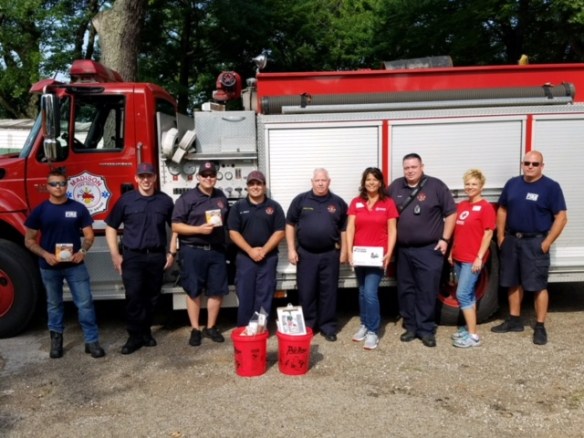
Volunteers from Mechanics Bank and the Mansfield Police Department with Red Cross workers on Richland County United Way Day of Caring,  August 3, 2018.

MANSFIELD, Ohio – Two Mansfield residents owe their very lives to free smoke alarms from the American Red Cross.

The alarms – installed during the United Way of Richland County Day of Caring on Aug. 4, 2017 – did their job on Feb. 13 this year, when fire broke out in a mobile home and a mother and her daughter were able to escape safely.

“Having working smoke alarms is vital to the safety and security of the residents in a home,” said Lara Kiefer, executive director of the Lake Erie/Heartland Chapter of the Red Cross, which serves Richland and six other northcentral Ohio counties.

“Most people think they have up to 10 minutes to safely escape a home fire, but studies show it’s closer to two minutes,” she said. The vast majority of the disasters the Red Cross responds to are home fires and tragically, seven people die every day in this country from home fire-related injuries.

In 2014, the Red Cross launched the Home Fire Campaign, a nationwide initiative to reduce the number of fire related deaths by 25 percent. Since the start of the program, more than 460 lives have been saved, including 12 in the city of Lorain.

To learn more about the importance of having working smoke alarms on every level of your home, or to ask for a home fire safety inspection and smoke alarm installation, visit soundthealarm.org/neo.

2018 Richland Co Day of CaringI

Lake Erie/Heartland Chapter Executive Director Lara Kiefer and Executive Coordinator Christina Ennis with members of the Madison Township Fire Department

On Friday, August 3rd, Red Cross volunteers and other community partners, including Mechanics Bank, the Mansfield Police Department and the Madison Township Fire Department, joined volunteers from the United Way of Richland County in this year’s Day of Caring, installing smoke alarms and providing fire safety education to Mansfield residents.

“It’s gratifying to know that our partnership with the United Way of Richland County has had such a positive impact in our community,” Keifer said, referring to the lives saved in Mansfield earlier this year.

To learn more about the many volunteer opportunities within the Red Cross – from preventing and responding to disasters (such as home fires) to serving our armed forces to teaching first aid, babysitting or water safety skills – visit redcross.org/neo and click the volunteer tab.

Veronica Wise, Volunteer and Longtime Blood Donor

By Christy Peters, External Communications Manager

Veronica Wise began her journey with the American Red Cross at the former Portage County Chapter. As a volunteer, she helped coordinate blood drives and was a regular blood donor. So regular, in fact, that she has given more than 210 pints of blood to help patients in need. It is an amazing gift to give, and Veronica was recently recognized by Nancy Janis, the Executive Director of the Summit, Portage and Medina Counties Chapter for her efforts on behalf of the Red Cross.


IMG_6192

Red Cross volunteer and blood donor Veronica Wise received a Red Cross pin from Nancy Janis, Executive Director of the Summit, Portage and Medina Counties Chapter.


Not only did Veronica impact her community and the countless patients she helped save through blood donation, she instilled that same commitment to giving in her family. Karen Wise, Veronica’s daughter, knew from a young age the importance of giving back. She watched her mother donate blood and it made an impression on her. “When I was 16 it was a given – get your driver’s license and your Red Cross donor card,” Karen said.


IMG_6178

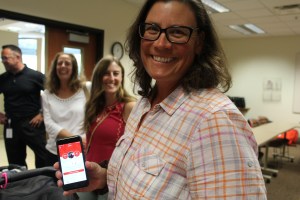
Karen displays the Red Cross Blood App

When asked about donating blood, 90-year-old Veronica insists, it wasn’t hard. “I enjoyed every minute of it.” The importance of donating grew for the Wise family when another of Veronica’s daughters was diagnosed with breast cancer. The family began giving platelets in her honor. Though, sadly, she lost her battle, the family continues to give blood regularly.


Karen shares that Veronica’s commitment left a mark on her family. “It’s something we can continue on,” she said. The Red Cross congratulates Veronica for her many donations and thanks her for inspiring so many to join her in helping save lives.  If you are so inspired, you can make an appointment to donate blood at RedCrossBlood.org, or call 1-800 RED CROSS.


Photo Credit: Jim McIntyre/American Red Cross.  Visit our album on Flickr for more photos.


NEO Shelter Closes

The longest-running shelter operation in Northeast Ohio in recent memory has ended.

For 11 nights, residents of the Loganberry Ridge Apartments in Richmond Heights spentIMG_6247 the overnights away from their homes, with some of their neighbors and American Red Cross workers as they waited for their homes to be deemed safe enough to reoccupy.  A fire on July 20, 2018 forced them from their apartments, and repairs kept them away until July 31.
IMG_6280

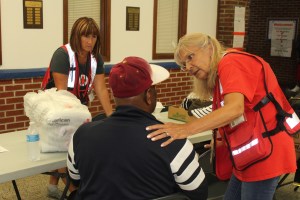
Red Cross volunteers Monica Bunner, left, and Sue Wisdom with a shelter resident


During that time, more than 50 Red Cross volunteers staffed the shelter, 24 hours a day.  The shelter operation began at Richmond Heights High School, where officials were able to move quickly to help accommodate nine residents the first night.  Due to previously scheduled school activities, the shelter location moved to the Christian Assembly Church on nearby Chardon Road, where an average of seven residents took shelter for the next nine nights.

“We operated a shelter for seven days in 2006, when the Grand River flooded in Painesville,” said Debbie Chitester, who has worked for the Red Cross in Northeast Ohio for more than 25 years.  She served as Director of Operations for the Richmond Heights shelter.  “We made sure the residents were safe, and tried to give them a home away from home.”

“Every one of my needs have been met,” said Tracy Foster, one of the Richmond Heights residents who stayed in the shelter. “I’ve had plenty of water, plenty of sandwiches, lunch, breakfast and dinner.”  Tracy was featured in a video on day three of the shelter operation.

Almost 1,000 meals and snacks were served during the 11-night shelter operation.  The cost of food and water, logistics, technology, and immediate financial assistance the Red Cross committed to giving residents affected by the fire totaled nearly $11,000.  The funds for assisting victims of disasters are only available because of the generosity of donors, and the power of volunteers, who mobilize every time disaster strikes in Northeast Ohio and across the country.  You can donate to the Red Cross or volunteer to help your neighbors during their darkest hours by visiting redcross.org/neo.

See more photos from the shelter operation here.

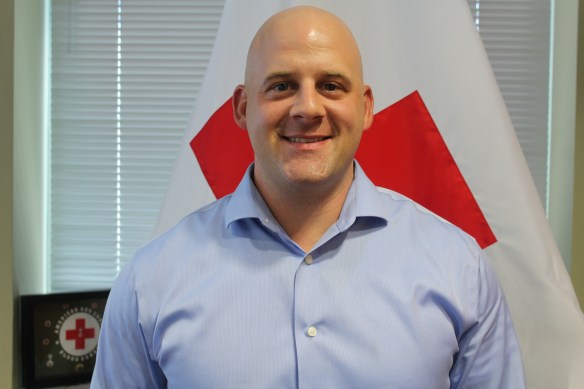
Spotlight on Josh Mattulat: New Executive Coordinator, Northeast Ohio Region

Former military officer reunited with CEO Mike Parks after losing his home in Texas during Hurricane Harvey

IMG_6236

By Brad Galvan, Red Cross volunteer

It’s apparent that retired U. S. Coast Guard Rear Admiral Michael Parks, the current CEO of the American Red Cross Northeast Ohio Region, agrees with U.S. Representative Dan Lipinski, who famously said, “On the battlefield, the military pledges to leave no soldier behind. As a nation, let it be our pledge that when they return home, we leave no veteran behind.”  Staying true to this pledge, Josh Mattulat was recently hired as the Red Cross Northeast Ohio Region’s executive coordinator.

Josh Mattulat spent two years as Mike’s right-hand man as military aide when both were serving our country in the Ninth  Coast Guard District headquartered in Cleveland. The district was involved in challenging missions spanning the Great Lakes, from search and rescue, to pollution control, to border security.

Following that assignment, Josh moved his family to Seattle to continue his Coast Guard career. For  three years, he led a team of more than 100 that focused on maritime safety and security.

In 2017, Josh and his wife Katherine, parents of four children, decided it was time to set down their roots and raise their children. Josh left the Coast Guard and the family moved to Galveston, Texas, where Josh launched his own business as a metal fabricator. Unfortunately, a few months later their home was destroyed by Hurricane Harvey. Safe, but displaced and devastated, Josh and Katherine decided they needed to get out of Texas to catch their collective breaths. During a short visit at Josh’s father’s home in Idaho, Josh was job searching and saw a position with the Northeast Ohio Red Cross working under Mike. It was a great fit and he applied.  Josh and his family now live in Chagrin Falls, Ohio, and he works for the Red Cross’ Northeast Ohio Region. He couldn’t be happier.

“I’m surrounded by great people who add value to their communities and beyond,” Josh said.  “And words can’t express how much it means to be reunited with a personal mentor like Mike.”

When asked about being reunited with Josh, Mike said, “I’ve known Josh Mattulat for many years, and I’m so pleased he’s bringing his energy, enthusiasm and skills back to Northeast Ohio to help us meet mission each and every day.”

Josh, like other military veterans, has transferable skills that were obtained while on assignment in the service. Many military members find it tough landing a job after leaving the military, even former officers. He explains that the organizational, leadership, communication and logistical coordination traits can be applied in most organizations and employers will be very impressed with the loyalty, commitment and enthusiasm that most military veterans will display in a civilian organization. These attributes will benefit and serve his new employer well as Josh put his skills to work and dedicates his service to the Red Cross.

Mike Parks would certainly agree.

This article was edited by Glenda Bogar, Red Cross volunteer


Red Cross Responds to Richmond Heights Apartment Fire

After spending a second night in an American Red Cross shelter at Richmond Heights High School, Tracy Foster felt relieved.

“Every one of my needs have been met.  I’ve been able to shower, feed my cat, and got breakfast lunch and dinner.”

IMG_6246

Foster is one of the residents of the Loganberry Ridge Apartments who stayed in the shelter, after dozens were chased from their homes by fire on Friday, July 20, 2018.  Because of the potential need to provide lodging for so many people, the Red Cross established the shelter with the assistance of Richmond Heights Local Schools.

Most residents found alternative lodging arrangements.  But on Friday night, nine residents took shelter in the school.

Red Cross partners at the Salvation Army supplied dinner on Friday night, and the Cleveland Animal Protective League delivered supplies for the dog and two cats the residents brought with them. Pets that aren’t service animals aren’t normally permitted in a Red Cross shelter, but Richmond Heights school officials made an exception.

“It means everything to me to have my love here with me,” Tracy said of her cat Diamond.  “She’s a house cat.  She’s always home.  The fact that the shelter made it possible for her to have her own little home here has made her much more comfortable with the devastation we’re going through.”

It is not known when the residents will be able to return to their homes. But until then, the Red Cross is committed to providing shelter for all in need.

See more photos of our response and shelter operation here.

“The people who are here are awesome,” said shelter manager Sue Wisdom. “They’re a great group of people.  They’re very caring and appreciative of everything the Red Cross is doing for them.”

While partners often help with meals, most of the food provided to residents is supplied by the Red Cross. Combined with the cost of training volunteer shelter workers, the cots and blankets supplied to shelter residents, transportation, storage and logistics costs, the expenses add up.  That’s why donations to the Red Cross are so important.  A $50 donation can provide a full day of food and shelter for one person, including three meals, a cot, two blankets, and a comfort kit as well as the costs to support the Red Cross workers providing this needed service.

sm1

Shelter volunteers Monica Bunner and Sue Wisdom consult with a resident at the shelter at Richmond Heights High School on Sunday, July 22, 2018.

Donations can be made by visiting the Red Cross website, or by calling 1-800-RED CROSS.

The Loganberry Ridge residents had to move out of the high school on Sunday – due to previous commitments there.  They were resettled nearby, at the Christian Assembly Church, where the same five residents stayed again Sunday night. And fortunately for Tracy, she was able to keep her beloved Diamond by her side.

“I’m very grateful to the Red Cross for putting me AND my cat up for as long as we need to be.  The people are very kind.  Very warm and helpful.”

Meet ERV – the Newest Red Cross Emergency Response Vehicle

By Doug Bardwell – American Red Cross volunteer

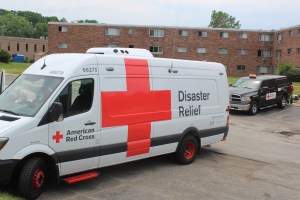
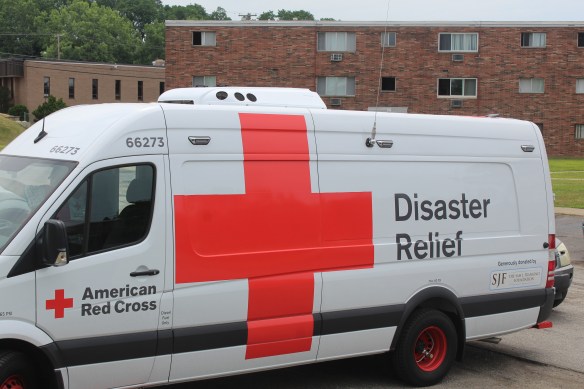
Responding to disasters, both locally and nationally, a team of two or more American Red Cross volunteers typically responds in an officially marked vehicle. For larger events, the vehicle of choice will probably be ERV – the Emergency Response Vehicle.

Originally, Clara Barton used a wagon for battlefield rescue missions.  As World War I and II occurred, military-style trucks were marked with the large Red Cross symbol and put into service.

Not until 1984 did the Red Cross begin standardization of the fleet, settling on the boxy, ambulance-style vehicle most often associated with disaster relief. Able to drive into affected neighborhoods to feed hundreds after a hurricane or tornado, the box truck design was also able to be loaded with hundreds of mops, pails and disinfectants for flood survivors.Red Cross Ready (002)

The design served the Red Cross admirably for years, but much of the fleet was more than 10 years old and in 2013, the decision was made to upgrade the fleet with a more modern vehicle type.

Meet ERV – Gen 2

ERV (002)

The newest style ERV is sleeker, more maneuverable and will cost less to operate than the last generation of vehicles.  And although they are more affordable, the vehicles are still very costly, at about $150,000 each.  We are grateful to The Sam J. Frankino Foundation, and Greater Cleveland Board Member Lorraine Dodero, for the generous donation that made the purchase of the new ERV possible.

IMG_6136

Greater Cleveland Board Member Lorraine Dodero cuts the ribbon for the new ERV, with Regional CEO Mike Parks

With modern materials and manufacturing processes, the vehicles are expected to last longer as well. While still providing ample room for supplies, the new ERV can easily be transformed from day-to-day local emergency responses, to hauling supplies for a larger disaster.

Modern two-way radio communications and GPS dispatching systems are just the beginning of the technology installed in the newest generation of response vehicles.  Ergonomics are also a large consideration, making it easier for both Red Cross volunteers and those being served alike.

Want to meet ERV in person?  Consider joining the team of volunteers known as the Disaster Action Team – who respond to local fires and other disasters.  Become a volunteer and help us provide support and hope when all seems lost.  Begin your volunteer process here.

EY Interns Help Make Dozens of Homes Safer

It was hot.  It was Friday the 13th.  But it didn’t stop more than 40 interns from Ernst and Young in Cleveland from making dozens of homes in the city safer, by installing smoke alarms and offering residents fire safety information.

They were helping the American Red Cross by taking part in a Sound the Alarm home fire safety and smoke alarm installation event.

IMG_6230

EY intern Nigel Williams of Marquette University installs a smoke alarm.

“When I learned about Sound the Alarm, and how the Red Cross makes so many homes safer by installing smoke alarms, I knew it would be a worthwhile project for our interns,” said Nick McCauley, Senior Manager, Assurance at EY and  a member of the board of directors for the Greater Cleveland chapter of the Red Cross.  “They loved being able to make a difference in so many people’s lives.”

The interns study at schools near, like Kent State University, and far, like Marquette University in Milwaukee.  They are working this summer at the EY office in downtown Cleveland.  But on Friday, July 13, 2018, they left the office and entered 77 homes in an east side neighborhood,  installing a total of 185 smoke alarms.

IMG_6228

EY Interns Nadia Dansani of Kent State University and Katherine Butler of the University of Cincinnati in the home of Danita Beamon Battle of Cleveland.

If you have an interest in helping make homes safer in vulnerable communities, become a Red Cross volunteer.  If you need smoke alarms in your home, visit soundthealarm.org/neo. To view more photos from the EY Sound the Alarm event, visit our photo album here.

Keep Your Pet Safe in the Event of a Home Fire

By Sue Wilson Cordle, Red Cross Volunteer and Board Member

Recent natural disasters like last year’s hurricanes, ongoing wildfires and even the volcano eruptions in Hawaii have brought pet rescue national attention. In a search and rescue situation, human safety always comes first, and pets are often left behind. We’ve all seen the heartbreaking pictures in the news of pets stranded in a life-threatening situation, making many of us realize that if we have pets, we need to make a plan to keep our pets, as well as our people-safe.

Far more common than a natural disaster, is a home fire. In fact, home fires are the most common disasters the Red Cross responds to, and the most preventable. I remember when I was in grade school, we had “Fire Safety Week” and the Fire Marshal from a local fire department came in and talked to all of us about an escape plan for our homes. We were reminded to go home and talk to our parents and perform at-home fire drills, similar to the ones we did in school, and to find a meeting spot in the yard to make sure everyone got out. I don’t recall dogs, cats or any kind of pets being in the escape planning, but they should be!

Sunday July 15th is National Pet Fire Safety Day, and the Red Cross has several suggestions to keep your family and pets safe in the event of a home fire. Most importantly, is prevention.

petfirst-app

Every year, pets are the cause of many preventable home fires. Curious pets can easily knock over lit candles, investigate what’s cooking on the stove, or even get into trouble if they get too close to a fire in the fireplace. Here are a few tips to keep pets safe around the house:

  • Ensure your pet is never left unattended around an open flame
  • Remove or protect stove knobs so they can’t accidentally jump up and turn on the stove
  • Invest in flame-less candles. Cats are known for batting at and knocking down lit candles
  • Secure especially active and young pets either in a crate or behind a gate in an easily accessible area

In the event of a fire, help firefighters find your pets easily.

  • Keep pets near an entrance while you are away from home
  • Invest in pet alert window clings to let firefighters know you have pets and how many
  • Keep collars on your pet so they can be leashed to escort out (cats and dog hide in fear and are sometimes difficult to capture)

Get more information  on how to keep your pet safe and learn more about pet first aid and sign up for a pet online first aid course here.