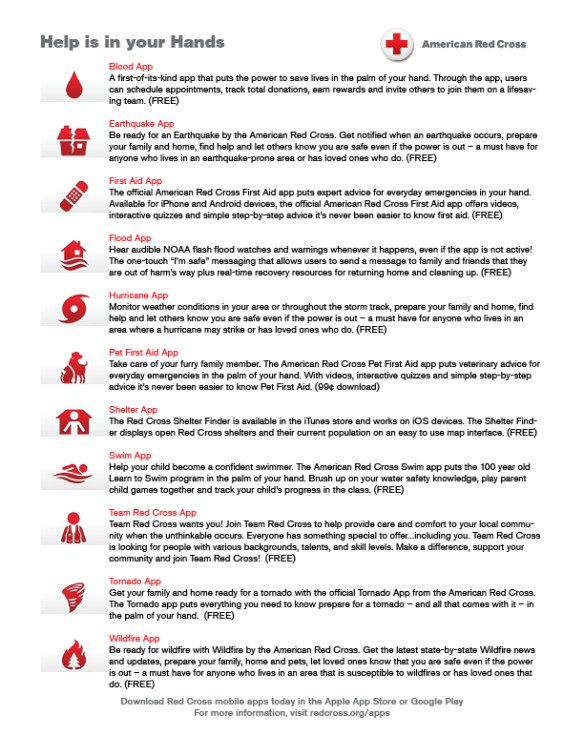
Download a flyer with all of the apps: Help Is In Your Hands .

Join us for the second annual America’s PrepareAthon! national day of action.
The last few years have been an important reminder to all of us that disasters can strike anytime and anyplace. Nearly every region of the country experienced some form of extreme weather event, including devastating tornadoes in Oklahoma, scorching wildfires throughout California, and destructive flooding in Northeastern Ohio.

The destructive power of weather affects all communities. Learning how prepare for an emergency will help determine your course of action during a disaster.
As with many life events, preparation is the key to success. When you prepare and practice for an emergency in advance of an event, it makes a real difference in your ability to take immediate and informed action when it matters most. Early action can also help you to recover more quickly.
That’s why thousands of individuals, organizations, schools, houses of worship, and local governments across the Nation are actively participating in a new national campaign for action – America’s PrepareAthon!
The Red Cross continues to support and promote this action-based initiative to build a more resilient Nation starting with the national day of action on September 30.
Can’t participate on September 30? Preparing for disasters is a year-round activity. So pick a date that works for you. You can still register to be counted in the movement. And be sure to post your preparedness activities on the national calendar.
It’s not a matter of if the next disaster will happen, but when. Take action and prepare now by completing simple steps such as making a plan and having an emergency kit. Start the conversation in your family today. It can help determine what you need to do next to become more prepared.
Be smart, take part, and prepare for emergencies before they strike!
Look for our volunteers on Dawg Pound Drive just outside the stadium at tomorrow’s Browns vs. Ravens game!
The Cleveland Browns are encouraging fans to volunteer 10 hours of service in their own communities during the year.
The First and Ten initiative, which launched in June of 2014, is the first of its kind in the NFL. The Browns are hoping that fans will volunteer over 500,000 hours to communities throughout the area, and really, anywhere that a Browns Fan may live. With over 10,000 pledges already in, they are well on their way to meeting that goal.
This is a perfect partnership for the American Red Cross, which relies on volunteers to continue its mission to prevent and eliminate human suffering in the face of emergencies. Volunteers make up more than 94% of the workforce of the Red Cross.
How can you volunteer to #Give10 hours to the Red Cross in your community?
You can get started as a volunteer by going to www.redcross.org/volunteer and filling out the online form.
Then head over the Brown’s First and Ten website to register, as a Browns’ fan, to give 10 hours in your community.
Share your #Give10 story
If you are social media savvy, you can share your story of giving 10 hours by using the hashtag #Give10 on Twitter. Then tag @BrownsGiveBack and @NEORedCross. Fans can follow the #Give10 movement on Twitter by following @BrownsGiveBack or searching for the hashtag #Give10.
Disaster volunteers responding to a flood call in Lorain #give10 @LCVolunteer @YourChronicle pic.twitter.com/ivX3Y4EGw8
— NEO Red Cross (@NEORedCross) September 12, 2014
Not on twitter? Share your story of volunteerism by visiting the First and Ten site.
When disaster strikes, all members of the family should be prepared with a disaster kit – including your pets. Keep items in an accessible place and store them in sturdy containers so that they can be carried easily.

Pictured beside Zack and Zoe are leashes, water, food, Vet information, dog toys, a towel, dog treats, medical history, medicine, current picture of Z&Z and a water bowl.
Your kit should include—
Click here for a complete list of pet disaster preparedness items: http://www.redcross.org/images/MEDIA_CustomProductCatalog/m3640126_PetSafety.pdf
Pets will look to family members for comfort during all the changes that disasters bring. Having a plan ahead of time will reduce stress and ensure you that you can care for your furry family members.
The Red Cross is launching a first-of-its kind Blood Donor App that puts the power to save lives in the palm of your hand.
The app makes it easier, faster and more convenient for users to schedule and manage their donation appointments, track the lifetime impact of their donations, and recruit friends and family to roll up a sleeve with them.
As the nation’s single largest supplier of blood and blood products, the Red Cross is uniquely positioned to bring this cutting edge technology to blood and platelet donors. In addition to scheduling and managing blood donation appointments, other features of the app include:
• A blood drive or blood donation locator;
• The ability to sync a blood donation appointment with the user’s calendar;
• Donors can share personalized #selfies about their donation experience through social media;
• Unlock special badges through interaction with the app, make donations and spread the word;
• A chance for donors to come together to form teams, tracking their cumulative impact and viewing standings on the Blood Donor Teams Leaderboard;
• Exclusive offers and discounts from some of America’s best brands, including Shari’s Berries, ProFlowers and 1A Auto, with new rewards added regularly; and
• Uplifting donor and blood recipient stories that show the power of rolling up a sleeve to help save lives.
The Blood Donor App, along with the Red Cross suite of preparedness apps, can be found in app stores by searching for American Red Cross. You can also visit redcross.org/apps or redcrossblood.org/bloodapp, or text* BLOODAPP to 90999 for a direct link to download.
Eligible blood donors do not need a smartphone to schedule an appointment to give blood. Appointments can always be made by calling 1-800-RED CROSS (1-800-733-2767) or by visiting redcrossblood.org.
How to donate blood
A blood donor card or driver’s license or two other forms of identification are required at check-in. Individuals who are 17 years of age (16 with parental consent in some states), weigh at least 110 pounds and are in generally good health may be eligible to donate blood. High school students and other donors 18 years of age and younger also have to meet certain height and weight requirements.
* Message and data rates for texting may apply.
September is National Preparedness Month. There are many ways that your family and community can prepare for an emergency. Over the next few weeks, we’ll be showcasing some of the simple steps that you can take to get prepared.
 The simplest way to prepare for a crisis is to have an emergency kit ready to go. An emergency kit is made up of basic necessities that will help you and your loved ones survive sheltering in place. (To shelter in place means that you are staying in a safe space in your home for any amount of time, like when you go to your basement or other enclosed area during a tornado warning.)
The core items needed for a basic emergency kit are available at many of the locations where you do your weekly shopping, so it doesn’t even require a special trip to get started!
Your kit should include:
Don’t forget to include specialized items for all of your family members, especially the tiny or four-legged ones! If relevant, be sure to include:
And some additional supplies that would be good to keep at home or in your survival kit (based on the types of disasters common to your area):
For more information on building an emergency kit, visit www.redcross.org/prepare or download our free Situational Emergency apps.
On Twitter? Show us your kit! Tweet a picture, tag @neoredcross and use the hashtag #NatlPrep.
One piece of the mission of the American Red Cross is to prevent human suffering in the face of emergencies. The simplest way to do that is to help individuals and families learn how to be prepared for the disasters that happen in our communities. When a disaster strikes, because it can and will happen, everyone will have the tools and knowledge to respond accordingly.

The month of September is National Preparedness Month. For the Red Cross and many of our partner organizations, September is the perfect opportunity to voice the power of being prepared in our homes and in our communities.
There are so many simple, quick ways to prepare for an emergency situation.
All September long, our blog will be dedicated to details ways that you can get your family prepared, so be sure to subscribe or check back often.
If you are regular reader of this blog or just happened here through Google, please, share this link with your friends and colleagues. It is vitally important that we help ourselves and each other before an emergency situation happens.
Tonight we had over 30 Disaster Responders attend an orientation in preparation for the Perry Nuclear Power Plant exercise in September. There were volunteers representing 5 chapters from around the region.

Jessica Sandoval, a summer intern with the Lorain County Chapter, displays her Leadership Lorain certificate.
Following my sophomore year as a marketing major at University of Dayton, I became involved with the Lorain County Chapter of the American Red Cross through the Leadership Lorain County Internship Program. As the Communications Specialist Intern, I was responsible for increasing Red Cross awareness and donations through effective communications, public relations and the use of social media tools.
Previous to my assignment, I knew very little about the American Red Cross, but I was quickly amazed by this incredible organization. The American Red Cross is a non-profit organization and not a federal agency. As such, it receives no regular federal funding. The Red Cross also does a lot more than host blood drives. Each region is well equipped with a Disaster Action Team, Disaster Mental Health Team, and an array of other volunteers. They also offer services to the Armed Forces—from preparing soldiers and their families for deployment to getting those same soldiers emergency contact with their families while overseas.
Based on my experience, I do not think the public is well aware of the extent to which the Red Cross helps our local, as well as national, communities.
While attending a Friday Forum at the Cleveland City Club to hear President and CEO of the American Red Cross, Gail McGovern, speak I met a volunteer who truly changed my life. The woman, who dedicates 100% of her time to volunteering, and I discussed her career in the medical field and a trip she took to India to treat patients in a poor village. I commended her on her voluntarism and expressed how I wished my future profession in the business world would allow me to help people the same way hers does. I commented that those in the medical field have the ability to go the extra mile and help people in a more profound way than any other profession. She informed me it is not an extra mile, but a different mile.
During my time at the Lorain County Chapter I helped prepare for the annual 5K Run for the Red, and have witnessed the chapter go through a merger with the Firelands Chapter. I also created several campaigns for different chapter events including Christmas in July which supported the annual Holiday Mail for Heroes and the Pillowcase Project sponsored by Disney. I contributed blogs on chapter events and also created a Social Media and Marketing timeline for the annual 5K. I also canvased for our 5K, made phone calls in hopes of obtaining donations, and spread Red Cross awareness whenever and wherever I could. As a marketing major, I believe I learned so much about my future profession as well as what it is like to work for a non-profit organization. I had the opportunity to become CPR Certified as well as take Disaster Overview and Fundamental courses.
Whether it was hearing a volunteer’s Red Cross Story, or learning something new about my major (or even myself), I was inspired every single day when I stepped over the threshold of that history Lorain County building. I could not agree more with President and CEO of the American Red Cross, Gail McGovern, when she says, “the depth and breadth of all the Red Cross does still amaze me, and it’s an incredible privilege to play a part in it.” I plan on continuing my involvement with the American Red Cross as I complete the last two years of school and well into my future.
 NOHredcross