Volunteering Spans Generations for One Red Cross Family

Grandfather, Grandson in North Carolina Helping with Hurricane Response

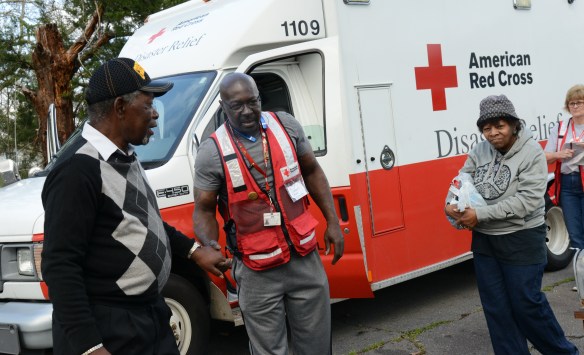
Alejandro Reynoso is trying to teach his grandson a lesson. His classroom is a Red Cross emergency response vehicle.

Mr. Reynoso and his grandson, 18-year old Dominic drove the ERV from Arizona to North Carolina to help people affected by Hurricane Matthew.

img_2675

“I think we should all take some time to contribute to society,” Mr. Reynoso says.  “It’s more of a duty.”

Dominic just graduated from high school, and isn’t sure what he wants to do in the future.  But for the present, he and his grandfather are busy dishing out bratwurst and baked beans, canned pears and potato chips to North Carolina residents impacted by flooding and other storm damage.

They make a good team.

“That lady told me she hadn’t eaten in three days,” Dominic says of one flood-affected resident, who received food prepared by the Southern Baptist Disaster Relief organization.  He gave her two meals and a case of bottled water.  “She said she has no water either.”img_2663

Mr. Reynoso is a Vietnam veteran who left his engineering firm to volunteer in North Carolina.  “That’s the price you pay.  It’s unconditional.  The reward is being asked to come back.”

That is the lesson he hopes to impart on his grandson.

If you would like to volunteer for the Red Cross, log onto redcross.org.

img_2756

Photos and story: Jim McIntyre/American Red Cross

NEO Volunteers and Staff Head to the East Coast for Hurricane Matthew Response

emily-probst“My name is Emily and I am the Disaster Program Specialist for the Greater Cleveland Chapter. I am heading out on my first deployment to assist with disaster relief for Hurricane Matthew. I am very excited to get down to Florida and make a direct impact to the community. I started working for the Red Cross because I wanted a job where I was making a positive impact everyday! I am more then ready to take this next step in my work and hit the ground running upon my arrival. “

Including Emily, nineteen NEO Red Cross workers have deployed to the East Coast, and many more are expected to leave in the coming days.

The Red Cross has launched a massive sheltering operation in response to Hurricane Matthew with more than 27,000 people seeking refuge in almost 200 Red Cross and community evacuation shelters across three states Thursday night. This included 133 shelters in Florida with more than 22,000 people; 18 shelters in Georgia with more than 2,100 people; and 47 shelters in South Carolina with more than 2,500 people.

More than 1,800 Red Cross disaster workers from across the country are on the ground or traveling to the southeast to support evacuation shelters and response efforts. In addition to providing a safe place to ride out the dangerous storm, the Red Cross is preparing to deliver relief supplies and help people recover from Matthew as soon as it is safe to do so.

The Red Cross has deployed numerous emergency response vehicles and 35 trailers filled with items like water, ready-to-eat meals, shelter and kitchen supplies, cleaning supplies and comfort kits, insect repellant, gloves, masks, shovels, rakes, coolers and more. The Red Cross is also working in close collaboration with government officials and community partners to make sure people get the help they need.

If someone you know needs to find a shelter, they can visit redcross.org, check the Red Cross Emergency App or call 1-800-768-8048. Anyone who plans to stay in a Red Cross shelter should bring prescription medications, extra clothing, pillows, blankets, hygiene supplies, important documents and other comfort items. They should also include any special items for children, such as diapers, formula and toys, or for family members who have unique needs.

Donations help those affected by disasters, big and small. To donate today, visit www.redcross.org/donate.

After Escaping Home Fire, Family Finds ‘Great Help’ from Red Cross

Christine Stevens was making coffee on a September morning when her Cleveland home caught fire.

As the smoke alarm sounded, Stevens and her teenage son and daughter fled to safety. The Cleveland Fire Department put out the blaze, but the family was suddenly left homeless with no immediate return in sight. A sparking electrical box caused the fire, and firefighters advised that the wiring for the house—which Stevens rented—needed to be brought to code.

img_1984

“I was scared,” Stevens said. “Where am I gonna live? What am I gonna do?”

She learned that the American Red Cross was on the way to offer help, which “kinda calmed me down.”

Upon arriving, Red Cross Disaster Program Specialist Emily Probst and volunteer Mike Gaynier met with the family, providing snacks, personal hygiene items, initial financial assistance and the reassurance of follow-up support for their recovery.

Photo credit: Jim McIntyre/American Red Cross

Stevens, whose family is staying with her mom and a friend, was grateful for the Red Cross assistance to help get back on her feet.  “They gave me some money [and] gave me some food and toiletries, which is a great help,” she said.

All Red Cross disaster assistance is free.  We rely on the generosity of donors to respond to families like Christine’s.  If you’d like to donate to disaster relief, log onto redcross.org and click donate, or call 1-800-RED CROSS.  You can also text the words RED CROSS to 90999 to make a $10 donation.

October is National Fire Prevention Month.  It’s a great time to safeguard your family against home fires.  To receive a free home fire safety inspection, information about preventing home fires, help with creating an escape plan, and free smoke alarms for your home, log onto our Operation Save-A-Life page.

Residents of Cleveland can call 216-361-5535. Akron-area residents can call 330-535-2030.

And you can download the Red Cross Emergency App, which has helpful information about preventing home fires.


Restoring Courage and Hope

Psychologist Volunteers to Help People During Their Darkest Hours
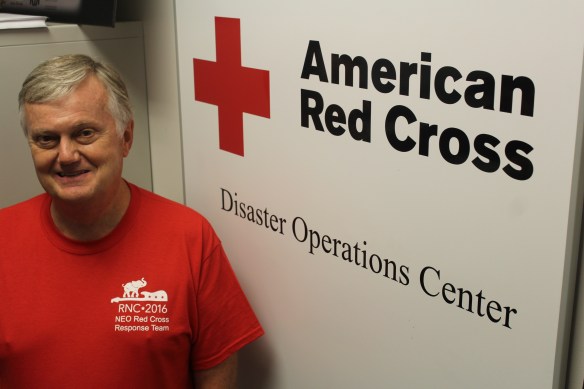
Kriss Wyant

By EILENE E. GUY
American Red Cross volunteer

CLEVELAND – “Volunteering with the American Red Cross in general, and for me in particular, represents a profound privilege.  It doesn’t take long to realize how close we all are to needing help,” says Kriss Wiant.

A psychologist by profession and a humanitarian by nature, Kriss finds valuable perspective and rich reward as a disaster mental health volunteer.

With more than 20 years of experience helping children, adults and families in conventional clinical settings, Kriss was looking for what he calls “innovative applications of psychology.” A chance encounter with a Red Cross Disaster Action Team member led him to join that group, responding to home fires, floods or tornadoes across the Greater Cleveland area.

“Connecting people with primary resources – food, shelter, essential medications – that goes a long way to helping people in their time of acute need,” he says.

Eventually, Kriss – who makes his home in Brecksville – decided to make himself available for deployment to larger-scale disasters beyond the Buckeye State.  Of the nine major relief operations he has traveled to, most have been related to tornadoes or hurricanes. Although working conditions can be challenging and stress levels high, Wiant knows how to make a difference.

“The unifying need among those traumatized by a disaster is the loss of courage, the loss of hope,” he says in the gentle, knowing tone of someone who understands trauma as both a doctor of psychology and a first-hand observer. “So what we do is restore courage, restore hope. Most of us can do that, even just by our presence.”

Kriss believes that even the untrained individual can offer psychological first aid. “You are standing on the shore for someone in the deep,” he says. “The only question is, how far can you wade in to reach that person.”

In the wake of a tragedy as dramatic as the May 2013 tornado that killed 24 people – including nine children – and caused an estimated $2 billion in property damage in Moore, Okla., Kriss was part of a large Red Cross mental health outreach to families of those who lost their lives or were seriously injured.

Some people, he found, had the emotional stamina to surround themselves with family, friends and faith; others he pointed toward local resources for longer-term professional support.

At the same time, he watches for signs of stress among the Red Cross responders who work long hours and interact with clients in often-devastating situations. He encourages workers to talk, to share their experiences. “That can be very therapeutic ,” he says.

Kriss is one of some 300 Red Cross disaster volunteers across the 22 counties of Northeast Ohio. Most respond to local disasters or participate in prevention activities such as Operation Save-a-Life, installing thousands of smoke alarms. Those with the time, training and experience can volunteer to respond farther from home.

In addition to his work helping people affected by disasters, Kriss provides Service to the Armed Forces.  In fact, he is one of 5 recipients of the Vega Award, given annually to individuals or groups that have performed outstanding service in a department/line of service for the Greater Cleveland Chapter.  Kriss was honored for his on-going support to the military community,  helping to develop Reconnection Workshop-type materials that have been used in two pilot projects with the Troop and Family Assistance Center, as well as with the Ohio Army National Guard Recruit Sustainment Program. The workshops aim to provide coping and reunification skills to family members of National Guard recruits who are preparing to leave for basic training or Advanced Individualized Training, as well as educate families on a board range of services within the military community and via the Red Cross.  In addition, Kriss makes follow up calls to those who have utilized the Red Cross Emergency Communication services, completes home visits to local veterans, and is a Reconnection Workshop Facilitator.

Other Vega Award winners, honored on Saturday, September 17, are Rita Szymczak, Mark Cline, Rhoda Seifert, and SAF Reconnetion Workshop Facilitators Tom Adams, Lynne Wiseman, Jackie Otte, and Kathy Parsons.

Visit the Greater Cleveland Chapter Facebook Page to see a photo gallery from the Volunteer Recognition Event.

To learn more about the wide variety of volunteer opportunities with the Red Cross – including Service to the Armed Forces, health and safety education, and blood services – visit www.redcross.org/neo and click on “volunteer.”

NEO Red Cross Continues to Support Victims in Louisiana

According to meteorologists, more than 6.9 trillion gallons of rain – enough water to fill 10.4 million Olympic pools – deluged Louisiana this week.

On Wednesday night, more than 4,100 people were still seeking refuge in 30 Red Cross and community shelters in Louisiana. And the flooding danger is not over. More rain is falling in Louisiana and flood waters are moving down-river, which could cause damage in new areas. The Red Cross is closely monitoring the situation to be ready to mount an additional response if necessary.

Red Cross volunteers – including 16 from right here in Northeast Ohio – continue to help thousands of people in Louisiana in what is the worst natural disaster to hit the United States since Superstorm Sandy in 2012. This response is anticipated to cost at least $30 million – and this number may grow as we learn more about the scope and magnitude of the devastation.

The flooding in Louisiana has left many areas without power and phone service, making it difficult for loved ones to connect. Local emergency lines have also been inundated with calls for help. The Red Cross has two ways to help families reconnect:

  • The Red Cross Emergency App features a “Family Safe” feature that allows people to check on loved ones who are in an area affected by an emergency and instantly see if they are okay – even if that loved one hasn’t downloaded the App on their device. The App is free and can be found in the app store for your mobile device by searching for “American Red Cross” or by going to redcross.org/apps.
  • The Red Cross is encouraging people to register on our Safe and Well website, www.redcross.org/safeandwell, to help people reconnect. If you are concerned about a loved one, visit the “Search” page, enter the person’s name and pre-disaster phone number or complete address. If you are outside the disaster area and you hear from loved ones without access to a computer, you can register them through Safe and Well. That way, other loved ones can be reassured as well.

Large disasters like this flooding create more needs than any one organization can meet, and the Red Cross is working closely with the entire response community – federal, state, county and local agencies, other non-profit organizations, churches, area businesses and others – to coordinate relief efforts and deliver help quickly and efficiently, keeping in mind the diverse needs of the community.

The Red Cross urgently needs the public to join us in supporting Louisiana by making a financial donation today. Help people affected by the Louisiana Floods by visiting redcross.org, calling 1-800-RED CROSS or texting the word LAFLOODS to 90999 to make a $10 donation. Donations enable the Red Cross to prepare for, respond to and help people recover from these disasters.


Bring IT On: Disaster Services Technology

When a disaster strikes, who is it that gets the basic IT services that we’ve come to depend upon back up and running? The Disaster Services Technology team – a unique group of volunteers who deploy to a disaster response to set up communications technology!

The team provides the necessary infrastructure that a response may require, from internet capabilities (think: Safe And Well Services) to telecommunications (like an antenna based radio if cellular services are down).

“We can service everyone from a single user connection up to a whole site,” said Ed Finley, National Field Communications Engineer.

This week the team held a rare hands-on training at our Akron office. The three-day course is only offered once a year in each division. The training staff has already taught the course in Mobile, Ala.; Oakland, Calif.; and Austin, Texas. After Akron, they will head out to Tinton Falls, N.J.; Columbia, S.C.; and Minneapolis, Minn.

The course gives volunteers the opportunity to train on equipment that will deploy to a disaster response; such as laptops, cell phones, routers and satellites.

“Not only will students learn how to set-up and use the equipment, but also that there is a support system behind them that will help them get through the process and be successful,” said Ed.

Students at the Akron class hail from all over Ohio and the rest of the country – California, New York, New Jersey, Arizona, Florida, Pennsylvania, Indiana, Michigan, Kentucky, and West Virginia.

If you are interested in joining the Disaster Services Technology team, visit www.redcross.org/volunteer and sign-up to be a volunteer. You’ll go through a couple of basic Red Cross courses, including Disaster Services Technology Overview, and from there you’ll be able to train with some of the IT leaders who we are lucky enough to have living in Northeast Ohio before deploying.

This slideshow requires JavaScript.


A Report on the Flooding in Louisiana

By: Pam Williams, volunteer


Since the flooding in the south began three weeks ago, nearly 2,000 Red Crossers working alongside partners have provided 4,700 overnight stays in 60 shelters; served 290,000 meals and snacks; distributed more than 119,000 relief items including comfort kits and cleaning supplies; and provided nearly 9,000 health and mental health consultation.

I deployed to Louisiana as part of the External Relations team. As a Government Operations Lead, I helped coordinate necessary services and activities with local, state, federal and Tribal government partners and worked with our Community Partner Services volunteers who identify non-government partners, private agencies and/or organizations and members of the affected communities to assist those affected by the disaster.

This was my 22nd deployment and several of them have been in response to floods. My friends think I’m off to see the country, and I suppose they’re right, but I’m seeing it in pain. However, while each disaster and each response is different I have found one constant – I am seeing people at their best. Whether it is Red Cross volunteers who leave their lives and families to respond, community groups who step up to help their neighbors or those affected by the disaster who are amazingly resilient there is a spirit that moves people forward.

Since returning to Northeast Ohio, here are some of the things I have learned about the response in Louisiana:

  • This is the largest sheltering operation for the Red Cross in Louisiana since Hurricane Gustav and Ike in 2008, and Hurricane Isaac in 2012.
  • As many as 12,000 people have been impacted by the flooding across the state with hundreds of residences either destroyed or receiving major damage.
  • The Red Cross estimates that we will spend between $8.5 million and $11.5 million helping people affected by spring floods and storms across Texas, Mississippi, Louisiana and Tennessee – and we haven’t raised anywhere near the millions of dollars we’re spending to provide the relief needed.
  • Since the flooding began, the Red Cross and our partners have provided more than 3,000 overnight stays in 30 shelters; served 216,000 meals and snacks; distributed 53,000 relief items including comfort kits and cleaning supplies; and provided 3,800 health and mental health consultations in Louisiana alone. Over three weeks into this response operation we are still sheltering affected residents and pockets of previously unidentified people are popping up everyday. There are over 430 areas that continue to be marked as inaccessible so our Disaster Assessment teams can’t yet get in to see how badly the homes have been affected.

The Red Cross has also deployed hundreds of volunteers (like me) to staff these disasters–and we are appealing for additional Red Cross volunteers now. The time and talent of every volunteer makes a real difference in people’s lives. Go to redcross.org/volunteer today to learn more about volunteer opportunities and how to submit a volunteer application.

Louisiana Floods 2016

Sunday March 13, 2016. Rayville, Louisiana. Bobby Ray Griffin and Mildred Means took on more than a foot of water in their Rayville, Louisiana, home. They had already spent much of the day removing flood-damaged furniture from their home when Red Cross volunteers came through their neighborhood with snacks and water. Photo by Daniel Cima/American Red Cross

Louisiana Floods 2016

March 14, 2016. Monroe, Louisiana. At 9-months-old, Jakenzie Bradford is one of the youngest staying at this Monroe, Louisiana, Red Cross shelter. She and her family where displaced when floodwaters entered their home nearly a week ago. The Red Cross provides a safe place where children and families can feel comfortable and secure as they begin the road to recovery after disasters like floods. Photo by Daniel Cima/American Red Cross

Combined Community and Red Cross Response to Brunswick Apartment Fires

Dozens of residents were forced from their homes this week in Brunswick, where two separate apartment building fires broke out within days of each other.  Both fires drew American Red Cross response.

Late Monday night, fire broke out at the Hickory Hill Apartments.  It drove residents from 24 units away from their homes.  More than 60 people were affected.

A four year-old girl died in the fire.  Six others were injured.

The Red Cross set up an area inside Hilkert Hall, on the campus of St. Ambrose Catholic Church nearby, to allow volunteers to assist the affected residents, who were given more than $9,000 collectively in financial assistance.  The money was to be used for lodging, food, clothing, and whatever the residents needed to help get them through the initial hours and days following the disaster.

In addition, neighbors brought clothes, food, household items and cash donations to the church, where the affected residents were invited to sort through the donations and take what they needed.

The Red Cross will provide follow-up assistance, such as referrals to other community agencies and mental health counseling  as needed.

Photo credit: Jim McIntyre/American Red Cross

The second fire in Brunswick occurred early Thursday morning, at the Laurel Hill Apartments, where one unit was destroyed and 11 others were damaged. Assistance totaling at least $3,500 was given to the affected residents.

There were no serious injuries reported.

The Red Cross offers free smoke alarm installation and fire safety information through the Operation Save-A-Life initiative.  You can learn more at redcross.org/neoosal.  

And donations for those affected by disasters big and small can always be made by calling 1-800 RED CROSS, or by logging onto redcross.org, or by sending the words RED CROSS via text message to 90999.

Carbon Monoxide Kills, Alarms Save Lives


CO

Photo credit: Cal Pusateri/American Red Cross Volunteer

Winter has finally decided to show up. With it has come deep snow in most areas of our region, and cold temperatures.

Given the increase in the number of carbon monoxide emergencies during cold snaps (like in this story), we want to remind you to exercise caution when heating your home.

Carbon monoxide is an invisible, odorless and silent killer that, nationally, claims hundreds of lives each year. A threat year round, carbon monoxide poisoning tends to increase when storms and power outages force people to turn to unsafe alternative heat sources such as fuel-burning appliances, gas generators, camp stoves and charcoal grills and use them in confined spaces.

The best way to keep your family safe during this time is to install carbon monoxide alarms and learn how to reduce the risk of carbon monoxide poisoning.

“Every home should have at least one carbon monoxide alarm in addition to their smoke alarms,” said Tim O’Toole, Regional Disaster Officer of the Red Cross of Northeast Ohio. “If there is only one carbon monoxide detector, it should be in or near sleeping areas. Both carbon monoxide and smoke alarms are relatively inexpensive and easy-to-maintain devices that have been proven to save lives. There are even models that feature a combined smoke and carbon monoxide alarm.”

Follow these safety recommendations:

  • Furnaces and other natural gas fired appliances should be serviced once a year.
  • Install carbon monoxide alarms in central locations on every level of your home and outside sleeping areas (avoid corners where air does not circulate). Test the alarm every month.
  • Have heating systems (including chimneys and vents) inspected and serviced annually, checking for blockages, corrosion, and partial and complete disconnections.
  • Never use a generator, grill or camp stove inside a home, garage or basement.
  • Do not use gas appliances such as ranges, ovens or clothes dryers to heat your home.
  • Know the symptoms of carbon monoxide poisoning: headache, dizziness, weakness, nausea, vomiting, sleepiness, and confusion. If you suspect carbon monoxide poisoning, move quickly to a fresh air location, and then call 9-1-1.
  • Treat the alarm signal as a real emergency each time. If the alarm sounds and you are not experiencing any symptoms described above, press the reset button. If the alarm continues to sound, call the fire department.

Download the Red Cross First Aid App at redcross.org/apps to get access to life-saving information on what to do for common, everyday first aid emergencies.

For more Red Cross fire safety and preparedness information, visit redcross.org/homefires.

Weather, Water and Home Fires: Our Weekend Update

As Red Cross chapters across the east coast began to ramp up a Winter Storm response for this past weekend’s weather, the Lake to River Chapter (covering the eastern edge of Ohio) began a response of a different kind.

In the shadow of the massive response to the water crisis in Flint, Mich., the Ohio Village of Sebring announced that testing had revealed elevated levels of lead in water from the Village of Sebring Public Water System.  In response, the Mahoning County emergency management agency (EMA) has established a bottled water distribution at the local community center (305 W. Texas Ave.)

Lead can cause serious health problems, especially for pregnant women, infants and children.

The Red Cross has been supporting the volunteers who are distributing water. We have been attending to their needs – providing meals, coffee, drinks and snacks – as they see to the needs of the community.

According to our partners at the Mahoning EMA, the State of Ohio is working to meet the bottled water needs of the community. No donations are required at this time.

Additionally, we continued to respond – as we do every day – to home fires throughout the region. This weekend, alone, we responded to 13 home fires. Through the generosity of our community, we were able to provide financial assistance to these families for things like shelter, emergency clothing, warm coats, food and hope to help them through the next few nights.

If you are interested in learning more about volunteering in your community, visit our page www.redcross.org/neo and click on Volunteer in the left-side menu. You can also reach our Volunteer Services department at 216-431-3328 or by emailing, NEOvolunteer@redcross.org.