By Mike Arthur, Regional Mass Care & Logistics Manager, American Red Cross of Northern Ohio
I’m grateful to live in northern Ohio, one of the safest areas of the country from a weather-related disaster standpoint. We don’t have to worry about a hurricane coming and wiping our homes away. We are unlikely to walk out our front doors and have trouble breathing due to smoke from a nearby wildfire.
I have never worried about the fate of my family and myself, where we would live and work after a disaster destroyed my home and place of work. I have never had to make a decision about which of my hard-earned belongings I need to take with me when I evacuate. I have never had my community devastated. Every year thousands of families have their lives changed drastically when their homes and communities are affected by disasters large and small.
Mike Arthur, during the Red Cross response to hurricane Harvey in Houston, Texas in 2017
I’m also grateful that I get the opportunity to help people in need. As a Regional Mass Care & Logistics Manager, I get to put the skills and talents learned over the course of my life to good use leading and supporting the American Red Cross workforce in meeting the needs of our clients locally and nationally.
I get to deploy for a few weeks each year making an immediate difference in someone’s life. Deployments to large disasters are tough but incredibly rewarding. The hours can be long. The food is not always five star. I sometimes sleep on a cot in a staff shelter with my fellow workers. It can be stressful. Compassion fatigue is a risk.
Residents wait to receive clean up supplies from the Red Cross after hurricane Harvey in 2017.
I look forward to each deployment and go as often as I can. I feel like I make a difference. I have made incredible friends across the country. I have great stories to tell. I get to bring hope to those in need. I help provide a safe place to sleep and food in bellies, and sometimes, most importantly I can provide a warm hug, bright smile and a sympathetic ear. My life is fuller because of my deployment experiences. I hope you will take to opportunity to join me out in the field this year and experience the magic of helping.
Help those in need when they need it most by becoming a volunteer with the Red Cross. To find a volunteer opportunity that’s right for you, visit redcross.org/volunteer.
Summer: a time for family gatherings, swimming, grilling, and many more events that have become staples of the season. Whatever your plans are, the American Red Cross Northern Ohio Region has some resources you can use to help you, and even your four-legged friends, have a safe summer.
July 30, 2014. City of Myrtle Beach Parks and Recreation, South Carolina. Julieth Martinez, 4, enjoying her swim lesson as part of the Centennial campaign. Photo by Connie Harvey/American Red Cross
WATER SAFETY
Every day, an average of 11 people die in the U.S. from unintentional drowning — and one in five of those are children 14 or younger according to the Centers for Disease Control and Prevention (CDC). The Red Cross wants everyone to know critical safety knowledge and skills that could save your life in and around the water. We encourage families to build confidence in the water by learning to be safe, making good choices, learning to swim and how to handle emergencies. · Preventing unsupervised access to water, providing constant, active adult supervision and knowing how to swim are critical layers of protection to help prevent drowning. · Classes to learn how to swim are available for both children and adults. Check the map for Learn-to-Swim providers in your community. Everyone should learn first aid and CPR too, so they know what to do in an emergency. · Download the Red Cross Swim app (https://www.redcross.org/get-help/how-to-prepare-for-emergencies/types-of-emergencies/water-safety/swim-safety.html), sponsored by The ZAC Foundation, for safety tips, kid-friendly videos and activities, and take the free Water Safety for Parents and Caregivers online course in English or in Spanish. · It’s best to swim in a lifeguarded area. Always designate a “water watcher” whose sole responsibility is to keep a close eye and constant attention on everyone in and around the water until the next water watcher takes over. · Drowning behavior is typically fast and silent. Unless rescued, a drowning person will last only 20 to 60 seconds before submerging. Reach or throw, don’t go! In the event of an emergency, reach or throw an object to the person in trouble. Don’t go in! You could become a victim yourself.
CAMPING SAFETY
If a camping trip is in your plans, know the level of ability of the people in your group and the environment around you. Plan accordingly. · Pack a first aid kit to handle insect stings, sprains, cuts and bruises and other injuries that could happen to someone in your group. Take a Red Cross First Aid and CPR course and download the First Aid app so that you will know what to do in case help is delayed. You’ll learn how to treat severe wounds, broken bones, bites and stings and more. · Sprains and falls are some of the most common misfortunes travelers may face. Falls are the biggest threat, many due to poor decision-making, lack of skill or not being properly prepared. Dehydration is also a danger. Plan ahead for these dangers. · Share your travel plans and locations with a family member, neighbor or friend. · Bring nutritious food items and water, light-weight clothing to layer and supplies for any pets.
GRILLING SAFETY
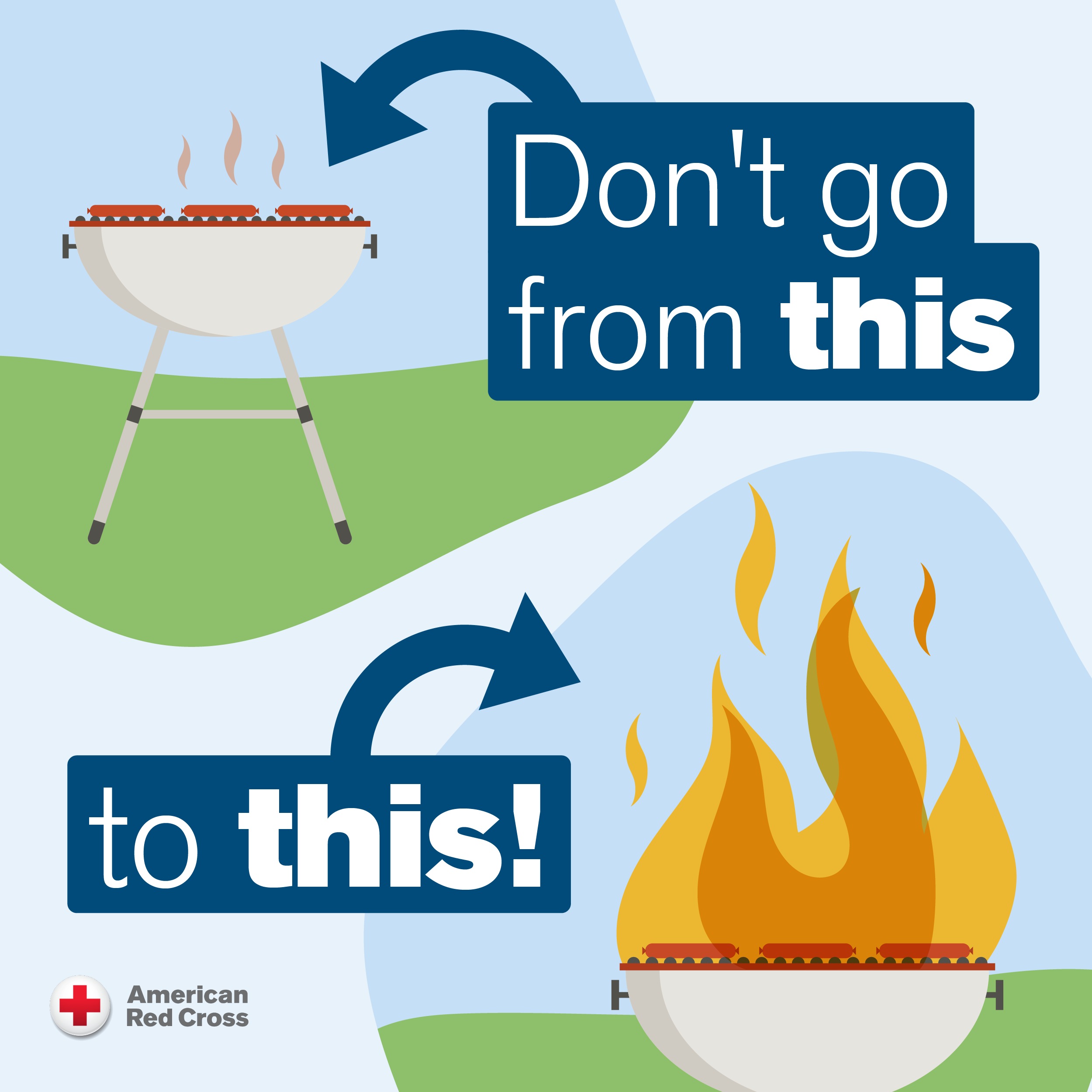
More than three-quarters of U.S. adults have used a grill — yet, grilling sparks more than 10,000 home fires on average each year. To avoid this, the Red Cross offers these grilling safety tips: · Always supervise a barbecue grill when in use. Don’t add charcoal starter fluid when coals have already been ignited. · Never grill indoors — not in the house, camper, tent or any enclosed area. · Make sure everyone, including pets, stays away from the grill. · Keep the grill out in the open, away from the house, deck, tree branches or anything that could catch fire. · Use the long-handled tools especially made for cooking on the grill to help keep the chef safe.
PET SAFETY
Summer’s heat can be dangerous for your family pets. Follow these steps to take to help ensure your pet stays safe this summer. · Don’t leave your pet in a hot vehicle, even for a few minutes. The inside temperature of the car can quickly reach 120 degrees even with the windows cracked open. · Animals can suffer heat stroke, a common problem for pets in the warmer weather. Dogs with short noses or snouts, like the boxer or bulldog, are especially prone to heat stroke, along with overweight pets, those with extremely thick fur or any pet with upper respiratory problems such as laryngeal paralysis or collapsing trachea. · Some of the signs of heat stroke in your pet are heavy panting and being unable to calm down, even when lying down, brick red gum color, fast pulse rate and being unable to get up. · If you suspect your pet has heat stroke, take their temperature rectally. If the temperature is above 105 degrees, cool the animal down. The easiest way to do this is by using the water hose. Stop cooling the animal when the temperature reaches 103 degrees. · Bring your pet to the veterinarian as soon as possible as heat stroke can lead to severe organ dysfunction and damage. Download the Red Cross Pet First Aid app for instant access on how to treat heat stroke, other emergencies and general care for cats and dogs and take the Cat and Dog First Aid Online Training course.
FIREWORKS SAFETY
· Never give fireworks to small children, and never throw or point a firework toward people, animals, vehicles, structures or flammable materials. Always follow the instructions on the packaging.
· Keep a supply of water close by as a precaution.
· Make sure the person lighting fireworks always wears eye protection.
· Light only one firework at a time and never attempt to relight a “dud.”
· Store fireworks in a cool, dry place away from children and pets.
June 20, 2018. Washington, DC. Development SAF Stock Photography Project 2018. Photo by Roy Cox/American Red Cross
In 1776, our founders signed the Declaration of Independence, but without a military to back up our claims, the British Crown could have quickly regained control of our country. Fast forward to 2022, and one needs to look no further than Ukraine to see why our country needs a well- trained, well-equipped, always-prepared military.
Our military guarantees our entire way of life, so we need to do all we can to be there for our fighting men and women, along with their families. That was the original aim of the Red Cross founder, Clara Barton when she began caring for the wounded during the Civil War.
Service to the Armed Forces (SAF)
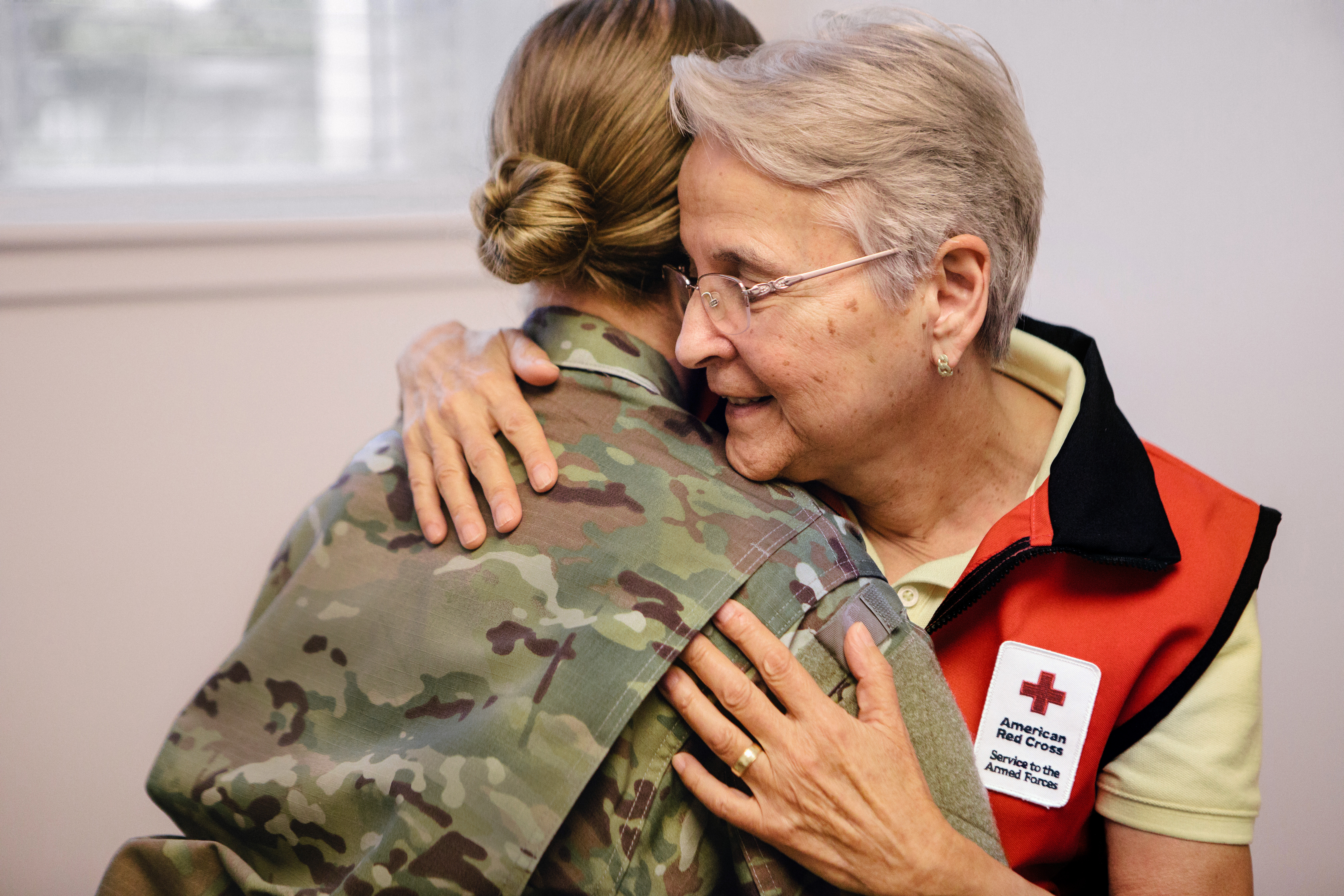
Since 1881, the American Red Cross has deployed alongside our military in every U.S. conflict since the Spanish-American War. The Red Cross also provides in-person support on more than 100 military installations and deployment sites worldwide, leveraging the services of 14,700 SAF volunteers around the globe.
“Members of the military, veterans, and their family members all make sacrifices,” said Jessica Tischler, Regional Program Director, Service to the Armed Forces and International Services. “From emotional wellness workshops to emergency communications, our staff of volunteers works hard to help provide valuable service to the armed forces.
Red Cross services for our military and their families include:
Before deployment:
“Get to know us before you need us” sessions inform the military family about the variety of Red Cross services available to them.
During deployment:
Delivering verified emergency messages to active-duty personnel worldwide Facilitating financial assistance and resources through Military Aid Societies Military hospital services – providing comfort and help with therapy Coping strategies for families at home Mind-body stress reduction workshops
After deployment:
Assistance at local VA hospitals and facilities Hero Care Resource Directory Information and referral services to community programs Military and Veteran Caregiver Network Reconnection workshops Assistance with veteran’s assistance appeals
Since 9/11, Red Cross and its volunteers have served more than 1 million military families, providing 24/7 emergency care and communications. Would you like to support military and veteran families in your community? Don’t take your freedoms for granted. Sign up to become a Red Cross volunteer or donate on our Support Military Families webpage.
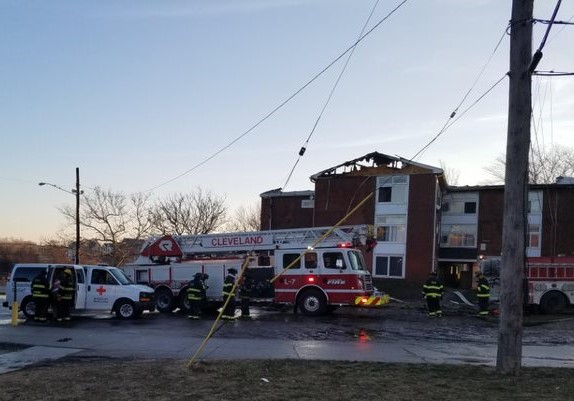
One-hundred residents of Northern Ohio received Red Cross assistance during the past week, April 4-10, as volunteers responded to two-dozen home fires.
Five of the fires affected multiple-family homes.
Cleveland Fire
“Our volunteer disaster responders have been very busy, and we are grateful that they answer the call, no matter when or where it happens,” said Tim O’Toole, Regional Disaster Officer. “They are true humanitarians. We could not respond to the needs of people in crisis without our volunteers.”
Immediate financial assistance totaling more than $22,700 was given to the affected residents. The money can be used for a hotel room, to replace clothing or other lost items, for meals or for whatever each resident prioritizes as a need.
In addition, Red Cross volunteer caseworkers reach out to the affected families to connect residents with additional community resources, as they try to move forward with their lives following the loss of their homes and possessions.
And if needed, Red Cross health and mental health volunteers are available to provide assistance as well.
The Red Cross never requires payment for the services provided to people who have experienced a disaster like a home fire. Such assistance is made possible through the generous donations of supporters. To help the next family that is forced by fire to flee their home, visit redcross.org/donate. You can also text REDCROSS to 90999 to make a $10 donation, or call 1-800-HELP NOW (1-800-435-7669) to make a donation on the phone.
Now that it’s spring, the storms that come along with the season and summer months also arrive. While many rainy days are part of the season, Northeast Ohio usually experiences several severe weather events throughout the year. The American Red Cross has tips to help keep you and your loved ones safe when severe weather strikes.
Severe Weather Safety
If thunderstorms are likely to occur, postpone outdoor activities. Many people who are struck by lightning aren’t in the area of a storm where it is raining.
Watch for storm signs – these can include darkening skies, lightning and increasing wind. If thunder roars, head indoors! If you can hear thunder, you are close enough to be in danger of being stuck by lightning.
If a severe thunderstorm warning is issued for your area and arrives: – Take shelter in a substantial building. If you aren’t near a building, shelter in a vehicle with the windows closed. Make sure to get out of mobile homes, as they can blow over in high winds. – If you’re driving, make your way to safely exit the road and park. Stay in your vehicle and turn on the emergency flashers so other cars on the road can see you until any heavy rain ends. – If you are outside and are unable to seek shelter inside of a safe building or vehicle, avoid high ground, water, tall or isolated trees and metal objects, such as fences and bleachers. Picnic shelters, dugouts, sheds and pavilions are not considered safe shelters. – Keep away from windows. – Don’t take a bath, shower, wash dishes or use plumbing.
If a tornado warning is issued for your area: – Move to an underground shelter, basement or safe room. If none of these are available to you, moving to a small, windowless interior room or hallway on the lowest level of a sturdy building is the safest alternative. Note: No area of a mobile home is safe during a tornado. If you have access to a sturdy shelter or a vehicle, move to this immediately. – If you are able to, go to the nearest local emergency shelter.
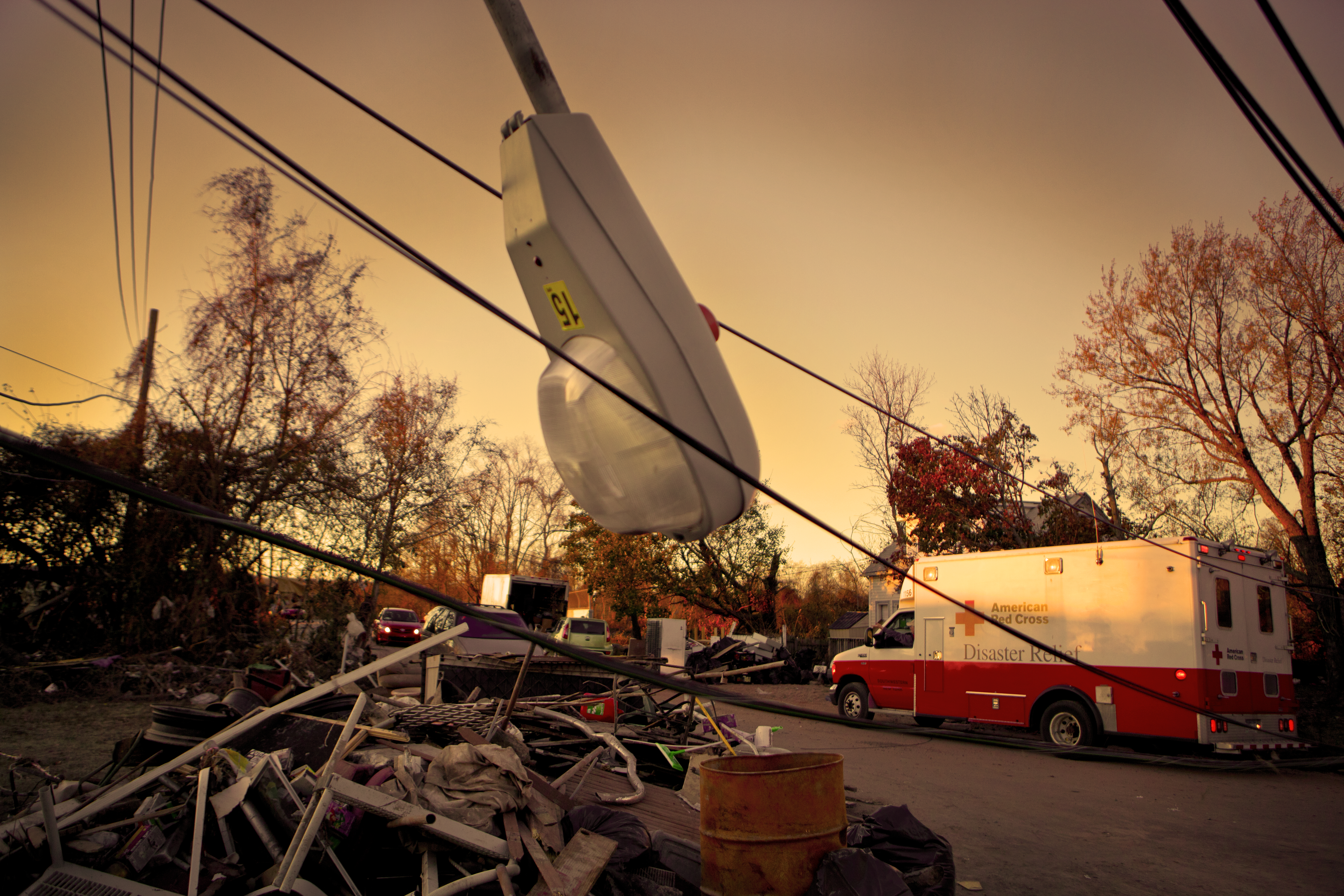
Superstorm Sandy 2012 November 5, 2012. Photo by Talia Frenkel/American Red Cross
If someone is struck by lightning: – Call for help immediately. Call 9-1-1 or your local emergency number. Anyone who has been struck by lightning requires professional medical care. Check the person for burns and other inquiries. – If the person has stopped breathing, call 9-1-1 and begin CPR. If the person is breathing normally, look for other possible injuries and care for them as necessary. – People who have been struck by lightning do not retain an electrical charge in their body.
Flooding Safety Flooding often occurs following a hurricane, thawing snow or several days of sustained rain. Flash floods, on the other hand, occur suddenly due to rapidly rising water along a stream, body of water or low-lying area.
If there is a flood risk in your area: – Listen to local radio, NOAA or TV news stations for the latest updates and information about weather in your area. – Be prepared to evacuate quickly if you need to evacuate. Know your routes and destinations ahead of time. Find a local emergency shelter. – Check your emergency kit and replenish any items missing or that are in short supply, such as medical supplies and medications.
If you have pets or livestock:
Consider a precautionary evacuation of your animals, especially any large or numerous animals. Waiting until the last minute could be fatal for them and dangerous for you.
Where possible, move livestock to higher ground. If using a horse or other trailer to evacuate your animals, move sooner rather than later.
Bring your companion animals indoors and maintain direct control of them. Be sure that your pet emergency kit is ready to go in case of evacuation.
For more information on how to prepare and respond in a severe weather emergency, visit redcross.org.
Mike Parks, CEO of the Northern Ohio Region of the American Red Cross, Janet Coleman, and Pharmacist Matt Kirby – Photo credit: Christy Peters/American Red Cross
Anyone who has spent any time in Northeast Ohio, driving around listening to the radio could probably finish this sentence in a flash – “Discount Drug Mart saves you the runaround…” If it didn’t immediately pop into your head, it’s “you’ll find everything you need.” The jingle was probably talking about a gallon of milk and a loaf of bread. But, for one North Olmsted woman, being at Discount Drug Mart recently saved her more than the runaround – it saved her life.
Matt Kirby, a pharmacist at the North Olmsted Discount Drug Mart, was going through a normal day when a fellow employee ran to the pharmacy and alerted him that someone had collapsed near the deli. Matt sprang into action and found a woman lying on the floor. She was not breathing and had no pulse. Using lifesaving skills he learned in a Red Cross class, Matt began CPR. On his 22nd chest compression, the customer was revived. She was transported to a hospital and recovered.
In an interview with Cleveland.com, Matt said, “I think the more amazing part of the story was that a week later, they (the customer and her husband) celebrated their 50th wedding anniversary, and she was around for that. That was my reward – her being able to make it to that. Also, seeing her walk back into the store, that made it all worth it.”
Janet and Kevin Coleman with Pharmacist Matt Kirby and CEO of the Northern Ohio Region of the American Red Cross Mike Parks
Because of his heroic actions, Matt was awarded the American Red Cross Lifesaving Award for Professional Responders, one of the highest honors given by the organization. The award honors someone who embodies the spirit of the Red Cross by using action to help alleviate human suffering in the face of an emergency.
Like Matt Kirby, you never know when you may be called upon to help save a life. Make sure you’re prepared by signing up for training classes with the Red Cross. The organization offers a variety of courses to help the community be prepared when an emergency arises.
Do you know a hero? The Red Cross wants to recognize ordinary people who perform extraordinary acts of courage. If you know a hero who has used their Red Cross skills to help save a life, please share their story with us!
Edited by Glenda Bogar/American Red Cross volunteer
Richard and Carol Gundelach – Photo Credit: Jim McIntyre/American Red Cross
Richard Gundelach donates platelets every two weeks, and on March 11, 2022, he reached a milestone: 600 platelet units donated.
His wife Carol baked a carrot cake to mark the occasion.
“Compared to giving (whole) blood, it’s easier,” Richard said after the donation. “People need it.”
Platelets are cell fragments in our blood that form clots and stop or prevent bleeding. They can be essential to helping patients survive surgeries such as organ transplants, and to fight cancer, chronic diseases and traumatic injuries.
During the platelet donation, the blood clotting portion of whole blood is “spun” out and the rest of the blood is returned to the donor; typically, the body replaces its platelets in 24-36 hours.
Platelets are always in short supply because they only have a shelf life of five days. Every 15 seconds, someone needs platelets.
Richard Gundelach – Photo Credit: Jim McIntyre/American Red Cross
Encouraged by a friend, Richard began donating platelets during a time of unemployment 27 years ago. He’s retired now, and he wants to continue giving regularly.
His new goal: to donate 1,000 units of platelets.
When he achieves that goal, Carol may need to bake a bigger cake!
Donors can make an appointment to give platelets, whole blood or plasma by visiting redcrossblood.org, by calling 1-800-RED CROSS, or by installing the Red Cross blood app on their smartphones.
Edited by Glenda Bogar. American Red Cross volunteer
March 23rd is the eighth annual American Red Cross Giving Day, when communities come together to raise awareness about our critical disaster relief mission and fund our lifesaving work across the country. As recent events show, the Red Cross mission and services are critically needed, as #HelpCantWait.
As I reported earlier this month, Disaster Action Team (DAT) responses in our region increased by over 30% in February, mainly due to home fires, and March has continued to be exceptionally busy. Nationally, the Red Cross responded to more than 15,900 home fires since January 1, providing help to almost 60,000.
Please see this video for a behind-the-scenes look at the work Giving Day makes possible.
The blood supply is vulnerable, and help is greatly needed, from blood donors, volunteers, and those providing financial support.
In addition, climate change, global instability, and the effects of the pandemic will continue to pose challenges for all humanitarian services. Challenges that, with your help, the Red Cross will rise to meet.
On a personal note, as a disaster responder I have seen the benefits of Red Cross services. I often saw the relief on people’s faces when we arrived after a home fire, knowing they would have help recovering. And, as assistance was provided, I also frequently saw human resiliency and signs of hope returning. Such moments occur, on average, more than three times a day in Northern Ohio and are made possible by donors and volunteers.
Here are some examples of what a financial gift can provide:
$3: one comfort kit containing hygiene items.
$15: one smoke alarm installation with fire safety education.
$50: a full day of food and shelter for one person.
$135: one smoke alarm and fire safety education for a hearing-impaired person.
$150: travel, meals, and shelter for one day for a deployed Red Cross disaster relief, health, or mental health worker.
$200: a full day of food and shelter to a family of four. Includes the cost of Red Cross workers to provide this service.
$350: the daily cost to deploy an Emergency Response Vehicle (ERV).
$605: financial assistance for a family impacted by a local disaster, like a home fire. This helps the family purchase food, lodging, clothing, and other critical needs.
$4,000: a Sound the Alarm event. Includes installing smoke alarms and providing a fire safety package, deploying an ERV for the day, and lunch for volunteers. Average events install around 200 alarms.
To participate in Giving Day, please visit redcross.org/GivingDay. A gift of any size makes a difference.
For Northern Ohio volunteer opportunities, please visit this link..
If you had 4,100 hours to do whatever you wanted, what would you do? If it helps, that’s almost 175 days. Would you take a vacation? Or a few? Catch up on sleep? Finally read all those books on your nightstand?
American Red Cross Northern Ohio volunteer Sharon Nicastro took her hours and spent them helping others. In fact, she took exactly 4,172 hours working to assist the military and their families as a Red Cross Service to the Armed Forces and International Services (SAF/IS) volunteer. During a virtual ceremony on Martin Luther King Jr., Day this past February, Sharon was awarded the President’s Lifetime Achievement Award, a civil award bestowed by the President of the United States. Also called the Presidents Call to Service Award, a volunteer must give 4,000 hours or more over a lifetime of volunteering to receive this prestigious award.
Admiral Mike Parks, CEO of the American Red Cross Northern Ohio Region, presents Sharon Nicastro with the President’s Lifetime Achievement Award
During the ceremony Koby Langley, Senior Vice President, Red Cross International Services and Service to the Armed Forces, said “This level of achievement represents a person who’s dedicated their entire life to improving the world around them. They’ve dedicated themselves to being a humanitarian, to help others in need.”
Sharon Nicastro volunteers at the Cleveland VA Medical Center on Pearl Harbor Day (Photo taken prior to COVID-19)
With how busy life seems to be for everyone these days, many may wonder why Sharon has spent so much time in serving others. She says her lifelong commitment began with her father, who encouraged his children to volunteer. “If dad went to the clambake to help, all us kids went to the clambake to help,” said Sharon. For Sharon and her family, it wasn’t a question of will you help but why wouldn’t you?
During her time as an SAF/IS volunteer, Sharon has supported military families during deployments and emergencies. She has also helped our nation’s veterans after their service ends. Sharon has taught CPR and hands only CPR classes in Northern Ohio and volunteers at the VA Medical Center in Cleveland. “Sharon is an inspiring woman to work with. Her dedication to support service members, veterans and their families is humbling,” said Jessica Tischler, SAF/IS Regional Program Manager. “She is also a force multiplier as she engages and leads new volunteers in delivering services and works with community partners. Winston Churchill said ‘We make a living by what we get. We make a life by what we give’ and that encompasses what Sharon has shared with the Red Cross.”
Sharon Nicastro and volunteer Jackie Otte teach a CPR class in Cleveland. (Photo taken prior to COVID-19)
The Northern Ohio Region is incredibly fortunate to have Sharon Nicastro on our team. We congratulate her on this outstanding achievement. And we look forward to what she does next because, of course, Sharon doesn’t plan to stop volunteering anytime soon!
If Sharon has inspired you the way she inspires all of us, learn how you can become a Red Cross volunteer and start working your way to that 4,000-hour milestone, at RedCross.org/VolunteerToday.
Last month the blood supply was in “crisis.” This month it’s rated “vulnerable.” Neither of those are optimal – the latter being only incrementally better. Bottom line = we still need everyone to donate if they are able.
Photo Credit: Doug Bardwell, Red Cross Volunteer
With relaxation of COVID-19 restrictions, doctors are once again allowing elective surgery. Don’t associate “elective” with just things as tummy tucks and facelifts.
Elective means it can be scheduled in advance instead of being scheduled as an emergency. Some heart surgeries, including bypass and valve surgeries, as well as some cancer surgeries or biopsies are scheduled electively. When elective surgeries are delayed for too long, life-threatening emergencies can occur.
Since issuing its first-ever blood crisis alert, severe winter weather has further complicated efforts to rebuild the Red Cross blood supply. So far in 2022, approximately 600 blood drives have been canceled across the country due to winter storms, forcing nearly 20,000 blood and platelet donations to go uncollected.
Photo Credit: Doug Bardwell, Red Cross Volunteer
Don’t let the supply go back to “crisis” mode – make and keep those appointments. It’s quick and easy to find a location and time near you at redcrossblood.org.
If you have either type O positive or O negative – you are needed most urgently: o Type O positive is the most transfused blood type and can be transfused to Rh-positive patients of any blood type. o Type O negative is the universal blood type and what emergency room personnel reach for when there is no time to determine the blood type of patients in the most serious situations.
Platelet donations are also urgently needed. Platelets are the clotting portion of blood, which must be transfused within five days of donation. Nearly half of all platelet donations are given to patients undergoing cancer treatments.
Need more motivation???
For drives March 1-31: All who come to give blood or platelets will get a $10 e-gift card, thanks to Fanatics, world’s largest collection of officially licensed sports gear.
Plus, donors will also automatically be entered for a chance to win a trip for two to the 2022 MLB® All-Star Game® in Los Angeles, California, when you come to give March 1-31. The package includes two tickets to 2022 MLB® All-Star Saturday, the 2022 Home Run Derby and the 2022 MLB® All-Star Game®, round-trip airfare to Los Angeles, four-night hotel accommodations (July 16-20, 2022), plus a $750 gift card for expenses. Details available at rcblood.org/team.
Edited by Glenda Bogar, American Red Cross volunteer








 NOHredcross