Stay safe this summer when temperatures heat up

By Tim Poe, American Red Cross volunteer
While Northern Ohio hasn’t seen temperatures over 90 degrees Fahrenheit since last year, summer is here, and it is time to prepare for high temperatures. Extreme heat is happening more often and more intensely — 2024 was the hottest year on record globally — and in more places, like Northern Ohio. As extreme heat is a leading cause of weather-related deaths in the U.S., the American Red Cross urges everyone to take critical actions to stay safe. These include: 

Stay hydrated. When temperatures are high, drink a cup of water every hour, even if you aren’t thirsty. Avoid sugary, caffeinated and alcoholic drinks. Remind friends and family members to do the same. Also, babies should be breast- or bottle-fed often. Fewer wet diapers or darker urine can be signs of dehydration. 

Stay cool. Spend time in air-conditioned places. If your home is too hot, go to a mall, library or cooling center. You can also take a cool shower or bath. Please make sure to look out for older neighbors and relatives as well as anyone without air conditioning.  

Outdoor workers and athletes should take breaks in the shade and frequently drink water: a cup every 20 minutes. They should also use a buddy system to check on one another. 

Wear lightweight, loose-fitting clothes in bright colors. 

Never leave a child or pet alone inside a parked car, and make sure pets have access to fresh water and shade. 

Prepare for power outages during heat waves. Be ready to stock an ice-filled cooler with food, water and medicine, so that they don’t spoil. If you need to keep medicine cold or use medical devices that need power, talk to your doctor about a backup plan. Also keep food cold by keeping refrigerator and freezer doors closed as much as possible; eat fresh, perishable foods first; and throw out perishable food that has been warmer than 40 degrees Fahrenheit. More information is available here

Stay connected.  Check on others and ask for help if you need it. Also download the free Red Cross emergency app

Know the signs of heat illness. While some are at higher risk of heat related illness, such as older adults, children, pregnant women and those with medical conditions, anyone can become ill when their body cannot properly cool down. It is critical to act fast, as some types of heat illness can be deadly. 

Heat cramps are signaled by heavy sweating and muscle pain. Stop what you’re doing, rest in a cool place and slowly sip water. Don’t drink if you feel sick, and get medical help if cramps last over an hour or you have heart problems.  

Heat exhaustion is signaled by heavy sweating, weakness, cool and clammy skin, muscle cramps, dizziness, fainting, nausea or vomiting. In addition to the above, loosen your clothes and place a cool wet cloth on your body. Get medical help if you don’t feel better, vomit or have heart problems.  

Heat stroke is a deadly condition signaled by high body temperature, rapid heartbeat, confusion, headache, dizziness, fainting, nausea or vomiting. Call 911. Move to a cooler place, remove extra clothing and use a wet cloth or a cool bath to cool down. Don’t drink anything. 

Learn more tips and download the Red Cross’ Extreme Heat Safety Checklist HERE. 

Edited by Glenda Bogar, American Red Cross volunteer

Stay safe and look out for one another in extreme heat

By Tim Poe, American Red Cross volunteer

July 30, 2014. City of Myrtle Beach Parks and Recreation, South Carolina. Julieth Martinez, 4, enjoying her swim lesson as part of the Centennial campaign. Photo by Connie Harvey/American Red Cross

I first saw the effects of heat stroke when I was 10. I was at a day camp for the first time. Decades later, I vaguely recall activities, canoes, a lake and even the heat. But I clearly remember seeing the fellow camper stumble, vomit and pass out. Counselors carried him inside and put him on a table, getting water and ice. The rest of us followed, worried, overhearing frantic conversations. Once inside, someone put on a movie to calm us, but I think we all knew he was in trouble and an ambulance was on the way. My memory becomes fuzzy after that. A darkened room, an ignored movie, a child my age prone on a table, teenagers tossing ice and water on him until the EMTs arrived, quickly giving treatment and taking him away. I saw him a few weeks later at another event, recovering.

As much as we enjoy summer and especially being active, heat can be dangerous, even life-threatening. In fact, the last several years have seen excessive heat cause more fatalities than all other weather events. Climate change is also making extreme heat events more frequent and severe, even here in Northern Ohio.

For a medical professional’s perspective on heat safety for our region, I reached out to Patricia Horvath, a registered nurse and American Red Cross volunteer regional nurse lead for Northern Ohio. Patricia explained, “a heat wave is more than 48 hours of high heat (90°F or higher) when high humidity (80 percent relative humidity or higher) is expected.”

Patricia Horvath, Regional Volunteer Nurse Lead

“For us in Northern Ohio, the uptick in heat-related illnesses such as heat exhaustion are often seen around local family fun runs, sports camps for kids and pre-season athletic training for high school kids during heat waves,” she said. “I’ve also experienced it at outdoor family reunions when seniors rapidly became dehydrated in the sun.

“The saddest and most devasting situation I have seen is the death of a child—left or forgotten—in a hot parked car,” she continued. “After an hour, the average in-car temperature is 43 degrees higher than the outdoor temperature. After 90 minutes, this rises to 48 degrees higher. Therefore, when it’s 90 degrees outside, it could reach an incredible 138 degrees in your parked car. That’s hotter than any outdoor temperature ever recorded on Earth! Parents, grandparents and caregivers need to establish memory hooks as a routine to be sure to check for the little ones in car seats before leaving. It’s easy to get distracted or absentminded these days. Unfortunately, this also occurs often with pets. If you see a child in a parked car alone on a hot day even with windows cracked, say something and get help. Minutes matter.”

Patricia also spoke of the importance of community. “Like most things in a community, it’s those who live there who look out for each other that makes it healthy and safe. With heat waves, communities in Northern Ohio now will open free access to designated ‘cooling centers’ for residents, such as recreational centers, libraries and community centers. Check on your vulnerable elderly neighbors to be sure they have access to air-conditioning. Invite them to your house or give them a ride to a cooling center for the day. I have had air conditioning parties for my neighbors and friends during heat waves. Growing up, this is something my parents used to do when AC in private homes was more of a luxury.”

Patricia’s general advice to stay safe is:

  • Be aware of the predicted heat and humidity for the day.
  • Keep hydrated even if you are not thirsty.
  • Keep cool, stay indoors or in the shade and, minimize exercise/activity.
  • Check in with kids and the elderly to keep them safe too.
  • Know the signs of heat exhaustion and heat stroke.

More information is available on the Red Cross heat safety page and the free Emergency App.

You can also see recent articles on summer road trip preparation, water safety, and severe weather safety.

Edited by Glenda Bogar, Red Cross volunteer.

Posted by Ryan Lang, Red Cross board member and volunteer.

Excessive heat a reminder to enjoy the end of summer safely

Although fall is right around the corner, you’d never know it from the recent high temperatures we’ve been experiencing in northern Ohio. Many people don’t realize excessive heat causes more deaths than all other weather events. As many of us squeeze in our final summer activities in the coming weeks, remember to stay safe when temperatures rise.

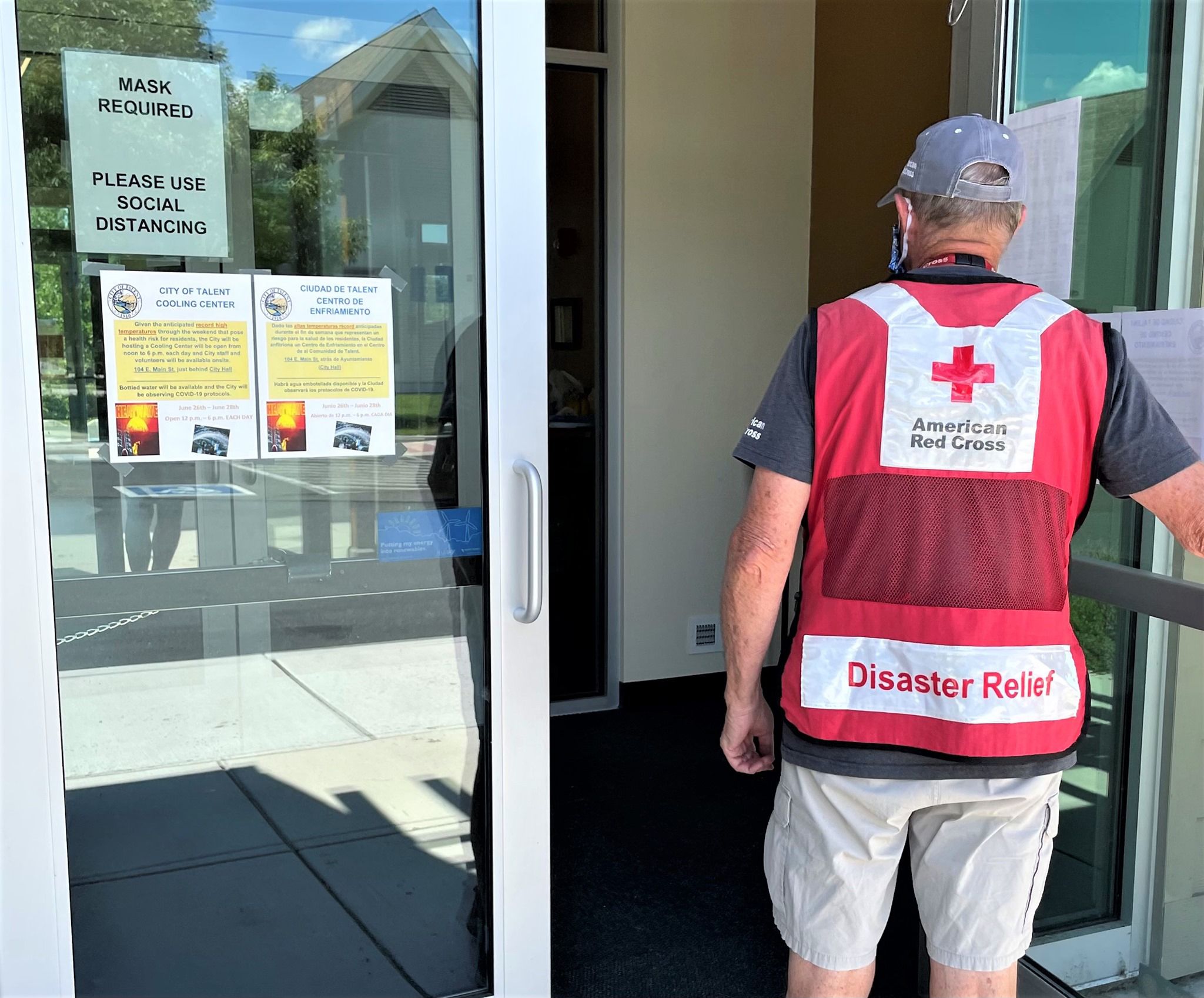
June 27, 2021. Talent, Oregon. Red Cross volunteer Chuck Albin delivering water and snacks to a cooling center in Talent, Oregon. Photo by Patty Albin/American Red Cross

Hot cars can be deadly so never leave children or pets in your vehicle. The inside temperature of the car can quickly reach 120 degrees. Check on family, friends and neighbors who do not have air conditioning, who spend much of their time alone or who are more likely to be affected by the heat. If someone doesn’t have air conditioning, they should seek relief from the heat during the warmest part of the day in places such as schools, libraries, theaters and malls.

And, don’t forget your pets! Read our recent blog on how to protect your pets during extreme heat. Also, download the Red Cross Pet First Aid app so you’re prepared in a pet emergency.

Extreme heat can often lead to thunderstorms and power outages. If thunder roars, go indoors! Watch for darkening skies, lightning flashes or increasing wind. If you can hear thunder, you are close enough to be in danger from lightning. Postpone outdoor activities if thunderstorms are likely to occur. If a severe thunderstorm warning is issued, take shelter in a substantial building or in a vehicle with the windows closed. If you are in a building, keep away from windows. Get out of mobile homes as they can blow over in high winds and do not take a bath, shower or use plumbing.

Wishing everyone a safe and enjoyable end of summer!

Some like it HOT, 3 Ways to Stay Safe in this Week’s Heat

summer-heatSome like it HOT.

But with this week’s toasty Northeast Ohio temperatures, it’s important that you keep three key things in mind to beat the heat: stay cool, stay hydrated and stay informed. And don’t forget about your friends and neighbors, check on those most at-risk at least twice a day.

Stay Cool

  1. Stay in air-conditioned buildings as much as possible.
  2. Do not rely on a fan as your primary cooling device.

Stay Hydrated

Your body may sweat more in these temps, which means you will be losing fluids.

  1. Drink more water than usual.
  2. Don’t wait until you’re thirsty to drink more fluids.
  3. Avoid alcohol or liquids containing high amounts of sugar.

Stay Informed

Download the free Red Cross First Aid app to learn more about how to treat heat related illnesses – like heat cramps or heat stroke.

For more information on at-risk populations, check out the Centers for Disease Control and Prevention’s website: http://www.cdc.gov/extremeheat/


Stay Safe in the Summer Heat

The long, hot days of summer can bring dangerously high temperatures. summer sunExcessive heat has caused more deaths than any other extreme weather in recent years. Do you know how to keep your family safe in a heat wave?

The Red Cross has steps people can follow to stay safe when it’s hot outside.

HOT CARS CAN BE DEADLY Never leave children or pets in your vehicle. The inside temperature of the car can quickly reach 120 degrees. Other heat safety steps include:

  • Stay hydrated by drinking plenty of fluids. Avoid drinks with caffeine or alcohol.
  • Avoid extreme temperature changes.
  • Wear loose-fitting, lightweight, light-colored clothing. Avoid dark colors because they absorb the sun’s rays.
  • Slow down, stay indoors and avoid strenuous exercise during the hottest part of the day.
  • Postpone outdoor games and activities.
  • Use a buddy system when working in excessive heat. Take frequent breaks if working outdoors.
  • Check on family, friends and neighbors who do not have air conditioning, who spend much of their time alone or who are more likely to be affected by the heat.
  • Check on animals frequently to ensure that they are not suffering from the heat. Make sure they have plenty of cool water.
  • If someone doesn’t have air conditioning, they should choose places to go to for relief from the heat during the warmest part of the day (schools, libraries, theaters, malls).

HEAT EXHAUSTION Excessive heat can lead to sunburn, heat cramps, heat exhaustion and heat stroke. If someone is experiencing heat cramps in the legs or abdomen, get them to a cooler place, have them rest, lightly stretch the affected muscle, and replenish their fluids with a half a glass (about 4 ounces) of cool water every 15 minutes.

If someone is exhibiting signs of heat exhaustion (cool, moist, pale or flushed skin, heavy sweating, headache, nausea, dizziness, weakness exhaustion), move them to a cooler place, remove or loosen tight clothing and spray the person with water or apply cool, wet cloths or towels to the skin. Fan the person. If they are conscious, give small amounts of cool water to drink. Make sure the person drinks slowly. Watch for changes in condition. If the person refuses water, vomits or begins to lose consciousness, call 9-1-1 or the local emergency number.

HEAT STROKE LIFE-THREATENING. Signs include hot, red skin which may be dry or moist; changes in consciousness; vomiting and high body temperature. Call 9-1-1 or the local emergency number immediately if someone shows signs of heat stroke. Move the person to a cooler place. Quickly cool the person’s body by immersing them up to their neck in cold water if possible. Otherwise, douse or spray the person with cold water, or cover the person with cold, wet towels or bags of ice.

For more information on what to do when temperatures rise, download the Red Cross Heat Wave Safety Checklist, or the free Red Cross Emergency App. The app also gives users the option to receive alerts for excessive heat watches, warnings and heat advisories. People can learn how to treat heat-related and other emergencies by taking First Aid and CPR/AED training online or in person. Go to redcross.org/takeaclass for more information.