Red Crossers working to reunite families after devastating storms

By Ryan Lang, American Red Cross board member and volunteer

Relief efforts continue throughout the Southeast weeks after Hurricanes Helene and Milton ravaged the Carolinas, Georgia and the Gulf Coast of Florida. The storms left a trail of damage totaling hundreds of billions of dollars and counting. At least 250 people were killed and dozens more are still missing.

American Red Cross workers and volunteers have been on the ground throughout the region since before the storms hit, operating shelters and assisting with cleanup. Those are the Red Crossers you’ve seen. But there are many more you haven’t seen, working tirelessly to reunite family members separated by the storms.

The Red Cross is one of many groups that work behind -the -scenes of a disaster to help reunite loved ones. We support requests for reunification that come in through our national call center including emergency welfare inquiries, family reunification requests and military inquiries.

Emma Banton, Regional Mass Care Manager

As of October 19, more than 11,500 inquiries have been made to help find missing residents in the Southeast. Regional Mass Care Manager for the Red Cross of Northern Ohio, Emma Banton, was assigned to help reunite people who are looking for their missing family members. She says the deployment has been extremely rewarding, but mentally and emotionally difficult at times.

“To be the person who can assist with reconnecting a family with their loved ones has been a tremendous feeling,” Emma said. “Unfortunately, so many lives were lost in this tragic disaster that the work of reunification does not always have the ending we hope for.”

Those cases that wind up working out as intended, with families and friends reuniting, are the reasons Emma and others do what they do. “Thank you for all that you do for the people affected by the hurricane,” one grateful family member wrote. Another person sharing their good news simply wrote, “They are OK,” letting Emma know she’d been in touch with her loved ones.

Monica Bunner, Red Cross disaster volunteer

Monica Bunner is a long-time disaster responder who has assisted with several national disaster relief operations. Monica said of her time as a reunification volunteer, “There is no greater demonstration of (the Red Cross’) commitment than to reunite loved ones who are emotionally struggling after a disaster.”

“It’s also a great opportunity for those who want to deploy but cannot be boots on the ground,” Monica added. “Equally important are the many team members who do the research, talk with the seekers and prepare (each) case virtually.”

To find out more about reunification, or if you need help finding a loved one in the aftermath of a disaster, click here.

Edited by Glenda Bogar, Red Cross volunteer
Red Cross executive helped launch disaster financial assistance program for Hurricane Harvey in 2017

Part II of Todd’s reflections on his deployment three years agoClick here to read Pt. 1

By Todd James, Executive Director, American Red Cross of North Central Ohio

August 26, 2020 – Note: At the time of this posting, on Wednesday, August 26, 2020, Hurricane Laura was expected to gain major hurricane status – possibly category 4 – and make landfall in the same general area of the Gulf Coast ravaged by Hurricane Harvey in 2017. Six volunteers from Northern Ohio were deployed prior to Laura’s landfall.

Ten days after returning home from Austin, where I had been deployed to lead communications following Hurricane Harvey as part of the American Red Cross’ Public Affairs team, I got a call asking if I could go back to Texas to lead a team in Houston. I am blessed to have a very understanding, compassionate wife who said, as she always does, “People need help, you need to go.” So, I headed out for my third deployment in six weeks.

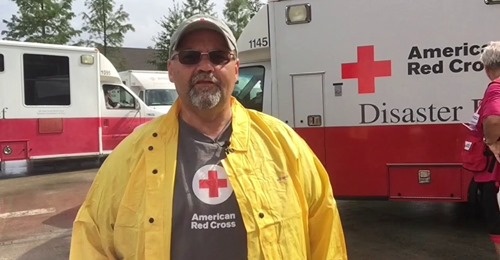
Todd James in Baton Rouge, Louisiana in 2017

Here’s the thing about being deployed: there are thousands of Red Cross responders who answer the call for help every day. Even though we come from all across the country, these operations often feel like a big family reunion. So many people I had worked with before and since were in Houston to help. And so much help was needed! Thousands of people were still staying in shelters, while hundreds of thousands were beginning the long road to recovery. 

3…2…1…Launch!

Thousands of Red Cross responders worked ceaselessly, providing shelter, food, comfort and much more, as they always do when disasters happen.

In the face of the unprecedented scope of the damage caused by Hurricane Harvey, the Red Cross was about to take a quantum leap forward in disaster response, launching the new Immediate Assistance Program (IAP). The IAP gives us a way to almost instantly verify people’s needs and provide immediate financial assistance so they can begin their recovery. Until now, this could mean days and, in large events, even weeks as Red Cross teams went house to house to verify damage and need, meet with families and provide financial help.

With the IAP, people apply with a phone call and with the help of technology and digital mapping, we verify their need and deposit help directly into their account or for pick up at their local Walmart. What a game changer! My team couldn’t have been any busier getting the information out so people could take advantage of this help.

Now, as you can imagine with any new technology like this being launched on this scale, there were some glitches. But thousands of people every day received the help they needed to get started on their recovery. In the first five months after Hurricane Harvey made landfall, 575,000 households received $230 million to use for help with groceries, gas, clothing, rent, bills and other needs for their families.

Since launching the IAP, the Red Cross has continued to improve the process. It’s now a regular part of our disaster response.

Outstanding in our field

A favorite story from my time in Texas happened one afternoon while my staff partner Matt and I were following one of our mobile feeding vehicles to get pictures and talk to the families they were helping. We received calls from our headquarters for interview requests to talk about the relief operation. So somewhere in the middle of rural south Texas, standing by a fenced-in pasture and surrounded by longhorn cattle, I was on my phone talking to a radio station in Maryland while Matt was on his phone being interviewed by a radio station in Phoenix, AZ. Welcome to the glamorous world of disaster Public Affairs!

After two weeks, I finished my deployment and returned home. But three years later, families and communities are still working to recover from the storm, and the Red Cross is still there supporting them. You can see a full report on our efforts at http://www.redcross.org/harveyrecoverygrants