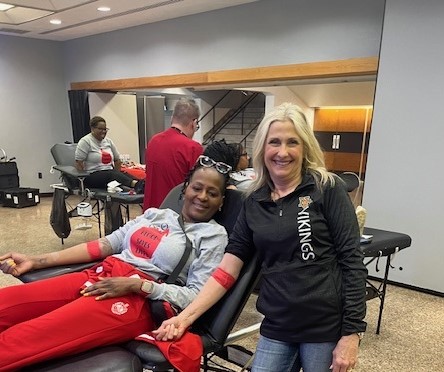
Sonata in B Positive (B+)

A blood donor story told in the spirit of film noir

By Tim Poe, American Red Cross volunteer

Tim Poe, Red Cross volunteer and blood donor

I shut off the car’s engine and reached for the bottle. This was the place. Looking at the glass and sandstone medical building bristling in the late-July afternoon, I unscrewed the cap and took a long swig. This wasn’t some liver-pummeling swill, though, nor even a dainty-derby aperitif. It was the good stuff: water, straight from the tap. I knew I’d need it; they’d told me so. They also told me to get a good night’s sleep, but the ghosts of nexuses past, present, and future rattling chains at bebop tempo in my brain had other ideas. But I had slept some, had drank plenty of water, and was here to do some good. I stepped out of my dented ride and gazed at a sky blue enough to make Monet weep. But today’s theme was red. I headed toward the building, prepared to lose some blood.

I had plenty, after all, and others needed it. Today I was a blood donor.

Cots, computers, snacks, beverages, people bustling, many wearing shades of red. I’d found the room. A Blood Donor Ambassador welcomed me with a smile and scanned the fuzzy square on my phone. I had completed the RapidPass that morning.

The two donors preceding me said they always gave together, as often as possible. O negatives, universal donors. Today they were donating whole blood. Next time, Power Red. These two were cool. I was humbled, in the presence of greatness.

Another groovy person called me over, verified the information I had provided earlier, asked a few more questions, checked vitals, and drew blood to check my iron, a large drop of crimson emerging from a finger. My mind wandered from iron to the irony of my blood type, which sounded like a happiness mantra: “Be positive.” Better suited for a life coach or morning weather reporter, not a mug who’d spent his formative years breathing blue notes through saxophones followed by a lifetime thinking of novel ways to describe dusks, dawns, dramas, drunks, and dreams.

My mental meanderings paused; time to get on a cot. Even in summer, I’m pale, nearly translucent with easily visible veins, a phlebotomist’s joy. A groovetastic phlebotomist in a cerise shirt handed me a squeezy then worked a scanner, tubing, bags, and swabs with the deftness of Bill Evans pressing piano keys into song. The scent of iodine sent a jumbled reel of hospital memories rolling through my mind. But those were times of need. Now to give, help someone going through something similar. I wondered if that someone’s personality matched “be positive.”

The needle. A pinch, the frosty tubing turned garnet as my blood flowed into unseen bags below. I resisted the urge to peer over at them, instead squeezing the foam every few seconds, my other hand with the phone, taking a photo, then scrolling in hope of finding some good news.

Soon came beeps and the return of the phlebotomist. With a flurry of clips, tubes, samples, cotton, and a candy red bandage wrap, I was done. I stood up, walked to the snack table, selected a blueberry granola bar, a bottle of spring water, and awaited the slight light- headedness to subside.

Shortly later I walked back down the hall, proudly wearing my bandaged arm, greeting others, possibly with a little “be positive” swagger. Because today, I did some good. Today, I was a blood donor.

Posted by Ryan Lang, American Red Cross board member and volunteer

Lifting of restrictions opens window for new blood donors

One-year anniversary of blanket deferral that prevented blood donations

By Kathryn Dean, American Red Cross volunteer

If you’ve ever attended a blood drive in the past and were turned away due to a deferral, there has never been a better time to reassess your eligibility. Over the past two years, two important deferrals that have been in place since the 1980s have been modified or lifted, increasing the ever-needed pool of eligible blood donors.

In 1986, Bovine Spongiform Encephalopathy, colloquially known as “Mad Cow Disease,” was discovered in cattle in the United Kingdom. This disease was found to be transmissible to humans if infected meat was eaten and caused a number of illnesses, including a variant of Cruetzfeld-Jakob disease (vCJD), a degenerative, fatal disease that affects the central nervous system of the host.

U.S. Air Force veteran John Dowell of Lakewood  gave blood after the variant Creutzfeldt-Jakob
(mad cow) Disease deferral was lifted.

Due to this, during the 1980’s and 90’s the Food and Drug Administration restricted people who had visited certain European countries from donating blood in the United States in an effort to prevent the transmission of vCJD. The American Red Cross honored this ban, which remained in place until 2022 when it was removed after a steep decline in reported cases and no signs of a second wave.

Additionally, in 2023 a second long-standing deferral that restricted gay and bisexual men from donating was modified to remove the blanket deferral and instead assess people on a case-by-case basis. This deferral was originally created in an attempt to curb the spread of HIV, which became an epidemic in the 1980s.

Red Cross worker and volunteer, Mark Fleischer

Both of these deferrals affected long-time Red Cross worker and volunteer, Mark Fleischer, who was able to donate blood for the first time in decades back in January of this year. You can read his story HERE and learn of his great pride in being able to donate again after years of ineligibility.

When I spoke to him back in January, he indicated that not only was he previously affected by the deferrals placed on gay men, but because of his brief time living in England back in 1992 and because of fears surrounding Mad Cow disease, he had been told he was ineligible to donate for life. Now all of that has changed with the recent modifications to blood donor eligibility requirements.

Mark Fleischer and phlebotomist Ed Leonardi

In an update since his January 2024 donation, Mark told me that he has helped organize and has participated in many successful blood drives at the Willoughby Senior Center, some of which have exceeded their goal for blood donations. He is also personally scheduled to donate blood again at the end of this month.

“Recruiting for blood donors is in full force and things are going great,” he said. He also previously told me, “You may have been deferred decades ago for something that may no longer be in place. So I want to encourage people to look at the questions that the Red Cross asks (and) look at the deferred list…those deferrals or restrictions may have been lifted.”

Mark Fleischer and Red Cross staff at blood drive

Check out the Red Cross Give Blood page to learn more about eligibility requirements, and to find a local blood drive near you.

Edited by Glenda Bogar, American Red Cross volunteer

Posted by Ryan Lang, American Red Cross board member and volunteer

First-time blood donor leads efforts to increase donations to aid those with sickle cell disease

By Eilene E. Guy, American Red Cross volunteer

When Dr. LaTrice Snodgrass puts her mind to a project, she goes all in.

Recently, she partnered with the American Red Cross and others to stage a blood drive targeted at the Black community, to benefit people living with sickle cell disease (SCD).

Dr. LaTrice Snodgrass and Kim Kroh, executive director of the Heartland, Stark and Muskingam Lakes chapter of the Red Cross

Not only did she spearhead the event, she literally rolled up her sleeve to donate blood – for the first time.

Through this donation, LaTrice learned that her blood is negative for three components, which makes her an ideal SCD donor. Blood transfusions from donors like LaTrice are vital to let SCD patients live comfortable, healthy lives.

LaTrice knows the importance of blood donations from her own racial community. More than 100,000 Americans — mostly African Americans — have sickle cell disease, which causes acute pain and over time damages vital organs. Her sorority, Delta Sigma Theta, put out a national call to boost donations from African Americans. “I told my sisters, we need to do this,” she said.

“I know there is a resistance in the Black community to trusting the medical establishment, but we have to overcome that. Our blood is truly lifesaving.” she said, explaining her decision to give blood for the first time, despite not being enthusiastic about needles.

SCD is an inherited condition that distorts soft, round red blood cells, turning them hard and crescent shaped. As a result, blood can’t flow smoothly to carry oxygen throughout the body, causing fatigue, severe pain, tissue and organ damage and even strokes.

Kim Kroh, executive director of the Heartland, Stark and Muskingam Lakes chapter of the Red Cross, was delighted to support LaTrice’s initiative. The project soon recruited the Strong Family Wellness Weekend, sponsored by Sean and Shaheedrah Strong, as well as the Black Nurses Association, Akron Children’s Hospital and Beacon Charitable Pharmacy, where LaTrice serves as CEO.

The drive at the Canton Civic Center exceeded its collection goal and, importantly, involved a lot of first-time donors.

“When the time comes for me to donate again, I plan to. And I’m going to reach out to my sorority sisters and friends to remind them that they need to donate again too,” she said.

Kim Kroh from the Red Cross, who has been giving blood for years, was on hand to support LaTrice through her first “poke.”

“I have a passion for (the cause of) sickle cell,” Kim said. “I know a teenager with sickle cell. What they go through is just terrible.”

The Red Cross supplies some 40 percent of the nation’s blood supply and launched a specific Sickle Cell Initiative three years ago to boost blood collection for this set of recipients.

Although Kim’s blood isn’t uniquely beneficial for SCD patients, it’s also vital: Every two seconds, someone in the U.S. needs blood, to deal with complications of childbirth, treatment for cancer, surgery or emergency room trauma.

To learn more about SCD or to make an appointment to donate blood, visit RedCrossBlood.org, use the free Blood Donor App or call 1-800-REDCROSS.

Edited by Glenda Bogar, Red Cross volunteer

Posted by Ryan Lang, Red Cross board member and volunteer
Recognizing blood donors on World Blood Donor Day

Increased need for donors during summer months

By Eilene E. Guy, American Red Cross volunteer

Why in the world would anybody willingly roll up a sleeve and take a needle jab, to give up a bag of precious blood?

“My mother, she gave I don’t know how many gallons,” one donor recently told me. This middle-aged daughter was honoring her late mother’s example of generosity.

Eilene E. Guy, Red Cross volunteer and blood donor

“Back in 1970, a friend of mine was going to have surgery, so I went to Cleveland to donate for him,” another donor recalled. With his donation the day we talked, that man was approaching his 35-gallon mark!

On this, World Blood Donor Day, the American Red Cross salutes the estimated 6.8 million people in the U.S. who donate blood. That yields about 13.6 million units (a “unit” of blood is about one pint) of whole blood and red blood cells a year.

That’s a whole lot of blood!

But consider: Every two seconds, someone in the U.S. needs blood or platelets. That amounts to some 29,000 units of red blood cells every day.

And this isn’t an option. Blood is saving the lives of critically injured emergency room patients, mothers and newborns experiencing complications of childbirth and folks having surgery. It’s sustaining hundreds of thousands of people undergoing chemotherapy treatment for cancer and tens of thousands who rely on blood transfusions to cope with the effects of sickle cell disease.

We’re fortunate to live in an age of modern medicine, but one challenge remains: There’s no way to “manufacture” blood.

So until that magic day, it’s a measure of our humanity that so many donors step forward to save the lives of others – in most cases, people they’ll never know.

The fact is, only about 3% of age-eligible people donate blood every year. That often leaves the supply agonizingly short. Over the last month, for example, the Red Cross collected about 20,000 fewer units of blood than needed to maintain a safe and stable national blood supply.

That’s worrisome, because blood donations typically drop during the summer months. At the same time, the need doesn’t stop.

Which brings us back to the source, blood donors.

I know from personal experience that it takes about an hour to go through the whole process: Screening to be sure I’m healthy and don’t have any disqualifications (The U.S. Food and Drug Administration decides what that would be, such as exposure to communicable diseases like malaria, or recent tattoos or piercings.); donating; and recovery (Water, juice and snacks are encouraged to jump-start the body’s replacement of the blood removed.)

You don’t need to know your blood type to make a blood donation. And if you think you’ve been disqualified, give it another try: You, or the rules, may have changed.

You can schedule your blood donation by using the free Blood Donor App, by visiting RedCrossBlood.org or by calling 1-800-RED CROSS (1-800-733-2767). 

On this World Blood Donor Day and every day, “bravo” to those who make the choice to save or sustain a life.

Edited by Glenda Bogar, Red Cross volunteer

Posted by Ryan Lang, Red Cross board member and volunteer

Give blood and get a free Cedar Point ticket

By Samantha Pudelski, American Red Cross volunteer

It’s almost summer, which means lots of time at the pool, summer barbeques, vacations and trips to Cedar Point. It’s also when blood donations tend to decline, as donors are busy with all of their summer activities. Unfortunately, the need for blood is constant in our community and across the country, and we need donors like you to help ensure those who need blood are able to receive it.

Every two seconds, someone in the U.S. needs blood. This includes accident and burn victims, heart surgery and organ transplant patients and those battling cancer.

This summer, the American Red Cross and Cedar Fair theme parks are teaming up again to encourage donors to help save lives this summer. All you need to do is donate blood at select blood drives through August 1st and you’ll receive a free Cedar Point ticket.*

To find a Cedar Point blood drive near you and schedule an appointment, visit RedCrossBlood.org and enter sponsor code “CEDARPOINT”. Appointments for these blood drives are highly encouraged.**

*All those who come to donate at select blood drives will receive one free ticket, valid for entry to Cedar Point, while supplies last. Tickets are valid during the 2024 season and other restrictions may apply. Check park website for information on capacity, open dates and hours.

**Donors without appointments are not guaranteed a Cedar Point ticket, as
supplies are limited.

Posted by Ryan Lang, Red Cross board member and volunteer

40-year blood donor nears 35 gallon mark

Gary Pfeiffer, of Wharton, Ohio, has donated nearly 35 gallons of blood. “I don’t make a big deal about it, it’s just another milestone for me. Once I got close, I started counting and keeping track,” said Pfeiffer.

Gary Pfeiffer, blood donor

Gary began donating blood more than 40 years ago, when a friend asked him if he had ever thought about it. When she suggested it to him, he thought that it would be something good to do, to help others.

He has donated at Red Cross blood drives throughout North Central Ohio, in Hardin County, Hancock County and Wyandot County.

And having O-positive blood, the most transfused type, Gary has had the opportunity to save many lives over the years. He has donated double red cells several times, which requires a longer wait time between donations.

Gary reached his 25-gallon donation a little over 9 gallons ago, at a drive in Upper Sandusky, Ohio. He says, “Christ gave His blood for everyone, the least I can do is help a few.” He plans on donating as long as he is able.

“I have gotten many little extras along the way, including my first pin, a set of 4 pins that when put together, make a red cross in the middle, a key chain, the document of my first donation, the original stick pin and gifts awarded with donations.”

“My wife made me a framed display of my pins, in the shape of a blood drop, which includes the stick pin, set of pins and key chain,” said Pfeiffer.

Pfeiffer Christmas tree

Gary and his wife Bettie create a different themed tree for Christmas every year. Last year, he said, “We chose to use my goal towards the 35 gallons of blood for our theme. Some drops are only partially viewable but there are 35 blood drops on the tree.”

Because his last donation was a Power Red donation (double red blood cells), Gary won’t be eligible to donate before this spring. But he plans to make his donation appointment as soon as he is eligible.

You can make an appointment to donate whole blood, Power Red or platelets by visiting redcrossblood.org, or by calling 1-800-RED CROSS. You can also make you appointment by downloading the Red Cross Blood Donor App.

Posted by Ryan Lang, Red Cross board member and volunteer

American Red Cross Taps Nursing Pool For New Blood Donor Ambassadors

By Ryan Lang, Red Cross board member and volunteer

Since the Civil War and the earliest days of the American Red Cross, nurses have been some of the biggest supporters of the mission. Red Cross founder Clara Barton was a nurse who risked her life supporting soldiers in the field. It is her legacy that all these years later inspires nursing students from colleges and universities across Northern Ohio to take part in the volunteer blood ambassador program. 

Dr. Mariann Harding of Kent State Tuscarawas is the Regional AS-L Coordinator with Kim Kroh, Executive Director, American Red Cross of Heartland, Stark and Muskingum Lakes

Dr. Mariann Harding, professor of nursing at Kent State University, Tuscarawas Campus, is coordinator for the Academic Service Leadership (ASL) program in Northern Ohio. ASL provides nursing students and nurses returning to college for their bachelor’s degree opportunities to volunteer in the local community.  Currently, about a hundred students participate in the program from Kent State University, both the Kent and Tuscarawas campuses, Case Western Reserve University, and the University of Akron.  

“Students in the Foundations of Nursing class have been volunteering as blood donor ambassadors for several years,” Dr. Harding said. “The donor ambassador experience has been a way to combine service with clinical-based learning.” 

Not only is the ASL program good for the community, Dr. Harding says it is also rewarding and beneficial for her students. “(They) enjoy giving back to the community and find volunteering a meaningful experience. They also learn about the donation process and the safeguards taken to protect the donated blood,” Dr. Harding added. “Many have given blood for the first time during their experience!” 

Kent State University Tuscarawas student, Penelope Cantu is a Red Cross Academic Service-Learning Blood Donor Ambassador volunteer.

Kent State University Tuscarawas student, Penelope Cantu, is a Red Cross ASL Blood Donor Ambassador volunteer. “Having the opportunity to volunteer at Red Cross blood drives has given me insight into how big of an impact blood drives are,” she said. “I had the pleasure of engaging with all kinds of people and listening to why they donate. Their stories helped me realize how much of a difference we all can make when we donate.” 

Find out more on the Blood Ambassador program and other volunteer opportunities here.

Local man donates blood for the first time in decades after LGBTQ+ restrictions lifted

By Kathryn Dean

Important changes to the U.S. Food and Drug Administration (FDA) guidelines regarding blood donations mean more LGBTQ+ community members are now eligible to donate blood.

Mark Fleischer, Blood Donor

This was great news for a local Northern Ohio man and former American Red Cross employee Mark Fleischer, who donated blood last week for the first time in over three decades. For eight years, Mark worked at the Red Cross, organizing and running blood drives. He currently does the same at the Willoughby Senior Center, and so is very familiar with the eligibility rules regarding blood donations.

Under the new guidelines adopted by the Red Cross on Aug. 7 of last year, donors are now asked a standardized set of eligibility questions, regardless of sexual orientation, sex, or gender. In addition, deferrals that previously restricted gay and bisexual men from donating have now been lifted and eligibility is decided on a case-by-case basis.

As a gay man, Mark was previously restricted from donating due to rules in place since the 1980’s, aimed at preventing the spread of HIV. Risks associated with HIV are now addressed in the new, standardized questionnaire and are based on individual behaviors and health histories.

Mark said that he was pleasantly surprised to hear of the changes late last year and was eager to donate and support the cause that he holds so dear to his heart. He encourages those who have previously been given deferrals in the past to check with the Red Cross website for updated information on eligibility.

“People who may think that they’re not able to donate because of maybe a drug they are taking or because of a travel restriction . . . times have changed so I would encourage everybody to take a look because you never know. That was exactly the case for me,” Mark said.

He also wants people to know the benefits of donating blood, especially since an emergency blood shortage was declared by the Red Cross last week.

Mark Fleischer, Blood Donor

“By taking those few moments and donating, you really could be touching the lives of somebody that maybe you don’t know, but it’s a gift that you can give through that donation. It doesn’t take a lot of time and it’s really, really, rewarding. I’m really excited about it,” Mark said. “That’s what I want to encourage people to do and not just gay men, but everybody. Whatever your sexuality is, whatever your gender, whatever your race. Roll your sleeve up, come on out, and help give the gift of life. I can’t encourage people enough to do that.”

Those who would like more information on this topic are encouraged to visit the Red Cross LGBTQ+ Donors page for detailed guidance and answers to many common questions.

For more information on donating, visit the Red Cross Give Blood page. During the month of January, all donors will be automatically entered to win a trip for two to Super Bowl LVIII in Las Vegas.

Edited by Glenda Bogar, Red Cross volunteer

Posted by Ryan Lang, Red Cross board member and volunteer

Beat the January blues by helping Red Cross overcome blood emergency

By Christy Peters, Regional Communications Manager

After avoiding it for a week and complaining about for much longer, I spent yesterday afternoon taking down and putting away my holiday decorations. It’s one of my least favorite things to do, for multiple reasons. It’s a tedious process because I have a lot of stuff and I can never remember what goes in which box. That leads to a not-so-fun game of decoration box packing Tetris that I never win.

Christy Peters, Red Cross Regional Communications Manager and blood donor

But I mostly put the task off because the first few weeks of January are my least favorite time of the year. I love everything about Christmas and packing everything up reminds me it’s over and I have to get back into a routine…back to work, waking up on time and not eating and drinking everything in sight! 

It turns out, I’m not alone. The “January blues” is a legitimate phenomenon felt by many, for almost all the reasons above. But this general malaise extends beyond diehard holiday lovers like me. January is also one of the most difficult times for the Red Cross to collect enough blood for patients. In fact, the organization is experiencing an emergency blood shortage as the nation faces the lowest number of people giving blood in 20 years.

Over the last 20 years, the number of people donating blood to the Red Cross has fallen by about 40%. When fewer people donate blood, even small disruptions to blood donations – such as the nearly 7,000-unit shortfall in blood donations the Red Cross experienced between Christmas and New Year’s Day alone – can have a huge impact on the availability of blood products and dramatic consequences for those in need of emergency blood transfusion. 

Blood products are currently going to hospitals faster than blood donations are coming in, and in recent weeks, the Red Cross has had to limit distributions of type O blood products – among the most transfused blood types – to hospitals. In Northern Ohio, more than 500 units of blood are needed every day to meet the needs of patients at more than 70 local hospitals.

The Red Cross is urging eligible donors to make an appointment to give blood now and in the coming weeks to help alleviate the shortage and ensure lifesaving medical procedures are not delayed. By giving blood for the first time, for the first time in a long time or just giving one more time this year than last, you can make a lifesaving impact.

To find a blood drive near you, download the Red Cross Blood Donor App, visit RedCrossBlood.org or call 1-800-RED CROSS (1-800-733-2767). All who come to give blood, platelets or plasma in January will automatically be entered for a chance to win a trip for two to Super Bowl LVIII in Las Vegas. Plus, helping save a life is probably the best antidote for the January blues!

Posted by Ryan Lang, Red Cross board member and volunteer

An intense, exhausting, grateful December

A personal account of getting through a tough time

By Tim Poe, American Red Cross volunteer

Streams of people, ambulances and occasionally a helicopter. In a parking lot and garage just beyond, cars arrive, depart, circle. Each time I look out the fourth-story window in my dad’s hospital room, I see this scene. Whether in the cerulean predawn, during the intense glow of short December days, or beneath pools of sodium light in long evenings, it continues. Lives impacted, whether through illness, tragedy, or disaster. Crises do not cease. I also watch the many who arrive to help, while others leave, often looking exhausted, and am grateful for them.

Tim Poe, Red Cross volunteer

The last few weeks have been a torrent of emotion, of worry, discussions, activity, seeking information, of varying between bleakness and optimism.

I am especially grateful to the doctors, nurses, and other medical professionals working to identify the cause of and cure my dad’s illness and address the complications that arise. And to the blood donors and blood services personnel who enabled a transfusion to be ready if needed. I take a mental note to schedule a blood donation.

I hear rhythms of footsteps, medical equipment rolling on wheeled carts, voices, a cacophony of whirs and beeps emerging from medical devices, approaching sirens (silenced just before arrival), PA announcements, and occasionally the music-box chime of “Lullaby and Good Night” announcing a new life. I imagine orchestrating all this into a symphony.

I think of the times I have been in that and other ERs and hospitals in the area, as an American Red Cross volunteer, a patient, a friend, and family member. And how grateful I am to have been able to help and receive it when needed.

I have previously written about seeing the results when bringing help to those in need as a Red Cross volunteer. The tears of relief, smiles returning to faces, human resilience being bolstered, people beginning to recover and move forward, and especially gratitude.

Linda, Tim, and Billy Poe

My goal with this article, before my dad’s illness, was to focus on how much your help is needed and the tremendous good it does. As we have recently written, the need for Red Cross services is tremendous and continues to increase, with the climate crisis, global instability, and other factors. We have also written about seeing the impact of your donations, whether through financial support, volunteering time, or donating blood.

But now I wanted to offer another perspective, that of a family member during a time of need. While my dad’s illness is not the result of a disaster—although having a blood transfusion ready was necessary—I am trying to show a little of the intensity and worry felt when in need of help, and the thankfulness and relief when help is received.

My dad is home now. Recovery will take some time, including doses of antibiotics every eight hours, which I am administering via an IV attached to a PICC line. As I write this, we are on day six of 10. Since my formal education is in literature and music, this is far outside my area of expertise. I’m experiencing a fair amount of anxiety and fatigue. My Red Cross experience helps, especially managing in times of crisis, but I have needed and found help, advice, expertise, wisdom, and kindness from medical professionals, friends, family members, and others in the Red Cross. Each instance has helped keep me going, to refocus, to help the optimism win out over the bleakness. And for that I am deeply grateful.

Through all this, my family and I have not done much for the holiday season. I did put up a Christmas tree, and there are a few decorations. I have not been able to attend celebrations, and there won’t be much to wrap and unwrap, but if all continues to improve, the season will be one of the most grateful, thanks to those who helped.

So when life regains some normalcy, I’m more resolute than ever to continue helping where and how I can, help with and encourage financial support, and schedule a blood donation .

Edited by Glenda Bogar, Red Cross volunteer

Posted by Ryan Lang, Red Cross board member and volunteer