The following account of a Red Cross response to a fatal home fire was written by Tom Revolinsky, disaster program manager for the American Red Cross of Northeast Ohio.
Tom Revolinsky
The fire occurred on January 24, 2021 on West 47th Place in Cleveland. The fire affected the house next door as well. The Red Cross provided assistance to both families affected by the fire.
Here is news coverage from Fox 8 showing three law enforcement officers rescuing the client and his mother from the fire.
A mother and her adult son were admitted to the MetroHealth Burn Unit. Dave Huey (Red Cross volunteer) did a remarkable job being in contact with the nurses at the burn unit as the son underwent multiple surgeries and was not in suitable condition to be interviewed.
We did the initial intake on February 12th. During that time, his mother died because of the injuries during the fire.
At the son’s request we contacted Busch Funeral Home and with the help of the MetroHealth Social Worker all the necessary paperwork was completed. We also worked with a social worker from Holy Family to deliver the financial assistance and pay for the funeral. The son is extremely grateful that the Red Cross lifted this burden from him (his words).
During the intake process we determined that the son lost his glasses during the fire. We were able to locate a Walmart where he had recently gotten a new pair of glasses and ordered the same replacement glasses, paid for by the Red Cross at no cost. (Senior Regional Disaster Program Manager) Renee Palagyi’s son in-law, who works at MetroHealth, was able to pick up the glasses and deliver them to the son (note: because of Covid it is difficult to get into hospitals). He has been released from the hospital in currently in rehab. He is extremely grateful that he can now watch TV and read as he tries to recover and resume a normal life.
He is a remarkable man as he was always had a positive outlook. We had some great conversations each time we spoke.
He is extremely grateful to the Red Cross and wants to visit the Chapter office and meet everyone once he is able. I would like to thank the following team members for their assistance in this case: Regional Disaster Officer Tim O’Toole, Senior Regional Disaster Program Manager Renee Palagyi, Regional Recovery Manager Barb Thomas, Disaster Program Specialist Jessi Graber, and disaster action team members (volunteers) Deb Ziss and Dave Huey.
Today, April 7, is World Health Day, a day in which the World Health Organization (WHO) raises awareness of an important issue. This year’s theme is one the American Red Cross strives daily to address: health equity and “building a fairer, healthier world.”
This is an important issue for the Red Cross as humanity, impartiality and universality are among our fundamental principles. Each day in the Northern Ohio region, as everywhere, Red Cross volunteers and staff work to assist anyone in need of our lifesaving and emergency relief services. This commitment is conveyed in several personal perspectives on this webpage, including recent articles from Chris Chmura and Doug Bardwell.
As the WHO points out, the COVID-19 pandemic has more clearly shown how some have better access to health care and have healthier lives than others. In addition, the CDC states, “There is increasing evidence that some racial and ethnic minority groups are being disproportionately affected by COVID-19.” Ohio Department of Health COVID-19 demographics also indicate a disparity.
While many of us may feel limited in addressing the causes of health inequality, there are several ways we can have an impact. Assisting the Red Cross in its mission is among them, whether through volunteering, donating blood or providing financial support.
Volunteering with the Red Cross has helped me see the health inequality in our region, and I am honored to have taken part in helping those in need. If you are interested in volunteering, there are a variety of opportunities available in Northern Ohio, including in Disaster Response, Blood Services and Services to the Armed Forces.
Blood donations are critical. As this article states, the blood supply needs to be as diverse as our region. A diverse blood supply is necessary for treating diseases like sickle cell, which mostly affects those of African and Latino descent. As I reported last September, blood donations from African Americans are vital in treating sickle cell disease, as blood must be closely matched to reduce the risk of complications.
The Red Cross would not be able to provide so much assistance without the generous support of its donors. If you can provide financial support, any amount helps.
Hopefully, we are approaching the end of the COVID-19 pandemic. But we cannot forget its difficult lessons. We must also continue to face other illnesses, health concerns and disasters. We need to work toward a better future with greater health equity. The Red Cross—with the support of its donors, volunteers and staff—will continue to honor its fundamental principles to assist all in need.
Edited by Glenda Bogar, American Red Cross volunteer
As tornadoes began touching down around my son’s home in Nashville again this year, my mind wandered back to the massive spring tornado damage I saw there last year. It also made me start thinking more about tornado preparedness for Northern Ohio.
Photo credit: Doug Bardwell, American Red Cross
We live in a development of all frame homes, built on concrete slabs, with no basements. If you had asked me where I would head in case of a tornado, my answer for years would have been our interior master bathroom.
WRONG –and since I’ve started researching it, I’ve compiled a list of myths and mistakes most people make about tornadoes.
Huddle in the southwest corner of your basement because most tornadoes come from that direction. Actually, tornadoes can come from any direction, including circling back on themselves.
Basements are the safest places to be. Generally true, but consider this: when picking a location in the basement, don’t let it be under something huge on the first floor, like a piano, refrigerator or giant entertainment center which could crush you. I saw lots of homes in Tennessee where everything that didn’t blow away went straight down to the basement.
Open your windows to equalize the pressure. Wrong. Scientists suggest that just isn’t the case. Rather, it can allow more wind inside causing even more damage. Better to spend your time dragging a mattress to put over you wherever you decide to hunker down. Bicycle or motorcycle helmets are also great protection.
The average tornado warning gives you just 13 minutes to prepare. Surprisingly, that’s the best-case scenario. In Tennessee, the massive EF4 tornado hit those homes about 60 seconds after the sirens began to blare.
I don’t need a NOAA weather radio because I’ll hear the sirens. Many people have reported not hearing the sirens at all due to thunder and strong winds blowing the opposite direction, pushing the sound away from their homes.
A great safe spot is your interior bathroom with no windows. That’s what I thought until I inspected it more closely. We have a counter-to-ceiling, eight-foot-wide mirror above our vanity that could become one giant guillotine if that wall were to buckle in a tornado. Secondly, we have two glass sliding doors on a walk-in shower. Bad location.
Packing candles in your emergency bag since batteries can die of old age. Bad for two reasons. Should your house get hit by a tornado, there’s a good chance that the gas lines in your home have been compromised and you don’t want to chance an explosion. Secondly, a wind-up NOAA Alert radio/flashlight/cellphone charger like this or this, is much more useful.
Many people keep their emergency kit in the garage near their cars. A better place might be to keep the bag in your designated safe spot since you’ll probably have less time to leave in case of a tornado than you would a pending flood or wildfire.
First thing to do in your safe spot is crouch under something heavy and cover your head. Absolutely a great idea, but first, text a loved one with your exact location in the home, so should your home be hit, they could tell first responders exactly where to look for you.
Every single day in Northern Ohio, the American Red Cross needs to collect approximately 500 pints of blood to meet the needs of patients in more than 70 local hospitals. And, in the midst of a continuing pandemic, the need for blood donors continues to be essential. Right now, the Red Cross needs donors of all types, especially those with type O blood, to race to give blood or platelets and help refuel the blood supply.
During the month of April, the Red Cross is teaming up with INDYCAR® to urge people to help keep the blood supply on track by donating blood or platelets. Those who come to give April 1-15, 2021, will automatically be entered to win a VIP trip for four to the 2022 Indianapolis 500®. The Red Cross will also automatically enter all who come to give in April for a chance to win one of five $1,000 e-gift cards to a merchant of choice. Additional details are available at RedCrossBlood.org/Indy500.
The need for blood doesn’t take a pit stop
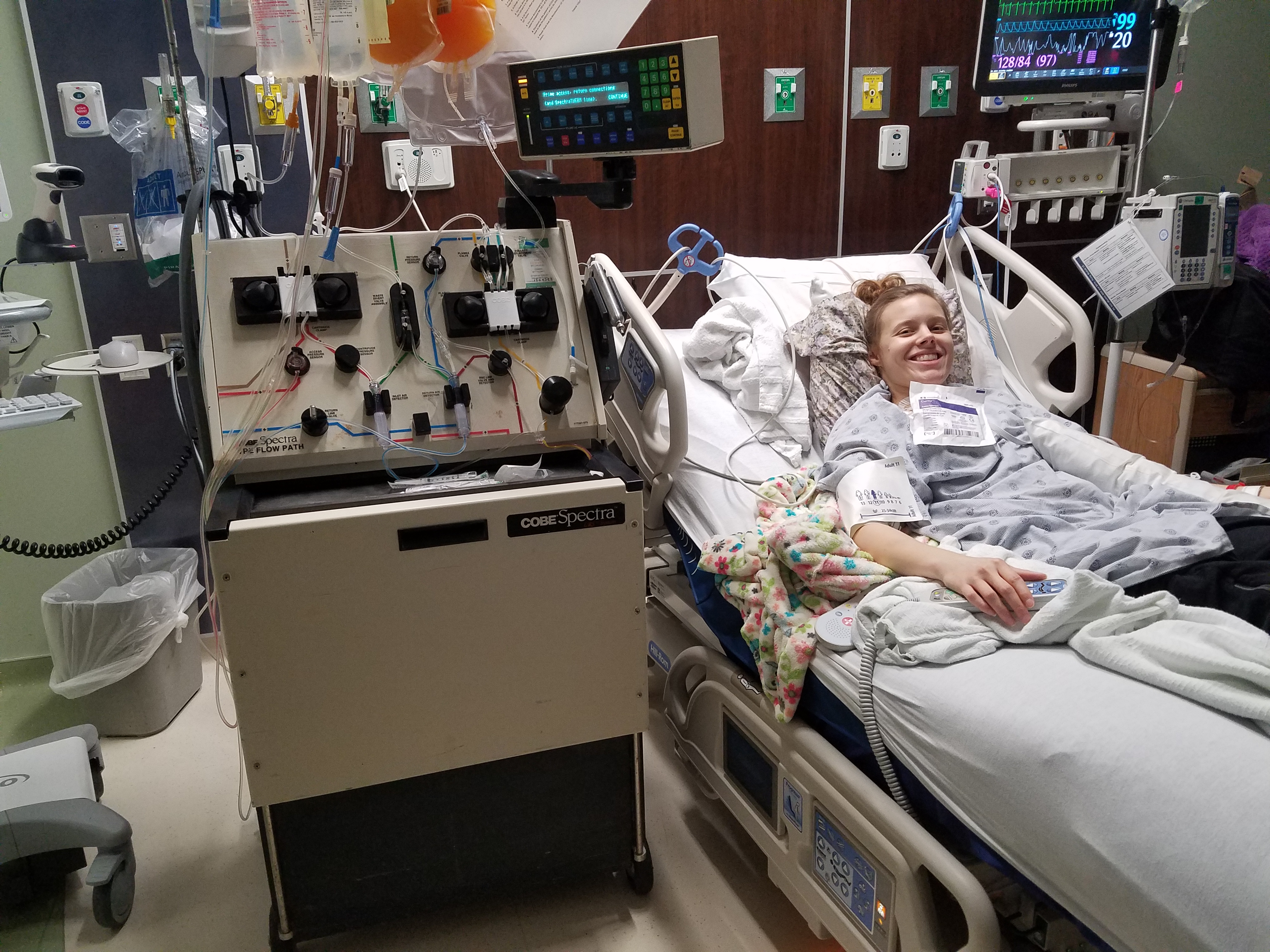
Every day – even during a pandemic – patients like Kristen Palocko rely on lifesaving blood products. In 2017, Palocko, a critical care nurse from Broadview Heights, was feeling extremely fatigued. After a trip to the ER, she found out she had a rare bleeding disorder called thrombotic thrombocytopenic purpura (TTP).
“This started me on a roller coaster of a 12-day hospital stay, a central dialysis line in my neck, and multiple units of red blood cells and plasma.” Kristin received 330 units of plasma, taking four hours each for 10 of those 12 days.
“I feel blessed for everyone’s thoughts and prayers through it all—especially the blood donors. They have helped me, and numerous others, in our time of greatest need with their generous donations,” said Palocko. “Without those willing to give of their time (and blood) there would not be treatment for TTP.”
In Northern Ohio, donors can visit one of four donation centers in Toledo, Cleveland, Akron or Parma. To schedule a donation appointment, download the Red Cross Blood Donor App, visit RedCrossBlood.org, call 1-800-RED CROSS (1-800-733-2767) or enable the Blood Donor Skill on any Alexa Echo device.
When seconds count in the race to save lives, it’s the blood already on the shelves that helps most. Join us and give to help ensure hospitals are ready to respond to the needs of patients this month.
The 25th annual Acts of Courage, featuring the H. Peter Burg Community Leadership & Spirit of the Red Cross awards was not the norm this year, but what has been? Nonetheless, on March 4, 2021, courage and recognition did not stop! Due to precautionary measures during COVID-19, the annual honorees made history streaming virtually together for this edition. It is regarded as the greatest celebrated acts of courage, compassion, character and humility in which the American Red Cross proudly honors our region’s deserving recipients each year.
Seven individuals captured Acts of Courage through reactive giving.
Dustin Nist – a Kent State business management student was returning home when he witnessed a car plunge into the Tuscarawas River near the Clinton fire station. He broke a window of the sinking car with a railroad tie after seeing an older woman with water up to her neck in a desperate situation. “I was talking to the lady, letting her know it’s alright,” before responders were able to extract the woman from the car with only minor injuries. He remains modest and said he was acting out of instinct and only glad he could help. Watch Dustin’s story here.
Yamil Encarnacion –a Twinsburg police officer, earned praise after he crawled into an overturned car in the eastbound lane of I-480 to rescue a 4-year-old child pinned in a car seat after an end over end traffic accident. The little girl’s legs were losing color, so officer Encarnacion jumped into action, crawling into the wreckage, cutting the child free. “I remember seeing an officer carrying my daughter, then he went back for my son and there was just blood all over his arms,” according to Emma Johnson, the mother. She says she will never forget what officer Encarnacion did for her and her family. Watch Yamil’s story here.
Richard Santucci & Jim Shepherd – On February 2, 2020, while at work at Nordson Xaloy Inc. in Austintown, Jim Shepherd helped save a life. A man lost consciousness, fell to the ground and began to have a seizure. Jim immediately assessed the man and alerted his team of the escalated incident. Richard Santucci also came to the man’s aid with an AED. Richard began to perform CPR while administering shocks to the gentleman until EMS arrived on scene. The skills learned in the Red Cross Training Services course helped to save the life of this man. Watch Richard and Jim’s story here.
Clarissa Gagne –a journalist with the Akron Beacon Journal, recounts when Clarissa was pregnant with her daughter, she learned CPR as part of her parenting classes. “It’s one of those skills you learn, and you pray you never have to use it.” But the second-grade teacher did so eight years later. Clarissa’s neighbor had collapsed in front of her when she and several neighbors rushed to help. “It was really a whole neighborhood event,” she said. One person called 911, while another watched the woman’s family. Each link in the chain—the person giving CPR, the 911 caller, the dispatcher, the paramedic, the hospital worker, worked together. Watch Clarissa’s story here.
Natalie Weisler – The Portage County 7-year-old woke up at home early Sunday morning November 8, while her parents and brother were still asleep, she went into the living room to watch television. Only a short time had passed before she heard a startling crash from the kitchen. Upon investigating, she found the breezeway in flames. Remaining calm, Natalie woke her parents and older brother to get out safely. Though the damages were extensive, she was brave under pressure and as her father, Justin Weisler, boldly stated, his daughter simply saved their lives. Watch Natalie’s story here.
Joanne White – The 80-year-old suffers from multiple health issues and has been confined to her Boardman home since March 2020, due to COVID-19. Rather than feeling sorry for herself, she began making masks. She made a bundle of masks weekly in all different fabrics, styles and seasonal designs to distribute to anyone who needed them. On a fixed income and never asking for any money or credit to buy materials, she only wanted to make people smile. She cannot imagine making money off those who may not have the means for something so important. Joanne has has made over 1,200 masks and has shipped them all over the country, essentially “covering” our community. Watch Joanne’s story here.
2021 Peter H. Burg Community Leadership Award – Honorees of this year’s philanthropic legacy award are an inspired couple who have embraced their adopted hometown, Nick and Cindy Browning. Nick is the president of Huntington National Bank and Huntington-Akron Foundation. Nick engages leaders, colleagues, customers and communities in improving the lives of families. Cindy is a dedicated community volunteer, having retired after a 35-year nursing career. Her passion for Hospice of Summa and Grace House Akron continues as she serves as a volunteer member and coordinator on the capital and policy committees. The couple’s past work includes youth, health, nonprofit and many other community projects. They were honored for the difference they make in the lives of those in our communities.
The 2021 Spirit of the Red Cross Award Winners – Through their success in the automotive industry, Greg and Alice Greenwood and their family of companies have become synonymous in the Mahoning Valley with devotion for over 36 years. The Greenwoods serve by following the core values the Greenwood dealerships were built upon: Respect, Trust, Honestly, Loyalty and Professionalism. The Greenwood family and its dealership teams are agents for philanthropy and community contribution by supporting the Red Cross in Youngstown, where Greg was an active board member and speaker. Their dealerships support many diverse organizations and events, including local schools, youth clubs, family healthcare and nonprofits. The Greenwood family and dealerships follow the example that Greg and Alice set in raising their three children, with selflessness and generosity.
Thank you to all the deserving award winners for placing others first and, like the Red Cross, being there when help is needed. You, too, can be a local hero. If you are interested in volunteering or to learn more about what caring folks and the Red Cross do on an ongoing basis, visit redcross.org.
Edited By: Glenda Bogar, American Red Cross Volunteer
If you live in Northern Ohio, you know that Mother Nature likes to remind us that we can get a snowstorm late in the season, have a possible tornado at any point or even have heavy rain going into spring (out West they call it mud season). The Rockies and High Plains just experienced several feet of snow, Chicago recently reported areas with 18 inches of snow and the Northeast continues to have a heavy cycle of snow.
The American Red Cross offers tips to prepare and keep you safe during severe weather events of any kind, during any season.
Tornado Safety
Know the difference. A tornado watch means a tornado is possible. A tornado warning means atornado is already occurring or will occur soon. Go to your safe place immediately. Watch for tornado danger signs: dark, often greenish clouds, a wall cloud, cloud of debris.
Know your community’s warning system. Many communities use sirens intended for outdoor warning purposes.
Identify a safe place in your home to gather – a basement, storm cellar or interior room on the lowest floor with no windows. A small, windowless interior room or hallway on the lowest level of a sturdy building is the safest alternative.
If you have time, move or secure items outside that can be picked up by the wind.
If you live in a mobile home, find a safe place in a nearby sturdy building. No mobile home is safe in a tornado. If you have access to a sturdy shelter or a vehicle, go to the shelter or building immediately, using your seat belt if driving.
If you are outside, seek shelter in a basement, shelter or sturdy building.
If you cannot quickly walk to a shelter, immediately get into a vehicle and try to drive to the closest sturdy shelter. Remember to buckle your seat belt.
Stay away from bridge/highway overpasses.
If strong winds and flying debris occurs while driving, pull over and park, keeping your seat belt on and engine running. Put your head down below the windows, covering your head with your hands and a blanket
Bring your companion animals indoors and maintain direct control of them.
Flooding Safety
Turn around, don’t drown. Stay off the roads. If you must drive and encounter a flooded roadway, turn around and go another way.
If you are caught on a flooded road and waters are rising rapidly around you, get out of the car quickly and move to higher ground. Most cars can be swept away by less than two feet of moving water.
Head for higher ground and stay there.
If your neighborhood is prone to flooding, be prepared to evacuate quickly if necessary.
Follow evacuation orders and do not attempt to return until officials say it is safe to do so.
Stay away from floodwaters. Beware of snakes, insects and other animals that may be in or around floodwaters and your home.
Keep children and pets away from hazardous sites and floodwater.
If power lines are down, do not step in puddles or standing water.
Winter Storm Safety
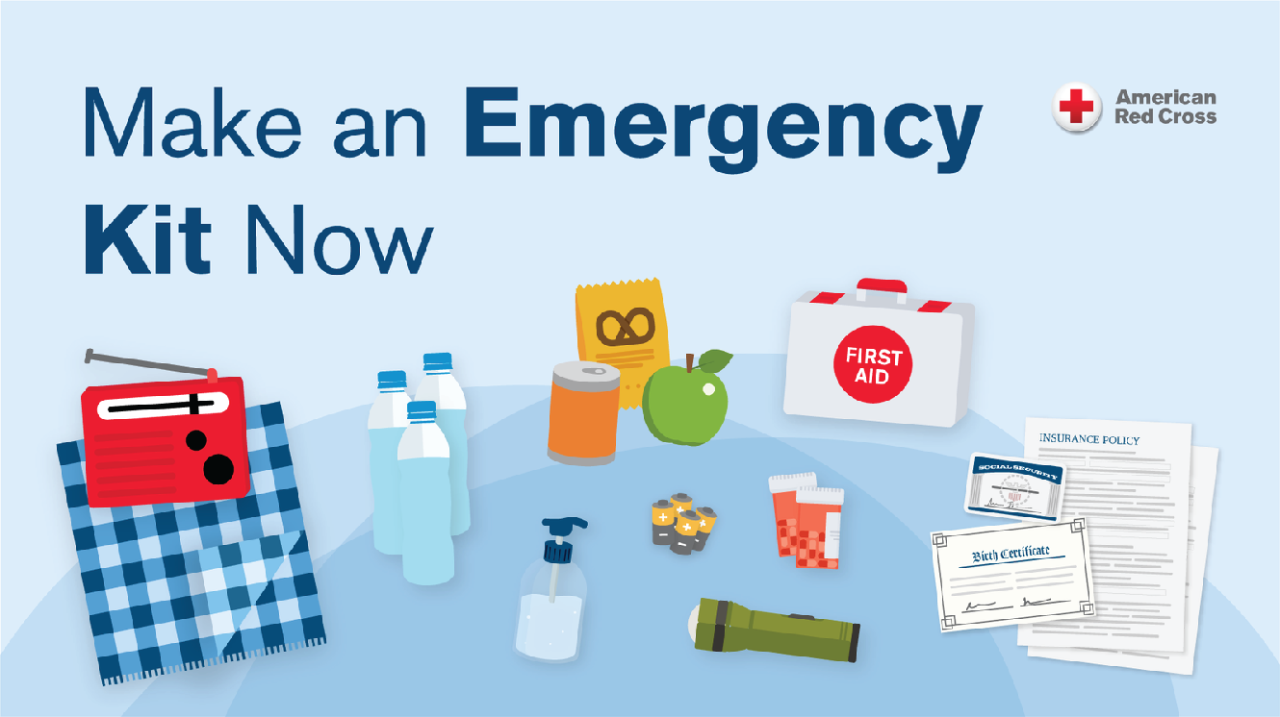
Be prepared for storms, even in spring. Have your disaster kit ready. Details about what should be included are on the Red Cross website. When the storm begins, listen to the advice of local officials and stay in a safe place until weather conditions improve and roads can be cleared.
STAY SAFE by following these steps:
Make sure you have enough heating fuel on hand.
Stay indoors and wear warm clothes. Layers of loose-fitting, lightweight, warm clothing will keep you warmer than a bulky sweater.
Check on relatives, neighbors and friends, particularly if they are elderly or if they live alone. Keep your vehicle’s gas tank full to keep the fuel line from freezing.
Be extremely careful if you have to shovel snow. Take frequent breaks and stay hydrated.
Watch for hypothermia and frostbite. Hypothermia symptoms include confusion, dizziness, exhaustion and severe shivering. Frostbite symptoms include numbness, flushed gray, white, blue or yellow skin discoloration, numbness, or waxy feeling skin.
Don’t forget your pets. Bring them indoors. If they can’t come inside, make sure they have enough shelter to keep them warm and that they can get to unfrozen water.
If possible, avoid driving in the storm. If you have to drive, have a window scraper, kitty litter or sand in case you get stuck, extra clothesand aDisaster Supplies Kitin your trunk.Fill the vehicle’s gas tank and clean the lights and windows to help you see.
Let someone know where you are going, the route you plan to take, and when you expect to get there. If your car gets stuck, help can be sent along your predetermined route.
Avoid Home Fire Danger
Storms can result in a high number of home fires. To avoid fire danger, remember the following:
Never use a stove or oven to heat your home. If you are using a fireplace, use a glass or metal fire screen large enough to catch sparks and rolling logs
Place space heaters on a level, hard surface and keep anything flammable at least three feet away. Turn off space heaters and make sure fireplace embers are out before leaving the room or going to bed.
Use generators correctly – never operate a generator inside the home, including in the basement or garage.
Don’t hook a generator up to the home’s wiring. The safest thing to do is to connect the equipment you want to power directly to the outlets on the generator.
If your power is out, avoid using candles to prevent a fire.
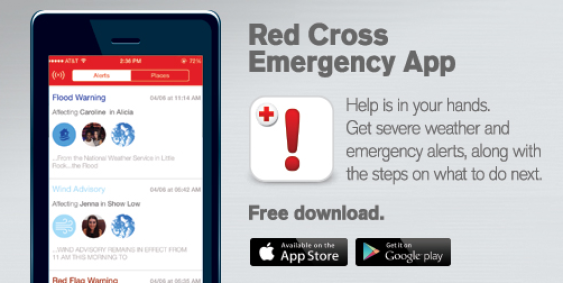
Download our apps. Download the free Red Cross Emergency App to receive emergency alerts and information about what to do in case of severe weather or flooding, as well as locations of shelters. You can find it in smartphone app stores by searching for the American Red Cross or going to redcross.org/apps.
Edited By: Glenda Bogar, American Red Cross Volunteer
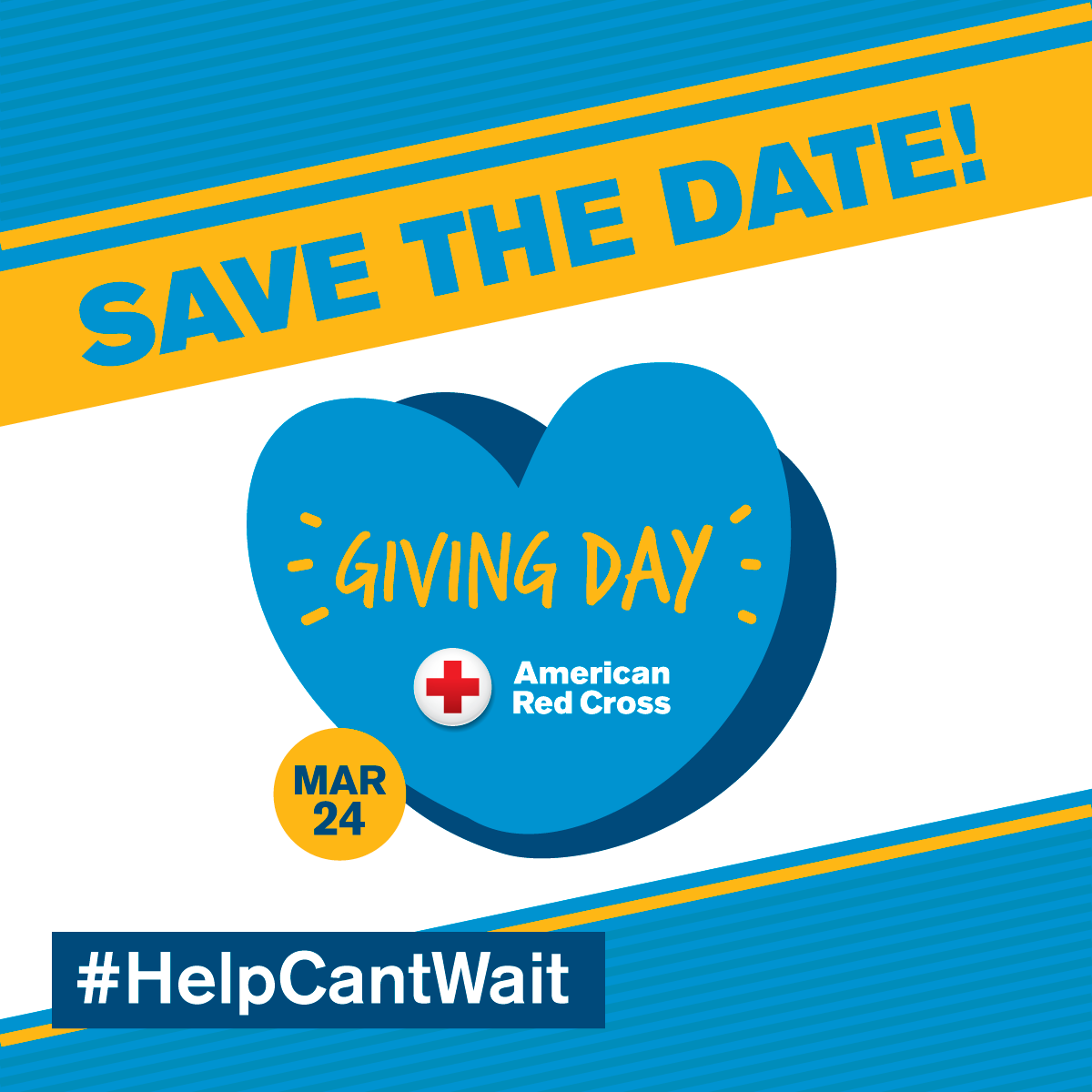
Please take part in Red Cross Giving Day as #HelpCantWait
Tim Poe, American Red Cross Volunteer.
As a Northern Ohio-based American Red Cross volunteer, I have seen how quickly disaster can strike. How a fire, tornado, lightning strike, flood, or other event impacts lives. And I have seen the effectiveness of your donations. How a comfort kit, meal, blanket, or financial assistance helps those affected begin to recover, to look toward the future. I have also seen the dedication and compassion of many Red Cross volunteers and staff members across several service areas, including Disaster Response, Blood Services, and Service to the Armed Forces. As today is Giving Day, please consider joining thousands of caring people and taking part, whether through financial support, a blood donation, or volunteering.
Red Cross services have been especially needed in the past year. In addition to the COVID-19 global pandemic, 2020 had the greatest number of billion-dollar disasters in a single year. Many from our region helped; nearly 200 Northern Ohioans deployed to 24 large-scale disasters during the year.
Locally, just since July 1, the Red Cross’s Northern Ohio region responded to 848 disasters, assisting 1,249 families (2,074 adults and 1,122 children).
Through it all, the Red Cross effectively continued its mission, with safety protocols in place.
Emotional, spiritual, and mental health support during the pandemic have been one focus area. In 2020, disaster mental health and spiritual care volunteers had more than 53,000 conversations, and free counseling is available through the Red Cross’s Virtual Family Assistance Center for grieving families during COVID-19.
I spoke with Red Cross volunteer Mark Cline, whose numerous responsibilities include Region Program Lead for Northern Ohio’s Disaster Action Team (DAT). Mark focused on how the Red Cross has continued helping people recover from disasters using safety measures like virtual responses where possible. Mark lauded his fellow volunteers and staff, saying, “Being part of the Disaster Action Team proves to me a team working together will get the job done, even in a pandemic!”
Here are some examples of what a financial gift can provide:
$500: Help families affected by disasters. In Northern Ohio, the Red Cross responds to an average of more than three disasters each day, mostly home fires.
$200: Deploy an emergency response vehicle (ERV) for a day. ERVs deliver food, supplies, comfort, and information to those in need.
$100: Cleaning supply kits for five families.
$95: A day’s worth of food and essential supplies for a family in urgent need after a disaster.
$60: Warm meals for six.
$35: Essential relief items for two.
To participate in Giving Day with financial support, please go to redcross.org/GivingDay. A gift of any size makes a difference.
If you are healthy and feeling well, please consider donating blood. Visit RedCrossBlood.org.
To learn lifesaving skills like CPR and First Aid, consider taking a class at redcross.org/TakeAClass. Online options include Psychological First Aid for COVID-19.
Donating when you are able to can be a wonderful way to give back to your community and help those who are in need. There are many ways you can support and give to the American Red Cross, including providing a financial gift.
You may be asking yourself: How is my donation used? How much of it is used? How can I donate? All of these are great questions, and ones you should ask before donating to any cause, charity or organization. For those who have questions about the Red Cross, we are providing the answers to some of these common questions about financial contributions.
How much of my donation goes to the Red Cross?
An average of 90 cents of every dollar we receive is invested in delivering care and comfort to those in need.
How is my donation used by the Red Cross?
With the generous support of our donors, we help millions of people each year. Financial donations help to support our programs like disaster relief, blood drives, our Home Fire Campaign, training classes, services to the armed forces and more. Learn more about the work we do here in Northern Ohio.
How can I donate?
If you are looking to give a financial donation to the Red Cross, there are many ways you can donate:
Make a donation online
Send a donation by mail
Donate over the phone
Text to donate $10
Alexa Donations with Amazon Pay
Donate stock, your car, hotel points or airline miles
Give in tribute to someone
Give monthly
If you want your donation to go even further, ask your employer if they would sponsor a matching program for employees. In a matching program, your donation is matched by the organization or individual that is sponsoring the program.
There are many ways you can give back and support the Red Cross’ mission. We encourage you to learn more about our mission and our work, and if you are able to do so, consider donating this coming Giving Day on March 24—or any day. For details on how to donate or to make a secure donation online, click here.
We thank you for your support!
Edited by: Glenda Bogar, American Red Cross Volunteer
Women’s History Month profile of Clara Barton’s successor
By: Olivia Wyles, American Red Cross Volunteer
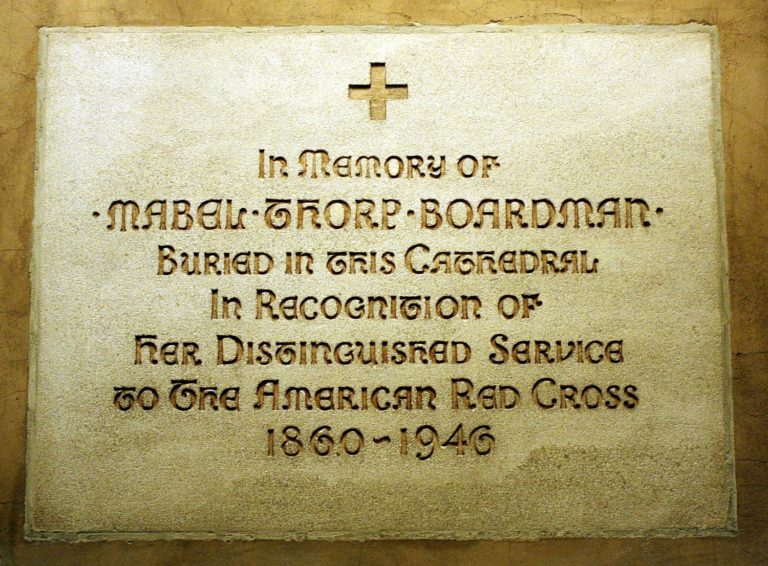
March is recognized not only as Red Cross Month, but also as Women’s History Month, and the Red Cross has a powerhouse of a woman to recognize. One of Northeast Ohio’s very own, Mabel Boardman, was born in Cleveland, Ohio, in 1860 and passed away from coronary thrombosis in 1946. During her 86 years of life, Mabel lived an exciting and innovative life, with much of the fruits of her labor being the development of the sturdy framework that the Red Cross has today.
Mabel Boardman served with numerous social philanthropies throughout her life, one of which was serving on the executive committee of the Red Cross. After Clara Barton’s resignation in 1904, the Red Cross received a formal federal charter under President Woodrow Wilson, and although Boardman’s name was listed on the list of incorporators, she claims to have never given her consent. She was commonly referred to as the “administrative genius” of the Red Cross and was the acting leader of the organization, but she humbly refused any formal recognitions because of her fear that having a woman as a leader would harm the public’s confidence in the organization and diminish its credibility.
Mabel Boardman
The achievements that Boardman spearheaded for the Red Cross are numerous, but one of the most notable is that she was able to establish a large, permanent endowment fund for the organization that would give it a strong, reliable financial foundation for the future. In addition, she established Red Cross branches across the country, which directly impacted the global presence that the organization would come to have. Boardman established cooperation with other groups, like the American Nursing Association, that resulted in improved services, and she also developed the readiness of the Red Cross to respond quickly to disasters. Boardman organized the Volunteer Special Services division and served as the director in 1923 and retired 17 years later in 1940 after the membership roll in Volunteer Services reached 2.72 million.
Much of the Red Cross’ successes and developments can be traced back to Boardman and her ability to transform a 300-member society into an innovative and flourishing institution with over 29 million junior and senior members. She received the first Distinguished Service Medal ever awarded by the Red Cross. She definitely wins our vote to be recognized as a notable Northeast Ohio woman this Women’s History Month.
Edited by: Glenda Bogar, American Red Cross Volunteer
Throughout the month of March, we honor people like you who make the lifesaving mission of the American Red Cross possible — the individuals across the country who turn compassion into action, helping others in times of crisis. Our Red Cross Month celebration has been an annual tradition since 1943, when President Franklin D. Roosevelt issued the first Red Cross Month proclamation.
My Volunteer Story
For close to a year, I have been an American Red Cross Transportation Specialist. The COVID-19 pandemic has dramatically challenged all of us in our daily lives but has also resulted in many learning what is important in their personal lives—family, friends and local communities. I was searching for a way to give back with the extra time I had during the stay-at-home orders. The Transportation Specialist role was a great match.
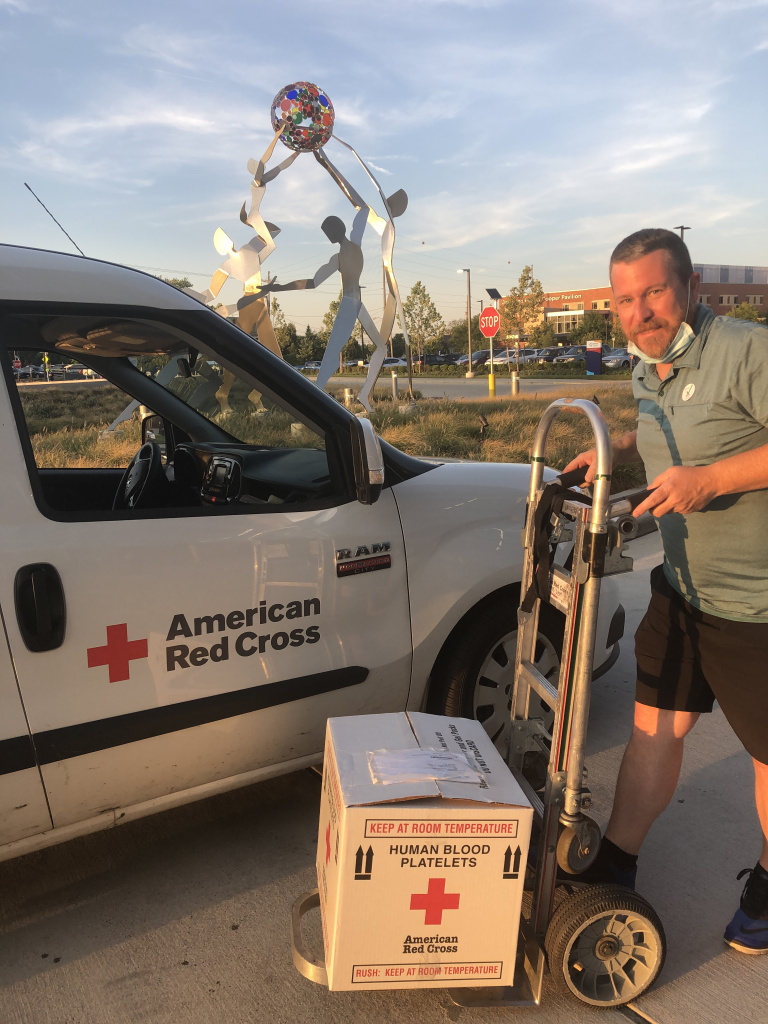
Volunteer Transportation Specialists deliver lifesaving blood products from Red Cross distribution facilities to hospitals, using a Red Cross-owned vehicle. Simply put, you pick up processed blood at a distribution center, drive it to assigned hospitals and return to drop off empty boxes that you collect.
Chris Chmura delivers blood to a local hospital in his role as a volunteer transportation specialist with the American Red Cross.
My commitment is two to four shifts per month (or more if I can) based on my personal and professional schedule. Typical shifts are about four hours, so I usually schedule to cover routes in the evening /night after work. The Red Cross offers training online and then time spent with a veteran driver to shadow a few days. The amazing employees at the Red Cross support you by answering questions, helping to work with your schedule and steer you in the right direction as you learn your role.
A few reasons I enjoy the role:
My day job is not in the medical field, and I find visiting the Red Cross lab and various hospitals interesting to learn about. You get to experience “behind the scenes” how the Red Cross collects donated blood, how they prepare it for hospitals and see first-hand who it goes to. My favorite route is delivering to Akron Children’s Hospital.
You feel a pride and satisfaction volunteering.
When I donate blood, I feel a connection to the group who supports the whole process.
Other volunteers are welcoming, fun to connect with and build relationships with.
I enjoy meeting various people throughout the Red Cross and hospitals that I visit across Northeast Ohio.
A large percentage of my time volunteering is drive time, so I relax by listening to podcasts, sports radio or music.
Is this Position for You?
Do you enjoy helping your neighbors, giving back to your community and want to enhance your life by using your talents? The Transportation Specialist position might be a good fit for you. You will also need to meet these qualifications to become one:
Have a valid state driver’s license and proof of insurance
Have three years driving experience and a clean driving record
We invite you and others to join the Red Cross mission by volunteering, giving blood, learning lifesaving skills or making a financial donation. We are ordinary individuals with the innate desire to do extraordinary things. Red Cross staff and volunteers bring their diverse backgrounds and skills to the table, united by the passion we share for our mission—to prevent and alleviate suffering in the face of emergencies.
Safety First!
Interested in serving to meet essential service needs in the public? Be sure to review the CDC guidance for people who are at higher risk for severe illness, consult your health care provider and follow local guidance. The number one priority of the American Red Cross is the health and safety of our employees, volunteers, blood donors and recipients, and the people we serve.
Blood Donations
Don’t forget to donate blood! You don’t need a special reason to give blood. You just need your own reason.
Some of us give blood because we were asked by a friend.
Some know that a family member or a friend might need blood someday.









 NOHredcross