Tiffany Circle Members Visit Cleveland FBI Building

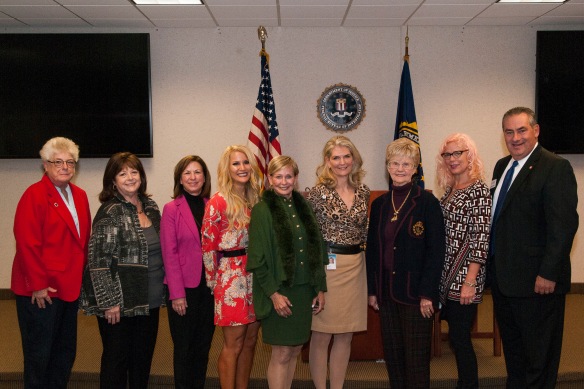
Greater Cleveland Chapter Board and Tiffany Circle Member, Laurie Laidlaw, welcomed fellow Tiffany Circle members recently to an exclusive experience.

_jrs0044

They were gathered at the FBI building in downtown Cleveland as part of their quarterly Tiffany Circle gathering. Stephen Anthony, the Special Agent in Charge of the Cleveland Office of the FBI, spoke to the women about the special relationship of the FBI and the Red Cross, and shared information about the FBI surveillance and response during last summer’s RNC.

The group also learned about active shooter scenarios from Supervisory Senior Resident Agent Todd Werth, and how they could stay safe during such an event.

Finally, the Tiffany Circle members were given a tour of the FBI Cleveland Gun Vault.

By investing $10,000 or more annually in their local Red Cross chapters, the women of the Tiffany Circle follow in the footsteps of a long line of women leaders who have helped the Red Cross serve the American public in times of war and peace with disaster assistance, blood collection, safety training and countless other community assistance services.

To learn more about how to join our local Tiffany Circle, please call 216-431-3010 and ask for Scott Thompson.

Celebrating the Holidays in NEO

There were tons and tons of cookies.

(And, let’s be honest, isn’t that all you need to get a holiday celebration started?)

With food, friendship, board games, and – yes – cookies, staff from across the region gathered together at the Akron office to celebrate the holiday season.

There were many activities, including a holiday song game where all in attendance were paired off and encouraged to sing a snippet of a holiday classic. The highlight was surely the duet, “Baby it’s Cold Outside” as sung by Mike Parks and new employee, Garland Hairston.

In addition to cookies, singing, laughter and comradery, staff members collected toys that will be given to children who experience a home fire this winter.

Holiday Party 2016

Click on the image above to view our Flickr album.

Frozen, But Not in a Disney Princess Sort-of Way…

True story: One frozen January day in 2013, I went to check on my parents’ home while they were out of town. As I entered the house, it was immediately clear that something was very wrong. I could still see the steam from my own breath even as I walked in to the living room. And there was a rushing sound coming from the back of the house, like I was standing at the observation deck overlooking Niagara Falls.
In their absence, my parents’ furnace had gone out and one of the pipes in the upstairs shower had burst in the frigid temperatures. Water was cascading through the ceiling of the kitchen, pouring out of the cabinets, raining through the overhead light fixture. The carpet in the dining room, just through the arched doorway, was soaked 4-feet out from the pool of water standing on the linoleum.
Everything had to be replaced.
Being prepared and informed may help you and your family avoid the messy and often expensive issue of frozen pipes. With today’s below freezing temperatures already causing concern, here is some information and suggestions around how to thaw  water pipes in the home if they do freeze and what you can do to prevent the problem.
frozen-pipe-ice.jpg
Why Pipe Freezing is a Problem:
Water has a unique property in that it expands as it freezes. This expansion puts tremendous pressure on whatever is containing it, including metal or plastic pipes. No matter the “strength” of a container, expanding water can cause pipes to break. Pipes that freeze most frequently are those that are exposed to severe cold, like outdoor hose bibs, swimming pool supply lines, water sprinkler lines, and water supply pipes in unheated interior areas like basements and crawl spaces, attics, garages, kitchen cabinets – or bathrooms when the furnace has been not working for who-knows-how-long. Pipes that run against exterior walls (like my parents’) that have little or no insulation are also subject to freezing.
Here’s what you can do right now:
  • Keep garage doors closed if there are water supply lines in the garage.
  • Open kitchen and bathroom cabinet doors to allow warmer air to circulate around the plumbing. Be sure to move any harmful cleaners and household chemicals up out of the reach of children.
  • When the weather is very cold outside, let the cold water drip from the faucet served by exposed pipes. Running water through the pipe – even at a trickle – helps prevent pipes from freezing.
  • Keep the thermostat set to the same temperature both during the day and at night. By temporarily suspending the use of lower nighttime temperatures, you may incur a higher heating bill, but you can prevent a much more costly repair job if pipes freeze and burst.
  • If you will be going away during cold weather, leave the heat on in your home, set to a temperature no lower than 55° F.
To Thaw Frozen Pipes
  • If you turn on a faucet and only a trickle comes out, suspect a frozen pipe. Likely places for frozen pipes include against exterior walls or where your water service enters your home through the foundation.
  • Keep the faucet open. As you treat the frozen pipe and the frozen area begins to melt, water will begin to flow through the frozen area. Running water through the pipe will help melt ice in the pipe.
  • Apply heat to the section of pipe using an electric heating pad wrapped around the pipe, an electric hair dryer, a portable space heater (kept away from flammable materials), or by wrapping pipes with towels soaked in hot water. Do not use a blowtorch, kerosene or propane heater, charcoal stove, or other open flame device.
  • Apply heat until full water pressure is restored. If you are unable to locate the frozen area, if the frozen area is not accessible, or if you can not thaw the pipe, call a licensed plumber.
  • Check all other faucets in your home to find out if you have additional frozen pipes. If one pipe freezes, others may freeze, too.
Preventing Frozen Pipes today or tomorrow (or anytime this season):

Before the onset of cold weather, prevent freezing of these water supply lines and pipes by following these recommendations:

  • Drain water from swimming pool and water sprinkler supply lines following manufacturer’s or installer’s directions. Do not put antifreeze in these lines unless directed. Antifreeze is environmentally harmful, and is dangerous to humans, pets, wildlife, and landscaping.
  • Remove, drain, and store hoses used outdoors. Close inside valves supplying outdoor hose bibs. Open the outside hose bibs to allow water to drain. Keep the outside valve open so that any water remaining in the pipe can expand without causing the pipe to break.
  • Check around the home for other areas where water supply lines are located in unheated areas. Look in the basement, crawl space, attic, garage, and under kitchen and bathroom cabinets. Both hot and cold water pipes in these areas should be insulated.
  • Consider installing specific products made to insulate water pipes like a “pipe sleeve” or installing UL-listed “heat tape,” “heat cable,” or similar materials on exposed water pipes. Newspaper can provide some degree of insulation and protection to exposed pipes – even ¼” of newspaper can provide significant protection in areas that usually do not have frequent or prolonged temperatures below freezing.
Future Protection:
  • Consider relocating exposed pipes to provide increased protection from freezing.
  • Pipes can be relocated by a professional if the home is remodeled.
  • Add insulation to attics, basements and crawl spaces. Insulation will maintain higher temperatures in these areas.
  • For more information, please contact a licensed plumber or building professional.

Get Your Vehicle Ready for Winter

Timely Advice Ahead of First Winter Storm of the Season

Driving in a winter storm presents its own unique challenges. The Red Cross has steps people can follow to get their vehicle ready for winter as well as what they should do if they are caught in a winter storm.

“Check your vehicle and stock it with some emergency supplies,” said Tim O’Toole, Disaster Services Officer. “The best thing you can do is stay off the roads during a winter storm.”

GET YOUR VEHICLE READY FOR WINTER  Plan ahead. Have a mechanic check your tires, battery, brakes and antifreeze levels. Make sure your vehicle is ready for winter with a window scraper, shovel, kitty litter or sand in case you get stuck, extra clothes and a Disaster Supplies Kit in your trunk. Pack high-protein snacks, water, first aid kit, flashlight, small battery-operated radio, an emergency contact card with names and phone numbers, extra prescription medications, blankets and important documents or information you may need.

car-winter

DRIVING IN WINTER  While the Red Cross encourages you to stay off the road if possible, if you have to drive in snow or freezing rain, follow these tips about how to drive safely during a winter storm and what to do if you become stuck in your vehicle:

  • Fill the vehicle’s gas tank and clean the lights and windows to help you see.
  • Pay attention to the weather forecast. Before you leave, let someone know where you are going, the route you plan to take, and when you expect to get there. If your car gets stuck, help can be sent along your predetermined route.
  • If you have to drive, make sure everyone has their seat belts on and give your full attention to the road. Avoid distractions such as cell phones.
  • Don’t follow other vehicles too closely. Sudden stops are difficult on snowy roadways.
  • Don’t use cruise control when driving in winter weather.
  • Don’t pass snow plows.
  • Know that ramps, bridges and overpasses will freeze before roadways.

If you become stuck in the snow or icy conditions:

  • Stay with the car. Do not try to walk to safety.
  • Tie a brightly colored cloth (preferably red) to the antenna for rescuers to see.
  • Don’t run your engine and heater constantly to help avoid running out of gas. Don’t use things like lights or the radio without the engine running so the battery doesn’t conk out.
  • If you can, move your vehicle off the roadway. Stay with it – don’t abandon it. If you have to get out of your vehicle, use the side away from traffic.
  • Start the car and use the heater for about 10 minutes every hour. Keep the exhaust pipe clear so fumes won’t back up in the car.
  • Leave the overhead light on when the engine is running to help rescuers see the vehicle.
  • Keep one window slightly open – away from the blowing wind – to let in air.

WEATHER ALERTS AND FIRST AID TIPS People can download the Red Cross Emergency App for instant access to winter storm tips and weather alerts for their area and where loved-ones live. Expert medical guidance and a hospital locator are included in the First Aid App in case travelers encounter any mishaps. Both apps are available to download for free in app stores or at redcross.org/apps.

Veterans Day Freebies and Discounts

First things first:IMG_0229

From the Titanic to Service: Dispatches from the East Coast

img_2098-2Dori Baumwart is passionate about service to others.

She is a Red Cross volunteer from Greenville, SC, assisting with sheltering in the southern part of the state during the Hurricane Matthew disaster relief operation.  Dori has a smile that is contagious, and even while waiting for her shelter assignment, she constantly asks, “What else can I do for you?”

Dori traces her love of helping strangers cope with disaster to her paternal grandmother, Amy.  When Amy was in her early twenties in 1912, her doctor told her she needed to leave her home in Great Britain to a warmer climate, so she booked a second-class passage on a ship headed for America.  As an unmarried woman traveling alone, Amy was an oddity on the Titanic but she was excited about starting her new life.

amy-stanleyAs the Titanic sank into the cold, Atlantic waters, Amy found herself standing on the deck as the lifeboat in front of her was filled to capacity. However, a young man who had a seat saw her there, and without any pressure from other passengers, he leaped out and offered his spot to her.

“I wouldn’t be here if it weren’t for the sacrifice of this unknown gentleman,” says Dori.  “My grandmother eventually met and married my grandfather in the United States.  What’s really neat is that the survivors from the Titanic were housed at the Met Life building in New York City after the Carpathian rescued them.  I worked for Met Life, so I always felt like everything came full circle.”

Today, as Dori prepares to head to the shelter to care for evacuees, she proudly shares the story of how her grandmother survived so that she could pay it forward.

If you are interested in volunteering with the Red Cross, get started on your application today at http://www.redcross.org/neo and click on Volunteer!

Story and Photos by Michelle Hankes/American Red Cross from redcrosssc.blogspot.com

NEO Volunteers and Staff Head to the East Coast for Hurricane Matthew Response

emily-probst“My name is Emily and I am the Disaster Program Specialist for the Greater Cleveland Chapter. I am heading out on my first deployment to assist with disaster relief for Hurricane Matthew. I am very excited to get down to Florida and make a direct impact to the community. I started working for the Red Cross because I wanted a job where I was making a positive impact everyday! I am more then ready to take this next step in my work and hit the ground running upon my arrival. “

Including Emily, nineteen NEO Red Cross workers have deployed to the East Coast, and many more are expected to leave in the coming days.

The Red Cross has launched a massive sheltering operation in response to Hurricane Matthew with more than 27,000 people seeking refuge in almost 200 Red Cross and community evacuation shelters across three states Thursday night. This included 133 shelters in Florida with more than 22,000 people; 18 shelters in Georgia with more than 2,100 people; and 47 shelters in South Carolina with more than 2,500 people.

More than 1,800 Red Cross disaster workers from across the country are on the ground or traveling to the southeast to support evacuation shelters and response efforts. In addition to providing a safe place to ride out the dangerous storm, the Red Cross is preparing to deliver relief supplies and help people recover from Matthew as soon as it is safe to do so.

The Red Cross has deployed numerous emergency response vehicles and 35 trailers filled with items like water, ready-to-eat meals, shelter and kitchen supplies, cleaning supplies and comfort kits, insect repellant, gloves, masks, shovels, rakes, coolers and more. The Red Cross is also working in close collaboration with government officials and community partners to make sure people get the help they need.

If someone you know needs to find a shelter, they can visit redcross.org, check the Red Cross Emergency App or call 1-800-768-8048. Anyone who plans to stay in a Red Cross shelter should bring prescription medications, extra clothing, pillows, blankets, hygiene supplies, important documents and other comfort items. They should also include any special items for children, such as diapers, formula and toys, or for family members who have unique needs.

Donations help those affected by disasters, big and small. To donate today, visit www.redcross.org/donate.

A Twist on a Holiday Classic

As in years past, we will begin collecting cards for our annual program – Holidays for Heroes. But this year, there is a new twist. We are hoping to collect cards that can be sent to service members, veterans and their families for EVERY HOLIDAY OVER THE COURSE OF THE COMING YEAR! That means Christmas and Chanukah cards, yes, but we are really hoping to get a large number of generalized cards of thanks that can be used for any occasion!

These cards are extremely touching to service members, veterans and their families. That is why we ask that you concentrate on providing a meaningful message in each card you write – even if that means you send in four cards instead of forty.

We will also be collecting new, small items to donate to the VA:

  • Blank greeting cards (not sealed); with a forever postage stamp for service members to use for their own correspondence
  • Combs/ brushes
  • Deodorant (roll-on/spray)
  • Disposable razors
  • Hand lotion
  • Shaving cream
  • Soap
  • White socks
  • Toothbrushes
  • Toothpaste
  • Adult coloring books
  • Colored pencils
  • Crayons
  • DVD movies
  • Large print: Sudoku, word search, crossword books
  • Low vision playing cards
  • Puzzles
  • Checkers/chess

The five chapters in Northeast Ohio are collecting the items and cards for local distribution to service members, their families, and veterans through area VA service locations, VFWs, and other military organizations. The cards may be delivered individually, included in care packages or displayed at common venues in military installations and hospitals.

A few rules:

  • The Red Cross does not provide cards to sign. Instead, please feel free to make cards or use any favorites that you have on hand.
  • In order to make cards as meaningful as possible for a wide audience, we recommend that you use generic titles such as “Dear Service Member,/Veteran/ Military Family Member” when writing the cards.
  • Please, no personal information such as addresses, phone numbers, or email addresses
  • Cards should not contain glitter because some cards may end up at the bedside of a wounded service member and the glitter could aggravate existing health issues.
  • Please do not seal in individual envelopes. It is easier for our volunteers to screen and sort the cards if they aren’t individually sealed in envelopes.
  • Individual cards can be dropped off or mailed to the Red Cross chapters in a large envelope or mailing box.
  • We ask that people not enclose any items with the holiday cards. Any items enclosed with the holiday cards will be removed, including photos and other gifts. If you wish to provide financial support for Red Cross services to the military, please donate online.
  • Chapters cannot accept cards after November 30– we still need time for our volunteers to sort and deliver!

You can mail cards, or drop cards and items off (between 9 a.m. and 4 p.m.) to the following locations:

Greater Cleveland Chapter
3747 Euclid Avenue
Cleveland, OH 44115

Lake Erie/Heartland Chapter
244 West South Street
Wooster, OH 44691

Elyria Office
2929 West River Rd. N.
Elyria, OH 44035

Mansfield Office
39 N. Park Street
Mansfield, OH 44902

 Lake to River Chapter
3530 Belmont Avenue
Suite 7
Youngstown, OH 44505

Jefferson County Office
81 Talbott Drive
Wintersville, OH 43953

Stark County & Muskingum Lakes Chapter
408 9th Street, SW
Canton, OH 44707

Muskingum Lakes Office
1451 4th St. NW
New Philadelphia, OH 44663

 Summit, Portage, and Medina Counties Chapter
501 West Market Street
Akron, OH 44303

How can you get involved in the Holiday Mail program beyond mailing a card?

Word of Mouth: Host a card signing party as part of your Thanksgiving Celebration!

Social Media: Connect with fellow card senders through social media channels and help us get the word out through Facebook and Twitter. Be sure to use the hashtag #holidaymail.

Help Sort and Deliver Cards: If you are interested in helping sort and deliver cards, please contact Jessica Tischler at 216-426-7525 to see how you can help.

A Lifelong Donor: Jean Myers’ Story

By Neleen Leslie
American Red Cross Volunteer

When people think of giving blood these days, they often think of the iconic Red Cross bloodmobile and a brief eight to ten-minute stint with Red Cross staff and volunteers. When giving blood, a donor doesn’t usually know who the recipient might be, but what if the person in need of blood was someone who they knew and loved? Perhaps a family member? What if the situation was so grave that the blood had to be transferred directly from her body to his? That’s how Jean Myers first gave blood.

New London High School 1937

Photo of the New London High School in 1937. http://www.oldohioschools.com

Jean (nee Haynes) was 16-years old when her father, Harold Haynes, was badly injured. Harold had fallen into a gutter while moving a bull on their family farm in Clarksfield, OH. Jean, was a junior at New London High School. Her dad had been hospitalized for some time when she was asked to give blood. She doesn’t remember being scared of the prospect; after all, this was her dad. What Jean remembers is taking the bus into town with her mother and riding the old streetcar down Euclid Avenue to Huron Road Hospital. Jean lay on a hospital bed next to her father, as blood was transferred directly from her body to his. It was May of 1946 and a school day, so believe it or not, she went right back to school afterwards. It was Jean’s first time giving blood, but it wouldn’t be her last.

img_2223Today, Jean is 87-years-old and has donated almost 16 gallons of blood, not including her first blood donation all those years ago. (Her total gallons donated would have been even more if she had not been rejected a number of times due to low iron levels.) Jean remembers when blood drives first started in New London. They were held at New London High School, which was a collection point for New London and neighboring communities. Volunteers would travel from as far as Greenwich to the high school to give blood. In those days, blood collection drives were held annually so if you were ineligible to give blood during a blood drive, it would be a whole year before you would have another chance to do so. The temporary collection center consisted of four gurneys organized in a square. That meant that donors had to wait their turn. And if their iron levels were low? Well, according to Jean, they would eat more broccoli and get ready for the next blood drive.

The old high school Jean remembers has since been torn down and Red Cross blood drives are now held at the New London Eagles Aerie #2869. Facilities aside, a lot has changed since Jean started giving blood. Donors are now able to give blood once every 56 days instead of once a year, and the process is a far cry from the blood drives at the old high school.

Some things however, have not changed. Jean continues to be in very good health, and plans to continue giving blood. In addition to giving blood, Jean has volunteered with the Red Cross as a receptionist and as a blood drive coordinator.

She describes the Red Cross as “a good group that does wonderful work.” She also adds that, “through the years, the extra blood makes a difference for the small town.” Jean was awarded a 70 year pin at the Red Cross Volunteer Recognition event in the Lake Erie/Heartland Chapter.

img_2232

American Red Cross Volunteer Jean Myers receives a 70-year pin from Lara Kiefer,                      Executive Director, Lake Erie/Heartland Chapter                                                                                                 Photo credit: Jim McIntyre/American Red Cross

If you would like to volunteer, please visit www.redcross.org/neo and click on Volunteer to get your profile started today!


Red Cross Volunteers Credited with Saving Man’s Life

Performed CPR, Used AED to Save a Man at the Wayne County Fair

Farm animals. Funnel cakes. First Aid.

All are traditions of the Wayne County Fair.

The Red Cross has been providing first aid to fair goers for more than 60  years, as a service to the community.  This year, that service helped save at least one life.

A man attending the fair on Monday, September 12, suffered cardiac arrest and collapsed. Red Cross first aid workers rushed to perform CPR. They also applied a newly-acquired AED (automated external defibrillator) while awaiting the arrival of Wayne County EMS personnel.

The man survived.  “The ER staff said the Red Cross saved his life, as there was no way he would have made it if he had to wait for the squad to reach him inside the fairgrounds,” said Lara Kiefer, Executive Director of the Lake Erie/Heartland Chapter.

Captain Doug Hunter of the Wayne County Sheriff’s office also credited the Red Cross crew, in a video posted on Facebook.  Capt. Hunter said, ” I want to recognize the life-saving efforts of the representatives of the Wayne County Red Cross.” He continued,
“They frantically started doing what they are trained to do and tried to revive this man.”  He went on to describe the use of the AED.  “It was not looking good folks. I had pretty much written this man off as not going to survive, but they kept going.”

Captain Hunter also credits a nurse from the Wooster Community Hospital for assisting.

“It was truly a remarkable moment,” Captain Hunter said, in describing the moment the man first showed signs of life. “The people from the Red Cross at the Wayne County Fairgrounds saved this man’s life.”

Most first aid requests involve far less serious ailments, but the service provided by the Red Cross was deemed so important, a facility was built on the fairgrounds for use as a first aid station during the run of the fair every year.

About 120,000 people attend the Wayne County Fair, and the Red Cross provides first aid service free of charge.  Red Cross first aid workers respond to 200-300 incidents each year.  Taxpayer money is saved, by reducing the number of calls made to 911.

Our first aid service at the fair has been valued at approximately $20,000.

But for the man who suffered cardiac arrest on Monday, no value can be placed on the life-saving skills of the Red Cross first aid responders.

You can learn the same life-saving skills employed by the Red Cross by taking a class, to learn First Aid, CPR and AED. Training for other skills, such as babysitting and swimming and water safety are also offered. Go to redcross.org/takeaclass.

Photo credit: Mary Williams/American Red Cross