American Red Cross launches first aid for opioid overdoses course

New online training helps people respond to opioid overdoses and save lives

The American Red Cross has launched First Aid for Opioid Overdoses – an online course to teach people how to respond to a known or suspected opioid overdose.

The 45 minute course contains content on how to identify the signs and symptoms of a suspected opioid overdose and the appropriate care to provide based on the responsiveness of the person. Information on how to use several different naloxone products – including a nasal atomizer, Narcan Nasal Spray, and EVZIO – to temporarily reverse the effects of an opioid overdose is also included.

People can register and access the course at https://www.redcross.org/take-a-class/opioidoverdose. Because an opioid overdose can lead to cardiac arrest, people are also encouraged to take a Red Cross CPR/AED course.

“An opioid overdose is a life-threatening emergency,” said Mike Parks, Regional CEO of the Red Cross of Northeast Ohio.  “When you suspect an opioid overdose, it’s important to start providing care immediately.”

Recently, the Red Cross had the opportunity to share its commitment and efforts to help address this public health crisis at a White House opioids event. Learn more about the event, and the involvement of the Red Cross here: https://www.whitehouse.gov/articles/year-historic-action-combat-opioid-crisis/

The Red Cross has also prepared guidance on opioid use and overdose response for those working in the organization’s shelters during disasters. Recently, these efforts empowered a Red Cross volunteer to help save the life of a person in a shelter during Hurricane Florence.
Hurricane Florence 2018

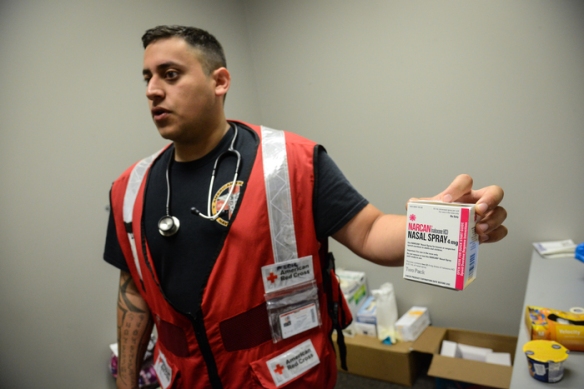
In addition to the new First Aid for Opioid Overdoses online course, this is the first year Red Cross disaster shelters are arming staff and volunteers with information and supplies to help ensure that everyone stays safe in the case of an opioid overdose. During Hurricane Florence, Julian Delgado with Health Services explains to volunteers how to administer these supplies for residents who may need them in shelters. Photo by Daniel Cima/American Red Cross.

“Residents staying at Red Cross shelters often reflect the demographics of the general population,” said Parks, who worked in shelters in North Carolina during the Hurricane Florence disaster relief operation.  “Volunteer shelter workers who are trained to provide treatment when an overdose is suspected will no doubt save more lives in the future.”



Add earthquake preparedness to your to-do list, even if you live in Ohio

By Doug Bardwell – American Red Cross Volunteer

Shake out

Held annually on the third Thursday of October, the ShakeOut International Day of Action is set for Thursday, October 18, 2018 at 10:18 a.m. During the self‐led drill, participants practice earthquake preparedness by learning to “Drop, Cover, and Hold On”. Endorsed by emergency officials and first responders, the safe response to an earthquake is to:

  • DROP where you are, onto your hands and knees. This position protects you from being knocked down and allows you to stay low and crawl to shelter if it’s nearby. If you have mobility issues, either lock the wheels of your wheelchair or stay seated, and bend over.
  • COVER your head and neck with one arm and hand. If a sturdy table or desk is nearby, crawl underneath it for shelter. If no shelter is nearby, crawl next to an interior wall, away from windows.
  • HOLD ON until the shaking stops. If you are under a table or desk for shelter, hold onto it with one hand and be ready to move with your shelter if it shifts.

Watch the video

Earthquakes in Ohio – really?  YES – REALLY

“People may say ‘Why do we need to practice earthquake drills in Ohio?’ We practice because Ohio does experience earthquakes,” said Sima Merick, executive director of the Ohio Emergency Management Agency . “Ohio has had four low-scale earthquakes so far this year. It is also good to know earthquake safety in the event you’ve traveled to another state or country where quakes can occur with higher magnitude and frequency.”

In January 1986, a 5.0-magnitude earthquake took place in Lake County, impacting most of northeastern Ohio. This was the first Ohio quake that caused injuries and to occur near a U.S. nuclear power plant. The 1986 quake ranks as the third largest in the state.

Ohio is on the periphery of the New Madrid Seismic Zone, an area in Missouri and adjacent states that was the site of the largest earthquake sequence to occur in U.S. history. Four great quakes were part of a series at New Madrid in 1811 and 1812. These events were felt throughout the eastern part of the country and were strong enough to topple chimneys in Cincinnati. In March of 1937, western Ohio experienced a 5.4-magnitude quake that knocked down or damaged every chimney in Anna (Shelby County). So much damage was caused to the local school that it had to be torn down.

For more information, or to register yourself, your company or your organization, visit the Great Central U.S. ShakeOut website for Ohio.  Two million Ohioans have already registered.

Also, check out the Red Cross Earthquake App where you can monitor relatives out of town and get the latest alerts.  Available for Android and iOS phones. In the app’s toolkit, you can notify relatives that you are safe, and locate open Red Cross shelters.


Emergency Preparedness for your Pets

By Sue Wilson, American Red Cross Board Member & Communications Volunteer Partner

When Hurricane Katrina hit New Orleans years ago, it was reported that more than 10,000 people refused evacuation because they didn’t want to leave their pets behind. Some of those people, and their pets, became casualties. When reporters asked survivors who didn’t evacuate why they would risk their lives for their pets, they said things like, “They are part of my family.” Or, “My pet is my kid; would you leave your kid behind?”

It’s a situation many animal lovers understand. And a situation many community leaders have considered to save lives of both pets and people.

The truth is, if it’s not safe for you to stay home, it’s not safe for your pet either. As we recognize World Animal Day (October 4), we recommend that as you make your emergency plans for your family in the event of a home fire, weather emergency or any disaster that might require you to leave your home, it is important that you include arrangements for your pet in those plans.

arc-volunteer-pat-kerns-and-lila-a-residents-dog

Red Cross volunteer Pat Kern with Lila in a shelter in North Carolina. Photo by Jim McIntyre/American Red Cross

While the American Red Cross has historically not allowed pets in shelters, mainly for health and sanitation reasons, they work with local and regional animal agencies that operate shelters that would keep pets and their people if not together then nearby. In our area, the Red Cross works with an organization called CARE.

“If we had a shelter opened, we would rely upon them to set up a pet shelter adjacent to the evacuation shelter,” said Debbie Chitester, disaster program manager for the Summit, Portage and Medina Counties Chapter “They have the equipment, supplies and volunteers to do that.”

Debbie also encourages people to have a plan for their pets.

California Wildfires 2018

Jordan, age 8, was able to be with his pets at a shelter in California last summer.
Photo by Virginia Becker/American Red Cross

“Think ahead to family or friends who may be able to take care of your pet,” she explained. “Talk with a vet or a boarding facility ahead of time to see if they have a plan and would be able to accept your pet,” she suggests. If a pet owner does not have any other place to take their pets, she said the Red Cross would activate the CARE team to set up a shelter for them. You can call your local Red Cross office to ask what shelters  are available for your pet if needed.

As you put your emergency plan and supply kit together for your family,make sure you have a separate one for your pet. Your pet emergency kit should include:

  • Sturdy leashes, harnesses and/or carriers to transport pets safely and ensure that they can’t escape.
  • Food, drinking water, bowls, cat litter/pan and a manual can opener if your pet eats canned food. Use plastic/waterproof bins to keep dry food dry and free of mold or bugs.
  • Medications and copies of medical records stored in a waterproof container.
  • A first aid kit.
  • Current photos of you with your pet(s) in case they get lost. Since many pets look alike, this will help eliminate mistaken identity and confusion.
  • Information on feeding schedules, medical conditions, behavioral problems, and the name and number of your veterinarian in case you have to foster or board your pets.
  • Pet beds and toys, if easily transportable.

Knowing you have a plan for your family, including your beloved pet(s), will give you peace of mind should a situation ever arise where you need  to evacuate your home. Click HERE for more information about preparing pets (and people) for emergencies.

September is National Preparedness Month

By Doug Bardwell, American Red Cross volunteer and Disaster Action Team member

One of the most often heard phrases during and after a disaster is “If I had only thought to (insert any of the following suggestions), I wouldn’t be in this mess now.” This is known as the “could of – should of” syndrome. You knew you could have prepared. You knew you should have prepared. But you didn’t.

Well, this September is your chance to get it done. The American Red Cross offers some helpful tips. All you need to do is follow through.

As we consider all the natural disasters that could strike, there are some basics that will apply across the board to hurricanes, floods, tornadoes, wildfires, etc.

  • Don’t wait until the day of a disaster to think about what to pack. Be prepared if you need to evacuate. Make a list of “must have” items right now and keep it somewhere handy.
    1. Have a family plan for a meeting place in case some family members are not home when you have to evacuate. In case someone comes looking for you, leave written instructions in the home as to where you went.first aid kit
    1. Pack enough for 72 hours at least. Pack the following items in an easy-to-carry container: a gallon of water per person, per day; non-perishable food; flashlight and hand-crank or battery-powered radio; extra batteries; sanitation and personal hygiene items; copies of important papers; extra cash; and any medical or baby supplies family members may need. Plan for your pets as well. Additional suggestions here. Even more suggestions here.
    1. Fill your car with gas. Never let it go below a half tank when threatening weather exists.
    1. Pay attention to officials and evacuate when suggested. Those who linger are the ones who find themselves in trouble.
  • The American Red Cross has multiple apps for iOS and Android with directions to mobile-apps-emergencylocal shelters, emergency first aid instructions and weather-related specifics. Download them to your phone now in case your wireless goes out later.
  • Simulate an emergency some weekend. Make sure your “Go Kit” fits in the car and spend a night away somewhere. Make a list of those things you wish you had included.
  • When you get home, make the changes and you’ll be ready in the event an emergency occurs.
  • Share your experience with other family and friends who don’t live with you.

Congratulations! You’ve just avoided the “could of – should of” syndrome and your family will be ready should an emergency strike.

Having worked in many emergency shelters, I know that those who were prepared are much better able to deal with the inconvenience of leaving their homes. Forgetting your wallet, your glasses or your medications just make the experience twice as stressful.

To learn more about how the Red Cross helps in emergencies, see these local and national articles. After you learn all that Red Cross does, hopefully you’ll want to make a donation.

Preparedness in a Pillowcase

Milestone reached for the Pillowcase Project

One million elementary school students across the country have now learned how to prepare themselves, their households and their communities for emergencies by participating in The Pillowcase Project. More than 11,000 of those children live in Northeast Ohio.


Originally created in New Orleans, The Pillowcase Project is a free program inspired by the story of local university students carrying their belongings in pillowcases during Hurricane Katrina evacuations. During the presentation, participants receive a pillowcase to decorate and then take home to use as a personal emergency supplies kit.

The curriculum, targeted at 3rd to 5th graders, is structured by a Learn, Practice, Share framework. Students learn about the science of a locally relevant hazard and how to best prepare for it. They practice what to do if a disaster occurs and how to cope with related fear and stress. Afterwards, they share the information and skills they have learned with their family and friends so everyone in the household knows what to do.

IMG_3353

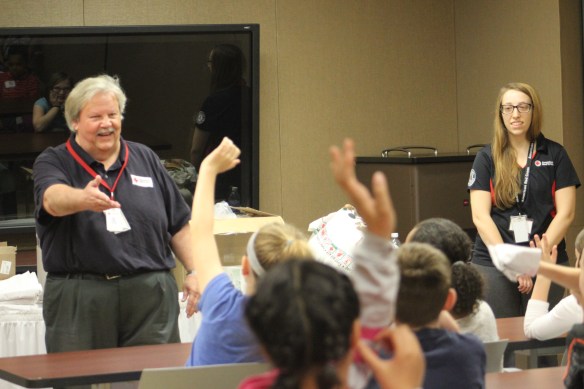
John Gareis, Regional Preparedness Manager was assisted by AmeriCorps worker Rachel Steiner at a Pillowcase Project presentation at the Cleveland VA Medical Center                                         Photo Credit: Jim McIntyre/American Red Cross

“It’s exciting to see young people in Northeast Ohio and across the country learn how to prepare themselves, their households, and their communities for emergencies and save lives by participating in The Pillowcase Project,” said John Gareis, Regional Preparedness Manager.

To date, 11 lives have been saved by four students who put into practice what they learned through the program. Last year, 9-year-old Camryn Sarnie of Ramona, Oklahoma was startled awake at 3:00 a.m. by a smoke alarm sounding in his home. The sound scared Camryn, but he recognized it and knew that it was alerting him to a fire. He knew that he had less than two minutes to escape, so he quickly woke up his parents, alerted them to the fire and instructed them to evacuate immediately. Camryn saved three lives that morning, including his own, by putting into practice what he learned just a few weeks earlier from The Pillowcase Project presentation at his school. According to Camryn’s mother, Lora, “Camryn told us all about what he learned in class after the presentation. Camryn is a true hero.”

IMG_5993

The Red Cross has engaged more than 35,000 volunteers and partnered with more than 13,000 schools, community organizations and partners to deliver this program to students across the country and at more than a dozen U.S. military stations abroad. The Walt Disney Company is the founding sponsor of the program.

Contact John Gareis at 216-431-3219 to schedule a Pillowcase Project presentation for your school, or email john.gareis@redcross.org. .  Additional information about The Pillowcase Project is available at redcross.org/pillowcase.

Ready to Help as Hurricane Season Begins

By Debra Kellar, Senior Specialist, Volunteer Services

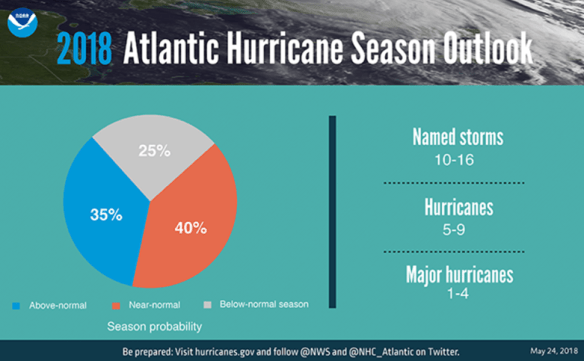
Preparations are underway along the coasts, as the 2018 hurricane season is upon us. June 1 marks the start of what forecasters anticipate being a ‘near or above-normal’ year for storms in both the Atlantic and Pacific basins.

Forecasters also predict, with a 70 percent likelihood, that we will see 10 to 16 named storms in the Atlantic, of which half could be powerful enough to be classified as hurricanes. One to four storms are expected to become major hurricanes. Based on this prediction, the 2018 season is expected to be similar to last year–one that saw catastrophic impacts from Hurricanes Harvey, Irma and Maria.


hurricane graphic

Animation provided by Yiqi Shao

Anatomy of a Hurricane

The formation of a hurricane begins as warm, moist air travels around the equator, rising as it heats, creating an area of low pressure beneath. As cooler air rushes in to take its place, it, too, begins to warm and rise before subsequently cooling, causing the formation of clouds. The system grows, further perpetuating the cycle.  As the winds get faster and faster, an eye will form in the center of the storm.

Once sustained wind speeds reach 39 m.p.h., the system is considered to be a tropical storm. Upon reaching 74 m.p.h., it is reclassified as a hurricane. The Saffir Simpson wind scale is used to further categorize a hurricane, with the weakest referred to as a Category 1 hurricane and winds in excess of 157 m.p.h. considered a Category 5.

Hurricane graphic 2

Graphics provided by the NOAA NWS National Hurricane Center, and the NOAA Central Pacific Hurricane Center.

Red Cross Recovery Efforts

Last year’s Category 5 hurricanes came in quick succession, causing response and recovery efforts to pivot and reorganize to meet the needs of those impacted as additional states became affected. The American Red Cross’ ability to adeptly transition comes from its readiness planning and from the unparalleled dedication of its volunteers. Current disaster volunteers had been poised to assist the impacted coastal states, with many volunteers from Northeast Ohio deployed to staging areas pre-landfall. As the 2017 season continued, more than 100 new volunteers from Northeast Ohio became trained to provide disaster relief as part of one of the premier humanitarian organizations in the world.

Helping People in Need

hurricane graphic 3

The Red Cross Disaster Cycle Services Department is already preparing its volunteer workforce in anticipation of another active hurricane season. If you or someone you know is interested in joining the disaster team, visit our website here to begin an online application or contact our Volunteer Services Department at 216-431-3328.

This year, Facebook has teamed up with the Red Cross to make sure people are prepared for hurricane season,  which runs through November 30. In addition to volunteering, you can help by donating to support disaster relief.

Debra Kellar studied climatology and cartography, and earned a Master’s Degree in Geography at Kent State University.

Thousands in NEO are Now More Prepared

About 9,000 residents of Northeast Ohio now have a better idea about how to prepare for emergencies.  And many of them also have new emergency first aid kits, thanks to our partners at Dominion Energy and the dozens of volunteers who helped distribute the information and the free kits on Saturday, April 7, 2018.

Shoppers at various malls and Walmart stores in Northeast Ohio were given a quiz, to test their preparedness knowledge.  They were quizzed on such topics as the lifespan of smoke alarms (10 years), the national “Call Before You Dig” phone number (811), and the most common cause of home fires (cooking.)

“Dominion Energy Ohio is proud to participate in another successful Preparedness Day with our partners in safety at the American Red Cross,” notes Jim Eck, vice president and general manager, Ohio and West Virginia Distribution. “We remind our customers and the general public that safety at home and at work requires daily vigilance and effort.”

“We are grateful for the help we get from Dominion Energy with Preparedness Day every year,” said John Gareis, Red Cross Regional Preparedness Manager.  “Our partnership has helped educate tens of thousands of people over the past several years, making them Red Cross ready.”

Nearly 4,000 Emergency First Aid kits were distributed to people who took the time to take the preparedness quiz.  You can purchase first aid kits and other emergency supplies at the Red Cross store.

And here you can see a photo album of our volunteers at work on Preparedness Day, 2018.

Save Face and Save a Life

By Doug Bardwell – American Red Cross volunteer

This year, March 10 can be a face-saving and a life-saving date – a two-for-one, if you will. How many other dates can make that claim?

Save Face

If you hadn’t noticed already, Daylight Saving Time comes on March 11.  So, traditional wisdom suggests that you turn your clocks ahead one hour before you go to bed on Saturday, March 10. That’s the number one way to save face Sunday morning, when you might otherwise show up an hour late for worship service or your weekly breakfast date with friends.

Save a Life

The American Red Cross can’t stress enough the need to check your smoke alarms at least twice a year. They’ve even come up with a handy tagline to help you remember – TURN and TEST. Simply stated, each time you TURN your clocks forward or back, also remember to TEST your smoke alarms.TurnAndTest1 (002)

Two of the biggest contributors to lost life in a fire situation are 1) lack of smoke alarms in the home and 2) worn out batteries or total lack thereof.

Every day, seven people die in the United States due to a home fire. Remember, you only have two minutes to escape most home fires without serious or fatal results.  That’s why it’s important to have an escape plan for your home – and to practice it.

If you don’t have smoke alarms or if they are more than 10-years old, contact the Red Cross for free installation of new smoke alarms.  Visit the Home Fire Campaign page on our website.

Bonus Save Face

If you’ve read this far, you deserve a bonus. Please refer to it as Daylight Saving Time, not Daylight Savings Time.  It’s not plural, despite what many people say. It’s one of those things that probably more than half the people get wrong – but now you know!  (Check here for more interesting Daylight Saving Time trivia.)


Be My Valentine – I Could Save Your Life!

By Rena Large, Volunteer, Citizen CPR Leader

With Valentine’s Day approaching, who isn’t thinking about people they love and the things we do to show them we care?

Maybe it’s not exactly what you had in mind, but one thing I do for the people I love is staying up to date on my CPR and First Aid certification. In my earlier years it was sometimes a requirement – as a babysitter, a camp counselor, a life guard – and later it seemed like a good idea as someone who cared for friends and family members and likes to be prepared for anything.

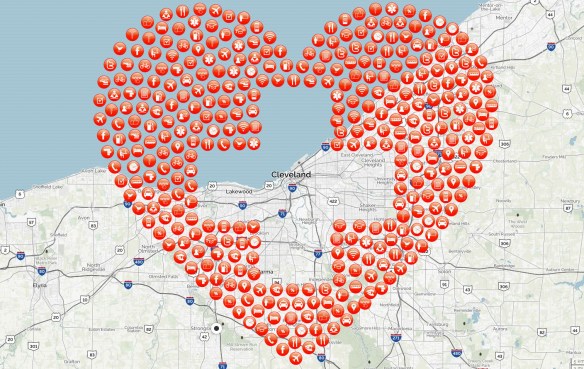
First Aid for Cleveland

Graphic provided by Doug Bardwell/American Red Cross Volunteer

Speaking of hearts…We all probably know someone who has had a cardiac emergency (maybe even witnessed it happen). Most out-of-hospital cardiac arrests happen in homes, and CPR – especially if performed in the first few minutes of cardiac arrest – can double or triple a person’s chance of survival. That’s one of the reasons I love Citizen CPR – a free non-certification program that teaches untrained bystanders to perform hands-only compressions, a simple skill that can keep vital blood and oxygen flowing in a cardiac emergency until trained responders arrive. Performing hands-only compressions is easy to remember and doesn’t require mouth-to-mouth rescue breaths or certification (something that deters some people) – all it requires is willingness to act!

Volunteer Citizen CPR Instructor Rena Large teaches MetroHealth employees lifesaving skills.  Photo credit: Jim McIntyre/American Red Cross

Being a volunteer Citizen CPR instructor in my community is one of the most rewarding things I do. Sometimes people are nervous about the idea – I always hear stories of people witnessing someone having a heart attack at a family reunion or work event and being afraid they will do something wrong if they try to help. Giving them the opportunity to see the skill and practice it takes the mystery away and gives people the confidence that they can do this in an emergency. It means so much to me that I know and can teach others how to save a life. If you aren’t CPR certified, take a moment to learn how to do hands-only compressions; or think about offering a Citizen CPR event in your community or workplace. It might be the most important gift you give this Valentine’s Day and all year long.

When the Weather Outside is Frightful, Driving Can Be, Too!

By Brad Galvan, American Red Cross Communications Volunteer

When wintry conditions strike, it can make for treacherous travel.  Follow these suggestions for staying safe so you can get over the river and through the woods this winter.

If you do not HAVE to go out, stay home.

– many employers have flexible options for poor weather days – speak with your supervisor and work out a proactive plan that involves Skype, email and instant messages so you can still get the job done.

generally, meteorologists give plenty of notice when winter storms are on their way. That’s your cue to stock your pantry and tackle any errands that may need to get done prior to being snowed-in.

If you truly need to go out, here’s how to stay safe:

Vehicle: make sure your car has plenty of fuel, windshield washer fluid, a snow brush and a safety kit. The best kits contain: flares, a bright safety vest, a blanket, tire pressure gauge, jumper cables, flashlight and minor first aid supplies. Your vehicle should be equipped with quality tires, working wipers and heat as well as a working defrost system. You’ll also want to make sure your cell phone is fully charged.

Bring enough of the following for each person:

  • Blankets or sleeping bags
  • Rain gear, extra sets of dry clothing, mittens, socks, and wool hats
  • Newspapers for insulation
  • Plastic bags for sanitation
  • Canned fruit, nuts, and high energy snacks (Include a non-electric can opener if necessary)
  • Warm broth in a thermos and several bottles of water
  • Keep a cell phone or two-way radio with you. Make sure the battery is charged.
  • Plan to travel during daylight and, if possible, take at least one other person with you.
  • Let someone know your destination, your route, and when you expect to arrive. If your vehicle gets stuck along the way, help can be sent along your predetermined route.
  • Before leaving, listen to weather reports for your area and the areas you will be passing through, or call the state highway patrol for the latest road conditions.
  • Be on the lookout for sleet, freezing rain, freezing drizzle, and dense fog, which can make driving very hazardous

The drive: Prior to hitting the road, be sure to have your preferred route and a back-up route in-case the weather gets to be too severe. You’ll need to make sure all snow, frost and ice is removed from your vehicle, including the roof.

Once you are behind the wheel, it’s important to maintain proper distance from the vehicles ahead of you. The slick roads could cause breaking to be a challenge so give yourself plenty of space. Additionally, the snow plows on the roads are there for your safety – please be generous with the space you give them, too. The plows generally travel well below the speed limit, so be patient.

For more winter driving tips, visit here.26196357_10155747520710071_8760805260501895770_n

As pretty as Northern Ohio winters can be, they can be even more frustrating to navigate. Remember to take your time and take precautions to travel safely. And if it can wait, just enjoy a cup of hot cocoa from the comfort of your warm home!