Blood Drives Abound this Holiday Season

Give more life this holiday season by donating blood or platelets at one of the many blood drives scheduled throughout Northeast Ohio.  Donations typically drop during the holidays, with people occupied by other activities or travel.  But patients don’t get a holiday from the need for blood or platelets, so if you can, visit redcrossblood.org to find the blood drive most convenient for you, or call 1-800 RED CROSS.

Some of the blood drives scheduled include:

  • Tuesday, December 19 – Quicken Loans Arena, 12:00 noon to 6:00 pm.
  • Tuesday, December 19 – Hilton Garden Inn Twinsburg, 7:00 am – 7:00 pm.
  • Thursday, December 21 – Sheraton Suites Akron Cuyahoga Falls, 7: 00 am – 7:00 pm.
  • Friday, December 22 – Stambaugh Auditorium, Youngstown, 9:00 am – 4:00 pm
  • Friday, December 22 – Packard Music Hall, Warren, 9:00 am – 4:00 pm.

A special blood drive took place in Ashtabula last week.  Red Cross Communications Volunteer Paul Wadowick captured the story:

Arturo Gomez, a sophomore at Lakeside High in the Ashtabula City School District, wanted to help his community in a positive way.  Arturo shared, “By surrounding myself in a blood drive environment, it would also help me towards my goal to be an RN.” The door opened towards achieving this project with parental support. Eager to do this drive, Arturo met with the area blood drive manager, Tara Dragon. She introduced him to the components needed for organizing a drive. Next, this fifteen year old applied himself to promoting. Flyers were posted in the school and community.  Social media was engaged.  One-on-one contacts were made with people he knows. Blood drive reality arrived on December 15, 2017.
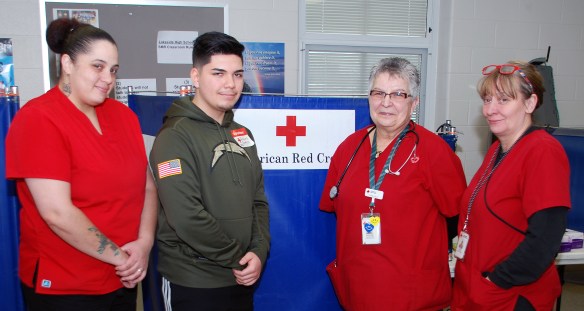
Sophomore Hosts BD 2017 12 15

Arturo hosted during the entire scheduled time. The volunteer Blood Drive Ambassador highlighted ‘customer service’ ways for registration requirements and canteen courtesies. When the day was done, Arturo’s learning curve had grown and four first time donors had signed in.  Thank you Arturo for a job well done!

Veteran Police Officer Returns from CA Wildfire Response

Gets Emotional Describing the Devastation Following His First Red Cross Assignment

When Angel Morales signed-up to volunteer for the American Red Cross, he figured it would take six months before he’d be ready to help people suffering from major disasters.

It was more like six days.

IMG_5097

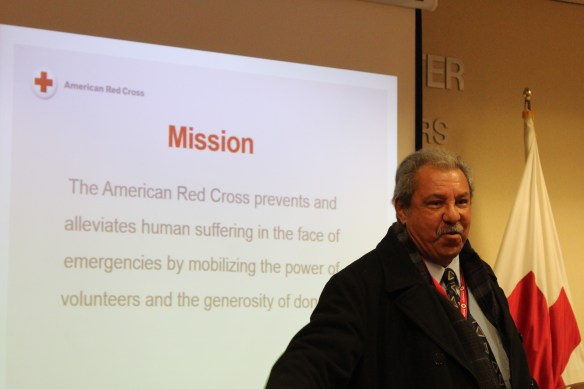
Red Cross volunteer Angel Morales speaks to the Greater Cleveland Board of Directors on December 12, 2017

“Can you go out to California?  We’ve got wildfires there.”  That’s what Angel says he heard when Emily Probst, Regional Disaster Workforce Engagement Manager called, less than a week after his initial training as a disaster responder.

“I took a two-day course.  It was very good. They gave me the basics for sheltering, feeding, and what they call mass care,” Angel recently told members of the Greater Cleveland Board of Directors. “They said in the classes ‘be ready to do whatever they need you to do to fill in.’  I wound up working at a warehouse, very left of center from what I’ve been doing administration-wise. It was a hands-on kind of job.”

Angel currently serves as the Deputy Chief of Police for the Cuyahoga Metropolitan Housing Authority.  Before that, he led security for the Cleveland Browns, after spending more than 25 years with the Cleveland Police Department, “retiring” as Deputy Chief in 1999.

“I think everybody understands that retirement is just a transition to something else. So, I try to give back.  And I wanted to do hands-on rather than be a boss all the time, so I figured ‘let me start fresh with the Red Cross.’”

IMG_5094

Red Cross volunteer Angel Morales

Despite all his years in law enforcement, Angel says the devastation he experienced in California touched his heart. “In a wildfire, it’s different from a hurricane or a storm. Everything is devastated. There’s nothing. It’s burnt to the ground.”  He teared-up as he continued, “You can see me get emotional about it. People lose everything, it just touches your heart. You feel it. It doesn’t matter where you come from, you feel the devastation in your heart.”

Still, he calls the two-weeks he spent helping people impacted by the wildfires a great experience.  And he commends all the volunteers he met and worked with, people from all across the country and from different walks of life.

“They really make a great contribution.”

The Red Cross is always looking for volunteers to train, so that they can help people affected by disasters big and small, near and far, from wildfires in California to home fires in your community.  Visit redcross.org/neo and click the “volunteer” tab to start the application process.

Cold Weather Injuries Are Not Cool

By: Doug Bardwell – American Red Cross Volunteer

North Dakota and Minnesota FloodsWinter is beautiful, provided you are inside looking out.  If you are outside, and can’t get in to get warm, you better be prepared.  Hypothermia, frostnip and frostbite are all possibilities, and all can be serious.


Hypothermia is the medical emergency that can result from losing body heat faster than it can be replaced.  Your normal body temperature is 98.6°F; but you can start to notice signs of hypothermia when your temperature falls below 95°F.  Typical causes are being inadequately clothed or exposure to extreme cold temperatures, like icy water. Avalanche victims often suffer hypothermia if not rescued quickly.

First aid varies with the severity of the frostbite, but generally, if the hypothermia is mild:

  • Call for help immediately
  • Move the person inside a tent or dry shelter to prevent further wind damage.
  • Remove wet clothing
  • Place the victim in a sleeping bag and cover their head
  • Do not allow them to sit or stand
  • If alert, a person may be given warm drinks like soup or hot chocolate – no alcohol or caffeine.
  • Build a fire to warm they gradually until a heated ambulance arrives.

For severe hypothermia, consider the situation life-threatening and seek medical assistance immediately.  Do not rub the person’s extremities, as that my cause ice crystals in the blood to rupture skin cells.  Even if the person’s pulse drops to 2-3 beats per minute, they may still be revived with expert treatment. Do not initiate CPR.

Frostnip is the least serious of the three, but must be treated properly. It occurs when noses, cheeks, ear lobes, fingers or toes are exposed to freezing temperatures and the top layer of skin freezes. The skin becomes white in color and feels hard to the touch.

First aid consists of:

  • Gently rewarming the affected area by holding it against non-freezing skin elsewhere on the person’s body or that of the rescuer.
  • Do not rub the skin for fear of rupturing the ice crystals in the cells.
  • Do not use hot water bottles, etc. that are drastically warmer than the skin’s normal temperature.
  • Frostbite can be caused by exposure to extremely cold temperatures or by contact with extremely cold objects. During frostbite situations, the tissue temperature dips below the freezing point and normal blood flow is obstructed. Symptoms of mild frostbite include slight pain, while severe frostbite can occur with no pain, or possibly a burning sensation resulting in visible blisters.

First aid is similar to hypothermia above. In addition:

  • Loosely cover the affected area with a sterile dressing.
  • Place gauze between fingers and toes to absorb moisture.
  • Again, do not rub the affected areas.

Prevention is obviously preferable to any of the above.  Keep all extremities protected when out in the elements, including your eyes if winds are extreme.  For more first aid hints, consult the Red Cross First Aid app available for both Android and iOS devices, or consider taking a Red Cross sponsored first aid class.

Beautiful to View – Dangerous to Ignore

By Doug Bardwell – American Red Cross Volunteer-Communications and Disaster Services

Candles can add beauty, fragrance and ambiance to any home.  They can even add the scent of fresh pine to a home with an artificial tree. But, home safety trumps ambiance, so keep these easy to follow suggestions in mind during the holiday season (and the rest of the year as well.)

Candle2

Photo credit: Mel Turner on Unsplash

Flickering flames can be extremely interesting to toddlers.  Keeping candles high enough to avoid their reach goes without saying, but if your toddler is ingenious enough to drag over a stool or chair, make sure that the candle will still be out of reach.

If you live in a home with cats, make sure that the candle is somewhere kitty can’t jump or climb.  One swish of a long, furry tail and your candle could come flying down.

Never place candles near draperies or other flammable fabrics. Also, consider open windows. Loose papers or blowing curtains could easily come in contact with the flame.

Candles in the bedroom can be truly romantic; but, statistics show that one-third of candle fires start in the bedroom and approximately half of candle-related deaths occur after midnight and before 6:00 a.m. Be sure to extinguish your candles before you dose off to sleep, or better yet, opt for the inexpensive, flickering, battery-operated candles.  Some even come with small remote controls.

Candle1

If there is a power outage, opt for a flashlight or other battery-powered light. Candles can easily get knocked over in the darkness.  As an alternate, consider these Red Cross nightlights which plug into an outlet, and emit a soft glow. If the power goes out, they turn to a bright white light and can actually be removed from the outlet to serve as a flashlight.  No batteries to ever worry about, since the outlet keeps them charged constantly.

Make sure the candle holder is sized properly for the intended candle. Preferably, have multiple holders for all your favorite-sized candles.  If the holder is too loose, the candle could shift and fall at any time.

Finally, a UL/NFPA approved fire extinguisher is always great to have nearby.  Make sure all family members know where it’s located and know how to properly use it. Now’s an ideal time to review your family escape plan as well.

Read on for more practical fire safety tips.

Is That Your Christmas Tree On Fire?

By Doug Bardwell,  American Red Cross Communications and Disaster Services Volunteer

171203-5770

As popular as artificial trees are, almost everyone loves the smell of a real tree during the holiday season. But, to make sure your holiday memories are nothing but wonderful, take a couple minutes to make sure your tree doesn’t cause the unexpected.

Your lovely tree can turn deadly in just seconds

Don’t let it happen to you or your loved ones.  Here are seven simple hints to keep in mind:

  1. Choose a fresh tree that you cut yourself, if possible. If not, shake the tree aggressively before buying and don’t select one that drops its needles while shaking. That’s a sure sign that it’s drying out already.
  2. If you didn’t cut the tree yourself, cut an additional two inches off the bottom of the tree to open its pores, so that it can absorb fresh water.
  3. Use a sturdy stand to prevent tipping, and make sure that the stand can hold an adequate amount of water to keep the tree as fresh as possible. Make a scheduled time to add water every day.
  4. Keep the tree at least three feet away from any ignition source, such as fireplaces, heaters, candles or high intensity lightbulbs.
  5. Use only UL-rated light strings on your tree and no more than the manufacturer’s recommended number of sets plugged together. Discard any lights with worn or frayed cords.
  6. Make sure the tree and cords do not extend into or across doorways or paths of egress.
  7. Make sure your smoke alarms are working properly and always turn off any Christmas lights before going to bed each night.

Out of control in 20 seconds – you won’t believe the speed or intensity of this fire

Watch this one-minute video from the National Fire Prevention Association showing how quickly a spark or small fire can ignite your beautiful tree.  In less than 20 seconds, you better be out of there. (You have discussed a family escape plan with your children haven’t you?)

As the video points out, a dry tree ignites faster than newspaper.  Protect yourself this season and enjoy the happiest of holidays.  If you need a smoke alarm installed in your home,  visit this page to click on your county of residence to request a free home fire safety inspection and free smoke alarm installations in your home..

Danke, gracias, grazie, merci: It’s International Volunteer Day!

The American Red Cross is a proud part of a vast network of international organizations. So when the United Nations began to promote December 5 as International Volunteer Day, we were completely on-board!

To our more than 1,700 local volunteers, who promote our mission to prepare and alleviate human suffering…Thank you! Thank you! Thank you!

Thank you, also, to those who serve the call of humanitarian organizations across the globe. And to those who serve along side of us as we continuethe recovery process from this year’s hurricane and wildfire season…thank you!

12264-003.jpg

If you would like to volunteer with the Red Cross, please visit redcross.org/neo and click on Volunteer. There are so many opportunities to serve, here in Northeast Ohio, and across the country.

Festive Fundraiser: Festival of Trees

That was some sleigh.

IMG_4995

Six feet long and four feet wide, with wispy garland, clusters of red berries, a padded red leather seat and a strip of festive bells, the sleigh proved to be the item that generated the most heating bidding during the 2018 Festival of Trees, a fundraiser for the Lake Erie/Heartland Chapter presented by Schaeffler.  In the end, close to $60,000 were raised for general disaster services in the local counties served by the chapter.

The sleigh went for a winning bid of $1,600.

Half of the more than 180 bidders placed their bids online, a first for the Festival of Trees. Also a first, the Blue Barn Winery in Wooster as the venue for the Festival.  With its rustic yet elegant decor,  the 85 guests in attendance enjoyed fine food and wine in an intimate setting compliments of Certified Angus Beef and Wooster Country Club.

The funds raised will benefit residents of Wayne, Holmes, Ashland, Richland, Huron, Lorain and Erie Counties who experience a disaster like a home fire.  “The local Red Cross assisted close to 300 families last year, distributing more than $180,000 dollars to help them during their darkest hour,” said Lara Kiefer, Executive Director of the Lake Erie/Heartland Chapter.  “The money raised at this year’s Festival of Trees will continue to help our neighbors recover from disasters like home fires and floods.”

You can help support the mission of the Red Cross by making a donation at redcross.org/neo, or by calling 1-800 Red Cross.

More photos from this year’s Festival of Trees can be seen by visiting our photo album on Flickr.  Photos from the November 17th preview event can be seen here.