As extreme weather events increase, so does the need for Red Cross services and volunteers

2024 is predicted to be an extremely active year

By Tim Poe, American Red Cross Volunteer

Polyrhythms of raindrops drum at the window, accented by rolling bellows of thunder, a severe late May storm approaches. Lights flicker. I am relieved the roof, damaged weeks ago, has finally been repaired. Yet as a Northern Ohio resident I am fortunate, as the region is less prone to natural disasters. Earlier, I watched reports from the latest of this spring’s tornado outbreaks. Amidst the catastrophic scenes, as always, American Red Cross volunteers and staff members are there, ensuring those impacted have food, shelter, care, comfort, and resources to begin recovering.

March 30, 2023. Amory, Mississippi. Red Crosser Eric Besson examines damage to a home on Thursday in Amory, Miss. As many as 2,000 structures across Mississippi received major damage or were destroyed by tornadoes on March 24. More than 380 trained Red Cross disaster workers are on the ground in Mississippi, Georgia and Alabama, as the nonprofit organization works with partners to make sure everyone has a safe place to stay, meals, emotional support and comfort in the aftermath of deadly tornadoes on March 24. Photo by Scott Dalton/American Red Cross

As extreme weather events become more frequent and severe–and 2024 is predicted to be an exceptionally active year–the need for Red Cross services is increasing. Already, the Red Cross responds to almost twice as many large disasters than it did a decade ago, and in just the last 10 months, 125 volunteers from Northern Ohio have assisted residents affected by hurricanes and wildfires across the U.S. Four Northern Ohio volunteers are currently deployed to Texas and Iowa.

As eventful as 2023 was, with weather-related disasters forcing an estimated 2.5 million people from their homes, one-third of them for longer than a month, according to the New York Times, 2024 may be even more severe.

The National Oceanic and Atmospheric Administration (NOAA) reports that, as of May 8, 2024, the US has had seven confirmed weather/climate disaster events, each with losses over $1 billion, resulting in the deaths of 70 people. The NOAA also states there were 384 preliminary tornado reports in April, more than double the 1991-2020 average and the second highest April count on record.

March 31, 2023. Rolling Fork, Mississippi. Red Crosser Yolanda Gainwell visits with Karebya Christmas on Friday outside Christmas’ heavily damaged home in Rolling Fork, Miss. Christmas was home with her three children – ranging in age from 2 to 11 years old – when the tornado arrived. Just like Christmas’ grandmother taught her, she brought the family into the bathtub and put a pillow on top of them. No one was injured, but her home suffered major damages, disrupting their lives, as well as the self-owned business she ran from the home. On Friday, Christmas received help at a drive-through distribution center, where the Red Cross and partners distributed rakes, shovels, totes, clean-up kits, flashlights, batteries and more. Displaced, Christmas is staying at a hotel in Ridgeland, Miss. until at least Monday. As she finished talking with Gainwell, Christmas thanked her for coming to talk with her at her home, but with the damage rendering it uninhabitable, she hesitated to call it a home. “I don’t know what to call it – my blessing in disguise, maybe,” she said. Photo by Scott Dalton/American Red Cross

As summer approaches, the likelihood of an extremely active hurricane season and above-average wildfire season looms. Jim McIntyre, Regional Communications Director for the American Red Cross, Northern Ohio Region, recently conducted an interview with meteorologist Trent Magill of WEWS News 5. Jim and Trent discussed recent events, the need for planning and Red Cross services, and the outlook for the hurricane and severe storm season. Trent states, “everything we’re seeing shows above average intensity,” and that “it’s going to be a rough season.” Continuing, Trent says “Everyone should have a plan.”

Hopefully, you are wondering what you can do. For one, make sure you are prepared and have a plan. For another, please consider volunteering with the Red Cross. Volunteers account for 90% of the Red Cross workforce and represent a wide array of cultures, backgrounds, ages, gender identities, lifestyles, and beliefs, just like those we serve. Everyone is welcome, and free online training is provided.
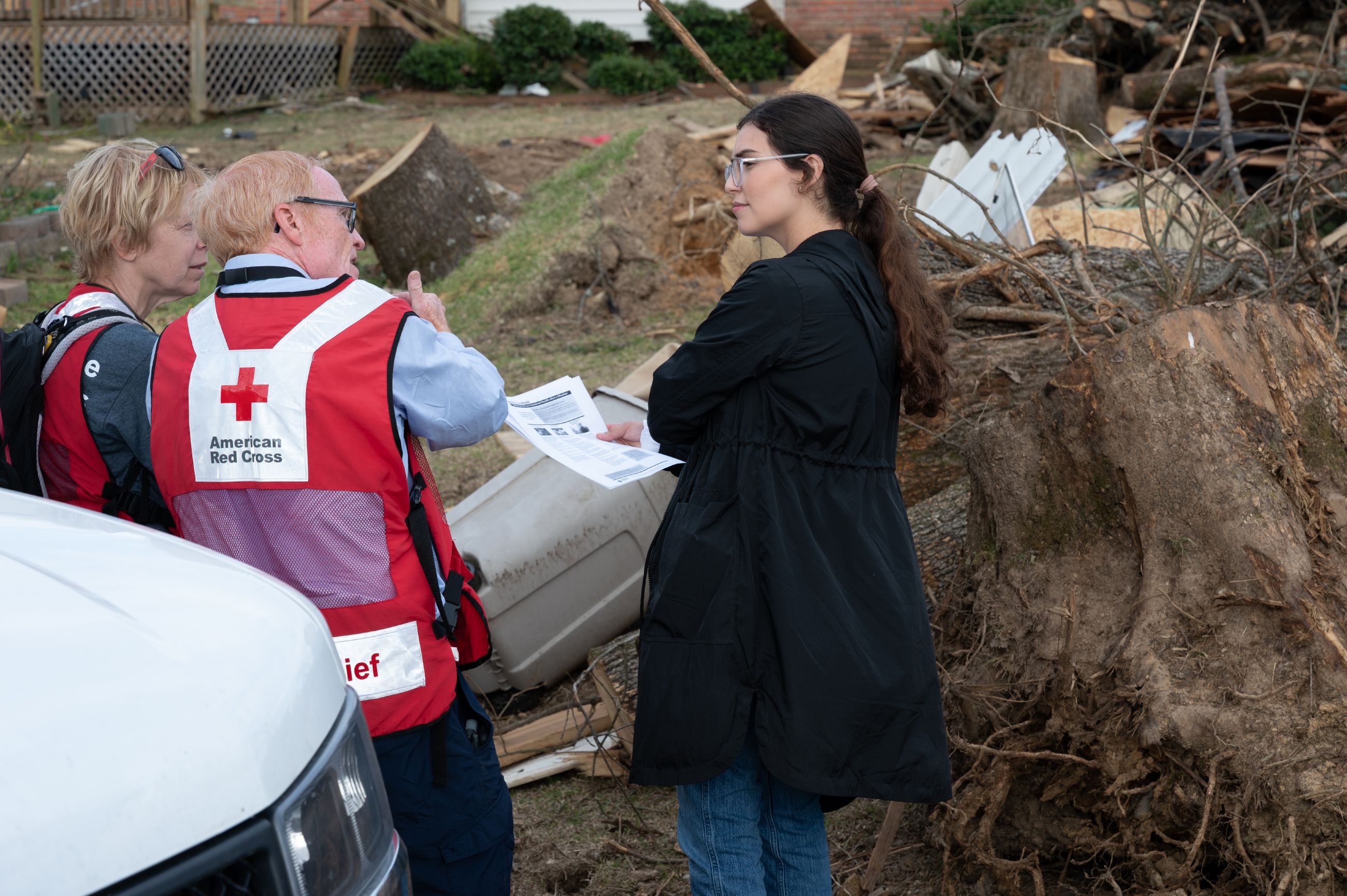
April 9, 2023. Little Rock, Arkansas. William Burkey, a member of the Red Cross disaster mental health team, and Jamie Harms, a member of the disaster health services team, work together to bring comfort and hope to Paula Rocha, whose home was damaged by a tornado that struck Little Rock, Arkansas, and several nearby towns. Photo by Kevin Suttlehan/American Red Cross

Three key positions are especially needed: Disaster Action Team volunteers, who help families in need following a disaster; Shelter Services volunteers, who support day-to-day activities in an emergency shelter; and Disaster Health or Mental Health Services volunteers, who use their professional skills as licensed healthcare providers to assist those impacted by a disaster. Please consider joining, as I can personally attest you will work alongside outstanding people and the see difference Red Cross services provide.

Posted by Ryan Lang, American Red Cross board member and volunteer
    Northern Ohio volunteer delivered supplies and hope in the wake of Hurricane Ian

    By Michael deVulpillieres, American Red Cross

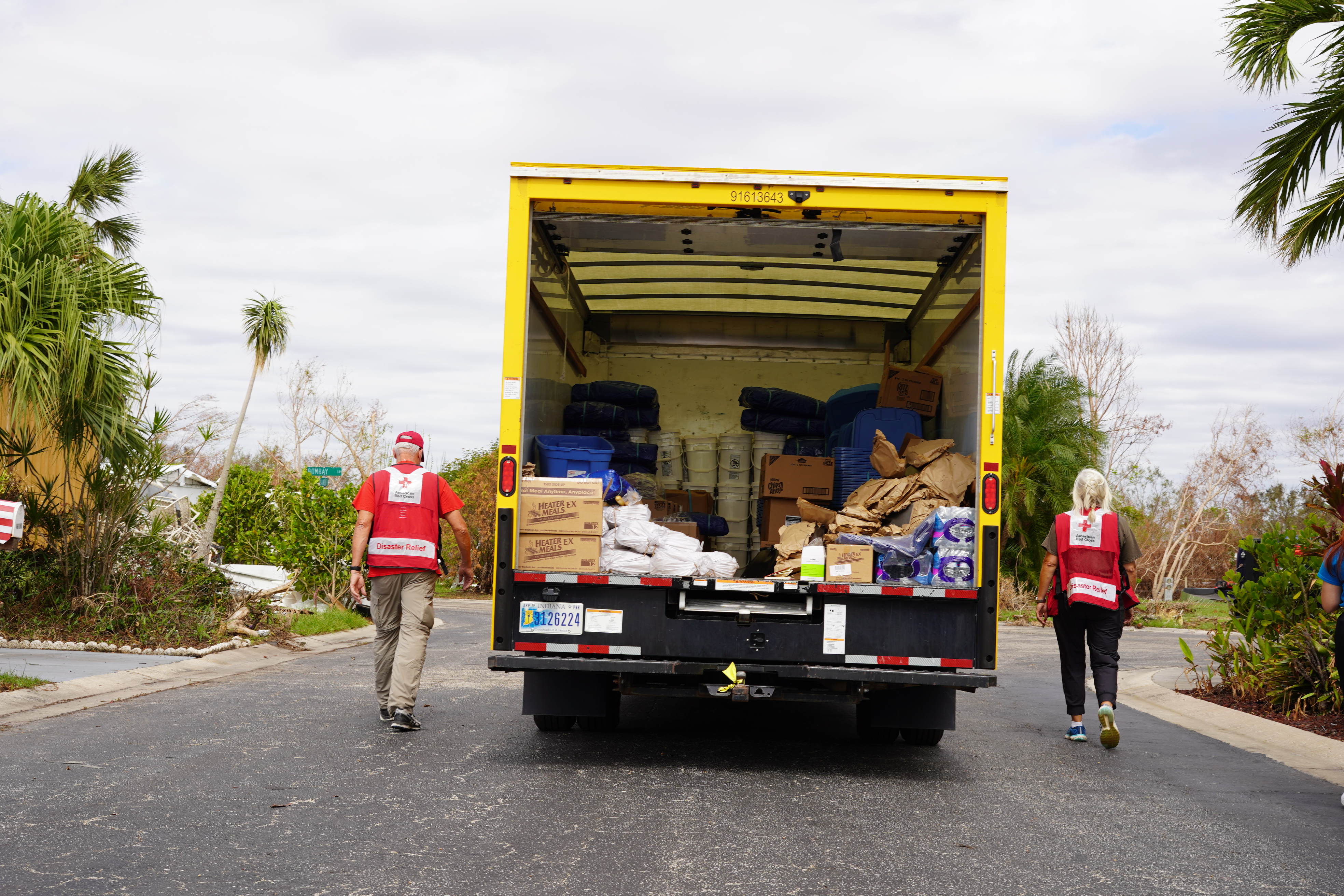
    Destruction was everywhere as a large truck with an American Red Cross logo taped to its side made its way slowly through Coastal Estates, a small Fort Myers neighborhood lined with single family homes, most either wiped out entirely or badly damaged by Hurricane Ian.

    On one side of the street, a stray cat wandered inside a blown-out manufactured home. A few doors down, the driver paused at the sight of a metal roof wrapped around a palm tree.

    “Within 30 minutes, we had five feet of water here,” Reba Fennessy told Red Cross volunteers Lisa Mize and David Tolander. “It was so scary.”

    American Red Cross volunteers David Tolander of Iowa and Lisa Mize of Huron, Ohio deliver relief supplies to a small neighborhood in Fort Myers, Florida, hit hard by Hurricane Ian. Photo credit: Michael deVulpillieres, American Red Cross

    Mize, who is from Huron, Ohio, and Tolander, from Waterloo, Iowa, first met a week earlier after arriving in Southwest Florida to be part of the hurricane relief efforts. They were assigned to deliver supplies together in some of the hardest hit parts of the state.

    Their presence meant more than the much-needed free relief items like tarps, bins, brooms, rakes, batteries, bleach and trash bags that filled their truck. Mize and Tolander also represented the reassurance that help would continue to be available as long as needed.

    “We’re here where the Gulf (of Mexico) meets the Bay (of the Caloosahatchee River), so we got a double whammy,” Catherine Casby said. The storm surge, pushed by 160-mile-an-hour winds, destroyed so many of the homes around hers. Though damaged, her small house is still standing.

    Catherine Casby, a resident of Fort Myers, Fla., hit hard by Hurricane Ian, speaks with Red Cross volunteer Lisa Mize. Photo Credit: Michael deVulpillieres, American Red Cross

    Casby spends her days clearing debris, cleaning up inside, and keeping an eye on her neighbors. “We look after each other,” she said of her tight-knit community. In fact, the night Ian made landfall, Casby braved the winds and flood waters to check on residents next door, injuring her leg in the process.

    While Mize, who works as a nurse back home, was handing out supplies, she asked Casby about her noticeable limp. Casby said she spent a few days in the hospital after the storm and is slowly recovering.

    “That’s the hardest part, the stories,” Mize said of the physical and emotional scars left by Ian. Yet during her Red Cross deployment, Mize has learned how to “laugh and smile, even in the worst of it.” Her positive disposition and sense of humor lifted the spirits of those around her.

    “The people are so appreciative of seeing anyone here,” Tolander said. “Many told us the Red Cross was the first and only people they’ve seen (helping).”

    Fennessy recalled how, a week after landfall, the Red Cross was in Coastal Estates providing warm meals. “It made us feel that someone cared,” she said, her voice breaking up with emotion.

    Before accepting some cleanup supplies from the truck, Fennessy looked up at Mize in the back of the vehicle and said, “If I could come up there, I’d give you a hug.” Mize promptly climbed down to share an embrace.

    Despite having just met a week earlier, Mize and Tolander talked and joked as if they’d known each other for years. There was a seamlessness about the way they worked together.

    “We’ve clicked really well,” said Mize, who recently joined the Red Cross. “This is my first deployment. But Dave has been on a lot, so he’s taught me quite a bit.” She paused. “He taught me that it’s OK to cry sometimes.”

    American Red Cross relief is free to anyone with disaster-caused needs, thanks to the generosity of the American people. To become a trained disaster volunteer, like Mize and Tolander, go to redcross.org/volunteer or call 1-800-REDCROSS.

    If you would like to support the Hurricane Ian response financially, visit redcross.org or CruzRojaAmericana.org, text the words IAN to 90999 to make a $10 donation, or call 1-800-HELP NOW.

    Edited by Eilene Guy, American Red Cross volunteer
    Posted by Ryan Lang, American Red Cross board member and volunteer