Donate Blood in March and receive a free A1C screening

By: Kathryn Dean, American Red Cross volunteer

The American Red Cross of Northern Ohio is helping to bridge access to health care for blood donors by providing free A1C testing, commonly used to screen for diabetes and prediabetes, on all successful blood, platelet and plasma donations in March.
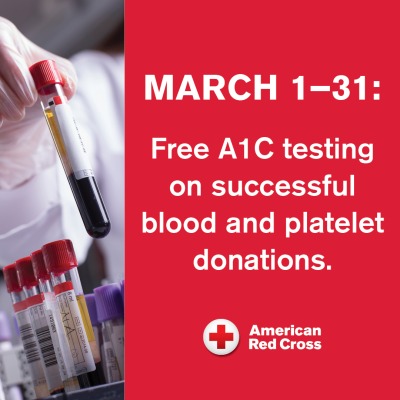
One-third of people lack access to regular primary care in the U.S., where diabetes affects 1 in 10 people and nearly a quarter of those living with it have been undiagnosed, according to the Centers for Disease Control and Prevention (CDC). The free A1C screening aims to help address this gap by empowering blood donors with valuable information to maintain their health and well-being.

What is the hemoglobin A1C test?  This is a common laboratory blood test that doctors use to help diagnose diabetes or prediabetes. Unlike a blood glucose test (or blood sugar test) which provides an instant snapshot of your current blood sugar levels, A1C reflects the average blood sugar levels of an individual over the past 3 months. This gives doctors a better idea of where your blood sugar typically lies, outside of the daily fluctuations.

Why is this important for me? It is estimated that there are over 8.7 million people in the U.S. living with undiagnosed prediabetes or diabetes. Type 2 diabetes accounts for over 90% of all cases and often remains symptomless until damage has been done. Untreated diabetes can lead to plaque build-up in the blood vessels which in turn puts you at greater risk for a stroke or heart attack. The eyes, kidneys, nerves, and skin are particularly vulnerable to the effects of decreased blood flow due to high glucose levels in the blood.  Fortunately, prediabetes is reversible with lifestyle changes, so early detection is key.

Blood donor, Audrey Savage
Photo by Michelle Frankfurter for the American Red Cross

How should I prepare for my donation?  No fasting is required for the A1C test or any other special preparation. Just be sure you are feeling well on the day of donation by getting enough rest, staying hydrated, and eating a well-balanced meal.

When will I get my results? You can expect your results within one to two weeks of your donation. Results will be posted on the Red Cross Donor App or through your donor’s account at RedCrossBlood.org.

What do my results mean?  An A1C test result of 5.7% or above will require follow-up with your primary care physician. Your doctor will be able to diagnose and guide you through an appropriate treatment plan. 

To learn more about the A1C test, pre-diabetes and diabetes, check out this informational page at the Red Cross website HERE. Download the Red Cross Blood Donor App HERE to schedule your next donation and view your donation history and test results.

Busting common myths about donating blood

By Samantha Pudeslki, American Red Cross volunteer

Have you always assumed you can’t donate blood? You’re not alone. There are a lot of people who may think they cannot donate, but actually can. Here are a few of the most common myths around blood donation restrictions and the facts you need to know.

Myth #1: You can’t donate blood if you have a tattoo and/or body piercing.

Fact: You can donate blood if you have tattoos and/or body piercings. If you recently had a tattoo and it was applied in a state-regulated/licensed tattoo facility using sterile needles and the ink was not reused, you may not have to wait to give blood. Those who are certain a sterile needle was used for a body piercing also may not need to wait. Otherwise, you must wait one year after receiving a tattoo or body piercing.

Myth #2: You can’t donate blood if you take regular medications.

Fact: In almost all cases, medications won’t disqualify you as a blood donor. Instead, your eligibility is based on the reason the medication was prescribed. As long as the condition is under control and you are healthy, blood donation is usually permitted. If you are unsure, visit our eligibility page at RedCrossBlood.org..

Myth #3: You can’t donate blood if you are a diabetic.

Fact: Diabetics who are well controlled on insulin or oral medications are eligible to donate.

Myth #4: You can’t donate blood if you have had cancer.

Fact: It depends on the type of cancer and your treatment history. Those who have had leukemia or lymphoma, including Hodgkin’s disease and other cancers of the blood are not eligible. With most other types of cancers, you are able to donate blood if it the cancer has been treated successfully and it has been more than 12 months since treatment. Cleveland city councilman Kevin Conwell is once again a regular donor, after winning a battle with cancer. Read his story here.

Myth #5: I am too old or too young to donate.

Fact: You must be 17 years old or 16 years old with parental/guardian consent to donate blood, if allowed by state law. There is no age limit for older adults as long as you are healthy and meet the other criteria.

Myth #6: You can’t donate blood if you have travelled outside of the U.S.

Fact: While there are some travel restrictions in place, they are very specific to the location and time period that the individual spent there. If you have questions about eligibility, you can call 866-236-3276 to speak with an eligibility specialist about your travel.

For more facts around the blood donation process, visit the American Red Cross FAQ page. Ready to donate? Visit our website to find an upcoming drive near you.

If you are someone who is unable to donate blood, there are other ways you can support the cause! The Northern Ohio Region of Red Cross relies on volunteers to help with essential tasks like registration to make sure blood drives run smoothly. To learn more about volunteer opportunities in Northern Ohio, click here.

Edited by Glenda Bogar, American Red Cross volunteer