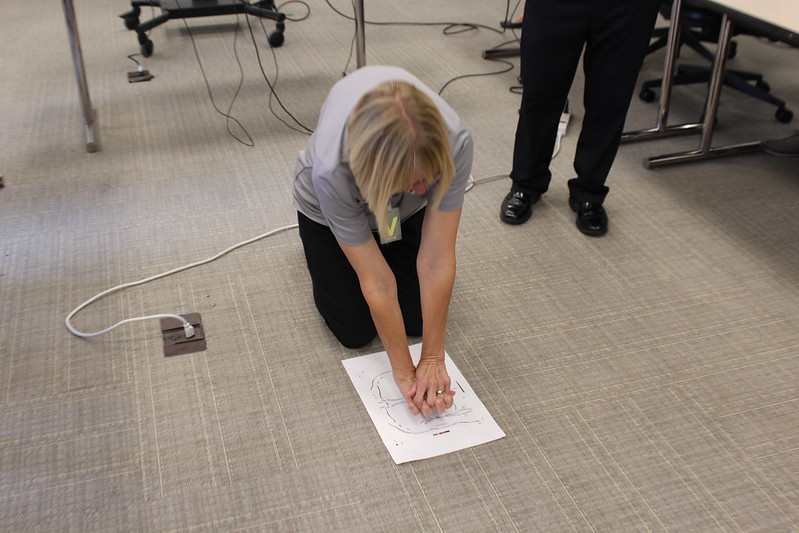
Red Cross offers training that can save lives

By Kathryn Dean

March is Red Cross Month and the American Red Cross wants to encourage everyone to learn the important skills of CPR, first aid and AED usage.
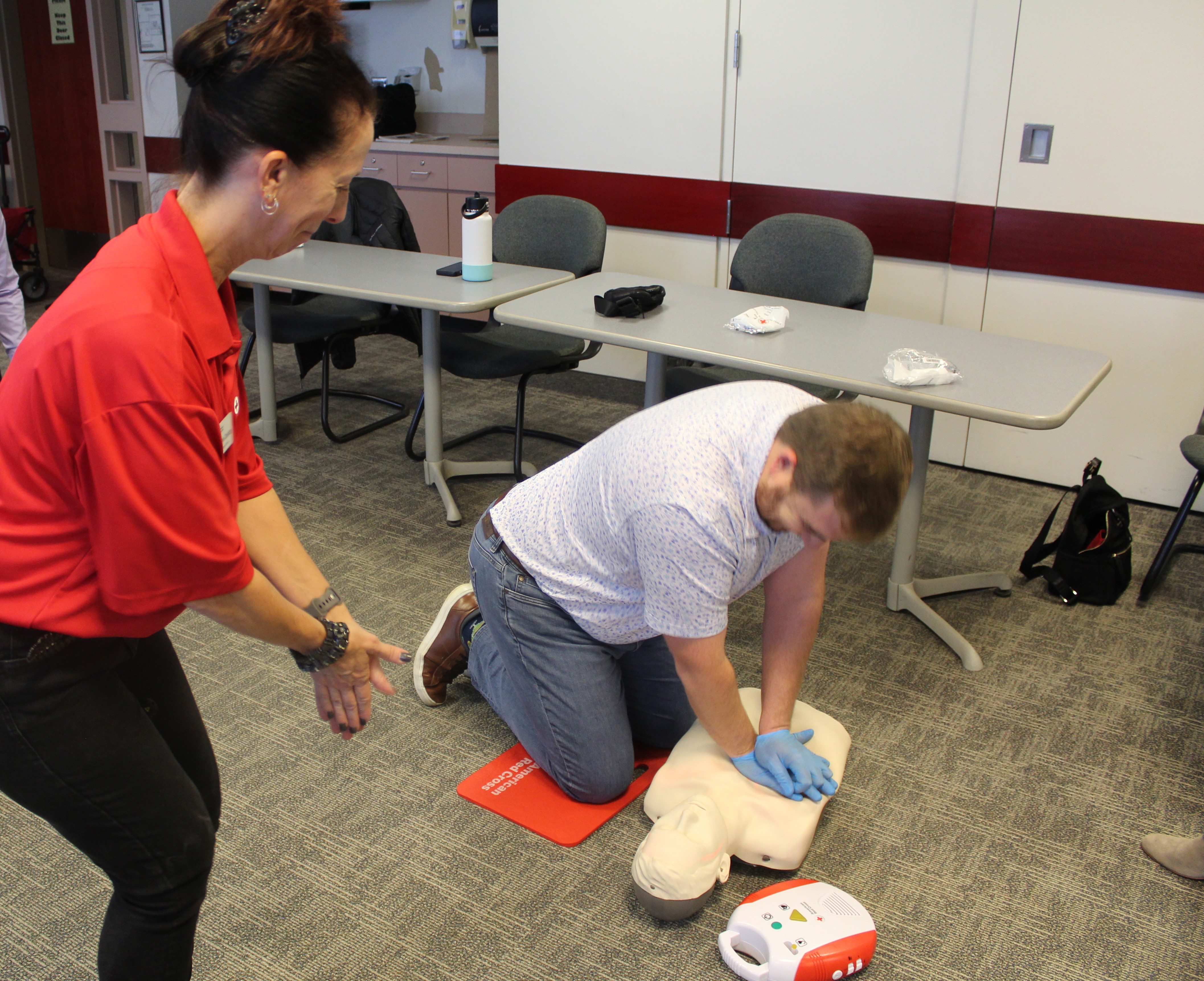
Red Cross instructor Angele Cassiday teaching CPR

Sudden cardiac arrest can happen anywhere. According to the American Heart Association, more than 357,000 cardiac arrests occur outside of the hospital setting each year in the United States, and nearly 90% of those arrests are fatal.

Despite this, survival rates can double or triple for victims of cardiac arrest if CPR is started immediately. That’s why training is vitally important so that prompt medical attention can be given before emergency responders arrive.

What should you do if you see a person suddenly collapse? Assess the scene for safety and check the victim’s pulse and breathing. Call 911. Start CPR. Use an AED.

How do you check a pulse? The easiest way is to place your fingers on the victim’s throat and slide your fingers laterally down into the groove on either side of the esophagus. The wrist can also be used; the pulse is located just below the thumb joint, also in the groove.

CPR, or cardio-pulmonary resuscitation, is the application of chest compressions to keep blood pumping through the body. The Hands-Only CPR method is recommended for bystanders in public settings, meaning the focus is solely on delivering chest compressions, without breaths, until emergency responders arrive.
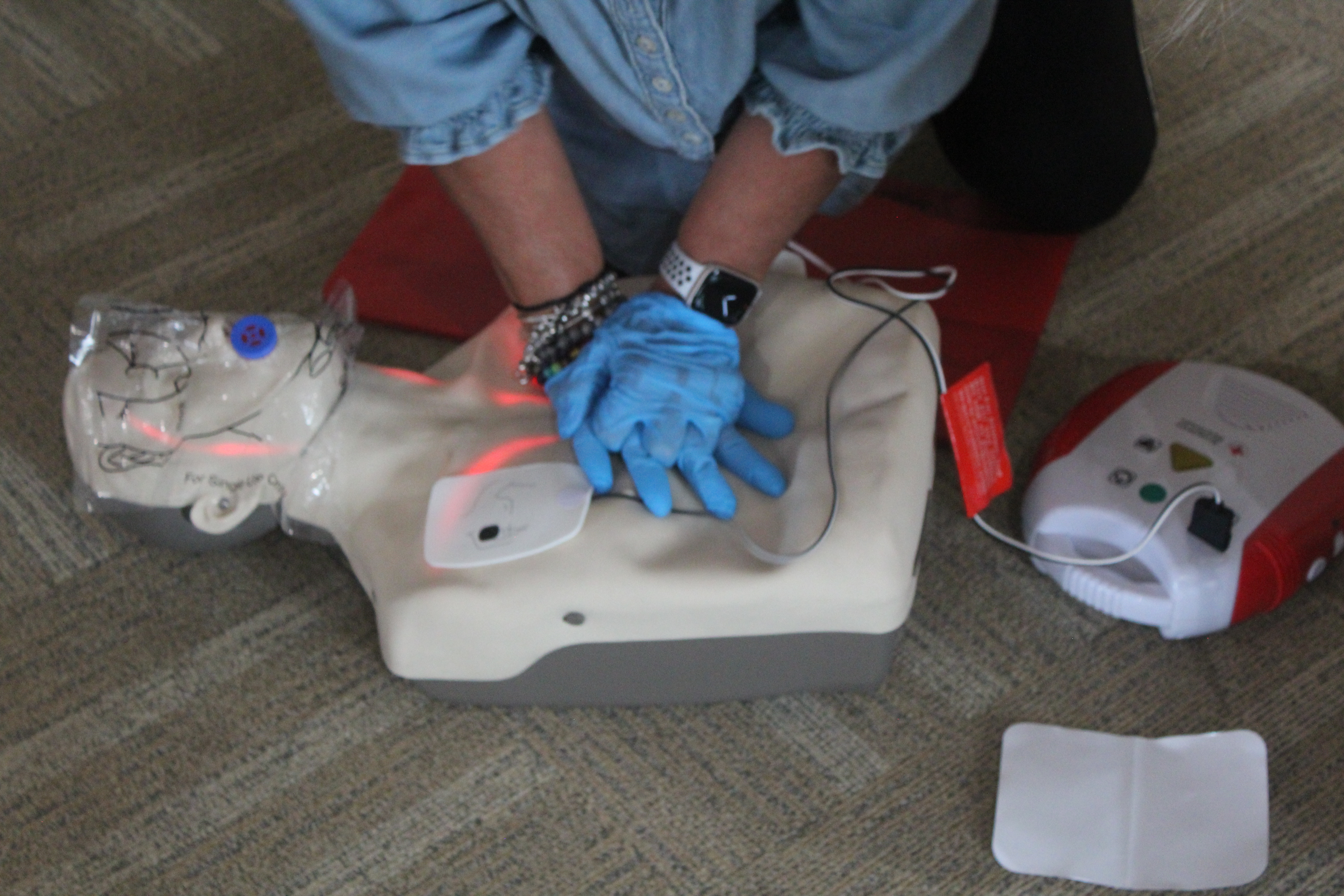
AED stands for automated external defibrillator. It is an important, lifesaving tool used in sudden cardiac arrest when the heart stops beating or is beating ineffectively. The machine is easy to use and talks you through the steps to deliver effective medical care until help arrives. Anyone can learn to use an AED.

More and more communities are placing AEDs in public areas, such as parks, town centers, grocery stores and workplaces, so lifesaving measures can be started even earlier. The next time you are out and about, note the locations of AED machines in your community. This knowledge may help save someone’s life one day.

Did you know that the Red Cross offers training in CPR, first aid and AED? While CPR and AED training is common among health care workers, child care workers and lifeguards, it is a skill that anyone can and should learn. Be prepared for any situation by visiting https://www.redcross.org/take-a-class and signing up to take an online or in-person class.

Edited by Glenda Bogar, Red Cross volunteer

Posted by Ryan Lang, Red Cross board member and volunteer
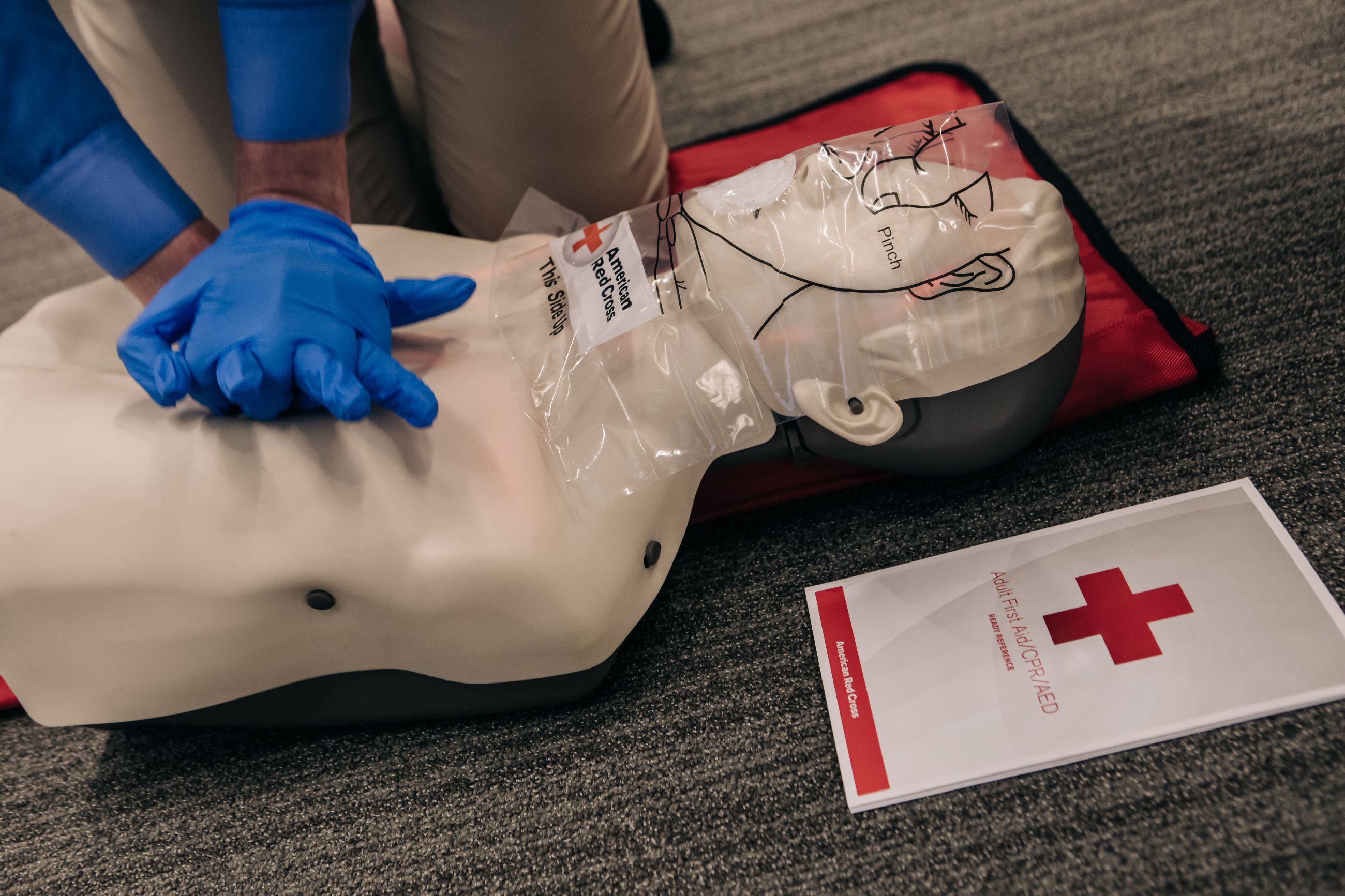
Nursing professor and students take lifesaving skills beyond the classroom

By Eilene E. Guy, American Red Cross volunteer

March 4, 2020- Let’s say you’re enjoying a quiet evening at home with family or friends and one of you suffers a cardiac emergency. Dr. Mariann Harding wants to increase the odds that someone there can give the victim—possibly you—a fighting chance to live.

CPR Stock Photography 2018

Dr. Harding is a professor of nursing technology at the Kent State University (KSU) Tuscarawas campus. So all her students are learning the critical skills to handle such an emergency. Now she’s discovered a way to expand that number of responders many times over.

This year, through the American Red Cross, 18 members of her nursing honor society are presenting Hands-Only CPR. They are teaching non-medical members of their communities how to maintain vital circulation in a stricken person until trained responders arrive.

Hersh Diek (002)

“Our goal is 200 people touched with this training this year,” said the professor, who likes to be called Mariann. “It’s going very smoothly. I think we’re going to make it.”

Mariann became acquainted with the Red Cross two and a half years ago by way of a local leadership workshop. She decided she could bring something worthwhile to the organization with her medical and educator background.

44864319982_64d9ea4bf8_c (1)

She joined the board of her local Stark and Muskingum Lakes Chapter and learned about the many preparedness and prevention programs of the Red Cross, including Hands-Only CPR. She realized her students would be ideal volunteer teachers to spread the word about this lifesaving technique.

Hands-Only CPR done by a bystander is recognized as being as effective as CPR with rescue breaths for the first crucial minutes after a cardiac event. “It’s better to use a stopgap that’s 90 percent effective than to do nothing,” Mariann said of the hands-only technique.

44864318982_2858217bef_c

KSU provided a grant to buy compression training “torsos” for her project. Last year she and 16 honor nursing students taught nearly 230 people—from teenagers to elderly churchgoers. She’s convinced, “Everybody can do something.”

The project has given her nursing students a shot of confidence in their own abilities to build healthier communities, and it’s introduced them to other Red Cross programs. “One of my students signed up to help with the smoke alarm installations and another one is interested in becoming a presenter for the safe sitter program.”

cpr2 (002)

As for Mariann, “I’m so enjoying my involvement with the Red Cross. I look forward to doing more.”

To learn about the many Red Cross programs that empower Americans to prevent, prepare for and respond to emergencies, or to become a volunteer, visit redcross.org or contact your local Red Cross chapter.

Edited by Glenda Bogar, American Red Cross volunteer

CPR: Easy to learn and could save a life

By Doug Bardwell , American Red Cross volunteer

February 6, 2019- The American Red Cross is well-known for the lifesaving training it makes available across the country. Classes are available for adult, child and infant CPR, First Aid and use of an Automated External Defibrillator (AED). Special classes are also offered for health/rescue workers, child care, babysitters and lifeguards.

If you see a teen or adult suddenly collapse, Hands-Only CPR is the recommended form of cardiopulmonary resuscitation (CPR). It not only increases the likelihood of surviving breathing and cardiac emergencies that occur outside of medical settings, but it’s simple to learn and easy to remember.

Icon PreparednessTo make learning easier, one year ago, the Red Cross introduced new CPR manikins affectionately called Big Red. The manikins help students get immediate feedback if they are performing the CPR technique correctly.
“Good CPR is a skill that almost anyone can do, but using the correct technique can be the difference between life and death for a person in cardiac arrest,” said Richard N. Bradley, M.D., FACEP, member of the American Red Cross Scientific Advisory Council, and chair of its Resuscitation Sub-Council. “The unique technology in the Big Red manikin enhances an amazing tool to improve students’ ability to learn the right way to provide lifesaving assistance.”

Anyone can master the technique

Before performing CPR, remember these few important steps:

  1. Look around and make sure the scene is safe for yourself and the victim.
  2. Tap the person on the shoulder and shout “Are you okay?” Look for signs of rhythmic, normal breathing.
  3. If none, call or have someone call 911, and then begin CPR.

Performing Hands-Only CPR:

  1. Kneel beside the person who needs help.
  2. Place the heel of one hand on the center of the chest.
  3. Place the heel of the other hand on top of the first hand, then lace your fingers together.
  4. Position your body so that your shoulders are directly over your hand and keep your arms straight.
  5. Push hard, push fast. Use your body weight to help you administer compressions that are at least 2 inches deep and delivered at a rate of at least 100 compressions per minute. (Just be sure to let the victim’s chest rise completely between compressions.)
  6. Keep pushing. Continue Hands-Only CPR until you see obvious signs of life (like breathing), another trained responder or EMS professional can take over, you’re too exhausted to continue, an AED becomes available, or the scene becomes unsafe.

This short video will give you the proper technique:

https://www.youtube.com/watch?v=-Yqk5cHXsko&feature=youtu.be

Yes, anyone can do it.

cpr tweet

In a recent Washington Post article, the writer tells the story of Cross Scott, a mechanic, who encountered a woman who had stopped breathing. He decided to administer CPR while waiting for the rescue squad to arrive. Having never taken a CPR course, he did recall watching  Michael Scott learning how to do CPR on an episode of “The Office.”  Within a minute, the woman began to breathe again.

You can watch the humorous, but lifesaving TV clip here:


Find a class and sign up today

To be a genuine asset to family, friends and your neighbors, consider signing up for a Red Cross class. With multiple opportunities each week, it’s easy to find one near you at a convenient time.

Classes can be done online, in person or a blended class using both online and in-person sessions. By taking part of the instruction online, you’ll spend less time in class, but have the advantage of reviewing anything that may have been unclear in the online materials.

Red Cross volunteers can get a voucher to cover the cost of the course. Inquire at your local chapter office.


How to do Hands-Only CPR

https://www.redcross.org/take-a-class/cpr/performing-cpr/hands-only-cpr

http://www.redcross.org/prepare/hands-only-cpr   video

http://www.redcross.org/take-a-class/cpr/cpr-training  take a class: online, in person, blended

Hands-Only CPR page

https://www.redcross.org/get-help/how-to-prepare-for-emergencies/be-red-cross-ready/hands-only-cpr.html


Edited by Glenda Bogar, American Red Cross volunteer

Partnering with KeyBank to teach hands-only CPR

By: Eric Alves, Regional Communications Specialist, American Red Cross of Northeast Ohio

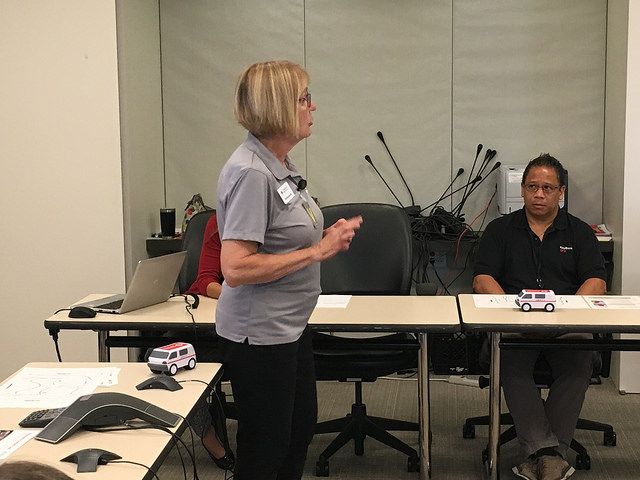
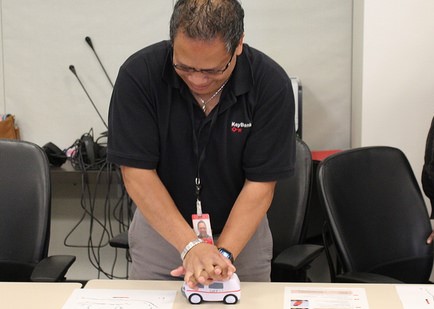
 Earlier this week, the American Red Cross teamed up with KeyBank to train interested employees on how to administer hands-only CPR.

The training was held in Key Tower in downtown Cleveland. Patricia Buckhold, a former Red Cross regional volunteer services officer and current volunteer, conducted the training.

43102118020_86a58eb21b_z

More than 30 KeyBank employees took part in the training. During two 30-minute sessions, participants watched a video and listened to Pat discuss the proper technique for hands-only CPR. Participants were also given the opportunity to put their training into action by using compression tools, in the shape of a Red Cross emergency response vehicle, to help reinforce their training in a hands-on approach.

“I think there’s a lot of interest in people knowing what to do in an emergency, and this is a good way to start their education,” said Katie Rothstein, KeyBank’s onsite health promotion specialist.

If you are interested in having the Red Cross conduct a hands-only CPR training for members of your organization, you may submit a request. The Red Cross also provides a wide array of training for individuals, such as CPR training, babysitting and child care training, and swimming lessons. To learn more about upcoming training courses,  . To schedule a training, call 1-800-Red Cross (1-800-733-2767) or visit redcross.org/take-a-class.

29977832777_e53a753093_z

To view more photos from the training, visit our Flickr page.