Four ways to stay safe this 4th of July

By Samantha Pudelski, American Red Cross volunteer

Fourth of July plans usually include fireworks, barbeques, and spending time near
water to stay cool in the warm July sun. Whether you plan to do all of these things or
just one of them, the American Red Cross wants you to enjoy a safe and fun fourth of
July holiday. Think of these four areas of safety this holiday weekend:

  1. Fireworks Safety
     The safest way to enjoy fireworks is by attending a public firework show that
    is put on by professionals.
     If you are planning to set off fireworks at home, make sure to:
    o Light fireworks at a safe distance from people, animals, structures,
    vehicles or anything that is flammable. Do not point or throw
    fireworks anyone or anything.
    o Never give fireworks to small children.
    o Follow the instructions on the fireworks packaging.
    o Have a supply of water close as a precaution.
    o If you the person lighting the fireworks, wear eye protection.
    o Only light one firework at a time. Never attempt to relight a “dud.”
    o Store fireworks away from children and pets, in a cool, dry place.
     There are many free community fireworks displays throughout Northern
    Ohio planned for the July 4 th weekend. Visit your city’s website for details or
    the links below to find fireworks displays near you.
    o Northern Ohio area fireworks
    o Youngstown area fireworks
    o Northwest Ohio, Southeast Michigan area fireworks

  2. Water Safety
     Anyone near water, whether it is a pool, lake, water park or other body of
    water, should know how to swim.
     At minimum, everyone should have water competency, meaning they can
    enter the water, take a breath, stay afloat, change positions, swim for a
    distance and get out of the water safely.
     Always swim in an area where lifeguards are on duty.
     Get out of the water at the first sign of thunder or lightning. Stay indoors and
    away from water at least 30 minutes after the last streak of lightning or roar
    of thunder.
     Watch children in or near the water closely and constantly.
     Pools and spas should be fenced with adequate, four-sided fencing.
     Children and inexperienced swimmers should wear a properly fitted U.S.
    Coast Guard-approved life jacket. Everyone on a boat should wear a life
    jacket, regardless of their ability to swim.

 If swimming in an open body of water, such as a lake, river or ocean, make
sure to swim with a buddy and walk carefully into open waters.
 If you get caught in a rip current, stay calm and try not to panic. Signal to
those on shore that you need help. Swim parallel to the shore until free of the
current and then swim towards the shore.

  1. Grilling Safety
     Grilling sparks more then 10,000 home fires each year.
     Always supervise a barbeque grill when it’s being used.
     Never grill indoors or in any enclosed area.
     Make sure people and pets stay away from the grill.
     Keep the grill away from the house, deck, tree branches or anything that
    could catch fire.
     Never add charcoal-started fluid to coals that have already been lit.

  2. Heat Safety
     Stay hydrated – drink enough water to help prevent heat illness.
     Make a plan to stay cool during the hottest parts of the day.
     Gather emergency supplies – create a kit for your home and when you’re on
    the go.
     Learn how to recognize and respond to heat illness. Learn CPR and first aid.

Bonus Number 5: Have some Free Time this Fourth of July? Donate Blood and
See a Movie


This July, The Red Cross, has teamed up with Universal Pictures’ new film,
TWISTERS to help avoid a summer blood shortage. Anyone who comes to give blood
or platelets with the Red Cross between July 1 and July 31 will get a Fandango Movie
Ticket via email. Learn more about the partnership and get more details here.

Posted by Ryan Lang, American Red Cross board member and volunteer
First-time blood donor leads efforts to increase donations to aid those with sickle cell disease

By Eilene E. Guy, American Red Cross volunteer

When Dr. LaTrice Snodgrass puts her mind to a project, she goes all in.

Recently, she partnered with the American Red Cross and others to stage a blood drive targeted at the Black community, to benefit people living with sickle cell disease (SCD).

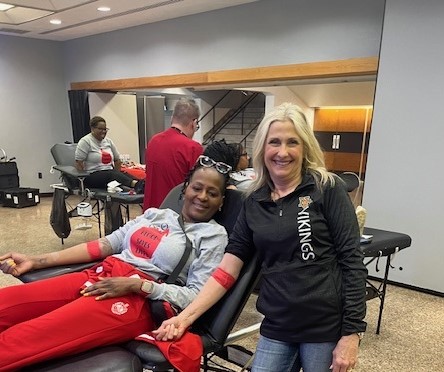
Dr. LaTrice Snodgrass and Kim Kroh, executive director of the Heartland, Stark and Muskingam Lakes chapter of the Red Cross

Not only did she spearhead the event, she literally rolled up her sleeve to donate blood – for the first time.

Through this donation, LaTrice learned that her blood is negative for three components, which makes her an ideal SCD donor. Blood transfusions from donors like LaTrice are vital to let SCD patients live comfortable, healthy lives.

LaTrice knows the importance of blood donations from her own racial community. More than 100,000 Americans — mostly African Americans — have sickle cell disease, which causes acute pain and over time damages vital organs. Her sorority, Delta Sigma Theta, put out a national call to boost donations from African Americans. “I told my sisters, we need to do this,” she said.

“I know there is a resistance in the Black community to trusting the medical establishment, but we have to overcome that. Our blood is truly lifesaving.” she said, explaining her decision to give blood for the first time, despite not being enthusiastic about needles.

SCD is an inherited condition that distorts soft, round red blood cells, turning them hard and crescent shaped. As a result, blood can’t flow smoothly to carry oxygen throughout the body, causing fatigue, severe pain, tissue and organ damage and even strokes.

Kim Kroh, executive director of the Heartland, Stark and Muskingam Lakes chapter of the Red Cross, was delighted to support LaTrice’s initiative. The project soon recruited the Strong Family Wellness Weekend, sponsored by Sean and Shaheedrah Strong, as well as the Black Nurses Association, Akron Children’s Hospital and Beacon Charitable Pharmacy, where LaTrice serves as CEO.

The drive at the Canton Civic Center exceeded its collection goal and, importantly, involved a lot of first-time donors.

“When the time comes for me to donate again, I plan to. And I’m going to reach out to my sorority sisters and friends to remind them that they need to donate again too,” she said.

Kim Kroh from the Red Cross, who has been giving blood for years, was on hand to support LaTrice through her first “poke.”

“I have a passion for (the cause of) sickle cell,” Kim said. “I know a teenager with sickle cell. What they go through is just terrible.”

The Red Cross supplies some 40 percent of the nation’s blood supply and launched a specific Sickle Cell Initiative three years ago to boost blood collection for this set of recipients.

Although Kim’s blood isn’t uniquely beneficial for SCD patients, it’s also vital: Every two seconds, someone in the U.S. needs blood, to deal with complications of childbirth, treatment for cancer, surgery or emergency room trauma.

To learn more about SCD or to make an appointment to donate blood, visit RedCrossBlood.org, use the free Blood Donor App or call 1-800-REDCROSS.

Edited by Glenda Bogar, Red Cross volunteer

Posted by Ryan Lang, Red Cross board member and volunteer
Recognizing blood donors on World Blood Donor Day

Increased need for donors during summer months

By Eilene E. Guy, American Red Cross volunteer

Why in the world would anybody willingly roll up a sleeve and take a needle jab, to give up a bag of precious blood?

“My mother, she gave I don’t know how many gallons,” one donor recently told me. This middle-aged daughter was honoring her late mother’s example of generosity.

Eilene E. Guy, Red Cross volunteer and blood donor

“Back in 1970, a friend of mine was going to have surgery, so I went to Cleveland to donate for him,” another donor recalled. With his donation the day we talked, that man was approaching his 35-gallon mark!

On this, World Blood Donor Day, the American Red Cross salutes the estimated 6.8 million people in the U.S. who donate blood. That yields about 13.6 million units (a “unit” of blood is about one pint) of whole blood and red blood cells a year.

That’s a whole lot of blood!

But consider: Every two seconds, someone in the U.S. needs blood or platelets. That amounts to some 29,000 units of red blood cells every day.

And this isn’t an option. Blood is saving the lives of critically injured emergency room patients, mothers and newborns experiencing complications of childbirth and folks having surgery. It’s sustaining hundreds of thousands of people undergoing chemotherapy treatment for cancer and tens of thousands who rely on blood transfusions to cope with the effects of sickle cell disease.

We’re fortunate to live in an age of modern medicine, but one challenge remains: There’s no way to “manufacture” blood.

So until that magic day, it’s a measure of our humanity that so many donors step forward to save the lives of others – in most cases, people they’ll never know.

The fact is, only about 3% of age-eligible people donate blood every year. That often leaves the supply agonizingly short. Over the last month, for example, the Red Cross collected about 20,000 fewer units of blood than needed to maintain a safe and stable national blood supply.

That’s worrisome, because blood donations typically drop during the summer months. At the same time, the need doesn’t stop.

Which brings us back to the source, blood donors.

I know from personal experience that it takes about an hour to go through the whole process: Screening to be sure I’m healthy and don’t have any disqualifications (The U.S. Food and Drug Administration decides what that would be, such as exposure to communicable diseases like malaria, or recent tattoos or piercings.); donating; and recovery (Water, juice and snacks are encouraged to jump-start the body’s replacement of the blood removed.)

You don’t need to know your blood type to make a blood donation. And if you think you’ve been disqualified, give it another try: You, or the rules, may have changed.

You can schedule your blood donation by using the free Blood Donor App, by visiting RedCrossBlood.org or by calling 1-800-RED CROSS (1-800-733-2767). 

On this World Blood Donor Day and every day, “bravo” to those who make the choice to save or sustain a life.

Edited by Glenda Bogar, Red Cross volunteer

Posted by Ryan Lang, Red Cross board member and volunteer

Give blood and get a free Cedar Point ticket

By Samantha Pudelski, American Red Cross volunteer

It’s almost summer, which means lots of time at the pool, summer barbeques, vacations and trips to Cedar Point. It’s also when blood donations tend to decline, as donors are busy with all of their summer activities. Unfortunately, the need for blood is constant in our community and across the country, and we need donors like you to help ensure those who need blood are able to receive it.

Every two seconds, someone in the U.S. needs blood. This includes accident and burn victims, heart surgery and organ transplant patients and those battling cancer.


This summer, the American Red Cross and Cedar Fair theme parks are teaming up again to encourage donors to help save lives this summer. All you need to do is donate blood at select blood drives through August 1st and you’ll receive a free Cedar Point ticket.*

To find a Cedar Point blood drive near you and schedule an appointment, visit RedCrossBlood.org and enter sponsor code “CEDARPOINT”. Appointments for these blood drives are highly encouraged.**

*All those who come to donate at select blood drives will receive one free ticket, valid for entry to Cedar Point, while supplies last. Tickets are valid during the 2024 season and other restrictions may apply. Check park website for information on capacity, open dates and hours.

**Donors without appointments are not guaranteed a Cedar Point ticket, as
supplies are limited.

Posted by Ryan Lang, Red Cross board member and volunteer